Best Utility Vehicle for a Small Farm: How Much Capability Do You Really Need?
Share
What is the best utility vehicle for a small farm? The answer is not automatically the largest UTV, the cheapest work vehicle, or the truck with the highest payload. For a small farm, the better question is how much working capability you will actually use.
A farm utility vehicle should match the work that happens repeatedly on the property. Some farms need four-wheel drive, heavy towing, multiple seats, and the ability to cross difficult terrain. Others mainly need a practical vehicle for everyday property work without paying for capabilities that rarely get used.
That difference matters because choosing a utility vehicle is not only a purchase-price decision. Every additional level of capability can bring additional cost, weight, maintenance, and complexity.
What Makes the Best Utility Vehicle for a Small Farm?
A useful way to compare vehicles is to separate essential capability from optional capability.
Before moving into a higher vehicle class, consider six questions:
1. Is four-wheel drive regularly necessary?
2. Is heavy towing part of normal farm work?
3. Do several workers need to ride together?
4. Does the vehicle regularly operate on steep, muddy, or difficult terrain?
5. Does it need to travel on public roads or cover longer distances?
6. Are you paying for capabilities that will actually be used every week?
These questions create a clearer way to evaluate a utility vehicle for farm use. They also prevent a small farm from buying too little capability for demanding work or paying too much for capability it rarely needs.
A Capability Ladder for Farm Utility Vehicles
Instead of starting with a vehicle name, think about farm work in capability levels.
Level 1: Light work and basic mobility
This level covers farms that need simple movement around a property without heavy towing, difficult off-road conditions, or multiple passengers.
Level 2: Cargo-focused utility work
At this level, carrying capacity becomes more important, but the farm still may not need the drivetrain, speed, passenger capacity, or towing capability of a full-size UTV.
Level 3: Rough-terrain utility
When mud, uneven ground, steep grades, or difficult access are routine rather than occasional, traction and off-road capability become much more valuable.
Level 4: Heavy towing and crew capability
A farm that regularly pulls equipment or needs to transport several workers has moved into a different requirement. A farm UTV or another heavy duty utility vehicle can justify its higher cost when these capabilities are used frequently.
Level 5: Road-capable farm transportation
When the job regularly extends beyond the property, requires longer travel, higher payloads, substantial trailer towing, or weather-protected transportation, a truck can become the appropriate investment.
When Is a Small Utility Vehicle Enough?
A small utility vehicle can make sense when the farm does not routinely require the upper levels of that capability ladder.
This is especially relevant on smaller properties where maneuverability and practical work capacity matter more than maximum towing power or passenger capacity. A compact utility vehicle can also be easier to position around buildings, work areas, and other spaces where a larger machine provides little additional benefit.
The important distinction is not simply vehicle size. It is whether the smaller vehicle still satisfies the farm's recurring requirements.
If the answer is yes, paying for unused heavy-duty capability does not necessarily create more value.
When Is a Farm UTV Worth Paying More For?
A farm UTV becomes much easier to justify when the farm regularly demands capabilities that a lighter work utility vehicle cannot provide.
Four-wheel drive on difficult terrain is one example. Heavy towing is another. Multiple-worker transportation, demanding grades, frequent mud, and sustained rough-ground use can also make a higher-capability UTV the better tool.
For these farms, choosing the best UTV for farming should focus on the capabilities that are repeatedly needed rather than on the longest specification list.
A heavy duty utility vehicle costs more for a reason. If its traction, towing capacity, suspension, and passenger capability are being used regularly, that additional investment is doing useful work.
When Does a Small Farm Actually Need a Truck?
The search for the best trucks for farm work raises a different question: when does a farm actually need truck-level capability?
A truck becomes more valuable when farm work includes regular public-road travel, longer distances between properties, substantial trailer towing, higher payload requirements, or the need for an enclosed cab and weather protection.
Those are meaningful capabilities. A farm that needs them should not select a smaller vehicle simply to reduce the purchase price.
But a farm that rarely uses those capabilities should recognize what it is paying for. Truck ownership can provide enormous flexibility, but that flexibility has the greatest value when the work actually requires it.
This creates a practical upgrade rule: move to truck-level capability because the work demands it, not simply because a truck appears to be the default farm vehicle.
Best Utility Vehicle for the Money: Pay for Capability You Use
The best utility vehicle for the money is not necessarily the vehicle with the lowest price.
Value depends on how much of the capability you purchase becomes useful capability in daily operation.
Consider four-wheel drive, heavy towing, multiple passenger seats, high road speed, and road-going capability. Each can be extremely valuable for the right farm. But if a small property rarely uses them, paying more to obtain all of them may not improve everyday productivity.
The opposite mistake is equally important. Buying a low-capability vehicle for work that genuinely requires heavy towing or difficult-terrain performance can create delays, limitations, and another purchase later.
A better value calculation is therefore:
Required capability + frequency of use + operating requirements + purchase cost.
That approach makes “best for the money” a farm-specific decision instead of a universal vehicle ranking.
Where Does an Electric Utility Vehicle Fit?
An electric utility vehicle adds another option to the lower and middle sections of the capability ladder.
Electric power can be particularly relevant when the priority is practical property work rather than long-distance road travel, extreme off-road performance, or heavy trailer towing. Different electric utility vehicles range from compact work platforms to larger four-wheel machines, so the power source alone does not determine whether a vehicle fits a farm.
For a smaller farm, an electric farm utility vehicle may deserve consideration when compact dimensions, work-focused operation, and cargo capability are more important than truck-level performance.
Some configurations also add a cargo box or powered dumping function. An electric utility vehicle with dump bed capability can be useful where unloading is part of the work, but a dump bed should still be treated as one capability within the larger buying decision rather than the reason to choose an unsuitable vehicle.
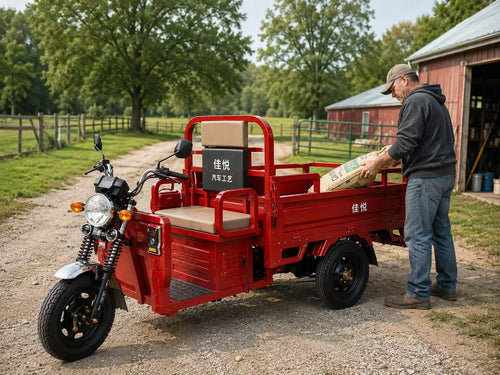
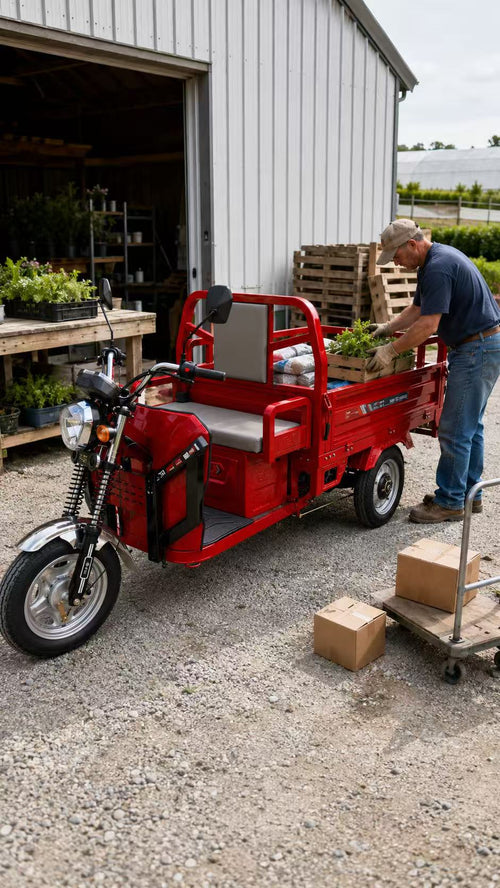
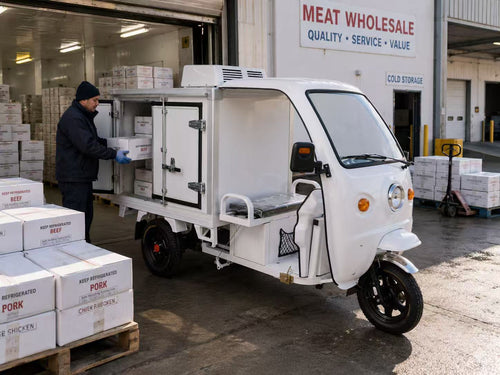
Compact electric cargo trikes occupy an even more specialized position. They can serve farms whose requirements remain in the lighter, cargo-focused portion of the capability ladder. They should not be presented as substitutes for a farm UTV that is genuinely needed for four-wheel-drive terrain, heavy towing, or crew transportation.
Quick Small-Farm Utility Vehicle Decision Guide
Light work, basic mobility, limited heavy-duty requirements:
Consider a small utility vehicle.
General recurring farm work with practical utility requirements:
Consider a farm utility vehicle or work utility vehicle matched to the property.
Compact spaces and moderate work requirements:
Consider a compact utility vehicle.
Frequent rough terrain, mud, steep grades, or substantial towing:
Consider a farm UTV or heavy duty utility vehicle.
Public-road travel, longer distances, major trailer towing, or higher payload requirements:
Consider a farm truck.
Compact, cargo-focused work where heavy towing and four-wheel-drive capability are not required:
An electric utility vehicle may be worth evaluating.
The Best Vehicle Is the Capability Level That Fits the Farm
There is no single best utility vehicle for every small farm.
A small utility vehicle can be the better investment for one property, while another farm genuinely needs the traction and towing capability of a UTV. A third operation may need a truck because its work extends onto public roads or involves heavier transportation.
The goal is not to buy the smallest vehicle, the biggest vehicle, or the vehicle with the most features. It is to identify the capability level the farm repeatedly uses and avoid paying for capability that contributes little to everyday work.
That is the most practical way to choose a farm utility vehicle—and the clearest way to decide when spending more is actually worth it.