How to Choose an Electric Utility Tricycle for Farm Use
Share
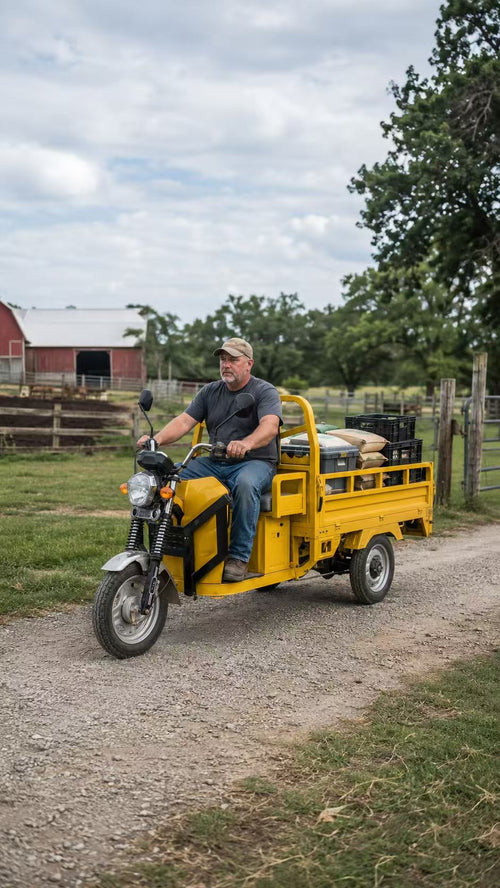
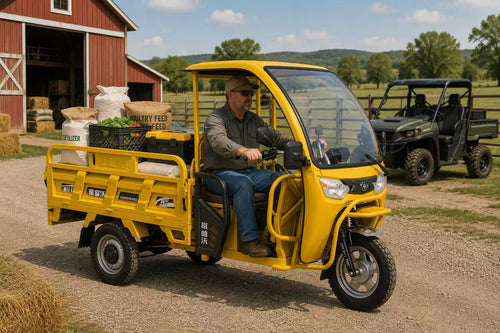
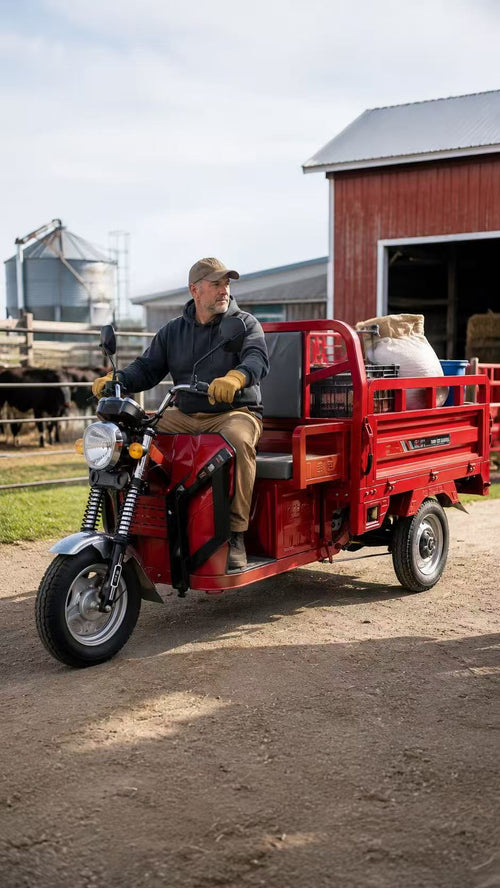
An electric utility tricycle for farm use should be chosen by the work it must complete every day, not only by its color, speed, or price. For many small farms, ranch properties, greenhouses, nurseries, orchards, private lots, and rural work areas, the real need is simple: move tools, feed, produce, buckets, parts, and supplies without using a full-size truck or UTV for every short trip.
A farm utility tricycle is not the same as a city passenger tricycle or a recreational e-bike. A proper farm-use electric tricycle should be treated as a compact work vehicle. The buyer should look at the cargo bed, payload, motor power, battery range, route conditions, stability, and how the vehicle will be used during a normal workday.
Why Farms Consider Electric Utility Tricycles
Many farm jobs are repetitive and short-distance. A worker may need to move feed from storage to animal areas, carry tools to a fence line, transport crates from a growing area to a packing table, or move small parts and supplies between barns, sheds, and work zones.
For these tasks, a full UTV may be larger and more expensive than necessary. A pickup truck may be too large for narrow lanes or too costly to run for repeated short trips. A wheelbarrow may be too slow and tiring when the same route must be repeated many times.
An electric utility tricycle for farm work can fill the gap between manual hauling and larger farm vehicles. It gives one operator a simple way to move daily materials across private property with less walking, less fuel use, and less noise.
Where an Electric Utility Tricycle Works Best
This type of vehicle works best when the route is predictable and the cargo is practical.
It can be useful for:
Moving feed bags from storage to animal areas
Carrying tools for fence, irrigation, or barn repair
Transporting produce crates to a packing area
Moving buckets, small parts, and farm supplies
Supporting greenhouse and nursery routes
Carrying seed, packaged materials, or light equipment
Reducing small truck trips inside private property
Helping one worker complete repeated daily chores
The best use case is not high-speed driving. The best use case is controlled short-distance hauling.
Cargo Bed Size Matters More Than Looks
The cargo bed is one of the most important parts of an electric farm utility tricycle. A long open cargo bed makes the vehicle more useful for daily farm logistics because it can carry mixed loads during the same day.
A buyer should check:
Cargo bed length
Cargo bed width
Side panel height
Loading height
Whether the cargo can be tied down
Whether bags, crates, buckets, and tools fit easily
Whether the bed is easy to load from the side or rear
An open cargo bed is useful when the load is organized: feed bags, produce crates, plastic bins, toolboxes, buckets, seed bags, and small parts. It allows the operator to arrange cargo by weight and keep the load low and balanced.
For loose materials such as manure, compost, mulch, soil, gravel, or bedding, a hydraulic dump model may be better. But for general farm utility work, an open cargo bed model is often simpler and easier to use.
Payload Should Match Real Loads
Payload is not only a number on a product page. It must match the real work on the farm.
A light but bulky load, such as empty crates, may fill the cargo bed quickly without adding much weight. A small number of wet feed bags, water containers, dense produce crates, or metal tools can become heavy fast.
Before choosing an electric cargo tricycle for farm use, the buyer should ask:
How many feed bags are usually moved at one time?
How many crates are carried per trip?
Are the materials dry, wet, packed, loose, or stacked?
Will the vehicle carry tools, parts, buckets, or small equipment?
Does the route include slopes, gravel, grass, or soft ground?
Will the operator stop and start often?
A good farm utility tricycle should carry the load low and stable. It should not require the operator to stack cargo too high or overload one side of the bed.
Motor Power and Farm Terrain
Motor power should match the farm route.
A buyer may see different motor options such as 1000W, 1500W, 2000W, or higher. These numbers matter, but the more important question is how the vehicle performs with cargo on real farm ground.
Farm routes may include:
Gravel lanes
Packed dirt roads
Barn entrances
Concrete loading areas
Greenhouse lanes
Nursery paths
Orchard rows
Small slopes
Tight turning areas
The vehicle does not need to be fast to be useful. In many farm settings, slow control is more valuable than top speed. The operator needs smooth starting, predictable braking, enough torque for loaded movement, and safe handling near workers, animals, gates, and equipment.
Battery Range as Daily Work Range
Battery range should be understood as daily work range.
An electric utility tricycle may not travel long distances each trip, but repeated short trips with cargo still use battery power. Starting, stopping, turning, and carrying weight are different from riding on a flat open road.
A buyer should think through a normal workday:
Where does the vehicle start?
Where is the first loading point?
Where does it unload?
How many trips happen in the morning?
Will it be used again in the afternoon?
Where can it be charged safely?
Is overnight charging enough?
For many farms, an electric model is practical because the route is repeated and predictable. The vehicle can work during the day and charge when parked.
Why Electric Can Make Sense for Farm Tasks
Electric power can be useful on farms because it reduces fuel handling, engine noise, and routine engine maintenance.
Around livestock, greenhouses, barns, and work areas, quieter operation can be helpful. A lower-noise vehicle is less disruptive when moving near animals, workers, or residential farm areas.
Electric utility tricycles also have fewer engine-related maintenance points than gas-powered machines. The operator still needs to check tires, brakes, battery condition, and general hardware, but there are no oil changes or fuel storage tasks like a small gas engine.
This makes electric models especially useful for short, repeated, private-property routes.
When It Can Replace a Light UTV
An electric utility tricycle can replace some light UTV tasks, but not all of them.
It may be a good alternative when the main work is:
Short-distance material hauling
Feed, tools, crates, and supplies
Private-property routes
Low-speed operation
Narrow work areas
Daily farm logistics
Light to medium cargo movement
It may not replace a UTV when the buyer needs:
Heavy towing
Deep mud performance
Passenger transport
Long-distance rough terrain
High-speed road use
Very steep hill work
Large implement hauling
The right question is not “Is it better than a UTV?” The better question is “Which daily jobs do not require a full UTV?”
Safety and Route Planning
Before buying, the buyer should walk the farm route.
Check:
Gate width
Barn aisle width
Turning space
Loading area
Unloading area
Ground condition
Slope angle
Parking area
Charging location
Shared paths with people, animals, tractors, or trucks
A vehicle that fits the route will be used often. A vehicle that is too wide, too long, too tall, or difficult to turn may not solve the daily hauling problem.
Private Property Use and Local Rules
Most electric utility tricycles for farm work should be considered private-property work vehicles. They are best used inside farms, ranches, nurseries, greenhouses, warehouses, private lots, and internal work areas.
If a buyer wants to use the vehicle on public roads, sidewalks, bike lanes, or shared streets, local laws should be checked before purchase. Road-use rules may depend on state, city, speed, lighting, registration, insurance, and vehicle classification.
For many farm buyers, the clearest use case is private property hauling.
Final Buying Thought
An electric utility tricycle for farm use should be selected by daily workload, not just by product appearance. A good choice should match the cargo bed size, payload, motor power, battery range, ground conditions, and real farm route.
For farms, homesteads, nurseries, greenhouses, ranch properties, orchards, and private agricultural work areas, the right electric utility tricycle can become a practical everyday tool for moving feed, tools, produce, buckets, and supplies without using a larger vehicle for every small job.