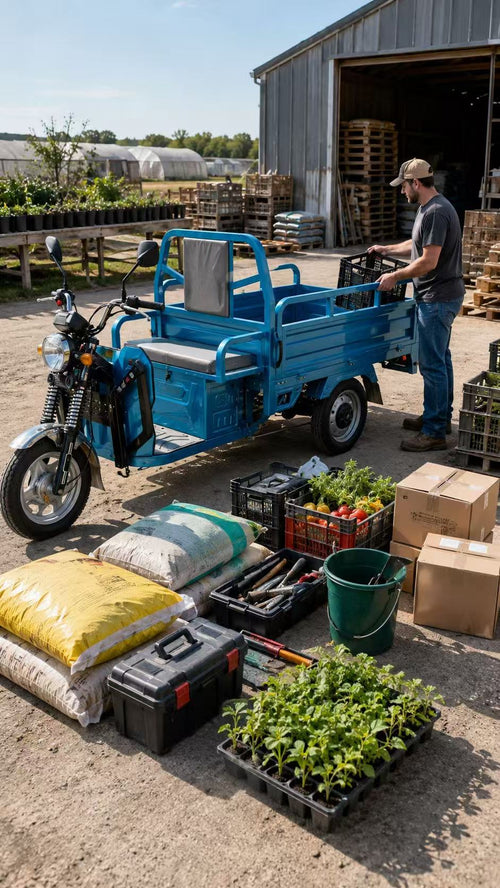
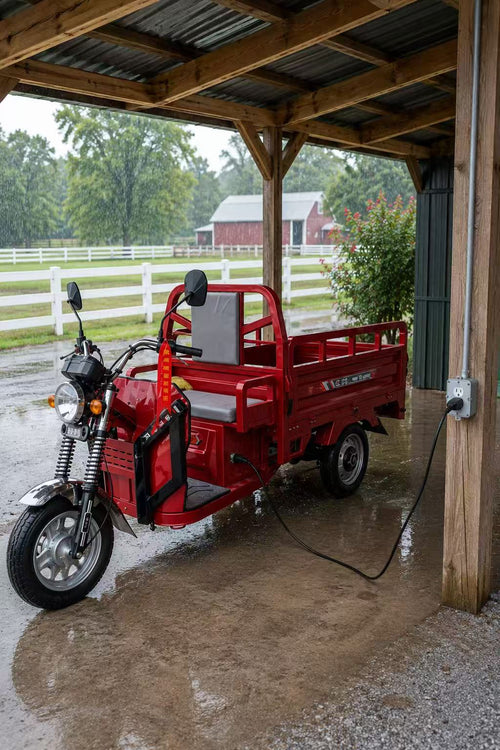
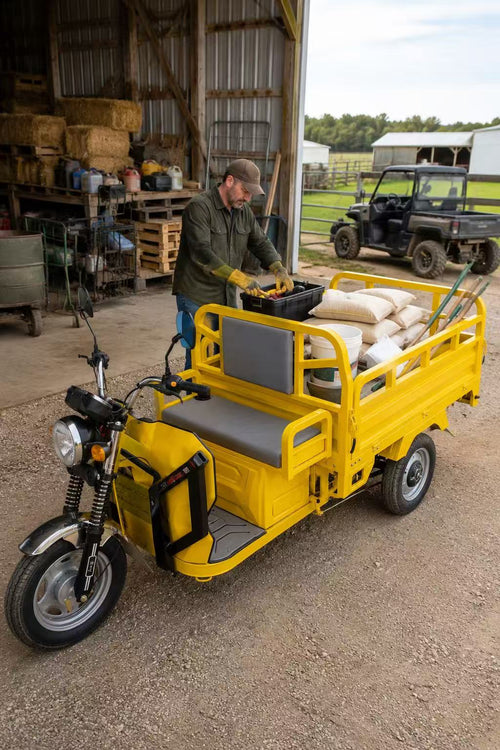
Should Resale Value Stop You From Buying a Lower-Cost Electric Farm Utility Trike?
Share
Many buyers compare a lower-cost electric farm utility trike with a used or new brand-name UTV and immediately ask:
Which vehicle will hold its value better?
That is a reasonable question.
A well-known UTV brand may have:
a larger dealer network
a more active used market
stronger brand recognition
more published resale data
more buyers searching for used machines
These factors can help a Ranger, Mule, Gator, or another established UTV retain part of its original price.
A less familiar electric cargo trike may not have the same resale market.
But resale value is only one part of the buying decision.
The more important question is:
Will you actually sell the vehicle soon, or will you use it for many years to complete daily work?
A machine with a higher future selling price is not automatically the better financial choice.
The buyer must compare:
purchase price
daily work completed
maintenance
energy cost
repair support
time saved
labor reduced
years of ownership
expected resale value
The correct question is not only:
How much can I sell it for later?
The better question is:
How much useful work will it complete before I sell or replace it?
Why Resale Value Feels Important
Farm equipment can be expensive.
Buyers do not want to spend thousands of dollars on a machine that becomes difficult to sell later.
A strong resale market can reduce financial risk.
It can matter when the buyer:
plans to upgrade frequently
may sell the property
expects the business to change
needs a different vehicle in a few years
uses financing
wants predictable asset value
For these buyers, resale value deserves serious attention.
A mature UTV market can make it easier to:
estimate future value
find buyers
trade the machine
compare used prices
finance a replacement
But not every buyer follows this ownership pattern.
Some buyers purchase a work vehicle and keep it until it has delivered most of its useful life.
For them, the future selling price may be much less important than the initial cost and the work completed every week.
A Higher Resale Price Does Not Mean Lower Total Loss
Consider two different buying decisions.
Vehicle A costs much more at the beginning and retains a higher percentage of its price.
Vehicle B costs much less but has a smaller used market.
Vehicle A may sell for more dollars later.
But it may also lose more dollars in total.
For example, a vehicle purchased at a very high price can retain value and still create a large depreciation cost.
A lower-cost electric farm utility trike may have weaker resale value, but the buyer has less money tied up from the beginning.
The buyer should compare the actual numbers:
purchase price minus future selling price
not only the future selling price by itself
A $20,000 machine that later sells for $12,000 has lost $8,000.
A $4,000 machine that later sells for $1,000 has lost $3,000.
The more expensive machine retained a much higher resale value, but the lower-cost machine still lost fewer dollars.
This is only a simple example.
Real costs also include:
maintenance
repairs
fuel or electricity
insurance
financing
transport
downtime
The point is not that the lower-cost vehicle always wins.
The point is that resale percentage alone can be misleading.
Long-Term Owners Should Think Differently
A buyer who plans to keep the vehicle for eight, ten, or more years should not make the entire decision around a three-year resale estimate.
After many years of work, the value created by the machine may come from:
thousands of short cargo trips
reduced walking
fewer pickup starts
less manual lifting
faster feed delivery
faster movement of tools
more efficient greenhouse work
less time carrying boxes by hand
At that point, the remaining selling price may be small compared with the work already completed.
A long-term owner should focus on:
whether the machine fits the route
whether it can carry the normal cargo
whether parts can be sourced
whether local repair can be arranged
whether the battery system is serviceable
whether the machine remains useful
The buyer is not purchasing only an asset.
The buyer is purchasing years of work.
When Resale Value Should Matter More
Resale value should receive more weight when the buyer expects to:
replace the machine within two or three years
upgrade as the business grows
change from electric to gasoline or diesel
move to another property
sell equipment regularly
use the machine seasonally
depend on dealer trade-in programs
The buyer should also value resale more when the vehicle has a high initial purchase price.
A small percentage difference on an expensive UTV can represent many thousands of dollars.
In that situation, brand reputation, service records, dealer support, and condition can strongly affect future value.
When Resale Value May Matter Less
Resale value may be less important when:
the vehicle will be kept long term
the purchase price is relatively low
the route is fixed and predictable
the work is short-distance
the vehicle replaces repeated manual transport
the buyer does not plan to trade frequently
the machine is expected to work until late in its economic life
For these buyers, a lower-cost electric cargo trike for farm work may create value through use rather than future sale.
The machine can be judged by:
cost per year
cost per trip
cost per hour of useful work
labor saved
fuel avoided
time saved
A machine does not need a strong resale market to create a strong operating return.
Used Brand-Name UTV or New Electric Utility Trike?
Some buyers compare a new electric farm utility trike with a used UTV at a similar price.
This comparison requires caution.
A used UTV may offer:
four wheels
greater terrain ability
higher speed
passenger seating
stronger towing
brand recognition
better resale demand
But the buyer may not know:
how it was driven
whether it entered deep water
whether it was overloaded
whether the maintenance was completed
whether the engine hours are accurate
whether the transmission was abused
whether the frame was damaged
A new electric utility trike with cargo bed may offer:
known history
new battery and electrical system
lower complexity
quiet operation
lower-speed private-site use
a cargo-focused design
But it may have:
a smaller used market
less brand recognition
less published resale history
different local service requirements
The buyer should compare the actual work, not only the name on the machine.
Does the Job Need UTV Capability?
A brand-name UTV may retain value partly because it offers more capability.
But the buyer should ask whether that capability is needed.
Does the route include:
deep mud
steep terrain
deep snow
forest trails
heavy towing
long off-road distances
passenger transport
If yes, the UTV may be the better machine.
If the daily route is:
short
firm
private
low-speed
cargo-focused
close to charging
then an electric farm utility trike may complete the work at a lower initial cost.
The buyer should not pay for resale value attached to features that will not be used.
The Work Completed Creates Value
A farm vehicle creates value every time it reduces effort or saves time.
An electric farm cargo trike may help move:
feed bags
tools
crates
boxes
buckets
nursery trays
repair parts
animal-care supplies
If one trip replaces several walking trips, the vehicle is producing value.
If it saves thirty minutes each day, that time has value.
If it reduces repeated lifting, that has value.
If it avoids using a pickup for short private-site routes, that can reduce fuel use and unnecessary engine starts.
The buyer should estimate:
minutes saved per day
days used per year
labor cost
fuel avoided
other equipment avoided
This gives a more complete picture than resale value alone.
Calculate Cost Per Useful Year
A simple way to evaluate a vehicle is:
total ownership cost divided by useful years
Ownership cost can include:
purchase price
maintenance
repairs
electricity or fuel
financing
insurance
shipping
minus future resale value
A vehicle with a lower resale price can still have a lower cost per useful year.
A vehicle with a higher resale price can still be expensive if the purchase price, maintenance, and financing are high.
The buyer should use realistic ownership assumptions.
Do not assume the machine will sell for an ideal price.
Do not assume it will require no repairs.
Do not assume a battery or engine will last forever.
Use conservative numbers.
The Resale Market Depends on Location
Used equipment value is not the same everywhere.
A brand-name UTV may sell quickly in one rural market and slowly in another.
An electric farm utility trike may attract:
small farms
nurseries
greenhouses
warehouses
property-maintenance buyers
private-market operators
But the local used market may still be developing.
Before depending on resale value, the buyer should check:
local classified listings
dealer trade-in policies
auction results
Facebook Marketplace
farm equipment groups
transport cost to another buyer
A theoretical resale price is not useful if there are no buyers nearby.
Dealer Support Can Increase Resale Value
A vehicle with a strong dealer network may be easier to sell because the next owner knows where to obtain:
parts
service
warranty support
diagnostics
accessories
This is a real advantage.
A lower-cost electric trike buyer should instead ask:
Can replacement batteries be sourced?
Can a local motor, electrical, golf-cart, farm-equipment, or small-equipment technician help?
Are common wear parts available?
Is technical support available from the seller?
A machine becomes easier to keep and easier to sell when support is clear.
Serviceability affects both operating value and resale value.
Condition Matters More Than Buyers Expect
A well-maintained lower-cost vehicle may be more attractive than an abused brand-name UTV.
Future value depends on:
battery condition
frame condition
brakes
tires
wiring
charger
cargo bed
paint and corrosion
maintenance records
storage
The owner should keep:
purchase documents
battery specifications
charger information
service records
replacement-part receipts
photos of maintenance
Good records can build confidence for a future buyer.
Resale value is not determined only by the badge.
It is also determined by condition and history.
Battery Replacement Affects Future Value
Electric vehicle buyers will ask about the battery.
A used buyer may want to know:
What battery type is installed?
How old is it?
How has it been charged?
Has it been deeply discharged?
What replacement will cost?
Can the battery be replaced locally?
A vehicle with an old or neglected battery may sell for less.
A vehicle with a recent documented battery replacement may be more attractive.
The original owner should treat battery care as part of asset protection.
That includes:
using the matched charger
charging in a dry covered location
avoiding prolonged deep discharge
following storage instructions
checking cables and terminals
keeping records
The battery is both an operating component and part of the future vehicle value.
Customization Can Help or Hurt
Some buyers add:
canopies
lights
racks
toolboxes
custom wiring
different batteries
suspension parts
These changes may improve usefulness for the current owner.
They do not always increase resale value.
A future buyer may worry about:
poor wiring
unsupported batteries
reduced warranty coverage
changed load capacity
hard-to-source parts
Permanent modifications should be documented.
The buyer should avoid random changes that make the machine difficult to service.
Useful removable accessories may be easier to transfer or sell separately.
Do Not Buy for an Imaginary Future Buyer
Some buyers choose a machine based on what another person may want years later.
That can lead them to purchase:
more speed
more seats
more towing
more suspension
more brand prestige
than the present job requires.
The future buyer is uncertain.
The current work is real.
The vehicle should first solve today’s problem.
Resale value matters, but it should not cause the buyer to ignore:
route
cargo
daily use
budget
charging
service
A machine that fits the current work can produce value immediately.
A machine purchased mainly for future resale may remain underused.
Financing Can Change the Calculation
A high-resale UTV may still create financial pressure when financed.
The buyer should consider:
down payment
interest
monthly payment
loan term
insurance
early payoff
remaining loan balance
Some used machines are listed at high prices because the owner still owes money.
The asking price may not represent actual market value.
A lower-cost electric farm utility trike may allow the buyer to avoid or reduce financing.
That can lower:
interest cost
monthly risk
cash-flow pressure
The buyer should compare the full financing cost, not only the sticker price and future sale price.
What If the Business Grows?
A small electric utility trike may fit the current operation.
The buyer may worry that the business will outgrow it.
That is possible.
But growth does not always make the first machine useless.
A smaller trike may later continue handling:
short routes
light cargo
indoor-outdoor transfers
greenhouse work
maintenance tasks
while a larger UTV or tractor handles heavier work.
The buyer should consider whether the vehicle can remain useful as a second machine.
A machine does not need to be sold to retain value.
It can continue creating value in a narrower role.
When a Brand-Name UTV Is the Better Financial Choice
A brand-name UTV may be the better choice when:
the property needs four-wheel drive
heavy towing is regular
passengers must be carried
the route is rough
the vehicle will be traded soon
dealer service is essential
the local resale market is strong
In those cases, the higher purchase price may be justified.
The buyer should not choose a simple electric trike for work it cannot perform.
The correct financial decision begins with choosing the correct machine.
When a Lower-Cost Electric Trike Makes More Sense
A lower-cost electric farm utility trike may make more sense when:
the route is short and firm
the work is low-speed
cargo matters more than passengers
heavy towing is not required
charging is nearby
the vehicle will be kept long term
the buyer wants lower initial cost
the machine replaces manual transport
This can fit:
small farms
homesteads
nurseries
greenhouses
warehouse yards
property-maintenance routes
private markets
The value comes from completing practical work repeatedly.
Questions to Ask Before Buying
Before allowing resale value to decide the purchase, ask:
How long will I keep the vehicle?
How often will I use it?
What work must it complete?
Do I need four-wheel drive?
Do I need towing?
Do I need passengers?
What is the actual purchase-price difference?
What will maintenance cost?
What will fuel or electricity cost?
What battery or engine service may be required?
What is the local used market?
How much could I realistically sell it for?
How much labor will the vehicle save?
These questions create a better ownership calculation.
A Simple Comparison Method
Compare each vehicle using the same categories:
Initial cost
Expected years of use
Annual maintenance
Energy cost
Major replacement cost
Work completed
Expected resale value
Local service support
Do not compare one vehicle’s purchase price with another vehicle’s monthly payment.
Do not compare one vehicle’s advertised resale value with another vehicle’s worst-case value.
Use the same assumptions.
The result may show that:
the brand-name UTV is worth more
the lower-cost trike is worth more
or the machines serve different jobs
That is the purpose of the comparison.
Resale Value Is Not the Same as Work Value
Resale value is what another buyer may pay later.
Work value is what the vehicle produces while you own it.
A machine can have modest resale value and strong work value.
A machine can also have strong resale value but create poor work value if it is too expensive, too large, or rarely used.
The buyer needs both concepts.
For a short-distance cargo machine, work value may include:
time saved
labor reduced
less fatigue
fewer pickup trips
faster material movement
more consistent daily routines
These benefits happen now.
They should be included in the buying decision.
Final Thought
Should resale value stop you from buying a lower-cost electric farm utility trike?
Not automatically.
Resale value matters most when the buyer plans to replace, trade, or sell the vehicle within a few years.
A mature brand-name UTV market can reduce uncertainty and support a higher future selling price.
But buyers who plan to keep the machine long term should focus more heavily on:
initial cost
daily work completed
maintenance
energy use
battery service
labor saved
route suitability
A lower-cost electric farm utility trike may have a smaller used market.
It can still create strong value when it completes short, low-speed cargo work for many years.
Do not ask only:
What will it sell for?
Also ask:
What will it do for me every day?
The best financial choice is the machine that fits the real work, remains serviceable, and creates enough value during ownership to justify its total cost.