Electric Cargo Tricycle for Farm Work: Why a Canopy Can Make Daily Hauling More Practical
Share
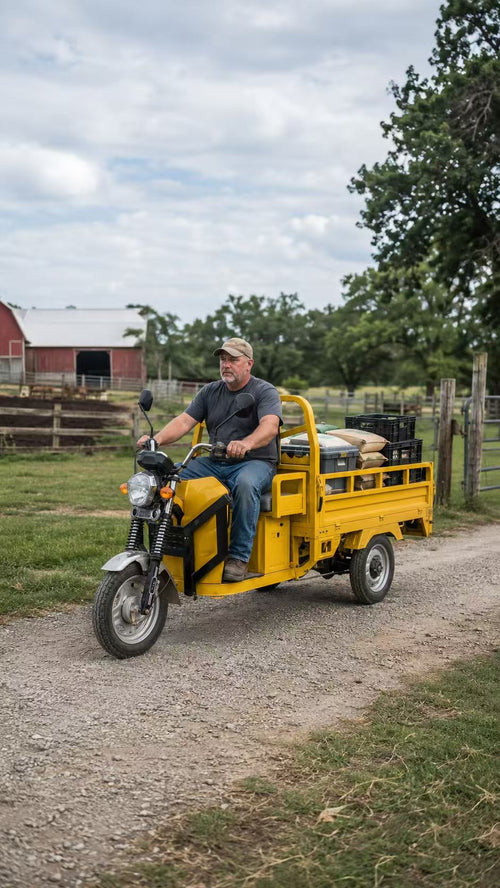
On many farms, the hardest transport work is not long-distance hauling. It is the repeated short-route movement of tools, feed, crates, trays, bags, and small materials from one part of the property to another. That is where an electric cargo tricycle can become a practical work vehicle.
A farm does not always need a large pickup or a full UTV for every small task. In many cases, a smaller machine is easier to use, easier to load, and more comfortable for repeated daily work. For farms, nurseries, orchards, ranches, and greenhouse operations, a canopy-equipped electric cargo tricycle can be a useful answer for internal transport.
This type of vehicle works best as a low-speed farm cargo vehicle for private property and non-highway routes. It helps reduce walking time, manual carrying, and repeated loading strain during the day. For buyers looking for an electric cargo tricycle for farm use, the real value is not just price. The value comes from matching the vehicle to the work route, the cargo type, and the operator’s daily routine.
Why a simple canopy design matters
Many buyers first look at motor size, top speed, or rated load. Those are important, but on real farm property, daily comfort and practical usability matter just as much. A canopy may look like a small detail, but for routine work it can make a noticeable difference.
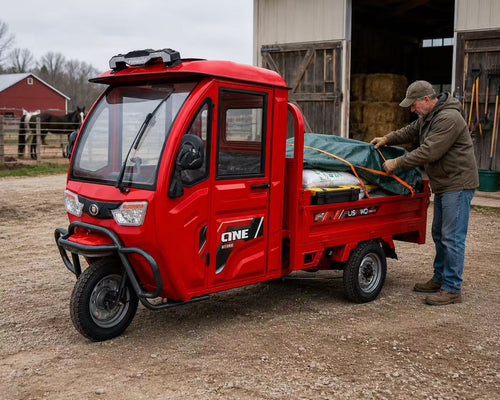
When a worker is moving around the farm several times a day, light sun protection and some shelter from changing weather conditions can improve comfort and reduce fatigue. On open land, in nursery rows, around animal areas, or between greenhouse structures, that extra protection can help the operator stay focused on the job instead of rushing to finish because of heat or light rain.
For this reason, a canopy version of a farm cargo trike can be more suitable than a totally open unit when the vehicle will be used again and again through the week. It is still a simple and practical machine, but it feels better matched to regular daily work.
Where this type of vehicle fits best
A canopy electric utility tricycle for farm work is most useful in places where the route is repetitive, the distance is short, and the load is too much for hand carrying but does not require a large truck.
Typical applications include:
- Moving feed bags from storage to livestock pens
- Carrying hand tools, hoses, and repair materials across the property
- Hauling produce crates during harvest and sorting work
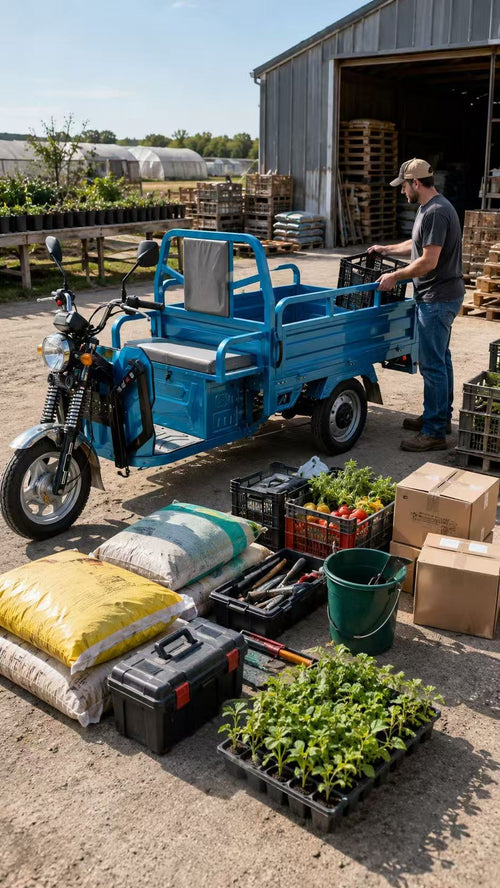
- Transporting nursery trays, plant containers, and soil materials
- Moving fertilizer bags, irrigation parts, and small maintenance supplies
- Carrying supplies between greenhouse buildings
- Supporting ranch chores around barns, sheds, and fenced work areas
In these settings, a small electric farm truck or electric farm trike often makes more sense than a larger road vehicle. It can enter tighter areas, handle narrow paths more easily, and reduce the stop-and-go inconvenience of using a larger machine for every minor task.
Why buyers compare it to a UTV alternative
A lot of farm buyers automatically think of a UTV when they need a work vehicle. But not every property needs the cost, size, and complexity of a full UTV. A canopy electric cargo tricycle for farm work can serve as a simpler material mover for internal property use.
This is especially true when the main jobs involve low-speed daily transport rather than towing, off-road recreation, or high-speed travel. If the vehicle’s job is to move items around the farm efficiently, then a compact electric farm utility vehicle can be enough.
For smaller farms and working properties, this kind of machine can serve as a UTV alternative in situations such as:
- Daily chore routes
- Repeated supply movement
- In-property harvesting support
- Greenhouse and nursery transport
- Property maintenance runs
That is why some buyers search for terms like small electric farm truck, electric farm utility vehicle, or electric cargo tricycle instead of searching only for UTVs. They are not always looking for the biggest machine. They are looking for the most practical one.
What to check before buying
Before choosing a farm cargo tricycle or electric farm cargo tricycle, buyers should focus on real use conditions instead of just headline specifications.
1. Route conditions
Look at the actual path the vehicle will follow. Is it mostly dirt, gravel, concrete, packed soil, or mixed terrain? Are there narrow turns, slopes, wet areas, or confined spaces? The best electric cargo tricycle for one farm may not be the best fit for another.
2. Daily load type
Think about what the vehicle will carry most often. Feed bags, produce crates, tools, nursery trays, and maintenance supplies all load differently. A buyer should consider not only rated payload, but also cargo shape, bed access, and how easy it is to load and unload.
3. Work frequency
If the vehicle will only be used once in a while, almost any suitable unit can work. But if it will be used multiple times every day, comfort, entry access, seating position, and weather protection become more important. That is where a canopy model gains value.
4. Property size
A small electric farm vehicle is especially useful when the property is large enough that walking wastes time, but not so large that a highway-capable vehicle is needed. For internal farm routes, a compact electric utility tricycle for farm work can fill that gap well.
5. Charging and maintenance expectations
Many buyers like an electric farm truck because of quieter operation and reduced daily maintenance compared with fuel-powered alternatives. But they should still think about charging habits, battery setup, and whether the vehicle’s design fits their long-term routine.
Why this vehicle works well for routine property work
A canopy electric cargo tricycle is not trying to replace every vehicle on the farm. It has a narrower purpose, and that is exactly why it can be valuable.
It is useful because it handles the work that happens every day but often gets overlooked:
- carrying one more load of tools
- making one more feed run
- moving one more batch of crates
- transporting one more set of supplies
- saving one more walking trip across the property
That type of repetitive labor is where an electric cargo tricycle for farm operations can create practical efficiency. Over time, the benefit is not only reduced labor effort. It also helps simplify work flow inside the property.
For many operators, the ideal farm work vehicle is not the one with the most extreme specs. It is the one that fits naturally into the daily routine.
Who this type of machine fits best
This kind of electric cargo tricycle is often a good fit for:
- small and medium farms
- nursery and greenhouse operators
- orchard work teams
- ranch and livestock properties
- private landowners with internal transport needs
- buyers looking for a small electric farm truck alternative
It is especially suitable for buyers who want a practical, low-speed farm cargo vehicle for internal routes and who value simple operation, compact size, and repeated daily usefulness.
Final thought
A canopy-equipped electric cargo tricycle is a practical option when the goal is not highway driving, but efficient transport around the property. For buyers comparing a farm cargo trike, electric farm trike, or small electric farm vehicle, the most important question is simple: does it match the actual daily work?
If the job involves short-route hauling of supplies, tools, feed, produce, and maintenance materials, then this type of electric utility tricycle for farm work can be a strong fit. And if those routes happen every day, a canopy can make the vehicle even more practical.
In real farm use, the best machine is often not the most complicated one. It is the one that helps the operator move faster, work easier, and repeat the same job with less effort.