Electric Farm Cargo Tricycle for Produce, Feed, and Equipment Transport
Share
For many small farms, orchards, greenhouses, nurseries, ranch properties, and rural work areas, the daily transportation problem is not always about long-distance driving. It is often about moving repeated loads across short routes: feed bags from storage to livestock areas, produce crates from the field to the packing shed, tools from the barn to a repair area, or small equipment between work zones.
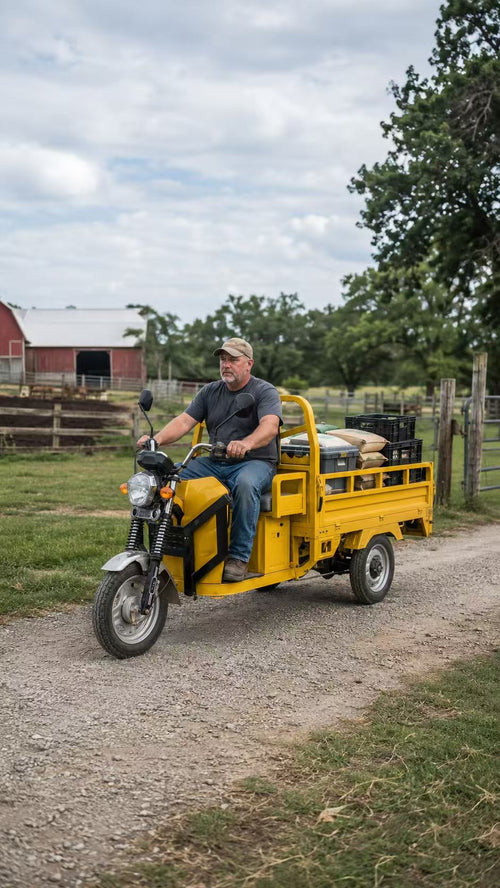
An electric farm cargo tricycle is designed for this kind of short-distance agricultural transport. Instead of using a large UTV, pickup truck, tractor, or manual wheelbarrow for every small load, a three-wheel electric cargo tricycle gives farm operators a compact, low-speed, battery-powered way to move materials around private property.
This type of vehicle is especially useful when the work route is narrow, repeated, and close to the farm operation itself.
Why Electric Farm Cargo Tricycles Fit Daily Farm Transport
A farm does not always need a full-size vehicle for every job. Many daily tasks involve moving moderate loads many times per day rather than hauling one oversized load once.
An electric farm cargo tricycle can help with:
- Moving harvested produce from field rows to a sorting or packing area
- Carrying feed bags to barns, poultry houses, goat pens, or horse stables
- Transporting hand tools, fencing supplies, buckets, small parts, and repair equipment
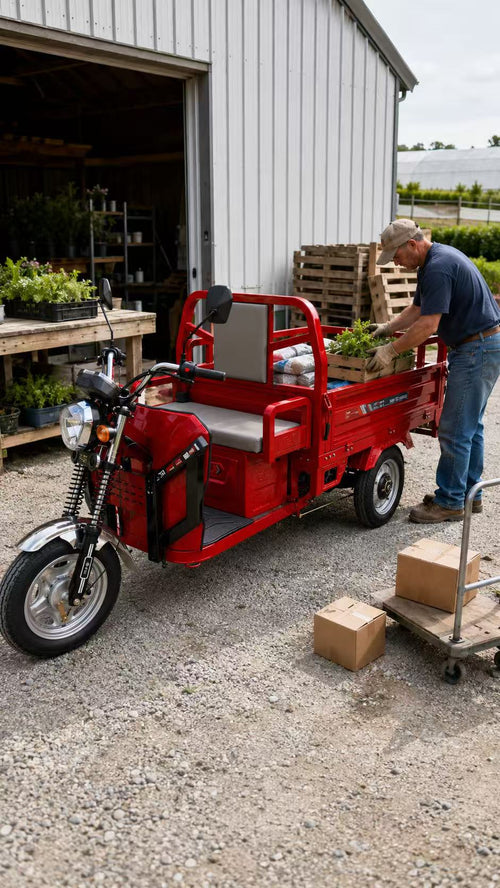
- Moving nursery trays, greenhouse supplies, soil bags, or irrigation parts
- Carrying lightweight farm materials through areas where a pickup truck is too large
- Reducing repeated manual pushing, lifting, and wheelbarrow trips
The value is not only the cargo bed. The value is the combination of a compact footprint, electric motor, stable three-wheel layout, and practical farm cargo space.
A Better Fit for Narrow Farm Paths
Many farms have routes that are not suitable for large vehicles. These may include greenhouse aisles, orchard lanes, barn-side paths, livestock service routes, nursery rows, gravel driveways, or narrow access roads around storage buildings.
A compact electric farm cargo tricycle can move through these areas more easily than a larger UTV or pickup truck. It is not intended to replace a tractor or 4x4 side-by-side for every job, but it can be very useful on short, low-speed work routes where turning space and access matter.
For farms that move many small and medium loads each day, the vehicle can act as a practical bridge between manual carts and larger farm vehicles.
What Loads Make Sense?
An electric farm cargo tricycle is best used for daily farm cargo that needs to be moved repeatedly but does not require a large truck.
Common load types include:
- Vegetable crates
- Fruit boxes
- Feed bags
- Hay flakes or small hay bundles
- Buckets and water containers
- Hand tools and repair tools
- Fencing supplies
- Greenhouse trays
- Nursery plants
- Soil bags and compost bags
- Light farm equipment
- Cleaning supplies for barns or animal areas
The key is to match the cargo bed size, payload rating, battery system, and motor power to the actual work route. A buyer should not only ask, “How much can it carry?” They should also ask, “What do I move every day, how far do I move it, and what kind of ground will the vehicle drive on?”
Electric Farm Cargo Tricycle vs. Wheelbarrow or Manual Cart
A wheelbarrow is simple and cheap, but it becomes tiring when the same route must be repeated many times. On farms, the problem is often not one trip. It is the fifth, tenth, or twentieth trip of the day.
An electric cargo tricycle helps reduce repeated pushing and lifting. It allows one operator to move feed, tools, produce, and supplies with less physical strain, especially across longer barn-to-field or storage-to-worksite routes.
This does not mean the wheelbarrow disappears. A wheelbarrow is still useful for tight corners, small cleanup jobs, and very short movements. But for repeated daily hauling, a powered cargo tricycle can make the work process smoother.
Electric Farm Cargo Tricycle vs. UTV
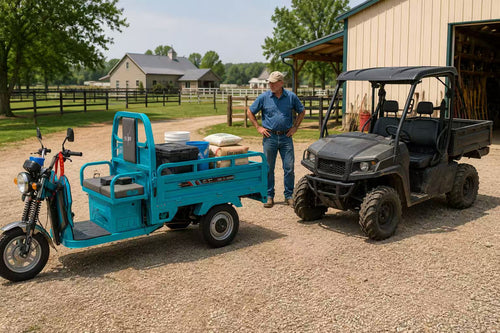
A UTV is stronger for rough trails, steep hills, deep mud, passenger carrying, towing, and full-property mobility. For larger ranches, rough terrain, or heavy-duty off-road use, a UTV may still be the better choice.
An electric farm cargo tricycle makes more sense when:
- The route is mostly flat or moderately uneven
- The work is low-speed and short-distance
- The main job is hauling cargo, not carrying passengers
- The farm needs a lower-cost utility option
- The operator wants quiet electric movement near animals
- The vehicle will be used around barns, greenhouses, orchards, or storage areas
- A full-size UTV is too large or too expensive for the task
The best way to think about it is simple: a UTV is a larger farm mobility vehicle, while an electric farm cargo tricycle is a compact daily load carrier.
What Buyers Should Check Before Choosing One
Before buying an electric farm cargo tricycle, the buyer should understand the real work conditions.
Important questions include:
1. What cargo will be moved most often?
Produce crates, feed bags, tools, nursery trays, soil bags, and equipment all require different cargo bed planning.
2. How much weight is moved per trip?
The buyer should choose a realistic payload, not just the highest number in a product listing.
3. What type of road or surface will the vehicle use?
Gravel, dirt paths, paved farm lanes, barn floors, greenhouse aisles, and orchard rows all affect tire choice and motor requirements.
4. Is a flat cargo bed or dump bed better?
A flat cargo bed is useful for boxes, tools, crates, feed bags, and equipment. A dump bed is better for loose material such as soil, compost, mulch, manure, gravel, or wood chips.
5. How far does each daily route run?
Battery range should be matched to the repeated daily route, not just the maximum advertised range.
6. Does the vehicle need open-air operation or weather protection?
Some buyers prefer an open cargo tricycle for easy access and lower cost. Others may prefer a covered cab or canopy for rain, wind, or colder climates.
Where This Vehicle Fits Best
An electric farm cargo tricycle is best suited for:
- Small farms
- Vegetable farms
- Orchards
- Vineyards
- Greenhouses
- Nurseries
- Horse stables
- Poultry farms
- Dairy support areas
- Rural private properties
- Market gardens
- Farm storage and packing areas
It is not meant to be a high-speed road vehicle or a full off-road UTV replacement. Its strength is practical, low-speed cargo movement on private property.
Final Thought
For farms that move produce, feed, tools, and equipment every day, an electric farm cargo tricycle can be a practical short-distance transport solution. It helps reduce repeated manual hauling, works well on narrow farm routes, and provides a lower-cost alternative for daily cargo movement where a full-size UTV may be more than the job requires.
The right choice depends on the load, route, terrain, and work pattern. For many small and mid-size agricultural operations, this type of electric cargo tricycle can become a simple, useful work vehicle for daily farm transport.