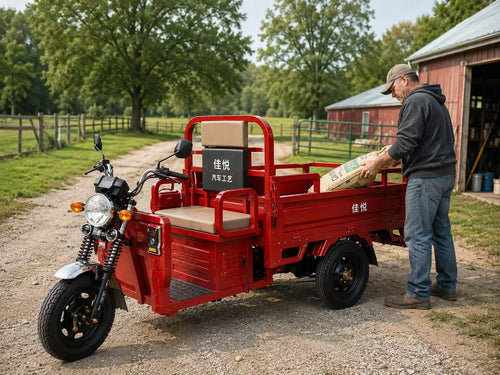
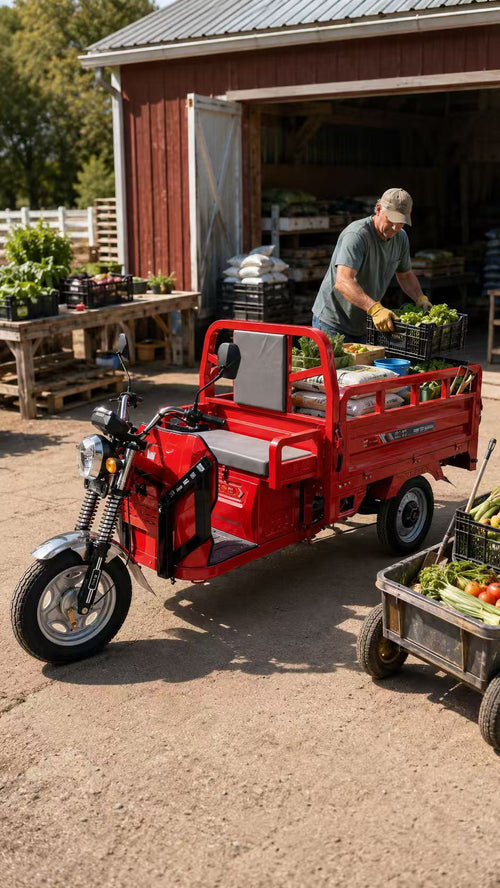
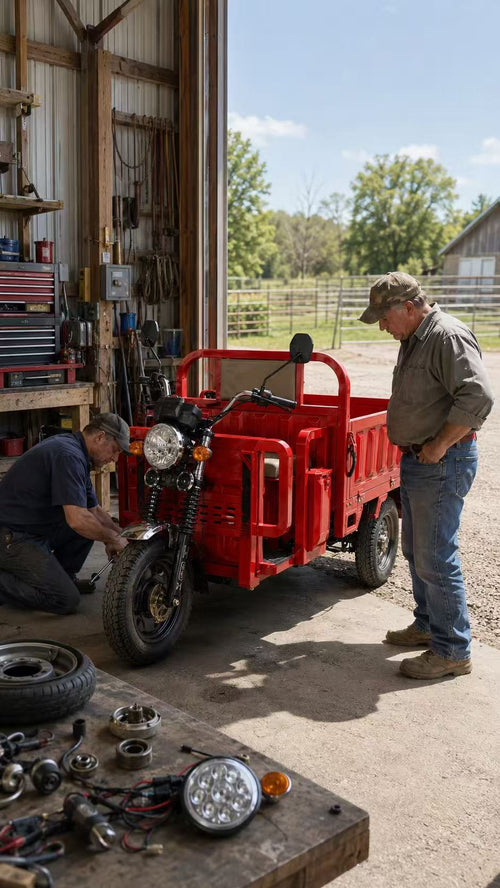
Will an Electric Farm Utility Trike Be Hard to Use Without Power Steering?
Share
Many farm buyers compare a simple electric farm utility trike with a larger UTV and ask the same question:
Will it be difficult to steer without power steering?
That concern is reasonable.
Power steering can reduce steering effort, especially when a vehicle is moving very slowly, turning in a tight area, carrying a heavy load, or working on rough ground.
But not every short farm cargo route requires it.
A low-speed electric cargo trike used on firm private property may still be practical without power steering when:
the route is short
the surface is firm
the vehicle keeps moving during turns
the cargo is balanced
the front tire pressure is correct
the operator does not need to turn sharply while stopped
The correct question is not only:
Does the vehicle have power steering?
The better question is:
How often will I need to make tight, slow turns under difficult conditions?
Why Power Steering Feels Valuable
Power steering can make a vehicle feel easier to control.
It may reduce the effort needed to turn the front wheels when:
the vehicle is nearly stopped
the ground is rough
the front tire is loaded
the operator is reversing
the turning space is limited
the operator has limited shoulder or arm strength
This is why many UTV buyers consider power steering an important comfort feature.
Some owners describe it as optional for general field use but valuable for repeated low-speed turning, snow work, trailer maneuvering, or long operating days.
The benefit is real.
But its value depends on how the machine is used.
A buyer who drives across open fields may judge it differently from a buyer who repeatedly turns inside a barnyard.
Short Farm Cargo Routes Create a Different Work Pattern
An electric farm utility trike is usually selected for low-speed, short-distance cargo work.
Typical routes may connect:
a barn
a feed storage area
a greenhouse
a nursery
a workshop
a warehouse yard
a packing area
The operator may drive for only a few minutes before stopping.
The vehicle may carry:
feed bags
tools
boxes
crates
buckets
repair parts
nursery trays
property-maintenance supplies
This work pattern does not always require the same steering system as a large UTV used for long trail travel, heavy snow work, or continuous rough-terrain operation.
If the route is firm and the operator makes smooth moving turns, manual steering may remain manageable.
Steering Is Usually Hardest While Stopped
A vehicle is generally harder to steer when it is not moving.
The tire must scrub against the ground instead of rolling through the turn.
This can feel especially heavy on:
concrete
rough gravel
soft soil
grass
mud
A better technique is to allow the vehicle to move slowly while turning.
The operator should avoid forcing the handlebars sharply from side to side while the vehicle is fully stopped.
This can reduce steering effort and tire scrub.
However, the operator must still move slowly and keep full control.
The goal is not to add speed.
It is to let the front wheel roll naturally through the turn.
Tight Spaces Increase the Need for Steering Effort
A wide open farm lane is different from a narrow loading area.
Steering effort becomes more important when the vehicle must:
turn inside a small yard
reverse near a wall
move between parked equipment
enter a narrow gate
make repeated three-point turns
work inside a warehouse lane
A buyer should measure the real turning space before purchasing.
The vehicle should not be chosen only by overall width.
The buyer should also consider:
vehicle length
front wheel position
cargo-bed overhang
gate placement
space needed to reverse
A compact vehicle can still require planning.
If the daily route demands repeated sharp turns in a confined area, power steering may provide more value.
Cargo Weight Can Change Steering Feel
The way cargo is loaded affects the whole vehicle.
A heavy rear load may not directly add large weight to the front wheel, but poor loading can still change handling and steering feel.
Cargo should remain:
within the rated capacity
low in the bed
balanced from side to side
secured when necessary
fully inside the cargo area
The buyer should avoid placing heavy items too high or too far to one side.
An uneven load may cause the operator to make more steering corrections.
That can make the vehicle feel harder to control.
A balanced load supports smoother turning.
Front Tire Pressure Matters
Incorrect front tire pressure can make steering feel heavier or less predictable.
An underinflated front tire can increase rolling resistance.
An overinflated tire may reduce ride comfort and contact quality.
The owner should follow the pressure recommendation for the actual tire and vehicle.
The front tire should also be checked for:
damage
uneven wear
low pressure
incorrect size
poor alignment
A steering problem should not automatically be blamed on the lack of power steering.
Basic tire and front-end condition should be inspected first.
Firm Routes Are Easier Than Soft Routes
Manual steering can feel reasonable on:
firm gravel
concrete
asphalt
compacted soil
maintained private roads
It may feel harder on:
deep gravel
soft grass
mud
loose soil
deep ruts
snow
A three-wheel cargo trike is not designed to replace a 4×4 UTV in difficult terrain.
If the daily route regularly includes mud, deep snow, rough pasture, steep ground, or severe ruts, the buyer may need a different machine.
That decision should be based on terrain, not only steering effort.
A stronger steering system cannot make the wrong vehicle suitable for the route.
Older Operators Need a More Careful Decision
Some older operators can use a simple farm utility trike comfortably.
Others may have:
shoulder pain
wrist pain
reduced grip strength
arthritis
back problems
limited mobility
For these buyers, steering effort becomes more important.
A vehicle that feels acceptable to one person may feel difficult to another.
The buyer should consider:
how often the operator turns
how narrow the route is
whether the operator reverses frequently
whether the vehicle is used every day
whether the operator must steer while nearly stopped
An operator with limited upper-body strength may benefit from power steering or a different vehicle design.
This should be evaluated honestly before purchase.
Frequent Stops and Starts Can Still Suit a Simple Trike
Farm work often involves many short tasks.
The operator may:
drive to a gate
stop
open it
continue to a feed area
stop again
unload supplies
return to the barn
This does not automatically make power steering necessary.
The important factor is how much tight steering happens during those stops.
If the route is open and the operator can make wide, smooth turns, manual steering may remain practical.
If every stop requires reversing, sharp turning, or maneuvering around obstacles, the work may become tiring.
The route design matters.
Can the buyer move equipment to create more space?
Can a gate be approached more directly?
Can the vehicle use a wider turning area?
Small route changes may reduce steering effort without changing the vehicle.
Do Not Confuse Simple Steering With Poor Quality
A vehicle without power steering is not automatically poorly designed.
Simple mechanical steering can offer:
fewer electrical components
lower purchase cost
easier inspection
simpler local repair
But it also has limits.
The buyer should not expect the same steering feel as a premium UTV with electric power steering.
The right comparison is not:
Which vehicle feels more advanced?
The right comparison is:
Which steering system is enough for the real daily work?
A simple system can be appropriate when the route and workload are simple.
When Power Steering Is More Valuable
Power steering becomes more useful when the buyer regularly needs:
tight low-speed turns
frequent reversing
trailer maneuvering
snow-plow work
rough ground
long driving periods
heavy front-end accessories
multiple operators
older or physically limited operators
These conditions increase steering effort and fatigue.
A power-steering UTV may justify its higher price when the work happens every day.
The feature has value when it improves control and reduces operator strain.
But it may add little value to a short open route with only a few gentle turns.
The Difference Between Turning While Moving and Turning While Stopped
A manual-steering vehicle usually feels easier when the front wheel is rolling.
The operator should plan the turn before reaching the corner.
A practical method is:
reduce speed
look through the turn
begin steering while moving slowly
avoid sudden full-lock movement
straighten gradually after the turn
The operator should not force the handlebars sharply while the vehicle is stationary unless necessary.
This reduces tire scrub and steering effort.
It can also reduce unnecessary wear.
The vehicle must remain at a safe low speed throughout the turn.
Smooth control is more important than quick movement.
Reversing Can Make Steering Feel Harder
Reversing often requires more attention.
The operator may need to:
look behind
turn the handlebars
judge the cargo-bed position
avoid walls or equipment
Manual steering can feel more demanding during repeated reversing.
A buyer should ask:
How often will I reverse?
Is the parking space wide enough?
Can I park facing outward?
Can I create a loop route instead of backing up?
A simple route change may reduce the need for difficult reverse maneuvering.
A loop can be more useful than a narrow dead end.
The Cargo Bed Must Be Considered During Turns
A large cargo bed creates strong utility value, but it also increases vehicle length.
The operator must remember the rear of the vehicle during tight turns.
The cargo bed may swing toward:
fences
walls
posts
parked equipment
stored materials
The buyer should leave enough clearance.
Power steering does not solve rear-clearance problems.
The operator still needs:
good visibility
slow speed
turning space
route planning
A vehicle can be easy to steer and still be too long for the available area.
The complete geometry matters.
Power Steering Does Not Replace Good Braking and Control
Steering is only one part of vehicle handling.
The buyer should also evaluate:
brakes
tire condition
load balance
visibility
operator position
route surface
A vehicle with power steering can still be unsuitable if the brakes, tires, load, or route are wrong.
A vehicle without power steering can still be practical when the entire setup matches the work.
Buyers should avoid choosing a vehicle based on one feature.
Is Power Steering Worth the Extra Cost?
The answer depends on frequency.
A buyer should ask:
How many hours will the vehicle operate each day?
How many tight turns happen?
How often does it reverse?
How many people will drive it?
Does any operator have shoulder or wrist problems?
Is the route open or confined?
Is snow work involved?
Is trailer maneuvering involved?
If power steering prevents fatigue every day, it may be worth the added cost.
If the vehicle only makes several short trips on a wide, firm route, the buyer may not use the feature enough to justify paying more.
The decision should be based on daily value.
When an Electric Farm Utility Trike Can Work Well Without It
A simple electric farm utility trike may work well without power steering when:
the route is short
the surface is firm
the speed is low
turning space is reasonable
the operator can steer while moving slowly
cargo is balanced
the front tire is correctly maintained
the work does not involve heavy towing
the operator does not have major arm or shoulder limitations
This can fit:
small farms
homesteads
nurseries
greenhouses
warehouses
property-maintenance areas
private markets
The vehicle can carry practical cargo without needing every UTV feature.
When Another Vehicle May Be the Better Choice
Another vehicle may be more suitable when:
the operator drives for hours
the route is rough
turns are constantly tight
reversing is frequent
the ground is soft
snow plowing is required
a trailer must be maneuvered
the operator has limited upper-body strength
A power-steering UTV, ATV, or another purpose-built machine may provide better control and comfort.
The buyer should not force a simple cargo trike into a work pattern it was not designed to handle.
A Test Should Match the Real Job
A buyer should test steering under realistic conditions when possible.
The test should include:
starting from the normal parking area
making the actual turn
passing through the real gate
carrying a moderate representative load
stopping at the normal work point
reversing if the job requires it
The buyer should not judge steering only while the vehicle is parked on a showroom floor.
A realistic test reveals:
steering effort
turning space
visibility
cargo-bed swing
reverse control
operator comfort
The real route is more important than a specification sheet.
Questions to Ask Before Buying
Before purchasing, the buyer should ask:
Does the vehicle have manual or power steering?
How heavy does the steering feel at low speed?
What is the turning radius?
What front tire pressure is recommended?
Can the vehicle make the normal gate turn?
How often will the operator reverse?
Will older workers use it?
Will the vehicle carry heavy front-mounted accessories?
Is snow work required?
Can the route be widened or simplified?
Does the work justify the added cost of power steering?
These questions help the buyer avoid paying for an unnecessary feature or ignoring a real operating need.
Final Thought
Will an electric farm utility trike be hard to use without power steering?
Not necessarily.
For short, low-speed cargo routes on firm private property, manual steering may be practical when:
the front tire is maintained
the cargo is balanced
the operator turns while moving slowly
the route provides enough space
the work does not require repeated tight maneuvering
Power steering becomes more valuable when the vehicle must make frequent slow turns, reverse often, work on rough ground, push snow, maneuver trailers, or serve operators with limited arm and shoulder strength.
The correct decision depends on the real route and the real operator.
Power steering is not automatically required.
It is also not merely a luxury when the work truly needs it.
The best vehicle is the one that can be steered safely, comfortably, and consistently during the jobs completed every day.