Is Cargo Bed Design More Important Than Motor Watts on an Electric Farm Cargo Trike?
Share
Many buyers compare electric farm cargo trikes by motor watts first.
1000W, 1500W, 2000W.
Those numbers are easy to understand. A higher number sounds stronger. It feels safer. It gives the buyer confidence that the machine may handle more farm work.
But on many farms, ranches, nurseries, greenhouses, homesteads, and private work areas, motor watts are not the only thing that decides daily usefulness.
The cargo bed may matter just as much.
Sometimes it matters more.
That may sound strange at first. A cargo bed does not sound as exciting as motor power. It does not look as impressive as top speed or range. It may not be the first thing buyers compare.
But the cargo bed is where the actual work happens.
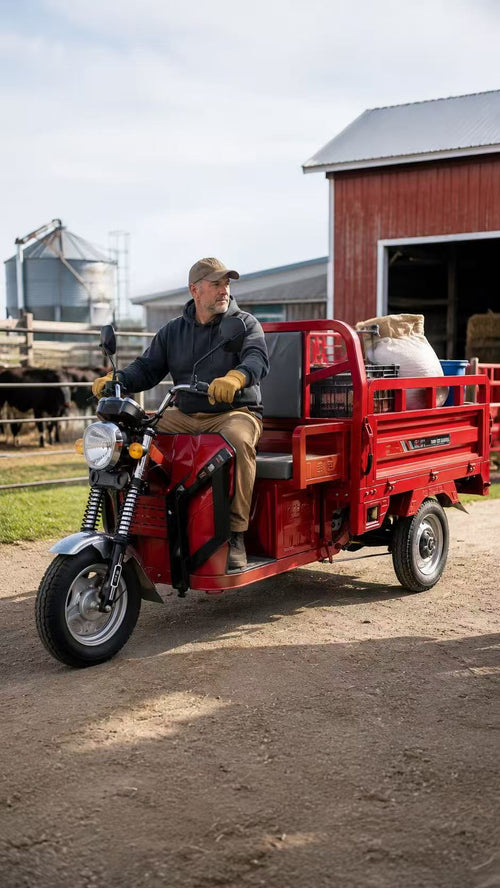
Feed bags go into the cargo bed.
Produce crates go into the cargo bed.
Tools, buckets, boxes, nursery trays, fencing supplies, repair parts, soil bags, and daily farm materials all go into the cargo bed.
If the cargo bed is not practical, the trike may not solve the buyer’s real problem, even if the motor sounds strong on paper.
That is why buyers should ask a better question:
Is the cargo bed design right for the work I do every day?
Why Buyers Focus on Motor Watts First
Motor watts are easy to compare.
A buyer may see several options and think:
1000W is basic.
1500W is stronger.
2000W must be better.
This is understandable.
Power matters when a trike needs to move with a load, start from a stop, travel across private farm routes, or handle repeated short-distance hauling.
A stronger motor may be helpful when the route includes moderate slopes, heavier daily loads, or frequent use.
But motor watts only help move the machine.
They do not decide whether the load is easy to place, stable to carry, simple to unload, or practical for the worker.
That is the part many buyers miss.
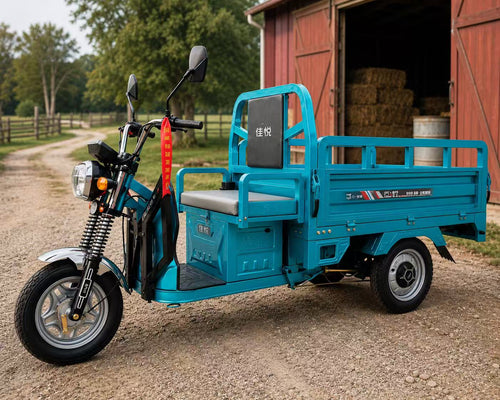
On a farm, the cargo bed is not just a box behind the seat.
It is the working surface of the machine.
The Cargo Bed Handles the Real Work
An electric farm cargo trike is not bought only for movement.
It is bought for material movement.
That means the cargo bed must match the materials.
A farm cargo trike may be used for feed bags, produce crates, plastic bins, hand tools, buckets, fencing parts, irrigation parts, cartons, small equipment, nursery trays, greenhouse supplies, or property maintenance materials.
These items are not all the same.
Some are heavy.
Some are bulky.
Some are fragile.
Some need side support.
Some need easy hand unloading.
Some should stay low and balanced.
Some should not be stacked high.
This is why cargo bed design matters.
A useful cargo bed helps the worker load, organize, secure, and unload daily materials without creating extra trouble.
Motor power can move the trike.
The cargo bed decides whether the trike is actually useful for the work.
Bed Size Is Not the Only Question
Many buyers look at cargo bed size first.
That is important, but size alone is not enough.
A large bed may look useful, but the buyer should ask:
Can I load it easily?
Can I reach the materials?
Can crates sit flat?
Can bags stay stable?
Can tools be separated from produce or feed?
Can the load stay low?
Can the side rails support the materials?
Can the worker unload without struggling?
Will the bed fit the daily route and turning space?
Will the buyer actually use the full bed, or only part of it?
Cargo bed size matters only when the shape and access match the work.
A farm cargo tricycle with a cargo bed should be judged by real use, not only by dimensions.
Side Rails Matter More Than Buyers Think
Side rails may look simple, but they are important.
Open side rails help keep crates, boxes, tools, and farm supplies from sliding out during low-speed movement.
They also help define the cargo area.
For many daily farm tasks, side rails are useful because the load is not one large object. It is often many smaller items.
For example:
two feed bags
one toolbox
several produce crates
a bucket
a few fencing parts
small repair materials
greenhouse trays
irrigation fittings
This kind of mixed load needs a practical cargo bed with enough support to keep items organized.
A flat platform without side support may be less useful for some farm work.
A cargo bed with usable rails can help the worker carry moderate daily materials more confidently.
The goal is not to overload the trike.
The goal is to keep normal farm materials stable and organized during repeated short trips.
Bed Height Affects Daily Labor
Bed height is another detail buyers often ignore.
If the cargo bed is too high, loading heavy bags or crates becomes tiring.
If the bed is too low, unloading may require more bending.
If the side rails are too difficult to reach over, the worker may struggle with larger items.
If the tailgate or side access is inconvenient, every trip takes more time.
This matters because farm work is repetitive.
A worker may load and unload many times per day.
Even small inconvenience becomes important when repeated daily.
A cargo bed that feels practical can reduce wasted movement.
A cargo bed that feels awkward can make the trike less useful, even if the motor is strong.
That is why buyers should think about the worker, not just the machine.
The best electric farm cargo trike is not only the one that moves.
It is the one that makes loading and unloading easier.
Open Cargo Bed or Dump Bed?
Another common buying question is whether to choose a regular open cargo bed or a hydraulic dump bed.
This is an important decision.
An open cargo bed is often better for items such as:
feed bags
produce crates
tools
boxes
buckets
nursery trays
greenhouse supplies
fencing materials
daily maintenance items
These materials usually need to be placed, arranged, carried, and unloaded by hand.
A dump bed may be better for loose materials such as soil, compost, mulch, manure, gravel, sand, or similar bulk materials that need controlled rear unloading.
But not every buyer needs a dump bed.
If the daily work is mostly crates, tools, feed bags, cartons, or supplies, a regular cargo bed may be simpler and more practical.
If the daily work includes loose bulk materials, a hydraulic dump model may save labor.
The mistake is buying by excitement instead of cargo type.
A dump bed sounds useful.
But the buyer should first ask:
What do I move most often?
If the answer is crates and supplies, an open cargo bed may be the better first choice.
If the answer is loose material, a dump bed may be worth considering.
Motor Watts Cannot Fix the Wrong Bed
A stronger motor does not fix a poor cargo match.
If the bed is wrong for the material, more watts do not solve the problem.
For example, if a buyer mainly moves produce crates, the issue may be flat loading space, side rails, crate stability, and easy unloading.
If a buyer mainly moves feed bags, the issue may be bed access, low loading height, balanced weight, and stable placement.
If a buyer mainly moves loose compost or manure, the issue may be whether a dump bed is needed.
If a buyer mainly moves tools and maintenance supplies, the issue may be organization and repeated access.
In each case, motor power is only one part of the machine.
The cargo bed decides whether the machine fits the job.
This is why electric farm cargo trike buyers should not start with motor watts alone.
They should start with cargo type.
Match the Cargo Bed to the Daily Load
A practical buyer should list the real daily load before choosing the model.
Not the biggest possible load.
Not the rare once-a-month task.
The daily load.
For example:
Do you move feed bags every morning?
Do you move produce crates during harvest?
Do you move tools across a private property?
Do you move nursery trays between growing areas?
Do you move boxes and supplies around a warehouse yard?
Do you move loose soil, compost, mulch, or manure?
Do you need hand unloading or dump unloading?
Do you need weather protection for the operator?
Do you need an open bed for fast access?
These questions make the buying decision clearer.
A buyer who understands cargo type can choose a better model.
An open cargo electric work trike may be enough for many daily farm materials.
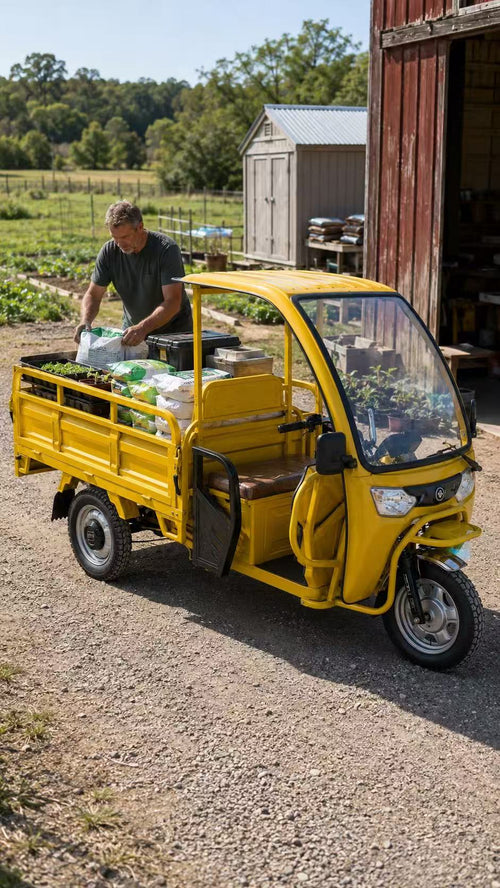
A canopy utility cargo vehicle may help when some operator coverage is useful.
A cab utility cargo vehicle may be better when more protection is needed.
A hydraulic dump utility vehicle may be better when loose materials are a regular part of the job.
The right answer depends on the cargo.
Not only the motor.
Do Not Overload Just Because the Bed Has Space
A common mistake is thinking that if an item fits in the cargo bed, the machine should carry it.
That is not safe thinking.
Cargo bed space and working load are different.
A bed may look large enough to hold many bags, crates, tools, or boxes, but the total weight may become too high.
This is especially true with:
wet soil
gravel
compost
manure
feed bags
water containers
metal tools
fencing parts
stacked crates
Buyers should keep loads low, balanced, and within the rated working capacity.
They should avoid stacking too high, loading too much weight on one side, or using the bed like a heavy construction trailer.
A good cargo bed should help organize a practical daily load.
It should not encourage abuse.
The smartest use is not to fill every inch.
The smartest use is to move a safe group of daily materials in fewer trips.
Why This Matters for Small Farms
Small farms often need equipment that is used many times per day.
The job may not be dramatic.
It may be simple movement between a shed, barn, packing area, greenhouse, orchard row, nursery table, feed storage area, or private work zone.
In that kind of daily use, cargo bed convenience matters a lot.
A worker needs to load quickly.
Carry safely.
Unload easily.
Return and repeat.
If the cargo bed supports that workflow, the electric farm cargo trike becomes more useful.
If the cargo bed does not support the workflow, the trike may sit unused.
This is why buyers should judge the machine by daily material flow, not only by motor power.
A practical cargo bed can make the difference between a tool that gets used and a tool that becomes inconvenient.
The Real Debate: Power or Practicality?
The real debate is not whether motor watts matter.
They do.
The real debate is whether buyers should start with motor watts or with the work.
A power-first buyer asks:
How many watts?
How fast?
How far?
How much can it carry?
A work-first buyer asks:
What do I move every day?
How do I load it?
How do I unload it?
Is the cargo bed practical?
Does the bed fit crates, bags, tools, and supplies?
Do I need dumping?
Will the worker use it every day?
The second set of questions usually leads to a better purchase decision.
Because the farm does not use a spec sheet.
The farm uses the cargo bed.
How to Choose the Right Cargo Bed
Before choosing an electric farm cargo trike, buyers should look at their real materials.
For crates and boxes, look for a bed that keeps items flat and stable.
For feed bags, look for easy loading and balanced placement.
For tools, look for enough space to separate sharp or heavy items from other cargo.
For nursery trays, look for a practical bed height and stable surface.
For loose material, consider whether hydraulic dumping is needed.
For mixed daily loads, look for a bed that can handle moderate, organized cargo without becoming difficult to use.
This is not only a product decision.
It is a workflow decision.
The better the cargo bed fits the work, the more often the trike will be used.
How This Applies to OneClickChina Buyers
OneClickChina offers different electric utility and cargo trike configurations, including ordinary open cargo models, canopy cargo models, cab utility cargo models, and hydraulic dump utility models.
This matters because buyers do not all move the same materials.
A buyer moving crates, feed bags, tools, and boxes may choose differently from a buyer moving loose manure, soil, compost, or gravel.
The ordinary open cargo electric utility trike is suited for many daily material movement tasks where fast access and a practical open bed are useful.
The canopy version may help when the operator wants some coverage.
The cab version may offer more protection for certain working conditions.
The hydraulic dump model is more relevant when controlled unloading of loose materials is part of the daily job.
Motor and battery options matter, but the model type and cargo bed purpose matter too.
A buyer should match the model to the daily material first.
Then choose the motor and battery setup that fits the route and workload.
Final Thought
Motor watts help move an electric farm cargo trike.
But the cargo bed decides how useful the trike is for daily farm work.
If the buyer moves feed bags, crates, tools, boxes, nursery trays, or supplies, the cargo bed must be practical, stable, easy to load, and easy to unload.
If the buyer moves loose bulk materials, a dump bed may matter more.
The smartest purchase is not always the strongest motor on paper.
It is the electric farm cargo trike with the cargo bed that matches the work.
Before choosing by watts, look at what you move every day.
The cargo bed may be the part that decides whether the machine becomes a daily tool or just another piece of equipment.