Electric Cargo Trike vs Wheelbarrow for Small Farm Daily Hauling
Share
Small farms often do not need a full-size UTV for every daily job.
Many daily farm tasks are much simpler:
moving feed
carrying tools
hauling fertilizer
transporting harvest crates
moving soil bags
carrying small equipment
moving supplies between barns, fields, gardens, and storage areas
For these jobs, many workers still use a wheelbarrow, hand cart, or small manual wagon.
That works for light occasional jobs.
But when the same hauling work happens again and again every day, manual transport becomes slow, tiring, and inefficient.
This is where a compact electric cargo trike can become a practical wheelbarrow alternative for small farms.
It is not trying to replace every farm vehicle.
It is designed to solve one common problem:
daily short-distance hauling with less manual labor.
Why Wheelbarrows Become a Problem on Small Farms
A wheelbarrow is simple, cheap, and useful.
For one or two small loads, it may be enough.
But small farm work is rarely only one or two loads.
Workers may need to move materials many times per day:
from storage shed to field
from barn to livestock area
from garden to compost pile
from feed room to animal pens
from orchard rows to packing area
from greenhouse to loading point
from driveway to work zone
Each trip may not look difficult by itself.
But after many repeated trips, the total labor adds up.
The biggest problems with wheelbarrow hauling are:
manual pushing
limited load size
slow travel speed
worker fatigue
repeated walking
difficult movement over uneven ground
extra time spent on simple transport tasks
For small farms, the issue is not only the weight of one load.
The real issue is the number of repeated trips.
What an Electric Cargo Trike Changes
An electric cargo trike gives small farms a powered way to move daily materials.
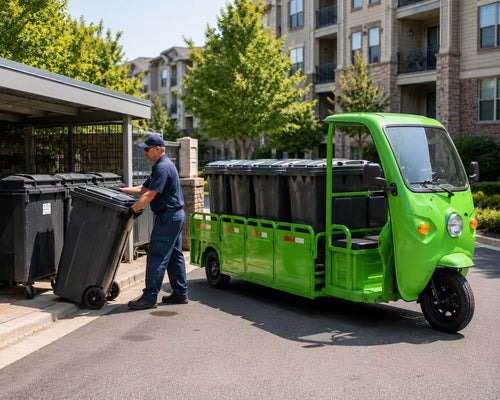
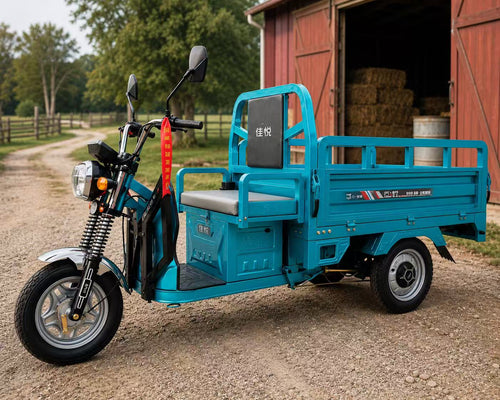
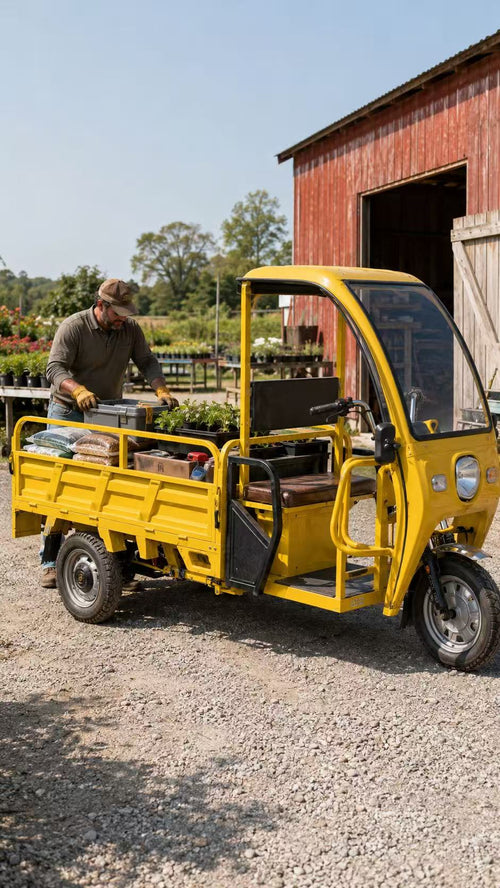
It has a rear cargo bed for supplies, tools, feed, crates, and farm materials. Instead of pushing every load by hand, one worker can load the cargo bed, drive the vehicle to the work area, unload, and return for the next task.
This can help with:
moving feed bags
carrying fertilizer
transporting hand tools
moving harvest crates
carrying soil bags
moving small parts and repair supplies
hauling garden materials
supporting daily property maintenance
moving supplies across short farm routes
The advantage is not only carrying more.
The advantage is reducing repeated manual transport.
For a small farm owner or worker, that can make daily work smoother and less physically demanding.
Electric Cargo Trike vs Wheelbarrow
A wheelbarrow is still useful for very small tasks.
But it has limits.
A wheelbarrow depends completely on the worker’s body. The heavier the load, the harder the pushing becomes. The more trips required, the more time and energy are lost.
An electric cargo trike is different because it uses powered movement.
Wheelbarrow advantages:
low cost
simple storage
easy for very light work
no charging required
useful for tight small spots
Wheelbarrow limits:
small load size
manual pushing
slow over repeated routes
physically tiring
less efficient for daily hauling
not ideal for longer property movement
Electric cargo trike advantages:
powered movement
larger cargo bed
less physical strain
fewer repeated trips
better for daily material transport
useful across barns, gardens, fields, and storage areas
more practical when one worker handles many jobs
The wheelbarrow still has a place.
But when the job repeats every day, a compact electric cargo trike can become the better work tool.
Why Small Farms Need Short-Distance Hauling Vehicles
Many small farm jobs happen within a limited area.
The route may be short, but it may be repeated many times.
For example:
feed storage to animal pens
barn to pasture gate
garden area to compost pile
orchard row to packing table
tool shed to repair area
greenhouse to loading space
field edge to storage zone
These are not highway trips.
They are not recreational rides.
They are work routes.
That is why a compact electric cargo trike can make sense. It is small enough for daily farm spaces but more efficient than pushing loads by hand.
For many farms, transport efficiency is not about speed.
It is about reducing unnecessary labor.
Electric Cargo Trike vs Golf Cart for Farm Work
Some small farms use golf carts because they are easy to drive and familiar.
But most golf carts are built mainly for moving people.
They usually have passenger seats, limited cargo space, and no real working cargo bed.
For farm hauling, the need is different.
Farm workers often need to move:
feed
tools
fertilizer
soil bags
harvest crates
fencing supplies
small equipment
garden materials
barn supplies
A compact electric cargo trike is more work-focused.
It gives more useful cargo space for materials instead of using most of the vehicle for passengers.
A golf cart is better for moving people.
An electric cargo trike is better for moving work materials.
That difference matters when the vehicle is used every day.
Electric Cargo Trike vs UTV for Small Farm Hauling
A UTV is useful when a farm needs higher speed, rough terrain travel, passenger seating, towing, or large-property movement.
But not every small farm needs a full-size UTV for daily hauling.
Many owners are not trying to cross rough trails or carry multiple passengers. They simply need to move supplies across the property.
For those buyers, a compact electric cargo trike can be a lower-cost and more focused option.
A UTV may be better for:
rough off-road routes
larger properties
towing attachments
moving passengers
higher-speed travel
heavy-duty outdoor use
An electric cargo trike may be better for:
short-distance hauling
daily farm supplies
feed and tools
harvest crates
garden materials
narrow working areas
lower-cost daily transport
reducing wheelbarrow trips
The right choice depends on the job.
If the main job is short-distance material movement, an electric cargo trike may be enough.
Electric Cargo Trike vs Pickup Truck for Daily Farm Tasks
A pickup truck is useful for road travel, heavy loads, long-distance transport, and large equipment movement.
But for small daily jobs inside a farm or property, a pickup truck can be too large.
It may not be convenient for:
tight barn areas
garden paths
orchard rows
greenhouse entrances
livestock working areas
short stop-and-go routes
small material movement
Using a pickup for every small job can waste time, space, and fuel.
A compact electric cargo trike can handle smaller daily routes where a truck feels oversized.
The pickup remains important for big jobs.
But the electric cargo trike can become the daily work helper for smaller repeated loads.
Best Uses for an Electric Cargo Trike on Small Farms
A compact electric cargo trike is especially useful for repeated daily hauling.
Good use cases include:
moving feed bags to livestock areas
carrying fertilizer to garden beds
transporting harvest crates from field to packing area
moving tools to repair zones
carrying soil bags and compost
transporting small equipment
moving irrigation parts
supporting greenhouse and nursery work
hauling supplies around barns and sheds
moving property maintenance materials
These jobs are not always heavy enough to justify a large vehicle.
But they are often too repetitive to handle comfortably by hand.
That is exactly where an electric cargo trike fits.
Who Should Consider This Type of Vehicle?
This type of vehicle is a good fit for buyers who say:
“I use a wheelbarrow too much.”
“I need to move feed, tools, and crates every day.”
“I do not need a full-size UTV yet.”
“I want something lower-cost than a UTV.”
“I need a small farm hauling vehicle.”
“I need a practical cargo bed, not passenger seats.”
“I want to reduce repeated manual trips.”
“I need something easier than pushing heavy loads by hand.”
It is especially suitable for:
small farms
vegetable farms
orchards
ranches
horse stables
poultry farms
greenhouses
nurseries
large gardens
rural properties
property maintenance teams
When a Wheelbarrow Is Still Enough
A wheelbarrow is still useful for very small jobs.
If the work only involves light occasional hauling, a wheelbarrow may be enough.
It is also useful in extremely tight areas where no vehicle can enter.
But if the same worker is making many trips per day, moving feed, tools, fertilizer, crates, soil, or farm supplies, a powered cargo trike can save time and reduce fatigue.
The goal is not to remove the wheelbarrow from the farm.
The goal is to stop using the wheelbarrow for jobs that should be handled by a powered hauling vehicle.
The OneClickChina Multi-Purpose Electric Utility Vehicle
The OneClickChina Multi-Purpose Electric Utility Vehicle is designed for practical daily hauling.
It gives small farms and property owners a compact electric cargo bed for moving materials across short distances.
It is a strong fit for buyers who need a lower-cost farm utility vehicle for:
feed
tools
fertilizer
harvest crates
soil bags
garden materials
barn supplies
greenhouse materials
property maintenance loads
For many small farms, it can work as a practical step between a wheelbarrow and a full-size UTV.
It is more efficient than repeated manual hauling and more work-focused than a passenger golf cart.
For daily short-distance transport, this type of electric cargo trike can help small farms move materials with less effort and better workflow.
Final Thoughts
Small farm transport efficiency does not always require a large machine.
Sometimes the biggest improvement comes from replacing repeated manual hauling with a compact powered cargo vehicle.
A wheelbarrow is useful for light work.
A golf cart is useful for moving people.
A pickup truck is useful for road travel and large loads.
A UTV is useful for rough terrain, towing, and passenger movement.
But for daily short-distance hauling of feed, tools, fertilizer, harvest crates, soil bags, and farm supplies, an electric cargo trike can be the better match.
It is compact, practical, lower-cost, and focused on the work small farms repeat every day.
For farm owners who want to reduce wheelbarrow trips and improve daily material movement, the OneClickChina Multi-Purpose Electric Utility Vehicle can be a practical electric cargo trike for everyday farm hauling.