Stop Thinking Like a Road Buyer: Low-Speed Electric Work Equipment for Private-Site Material Movement
Share
Many buyers first look at a small electric cargo trike and try to understand it through the wrong question:
Can it work like a road vehicle?
That is not the best way to judge this type of equipment.
For farm owners, ranch operators, homestead buyers, nursery teams, greenhouse workers, warehouse yards, seafood markets, produce markets, and property maintenance teams, the better question is:
Can this low-speed electric work equipment move materials efficiently inside a controlled work area?
This change in thinking is important.
OneClickChina electric transport work equipment is not positioned as public-road transportation. It should be understood as low-speed electric material movement equipment for private sites, internal routes, and controlled work environments.
That means buyers should not judge it the same way they judge a car, truck, motorcycle, or highway machine.
They should judge it by the work it is supposed to do.
What Private-Site Material Movement Really Means
Private-site material movement means moving goods, tools, supplies, or work materials within a defined operating area.
This may include:
inside a farm property
between barns and storage areas
around a ranch work yard
inside a greenhouse or nursery area
between warehouse buildings
around a seafood or produce market
inside a maintenance yard
around a private estate
inside a campus or facility area
within a construction support area
In these places, the main goal is not speed.
The main goal is repeated short-distance transport.
A worker may need to move supplies many times during the day. The distance may be short, but the labor adds up. Walking back and forth, carrying tools by hand, pushing small carts, or using larger equipment for small trips can waste time and energy.
This is where low-speed electric work equipment can make sense.
It does not need to be a road machine to be useful.
It needs to help workers move materials inside the place where the work actually happens.
Why Road Thinking Creates the Wrong Expectation
Road thinking focuses on speed, traffic, registration, road use, driving distance, and public-road identity.
That is not the core value of this equipment.
If a buyer starts from road thinking, they may ask the wrong questions:
How fast can it go?
Can it replace a pickup?
Can it travel long distances?
Can it be used like a normal road machine?
Can it handle public traffic?
Those questions move the buyer away from the real purpose.
A better set of questions would be:
What materials do I move every day?
How many short trips do workers make?
Is the work area controlled?
Is the route mostly internal?
Can this equipment reduce walking and carrying?
Can it move tools, feed, crates, supplies, or maintenance materials more efficiently?
Will a compact electric work unit be easier to use than larger equipment for small repeated jobs?
These are the questions that matter for private-site material movement.
This is not about replacing every machine on the property.
It is about solving repeated internal transport work.
The Real Job: Repeated Short Trips
Many work sites do not need a large machine for every task.
They need something practical for repeated short trips.
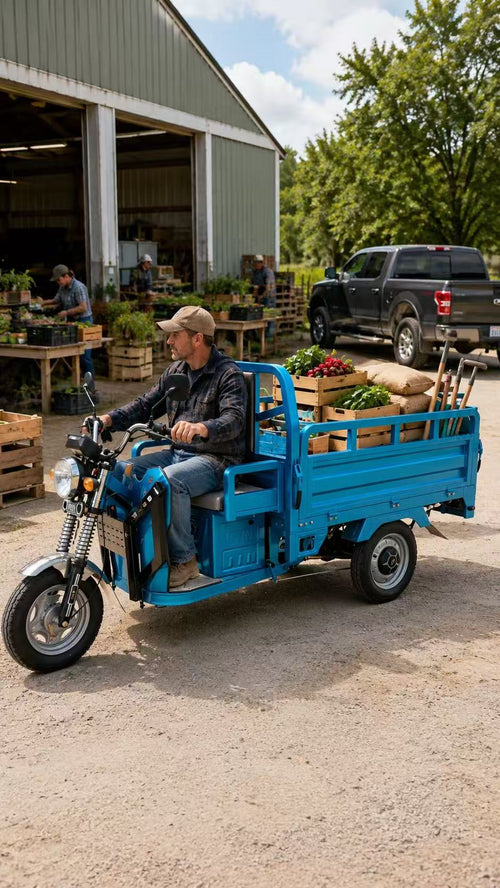
A farm may need to move feed bags, buckets, tools, fencing supplies, and harvest crates from one area to another.
A ranch may need to move small loads between a barn, a tack room, a storage area, and a livestock work zone.
A nursery may need to move trays, soil bags, tools, irrigation parts, and packaging materials.
A warehouse yard may need to move parts, small inventory, repair tools, and supplies between buildings.
A seafood or produce market may need to move crates, boxes, ice containers, packaging materials, or cleaning supplies across short distances.
These jobs are not always heavy enough to justify large equipment.
But they are repeated enough to create labor cost and fatigue.
That is the working space where low-speed electric transport equipment fits.
It supports the worker.
It reduces unnecessary carrying.
It keeps materials organized.
It helps move small and medium loads without using oversized equipment for every short trip.
Why Controlled Work Areas Matter
This equipment makes the most sense where the buyer controls the work area.
That may be a private farm route, a ranch yard, a greenhouse aisle, a nursery lane, a warehouse yard, a market loading area, or a private maintenance path.
A controlled work area gives the operator more predictable conditions.
The buyer usually knows:
where the equipment will be used
what route it will follow
what materials it will carry
where it will be loaded
where it will be unloaded
who will operate it
how often it will be used
This is very different from unpredictable public traffic.
In a controlled work area, the buyer can plan the route, avoid unnecessary hazards, choose firm ground, manage loading areas, and train workers on safe operation.
That is why the correct positioning is important.
This is low-speed electric work equipment for internal material movement.
It is not being sold as highway transportation.
How Buyers Should Judge This Equipment
A buyer should judge low-speed electric work equipment by work fit, not by road identity.
The most important buying questions are practical:
Is the main route short and repeated?
Is the work area private or controlled?
Are the materials suitable for the cargo bed?
Is the ground firm enough for regular operation?
Is the cargo usually hand-loaded or loose material?
Does the buyer need a standard cargo bed or a hydraulic dump bed?
Can the operator load and unload safely?
Is the work frequent enough to justify powered transport?
Is the equipment simple enough for daily use?
Can local repair support and standard compatible parts help long-term ownership?
These questions tell the buyer much more than road-style comparisons.
A buyer who needs public-road transportation should not treat this equipment as the answer.
A buyer who needs internal material movement may find it much more relevant.
Why Bigger Equipment Is Not Always Better
Many buyers already have access to larger equipment.
They may have a pickup, tractor, UTV, forklift, skid steer, or trailer.
But bigger equipment is not always the best tool for small repeated work.
A pickup may be too large for tight areas.
A tractor may be too slow to start for small errands.
A forklift may not fit the outdoor route.
A hand cart may be too tiring for repeated loads.
A wheelbarrow may be too slow when trips become frequent.
A larger machine may cost more to buy, fuel, maintain, store, or operate.
Low-speed electric transport work equipment sits in a different position.
It is not trying to be the strongest machine on the property.
It is designed to be a practical support tool for the small jobs that happen again and again.
This is an important difference.
The buyer should not ask whether it can replace every machine.
The buyer should ask whether it can reduce the number of small trips that waste time every day.
Where This Equipment Can Fit
This type of electric work equipment can fit many private-site operations, including:
small farms
ranches
horse stables
poultry farms
greenhouses
nurseries
orchards
produce markets
seafood markets
warehouse yards
maintenance properties
large private estates
campus service areas
construction support zones
The shared need is simple:
move materials across short distances without using oversized equipment every time.
That is the buyer problem.
The product should be judged against that problem.
Where Buyers Should Be Careful
This equipment is not the right fit for every situation.
Buyers should be careful if they need:
high-speed travel
long-distance transport
public-road commuting
heavy towing
deep mud operation
steep rough terrain
passenger transport
uncontrolled traffic environments
full-size equipment replacement
These are not the best use cases.
A good buying decision starts by saying what the equipment is not for.
That protects the buyer and creates a more realistic expectation.
If the work requires a road machine, highway machine, heavy-duty towing unit, or high-speed transportation option, the buyer should choose a different solution.
If the work requires low-speed internal material movement, this equipment may make more sense.
Why This Positioning Helps Buyers
Clear positioning reduces confusion.
If a buyer thinks this is a road product, they may compare it against the wrong options.
If a buyer understands it as low-speed electric work equipment, the buying decision becomes clearer.
The comparison changes from:
Can this replace a truck?
to:
Can this reduce repeated carrying and short-distance material movement?
The comparison changes from:
Can this handle road travel?
to:
Can this move supplies inside my worksite?
The comparison changes from:
Is this the biggest machine I can buy?
to:
Is this the right-size tool for repeated small jobs?
That is the correct way to think about it.
Why the Term “Work Equipment” Matters
Words matter.
If a product is described only as a vehicle, buyers may think about road use, transportation identity, and traffic rules.
If it is described as work equipment, buyers think about function.
That function is material movement.
A buyer does not buy a shovel because it is fast.
A buyer does not buy a pallet jack because it looks like a truck.
A buyer does not buy a utility cart because it can travel across town.
The buyer chooses the tool because it solves a specific work problem.
Low-speed electric transport equipment should be understood the same way.
Its value is not in public-road identity.
Its value is in helping people move materials more efficiently inside the work area they already control.
What OneClickChina Buyers Should Understand
OneClickChina positions this type of equipment for practical internal work.
The focus is:
short-distance material movement
low-speed work support
private-site use
controlled work areas
farm and ranch internal routes
warehouse and market movement
standard compatible parts when applicable
local repair coordination when available
factory-direct delivered pricing
This is not a luxury road product.
It is not a high-speed machine.
It is not meant to create confusion about public-road transportation.
It is a practical electric work tool for buyers who need help moving materials where the work happens.
Final Thought
Before buying low-speed electric work equipment, do not start with road thinking.
Start with the worksite.
Look at the daily route.
Look at the materials.
Look at the number of repeated trips.
Look at the loading and unloading points.
Look at whether workers are wasting time carrying, pushing, walking, or using oversized equipment for small jobs.
If the real problem is internal material movement, then low-speed electric transport work equipment may be a practical solution.
It should not be judged as a road product.
It should be judged as a work tool.
For many private-site buyers, that is the most accurate and useful way to understand it.