Is a Low-Cost Electric Farm Utility Trike a Smart Buy or a Risk?
Share
Some buyers see a low-cost electric farm utility trike and immediately become interested.
Other buyers see the same price and become suspicious.
That reaction is normal.
A lower delivered price can create a real question:
Is this a smart practical tool, or is it a risk?
That is the kind of question many farm, ranch, homestead, nursery, and private-property buyers should ask before buying any transport equipment.
The answer is not simple.
A low-cost electric farm utility trike can be a smart buy when the job is simple, repeated, low-speed, and inside a private or controlled work area.
It can also become a bad purchase if the buyer expects it to replace a full-size UTV, tractor, pickup truck, heavy construction machine, or public-road vehicle.
The real question is not whether low cost is good or bad.
The real question is whether the equipment fits the work.
Why Buyers Feel Suspicious About Low-Cost Electric Work Equipment
Many buyers are careful when they see a lower-priced electric work vehicle.
They may wonder:
Is the quality strong enough?
Will it handle real farm work?
What happens if something breaks?
Can local technicians understand it?
Are replacement parts available?
Is the price low because something important is missing?
Will it become expensive later?
These are fair questions.
A serious buyer should not ignore them.
Farm work can be hard on equipment. Loads can be heavier than expected. Routes can include gravel, grass, uneven ground, barn areas, storage yards, and repeated daily trips. A tool that looks good in a photo still has to fit the real working route.
That is why this article does not say every buyer should choose a low-cost electric farm utility trike.
Instead, it explains when this kind of equipment makes sense, when it does not, and what buyers should check before deciding.
Low Cost Does Not Automatically Mean Low Value
Many buyers connect low price with low value.
Sometimes that is correct.
A cheap tool that is used for the wrong job can fail quickly and become expensive.
But low cost does not always mean low value.
If the work itself is simple, the machine does not always need to be oversized, overbuilt, or overcomplicated.
For example, many small farms and private properties do not need high-speed travel for every task.
They do not need passenger seating for every trip.
They do not need towing for every daily job.
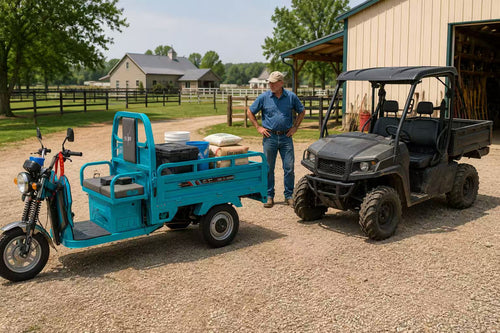
They do not need a full-size UTV to move a few feed bags, crates, tools, boxes, fencing supplies, nursery trays, or maintenance materials across short private routes.
In those situations, a lower-cost electric farm utility trike may deliver practical value because it solves the daily task without forcing the buyer to pay for capabilities they may rarely use.
This is the key idea.
The value is not in being the biggest machine.
The value is in being matched to the most repeated job.
Where a Low-Cost Electric Farm Utility Trike Makes Sense
A low-cost electric farm utility trike makes the most sense when the work is:
short-distance
low-speed
material-focused
repeated often
inside private property
inside a controlled work area
moderate in load
not dependent on public-road travel
not extreme off-road work
not heavy towing
not passenger transport
This may include many real daily tasks:
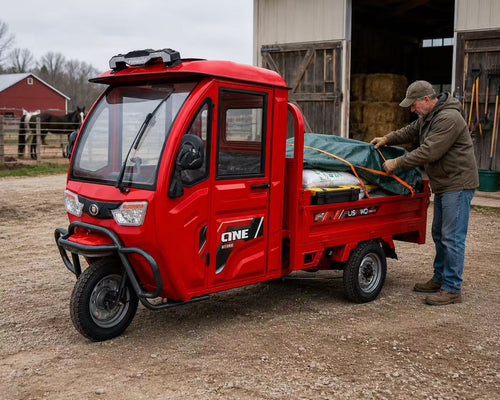
moving feed bags from storage to a barn
carrying hand tools to a repair area
moving produce crates to a packing table
transporting small farm supplies around a property
moving nursery trays, soil bags, and irrigation parts
carrying fencing supplies across a private route
moving cartons, buckets, and work materials between buildings
supporting daily greenhouse, orchard, homestead, and market-farm work
These are not dramatic jobs.
But they happen repeatedly.
And repeated work is where a practical cargo tool can become useful.
A compact electric utility trike does not need to win a comparison against a full-size UTV in every category. It only needs to solve the daily material movement problem better than hand carrying, a wheelbarrow, or using a larger machine for every small trip.
The Risk Starts When Buyers Expect Too Much
Most problems begin when the buyer expects the wrong job from the equipment.
A low-cost electric farm utility trike is not the right tool for every situation.
It should not be treated as a public-road vehicle.
It should not be treated as a high-speed UTV.
It should not be used like a tractor.
It should not replace a pickup truck for road travel.
It should not be used for extreme off-road riding.
It should not be overloaded just because the cargo bed looks useful.
It should not be expected to handle every heavy farm task.
If a buyer needs regular towing, rough terrain, high speed, long-distance property travel, passenger seating, or heavy-duty utility performance, a UTV may be a better choice.
If the buyer needs heavy construction work, a small electric trike is not the correct machine.
If the buyer needs public-road use, local laws must be checked before purchase.
The equipment becomes risky when the buyer tries to make it do work it was not designed to do.
That is not a low-price problem.
That is a job-matching problem.
The Most Important Question: What Is the Daily Route?
Before buying, the buyer should study the daily route.
Not the best route.
Not the easiest route.
The actual route.
Is it gravel?
Grass?
Packed dirt?
Concrete?
A barn lane?
A greenhouse path?
A private yard?
A market preparation area?
A warehouse yard?
How far does the route go?
How often does it repeat?
Are there slopes?
Are there tight turns?
Is the surface usually dry?
Does the route become muddy?
Are there gates, doors, or narrow work areas?
Can the operator drive slowly and safely?
A low-cost electric farm utility trike can be very useful on the right route.
But if the route is too rough, too steep, too unstable, or too demanding, the buyer should not pretend the price solves that problem.
The route must match the machine.
The Second Question: What Is the Real Load?
Many buyers look only at the cargo bed and imagine what they can fit inside.
That is not enough.
The important question is weight.
A cargo bed may have enough space for many items, but that does not mean every load is safe or reasonable.
Feed bags, soil bags, gravel, wet materials, compost, tools, fencing parts, boxes, and crates all add weight quickly.
The load should be moderate, balanced, and within the rated working capacity.
Buyers should avoid:
long-term overloading
stacking too high
uneven side loading
carrying unstable materials
loading more than the route can safely handle
driving too fast with a load
using the equipment on unsafe slopes
A low-cost electric farm utility trike is most useful when it reduces repeated small trips, not when it is abused as a heavy machine.
The smart use is not “carry everything at once.”
The smart use is “move a practical group of daily materials safely in fewer trips.”
The Third Question: Can Local Service Be Managed?
Service is one of the biggest concerns for buyers.
That concern is reasonable.
A buyer should think about maintenance before buying, not after something goes wrong.
The good news is that many electric transport work trikes are mechanically and electrically simpler than complex vehicles.
The core system is usually built around battery, controller, and motor. Around that are more familiar parts such as tires, brakes, lights, switches, wiring, connectors, bearings, frame, cargo bed, and basic hardware.
This does not mean every repair is easy.
It does not mean anyone can repair everything.
Battery, controller, motor, charger, and wiring work still require correct specifications and safe handling.
But it does mean the buyer should not automatically imagine the equipment as a complex car or full-size UTV.
Many basic inspections and repairs may be familiar to local technicians who work with electric bikes, electric scooters, electric trikes, golf carts, small electric equipment, farm equipment, or light mechanical systems.
A serious seller should help buyers identify the issue, confirm specifications, provide compatible part guidance, and support local repair coordination when needed.
This is where the after-sales system matters.
The buyer should ask:
Can I send photos and videos for diagnosis?
Can the seller help confirm part specifications?
Can common parts be matched locally when suitable?
Can a local technician handle basic inspection?
What warranty applies to the structure, motor, and battery?
What is not covered?
What should I avoid to protect the equipment?
These questions are more useful than simply asking, “Is it cheap?”
The real issue is support and fit.
The Fourth Question: Is the Delivered Price Really the Whole Story?
A delivered price is important because buyers want to understand the real entry cost.
OneClickChina product pages currently show different delivered price levels by model, including open cargo, canopy cargo, cab utility cargo, and hydraulic dump utility versions.
A lower delivered price can be attractive because it may reduce the first purchase barrier compared with many full-size UTVs or heavier utility machines.
But buyers should still look beyond the number.
They should understand:
what model they are buying
whether it is open, canopy, cab, or dump
what motor and battery option is selected
what cargo bed size fits the work
what load rating applies
what delivery time is expected
what warranty applies
what local laws may affect use
what type of route it will be used on
whether the buyer needs customization
A low delivered price is useful only when the buyer understands what the price includes and what the equipment is meant to do.
The price should not replace judgment.
It should support a clear buying decision.
When Low Cost Becomes a Smart Buy
A low-cost electric farm utility trike becomes a smart buy when the buyer has a clear use case.
For example:
A small farm needs to move feed, tools, and supplies every day.
A homestead needs a simple cargo tool for private property.
A nursery needs to move trays, soil bags, and irrigation parts.
A greenhouse needs short-distance movement between work zones.
A market farm needs help moving crates and supplies.
A property owner needs a small work vehicle for daily maintenance tasks.
A warehouse yard needs a low-speed cargo option for internal movement.
In these situations, the buyer is not trying to replace every large machine.
The buyer is solving a repeated daily problem.
That is where the value becomes easier to understand.
The equipment does not need to be perfect for every possible future job.
It needs to be useful for the work that happens most often.
When Low Cost Becomes a Bad Buy
The same equipment can become a bad buy if the buyer expects the wrong role.
It may be a bad choice if the buyer needs:
public-road driving
high-speed travel
passenger carrying
regular towing
extreme off-road use
deep mud performance
heavy construction hauling
large-scale ranch travel
continuous overloading
dealer-based UTV service expectations
a full replacement for a tractor, UTV, or pickup
In those cases, the lower price may be tempting, but the machine may not match the job.
That is why honest limits are important.
A good product page or buying guide should not pretend one machine fits every buyer.
The buyer should know where the equipment belongs and where it does not belong.
What a Careful Buyer Should Check Before Ordering
Before ordering a low-cost electric farm utility trike, a buyer should check several things.
First, check the route.
A good private route can make the machine useful. A bad route can make it frustrating.
Second, check the load.
The equipment should be used within its rated working capacity, with balanced and stable loads.
Third, check the use area.
This type of equipment is best for private farms, warehouses, logistics parks, private lots, work yards, and controlled areas. Public motor-road use requires checking local laws.
Fourth, check the model.
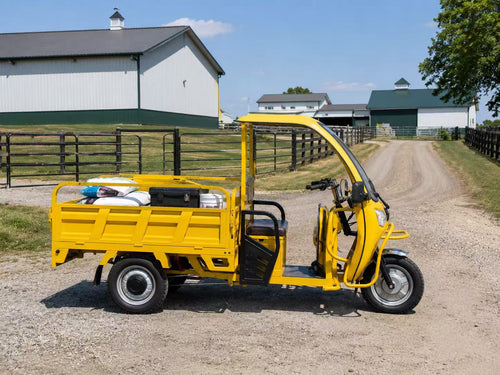
An open cargo model, canopy model, cab model, and hydraulic dump model are not the same. The buyer should choose based on weather, cargo type, comfort, dumping needs, and work pattern.
Fifth, check service expectations.
The buyer should understand warranty terms, replacement parts, local repair coordination, and what normal maintenance looks like.
Sixth, check whether the job is really simple enough.
If the job is simple, a lower-cost electric utility trike can make sense. If the job is demanding, a larger machine may be the better long-term choice.
This is how buyers reduce risk.
They do not reduce risk by buying blindly.
They reduce risk by matching the tool to the job.
The Real Debate Is Not Cheap vs Expensive
The real debate is not cheap versus expensive.
The real debate is fit versus mismatch.
An expensive machine can be a bad buy if it is oversized for daily work.
A low-cost machine can be a bad buy if it is used beyond its limits.
A low-cost machine can also be a smart buy if it solves the daily job at a reasonable delivered price.
That is why buyers should stop asking only:
Is it cheap?
They should ask:
Is the job simple enough for this equipment?
Is the route suitable?
Is the load reasonable?
Is the use area private or controlled?
Do I understand the limits?
Can I manage service locally if needed?
Will this tool be used often?
If the answer is yes, then a low-cost electric farm utility trike may be a practical and smart purchase.
If the answer is no, the buyer should choose a different machine.
Final Thought
A low-cost electric farm utility trike is neither automatically a smart buy nor automatically a risk.
It depends on the work.
For private-site, low-speed, short-distance movement of feed, tools, crates, boxes, supplies, and farm materials, it can be a practical daily work tool.
For public-road driving, heavy towing, extreme terrain, high-speed travel, or full UTV replacement, it is not the right machine.
That honest difference is what buyers should understand before ordering.
The smartest purchase is not always the most expensive machine.
It is not always the cheapest machine either.
The smartest purchase is the tool that fits the daily job.