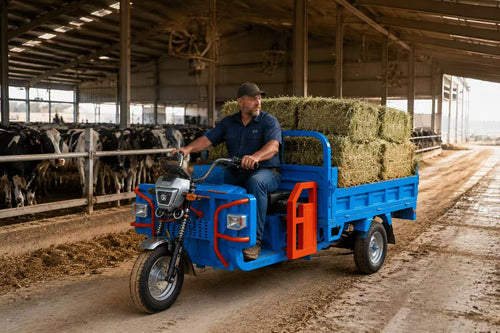
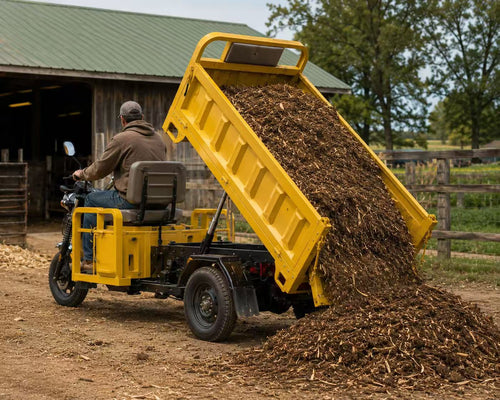
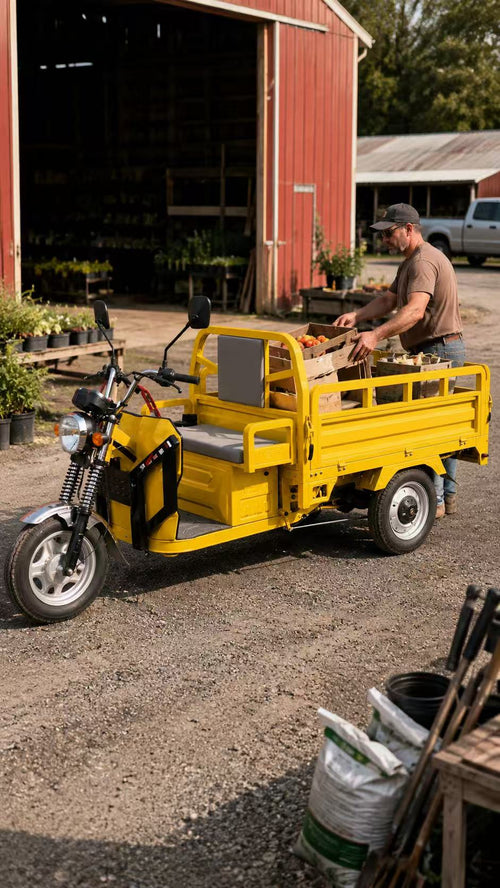
Electric Cargo Tricycle for Wholesale Markets: Material Handling Guide
Share
Wholesale markets depend on fast, repeated movement of produce, seafood, packaged foods, supplies, tools, and other goods between receiving areas, storage zones, cold rooms, vendor spaces, and loading docks. These trips are often too short for conventional trucks but too frequent and demanding for manual carts. An electric cargo tricycle provides a compact powered option for this type of daily material flow.
Unlike a consumer electric tricycle designed mainly for personal transportation, a commercial cargo tricycle is built around work. A rear cargo bed or platform, electric drive system, practical payload capacity, and compact three-wheel layout allow workers to move goods repeatedly without relying entirely on manual handling.
For wholesale market operators, the objective is not simply to replace one vehicle with another. The goal is to reduce unnecessary walking, manual pushing, repeated loading effort, and delays between different parts of the market.
Why Electric Cargo Tricycles Fit Wholesale Market Work
A wholesale market may handle hundreds of short internal trips during a working day. Products arrive at receiving areas, move into temporary or refrigerated storage, return to staging areas, and eventually travel to vendor stalls or loading docks.
For these operations, an electric cargo trike can perform many of the jobs buyers may otherwise associate with an electric utility cart or larger electric utility vehicle, while using a more compact footprint.
This is especially useful where:
• travel distances are short but repeated frequently;
• aisles and working areas have limited maneuvering space;
• workers regularly move boxes, crates, tools, supplies, or produce;
• internal transportation must operate around pedestrians and other equipment;
• a full-size truck or larger utility vehicle is unnecessary for every movement.
The three-wheel configuration also gives the vehicle a different operating profile from a conventional four-wheel utility vehicle. It is intended primarily for practical short-distance cargo movement rather than recreational driving or high-speed transportation.
From Cold Room to Loading Dock
One of the most demanding material-flow routes in a wholesale market is the movement between cold rooms, staging areas, and loading docks.
Cold-chain products such as vegetables, fruit, seafood, meat, dairy products, and other temperature-sensitive goods may need to be transferred repeatedly in relatively small batches. Using workers with hand carts for every trip increases physical effort and can slow the movement of goods during busy receiving and shipping periods.
A powered vehicle can create a more consistent workflow:
Cold room → staging area → sorting or vendor area → loading dock.
An electric warehouse cart may solve some of these tasks, particularly on smooth indoor floors. A motorized utility cart can also reduce manual pushing. However, where workers need a ride-on vehicle with a dedicated cargo bed and frequent movement between several market zones, an electric cargo tricycle can provide a useful alternative.
The important consideration is not the name of the equipment but whether its size, payload, cargo-bed dimensions, turning requirements, and operating range match the actual workflow.
Warehouse and Internal Material Movement
Wholesale markets often combine characteristics of warehouses, distribution facilities, retail spaces, and loading areas. That means one vehicle may encounter narrow passages, storage racks, pallets, stacked cartons, pedestrians, ramps, and outdoor service areas during the same shift.
For this reason, vehicle selection should begin with the movement of materials rather than maximum speed.
An electric utility cart or electric warehouse cart may be appropriate for lighter loads and simple routes. An electric burden carrier is another established material-handling solution in industrial facilities. For operations that require a cargo bed together with a compact ride-on platform, the electric cargo tricycle occupies a useful position between small powered carts and larger utility vehicles.
Its strongest use case is repeated point-to-point hauling: moving products, packaging materials, maintenance supplies, tools, waste, or other working loads from one operational zone to another.
Cargo Capacity, Power and Daily Workload
Payload requirements should be based on the heaviest realistic working load, not the average trip.
A vehicle that normally carries light cartons may occasionally need to transport dense produce, equipment, bulk supplies, or other heavier materials. Buyers should therefore consider cargo-bed dimensions and weight capacity together.
Motor power and battery capacity also need to reflect the operating environment. Frequent starts, heavier payloads, longer shifts, ramps, and repeated trips can require more energy than occasional light-duty movement.
For lighter wholesale-market transportation, a compact configuration may be sufficient. Higher-capacity systems are more appropriate when the vehicle will carry heavier loads or operate continuously throughout the working day.
This is where terms such as powered utility cart, battery powered utility cart, electric utility wagon, and heavy duty electric trike describe different parts of the same buyer problem: replacing repetitive manual hauling with appropriately sized powered equipment.
However, these equipment categories are not identical. A buyer should compare the actual vehicle structure and specifications rather than selecting equipment solely because two products appear under similar search terms.
Electric Cargo Tricycle vs. Manual and Larger Utility Equipment
Manual platform carts remain useful for very short movements, light loads, and operations where powered equipment is unnecessary. Their advantages include simplicity and low maintenance.
The limitation appears when workers must repeat the same loaded route many times. Physical effort accumulates, travel becomes slower, and productivity depends increasingly on the person pushing the cart.
At the opposite end, a larger electric utility vehicle can provide greater seating capacity, larger payload options, towing capability, or specialized configurations. These vehicles make sense when the work genuinely requires those capabilities.
An electric cargo tricycle fills the space between these two approaches.
It can provide powered cargo movement without requiring the footprint of a larger utility vehicle. This makes it particularly relevant to wholesale markets, warehouses, commercial facilities, agricultural distribution areas, and other locations where maneuverability and short-distance hauling are more important than road speed.
Choosing the Right Electric Cargo Tricycle for a Wholesale Market
Before selecting a vehicle, operators should map the actual route it will travel.
Start with these questions:
What is being transported?
Record typical goods as well as the heaviest expected load. Boxes of vegetables, seafood containers, packaging supplies, tools, equipment, and bulk materials place different demands on the cargo bed.
How far does each trip travel?
A short route repeated dozens of times can consume substantial battery capacity. Daily operating distance matters more than the distance of a single trip.
How wide are the narrowest working areas?
Measure doors, aisles, cold-room entrances, loading zones, and turning areas. Overall vehicle dimensions should be checked before purchase.
Does the route include slopes or ramps?
Payload combined with grade can materially change power requirements. Buyers should evaluate the complete working route rather than motor wattage alone.
How frequently will the vehicle operate?
Occasional transportation and continuous commercial operation are different duty cycles. Battery capacity, charging strategy, braking, tires, suspension, and overall vehicle construction should reflect actual usage.
Is a fixed cargo bed sufficient?
For cartons, produce crates, tools, and packaged goods, a standard cargo bed may be appropriate. Operations handling loose bulk materials may benefit from an electric dump cart or a vehicle equipped with a dumping cargo bed.
A Workflow-Based Buying Decision
The best vehicle is not necessarily the one with the highest motor rating or largest payload specification. Oversized equipment can create maneuverability problems, while undersized equipment may be overloaded or require too many trips.
A better purchasing process is:
1. Map the route.
2. Measure the narrowest access points.
3. Estimate normal and maximum payload.
4. Calculate expected daily trips.
5. Identify indoor and outdoor operating surfaces.
6. Check ramps and grades.
7. Determine required cargo-bed style.
8. Match motor, battery, brakes, tires, and suspension to the workload.
This workflow-based approach helps a wholesale business distinguish between an electric cargo tricycle, electric utility cart, electric warehouse cart, larger electric utility vehicle, and other powered material-handling equipment.
Frequently Asked Questions
Is an electric cargo tricycle the same as an electric cargo bike?
No. The term can appear across several product types. Commercial cargo tricycles may use heavier frames, larger cargo beds, higher payload capacities, and power systems designed for working applications. Buyers should evaluate specifications and intended use rather than relying only on the product name.
Can an electric cargo tricycle be used inside a warehouse or wholesale market?
It can be suitable for private commercial facilities when its dimensions, operating characteristics, ventilation requirements, floor conditions, and site rules are appropriate. Operators should confirm that the vehicle fits the specific facility and workflow.
Why use an electric cargo tricycle instead of a manual cart?
The main advantage is powered movement during repeated hauling. This can reduce manual pushing and make frequent point-to-point transportation more efficient, particularly when loads become heavier or routes become longer.
When is a larger electric utility vehicle a better choice?
A larger vehicle may be preferable when an operation requires multiple passengers, substantially greater payload, towing, specialized attachments, or other capabilities beyond compact cargo transportation.
What should a buyer check before ordering?
Payload, cargo-bed size, overall dimensions, motor power, battery capacity, expected range, braking, tires, grade requirements, charging conditions, operating environment, replacement parts, and after-sales support should all be considered.
Building a More Efficient Wholesale Market Material Flow
Electric cargo tricycles are not intended to replace every forklift, pallet jack, utility cart, or larger work vehicle in a wholesale operation. Their value comes from solving a specific gap: frequent short-distance movement of goods where manual carts create unnecessary labor and larger vehicles are more equipment than the task requires.
For produce markets, seafood markets, agricultural wholesale facilities, warehouses, and commercial distribution environments, the right electric cargo tricycle can connect receiving, storage, cold-room, staging, vendor, and loading-dock operations into a more efficient material-handling workflow.
The purchasing decision should therefore begin with the workflow itself. When payload, dimensions, power, battery capacity, cargo configuration, and operating environment are matched to real daily tasks, a compact electric cargo tricycle can become a practical part of a broader commercial material-handling system.