Cargo Bed First: Choose a Farm Work Vehicle by Load Type, Not Vehicle Category
Share
Cargo Bed First: Choose a Farm Work Vehicle by Load Type, Not Vehicle Category
Many buyers start the wrong way when choosing a small farm work vehicle.
They begin with the vehicle category.
Should I buy a UTV?
Should I buy a golf cart?
Should I buy a pickup truck?
Should I buy an electric cargo trike?
Those are useful questions, but they may not be the best first question.
For daily farm, ranch, nursery, greenhouse, warehouse, market, campus, and property work, the better first question is simpler:
What do you move every day?
The answer to that question often tells you more than the vehicle name.
Vehicle Category Can Be Misleading
A UTV, golf cart, pickup truck, wheelbarrow, hand cart, and electric cargo trike can all move something.
But they are not designed around the same job.
A golf cart is mainly designed to move people.
A pickup truck is designed for road use and larger transport jobs.
A UTV is designed for off-road utility, passengers, towing, rough terrain, and larger property movement.
A wheelbarrow or hand cart is simple, but it depends on human labor.
An electric cargo trike is different. It is a compact work tool built around short-distance cargo movement.
If the buyer only looks at the vehicle category, they may miss the real issue:
Does the cargo area match the daily load?
That is why the cargo bed should come first.
Start With the Daily Load
Before comparing brands, prices, or vehicle types, list what you actually move most often.
Do you move feed bags?
Toolboxes?
Buckets?
Nursery trays?
Small boxes?
Repair parts?
Cleaning supplies?
Fence hardware?
Mulch bags?
Fertilizer bags?
Compost?
Soil?
Manure?
Wood chips?
Different materials need different vehicle layouts.
A buyer moving boxed supplies may need a flat cargo bed.
A buyer moving loose material may need a hydraulic dump bed.
A buyer moving people may need passenger seats.
A buyer towing equipment may need a UTV or tractor.
The right vehicle depends on the load first, not the category name.
If You Move Bags, Boxes, Tools, and Trays
For many small farms and properties, daily work does not involve extreme terrain or heavy towing.
It involves moving practical materials.
Feed bags from storage to the barn.
Toolboxes from the shed to the repair area.
Buckets from one work zone to another.
Nursery trays between growing areas.
Small boxes from storage to a market setup.
Cleaning supplies around a campus or property.
Repair parts from a maintenance room to the job site.
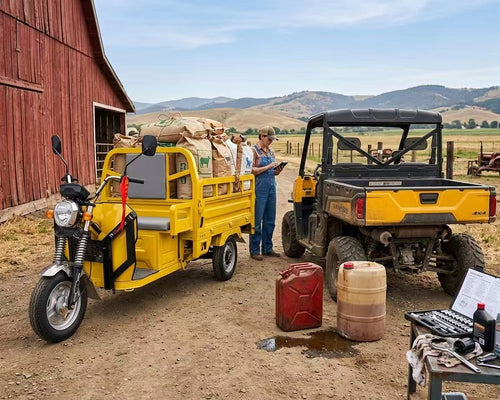
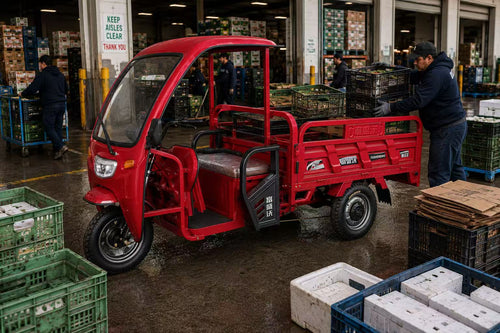
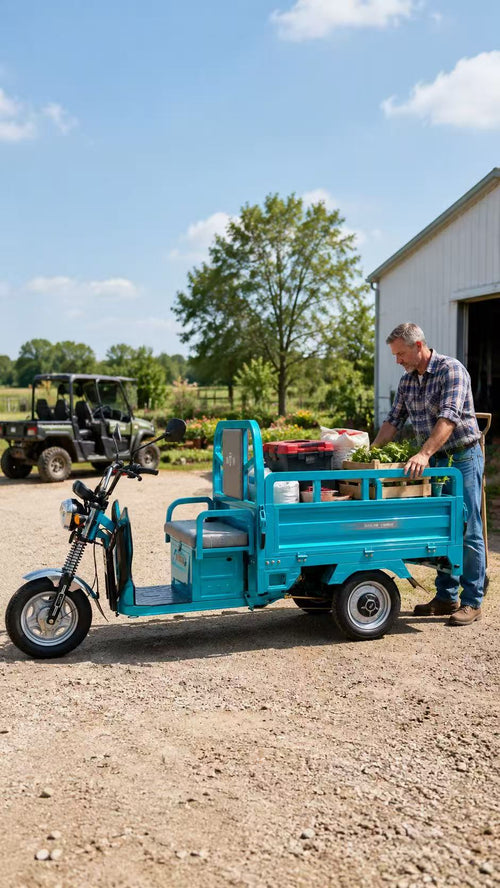
For this kind of work, an open flat-bed electric cargo trike can be a practical choice.
The cargo bed is the main feature.
It gives the worker a simple place to load materials, keep items organized, and move them over short routes without repeated walking or manual carrying.
If the load is already in bags, boxes, crates, trays, or buckets, a flat-bed cargo trike may be enough.
The buyer may not need a full-size UTV just to move daily supplies around a controlled work area.
If You Move Loose Materials
Some work is different.
Loose materials are harder to unload by hand.
Soil, compost, manure, mulch, wood chips, wet material, gravel, and cleanup debris often need a dump bed.
For those jobs, a hydraulic dump utility vehicle may be more useful than a flat-bed cargo trike.
The key question is not whether the vehicle is called a UTV or a trike.
The key question is whether the cargo bed can unload the material efficiently.
If the worker must shovel or lift every load by hand, the vehicle may still leave too much labor in the job.
For loose materials, dump function matters.
For bagged and boxed materials, flat-bed cargo space may matter more.
This is why load type should guide the vehicle choice.
If You Move People More Than Materials
Some buyers need to move people first.
A golf cart or UTV may be the better choice if the main task is moving workers, visitors, family members, or staff around a property.
Passenger seating matters when people are the main load.
A cargo trike is not designed to replace a passenger vehicle.
It is designed for work materials.
If your daily job is mainly transporting people, a cargo-first vehicle may not be the best match.
If your daily job is moving materials, tools, bags, trays, buckets, and supplies, passenger seating may be less important than the cargo bed.
If You Need Towing, 4x4, and Rough Terrain
Some jobs require more than cargo space.
If you need towing, 4x4 traction, steep terrain performance, deep mud capability, high ground clearance, long-distance property movement, or multiple passengers, a full-size UTV may be the right choice.
That is a different buying logic.
In that situation, the buyer is paying for a larger vehicle platform, power, suspension, traction, towing ability, and rough-terrain performance.
Those features can be valuable when the work requires them.
But if the daily job is short-distance hauling on gravel, firm dirt, paved yards, greenhouse aisles, barn areas, market spaces, or property paths, the buyer may not need that much machine.
The cargo bed and work route may matter more than the category label.
If You Need Short-Distance Cargo Movement
OneClickChina focuses on short-distance work vehicles.
That means the vehicle is not trying to be a highway truck, a recreational UTV, or a heavy towing machine.
It is built for daily material movement.
For many small farms, ranch homes, nurseries, greenhouses, warehouses, wholesale markets, campuses, and private worksites, the work pattern is simple:
load materials
move a short distance
unload near the work area
repeat when needed
That work pattern does not always need speed, luxury, or complex off-road systems.
It needs a practical cargo bed, simple operation, lower upfront cost, and enough working capacity for the real job.
That is where an electric cargo trike can make sense.
Flat Bed, Dump Bed, Canopy, or Cab?
After you understand the load type, the vehicle choice becomes easier.
If you move bags, boxes, tools, buckets, nursery trays, and maintenance supplies, a flat-bed electric cargo trike may be the best starting point.
If you move loose materials such as soil, compost, manure, mulch, wood chips, gravel, or cleanup debris, a hydraulic dump utility vehicle may be a better fit.
If you work outdoors under strong sun or light rain and still mainly need cargo movement, a canopy utility cargo vehicle may make sense.
If the operator needs stronger weather protection, a cab utility cargo vehicle may be the better choice.
This is a better way to choose.
Do not start with the vehicle name.
Start with the load, the route, and the daily work.
Cost-Effectiveness Comes From Matching the Load
Many buyers think cost-effectiveness means simply buying the cheapest vehicle.
That is not enough.
A low-price vehicle is not a good value if it does not match the job.
A high-price vehicle may also be poor value if the buyer pays for features that are rarely used.
True cost-effectiveness comes from matching the vehicle to the load.
If you do not need passenger seats, high speed, 4x4, towing, and rough-terrain performance, you may not need to pay for those features.
If your main need is daily cargo movement, the cargo bed should be the center of the decision.
For many small farms and properties, a compact electric cargo trike can provide enough working function at a much lower upfront cost than a full-size utility vehicle.
That is the practical value.
Simple Electric Service Logic
Service is also part of choosing a work vehicle.
A simple electric cargo trike has a different service logic than a gas-powered UTV or road vehicle.
The main systems are the battery, motor, controller, frame, wheels, brakes, cargo bed, wiring, and normal wear parts.
There is no engine oil to change.
There is no gas engine to maintain.
There is no fuel system to service.
That does not mean the vehicle never needs care. Tires, brakes, wiring, switches, batteries, and wear parts still need attention over time.
But the structure is easier to understand.
For buyers who want a practical work tool, that simplicity matters.
Local Repair Coordination Support
OneClickChina also understands that after-sales support matters when buying a work vehicle online.
The support model is practical and local.
When service is needed, we first ask the buyer to recommend a reputable local farm machinery repair technician, motor and electrical repair technician, small equipment repair shop, or independent electric vehicle repair shop near them.
If the buyer does not have a preferred technician, OneClickChina can help search nearby repair options through Google Maps and coordinate support using photos, videos, parts guidance, and remote communication.
The goal is simple:
help the customer solve service needs locally and reduce worry after purchase.
For a simple electric work vehicle, local repair coordination can be a realistic and useful support method.
Do Not Buy by Vehicle Name Alone
A vehicle name can create expectations.
UTV sounds powerful.
Golf cart sounds familiar.
Pickup truck sounds dependable.
Electric cargo trike may sound small to some buyers at first.
But the name does not decide the value.
The daily job decides the value.
If a vehicle matches the load, route, work speed, budget, and service needs, it can be the right tool.
If it does not match those things, even a larger or more expensive vehicle may not be the best choice.
Final Decision
Before choosing a farm work vehicle, look at the cargo bed first.
If you move people, choose a vehicle built for passengers.
If you tow heavy loads or cross rough terrain, consider a full-size UTV.
If you move loose materials, consider a hydraulic dump vehicle.
If you move bags, boxes, tools, buckets, nursery trays, repair parts, and daily supplies over short distances, a flat-bed electric cargo trike may be a practical and cost-effective choice.
Do not choose only by vehicle category.
Choose by what you move every day.