Farm Utility Vehicle Guide: Do You Really Need a $20,000 UTV for Farm Hauling?
Share
Choosing a farm utility vehicle is often treated as a simple question: Which UTV should I buy?
For many small farms, nurseries, orchards, greenhouses, ranch properties, and rural businesses, that is actually the wrong place to start.
The better question is: How much vehicle do you really need for the work you do every day?
A traditional farm UTV can be an excellent machine. Four-wheel drive, high ground clearance, towing capacity, passenger seating, suspension, and all-terrain capability make UTVs useful for large properties and difficult ground. But those capabilities come with a price. Many well-equipped utility vehicles used for farm work can cost well over $10,000, with premium models reaching $20,000 or considerably more.
If your daily work mainly involves moving feed, tools, fertilizer, harvested produce, plants, fencing materials, garbage, or other cargo over relatively short distances, paying for every capability of a full-size UTV may not always make economic sense.
That is where a compact electric farm utility vehicle or cargo trike deserves consideration.
The goal is not to argue that an electric cargo trike can replace every UTV. It cannot. The goal is to match the machine to the job instead of automatically buying the largest and most expensive vehicle.
What Does a Farm Utility Vehicle Actually Need to Do?
Google results for “farm utility vehicle” are dominated by UTVs and side-by-sides. That reflects how the category has traditionally been defined. Farmers commonly use these machines for hauling, towing, checking fields, traveling over rough acreage, transporting workers, and handling daily chores.
But “farm work” covers very different operating conditions.
A rancher crossing muddy pasture while towing a trailer has very different requirements from a greenhouse operator moving trays and fertilizer. An orchard worker traveling narrow rows does not necessarily need the same machine as someone crossing steep, rocky acreage.
Before comparing vehicles, separate your work into several basic requirements:
• How much cargo do you normally carry?
• How far do you travel on each trip?
• Do you need to tow heavy trailers?
• Do you regularly travel through deep mud or rough terrain?
• Do you need 4WD?
• How many people must the vehicle carry?
• Do you need a dump bed?
• How narrow are your gates, rows, barns, or greenhouse aisles?
• How much does downtime and routine maintenance matter?
• How much are you willing to spend for capabilities you may use only occasionally?
These questions often reveal whether you need a conventional UTV or simply a practical utility vehicle for farm hauling.
When a Traditional Farm UTV Makes Sense
A full-size UTV remains the better choice when the work genuinely requires its capabilities.
If your property has steep hills, deep mud, snow, rocky trails, or badly rutted ground, four-wheel drive and greater ground clearance can be important. The same applies when you regularly tow substantial trailers, carry several workers, or travel long distances across large acreage.
A UTV may be worth the higher purchase price when you regularly need:
• 4WD traction on difficult terrain
• substantial towing capacity
• high ground clearance
• two or more passenger seats
• long-distance travel across large properties
• heavy-duty suspension
• extensive accessories or implements
In these conditions, buying a cheaper vehicle that cannot perform the work would be false economy.
But many small-farm chores fall outside that category.
The Small-Farm Transportation Gap
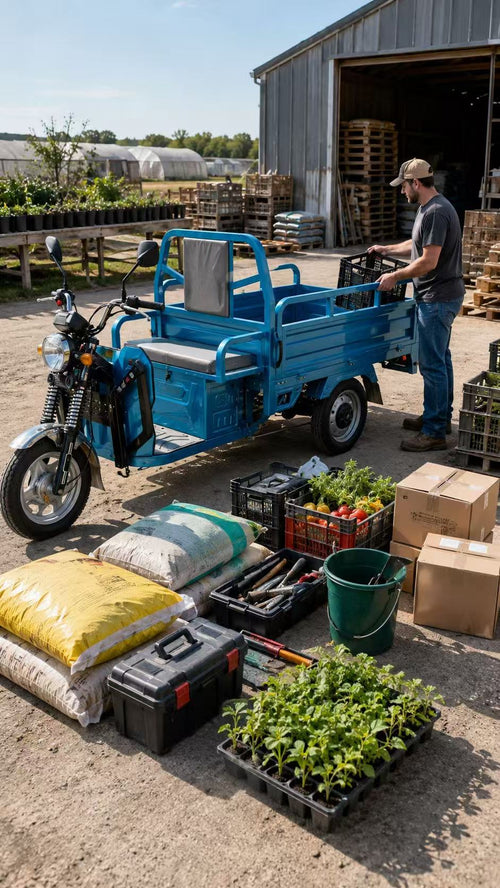
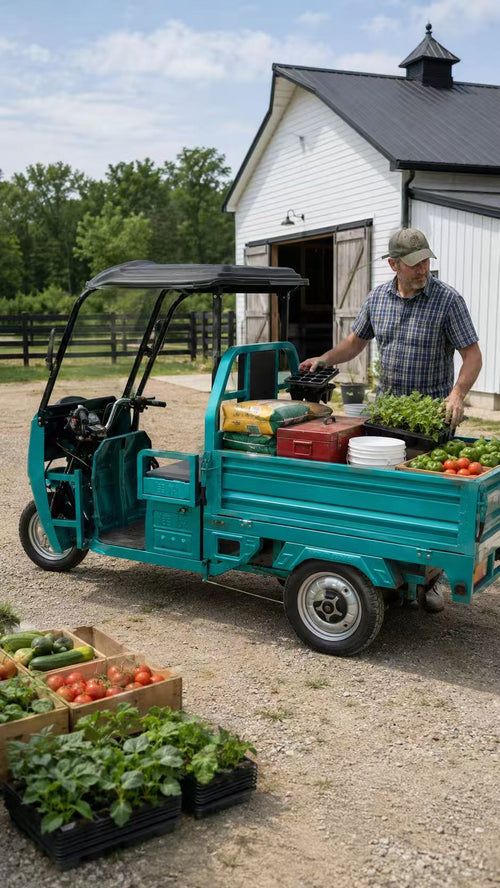
Consider a small farm, nursery, greenhouse, orchard, homestead, or produce operation where most trips involve carrying a few hundred pounds of materials from one part of the property to another.
Workers may move:
feed bags,
hand tools,
seed and fertilizer,
harvested vegetables,
fruit crates,
plants and nursery supplies,
fencing materials,
irrigation components,
soil or mulch,
animal supplies,
and general farm waste.
A pickup truck may be unnecessarily large for these jobs. A wheelbarrow or hand cart requires too much labor. A full-size UTV works well, but its purchase price may be difficult to justify if most trips are short and relatively light.
This creates a transportation gap between manual equipment and expensive conventional utility vehicles.
A compact electric cargo trike can fit directly into that gap.
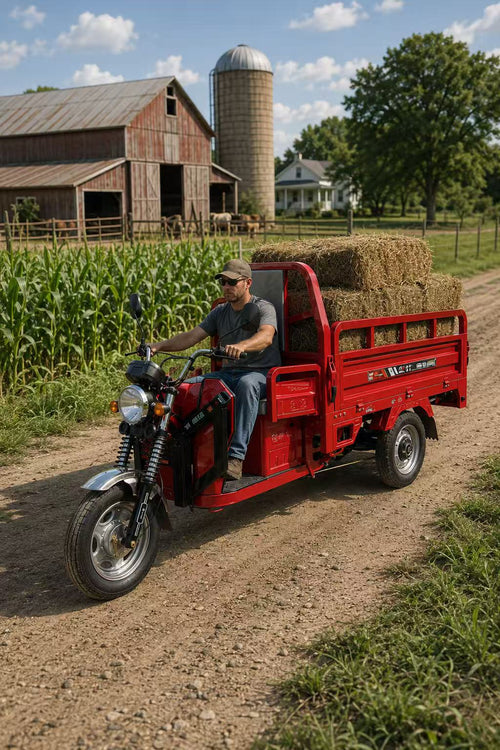
Instead of competing with a UTV at everything, it focuses on a narrower set of jobs: carrying material efficiently, making frequent short trips, operating in confined spaces, and reducing the labor involved in routine hauling.
$20,000 UTV vs $3,000 Electric Cargo Trike: What Are You Paying For?
The biggest mistake is comparing these vehicles only by horsepower, speed, towing capacity, or drivetrain.
They are built around different priorities.
A conventional farm UTV is designed to combine transportation, off-road mobility, towing, cargo capacity, and passenger capability in one machine. A compact electric cargo trike is primarily a working transport platform.
That distinction matters.
If a $15,000–$30,000 UTV spends most of its working life carrying tools, feed, produce, or waste between nearby locations, much of its capability may remain unused.
For a smaller operation, the purchase decision should therefore be based on cost per useful task rather than simply on which machine has the highest specifications.
For example, imagine that most daily trips are between a barn, greenhouse, storage area, packing shed, livestock area, or field entrance. The distance may be short, the speed requirement low, and the main purpose simply to move cargo.
In that environment, an electric utility vehicle can provide several practical advantages.
Lower Purchase Cost
A compact electric cargo trike can cost only a fraction of a premium farm UTV.
The savings can be significant for small farms where capital must also cover equipment, seed, fertilizer, irrigation, labor, buildings, and other operating expenses.
Lower Routine Operating Complexity
Electric drivetrains have fewer routine service items than gasoline or diesel engines. There is no engine oil to change, no fuel system to maintain, and no exhaust system.
That does not mean electric vehicles require no maintenance. Tires, brakes, bearings, suspension components, electrical systems, and batteries still require inspection and service.
But for frequent low-speed utility work, mechanical simplicity can be valuable.
Quiet Operation
Noise matters more in agriculture than it may initially appear.
An electric farm utility vehicle can operate around livestock, greenhouses, nurseries, residential properties, and workers without continuous engine noise.
For farms that begin work early in the morning or operate close to neighboring properties, quieter transportation can also be useful.
Compact Dimensions
Large UTVs are designed for capability, but their width can become a disadvantage in tight working environments.
A smaller cargo vehicle may be easier to use through narrow gates, between greenhouse structures, around barns, through nursery aisles, and along constrained service paths.
For some operations, maneuverability is more useful every day than maximum off-road capability.
Cargo Bed and Dumping Capability
For farm hauling, cargo-bed design can matter more than top speed.
A practical utility vehicle should make it easy to load feed, tools, produce, soil, fertilizer, waste, or other materials.
A hydraulic dump bed can further reduce manual unloading when transporting loose materials. Instead of shoveling the entire load out by hand, the operator can raise the bed and discharge suitable material directly.
This can be especially useful for repeated hauling jobs involving soil, mulch, animal waste, debris, feed, or similar materials.
Where an Electric Cargo Trike Is Not the Right Choice
A useful comparison also needs clear limitations.
A three-wheel electric utility vehicle should not be presented as a universal substitute for a 4x4 UTV.
Choose a conventional UTV when you regularly need heavy trailer towing, deep-mud capability, high ground clearance, aggressive off-road travel, multiple passenger seating, high-speed property travel, or demanding all-weather terrain performance.
Likewise, buyers should evaluate slope, surface condition, payload, braking requirements, battery range, charging access, and local operating conditions before selecting any electric farm vehicle.
The correct machine is the one that safely matches the actual workload.
A Better Way to Choose a Small Farm Utility Vehicle
Instead of beginning with a brand or vehicle category, begin with your most common daily task.
If 80 percent of your work involves moving cargo over short distances, prioritize payload, bed size, dumping ability, maneuverability, charging convenience, and operating cost.
If 80 percent involves crossing difficult terrain and towing equipment, prioritize traction, ground clearance, suspension, and towing capacity.
If your workload is mixed, calculate how frequently you genuinely need the expensive capabilities of a UTV.
Some farms may even benefit from using different machines for different jobs rather than forcing one expensive vehicle to perform everything.
For example, a full-size UTV could remain available for difficult terrain and towing, while a lower-cost electric cargo vehicle handles repetitive daily transportation. This can also reduce unnecessary hours and wear on the more expensive machine.
Questions to Ask Before Buying
Before searching for farm utility vehicles for sale, write down your real operating requirements.
What is the heaviest normal load?
Do not base the decision on the heaviest load you might move once a year. Focus first on routine work.
How far is a normal daily trip?
Short, repeated trips favor a different vehicle design from long-distance property travel.
What terrain do you actually use?
Packed farm roads, concrete, gravel, greenhouse floors, orchard lanes, and relatively level paths do not create the same requirements as deep mud, steep slopes, rocks, or snow.
Do you need towing or mainly hauling?
This distinction alone can substantially change the best vehicle choice.
Do you need passenger capacity?
If the machine usually carries only one operator and cargo, paying for additional seating may offer little benefit.
Would a dump bed save labor?
For operations repeatedly unloading bulk material, this can be more important than speed or horsepower.
What is the total cost of ownership?
Purchase price is only the beginning. Consider energy or fuel, routine service, replacement parts, maintenance time, and the value of the labor the vehicle can save.
The Best Farm Utility Vehicle Is Not Always the Biggest One
There is no single best farm utility vehicle for every farm.
A powerful 4x4 UTV is the correct investment when its towing capacity, terrain capability, passenger space, and durability are regularly required.
But a small farm should not automatically spend $15,000, $20,000, or more simply because UTVs dominate the farm utility vehicle category.
For short-distance hauling on suitable surfaces, a compact electric cargo trike may accomplish the everyday job at a much lower acquisition cost.
The important comparison is therefore not:
“Which vehicle has the most features?”
It is:
“Which vehicle gives me the capabilities I will actually use?”
For many small farms, nurseries, orchards, greenhouses, homesteads, and agricultural businesses, answering that question carefully can prevent both underbuying and overbuying.
A farm utility vehicle is ultimately a working tool. Its value should be measured by how effectively it moves people or materials, reduces labor, fits the property, and performs the jobs that occur every day.
Before paying for maximum capability, define the work first.
You may discover that you need a serious 4x4 UTV.
Or you may discover that what your farm really needs is a simpler, compact electric hauling vehicle.