Do You Really Need a 4×4 UTV for Short Farm Cargo Routes?
Share
Many farm buyers begin with the same assumption:
If a vehicle will be used on a farm, it should have four-wheel drive.
That sounds reasonable.
Farms can have mud, slopes, snow, rough ground, ruts, grass, gravel, and uneven paths.
A 4×4 UTV can provide important traction and off-road capability.
For some properties, that capability is necessary.
But not every farm route is an off-road route.
Many daily jobs happen on:
firm gravel lanes
concrete yards
compacted soil
barn access roads
nursery paths
warehouse yards
greenhouse service lanes
private property roads
If the daily work is short, low-speed, and focused on moving cargo between nearby work areas, the buyer may not need to pay for a full 4×4 UTV.
The better question is not:
Does the vehicle have four-wheel drive?
The better question is:
Does my real route require four-wheel drive?
That difference can change the entire buying decision.
Why Buyers Automatically Think 4×4
Four-wheel drive has become closely connected with farm and utility vehicles.
Buyers see 4×4 UTVs used for:
mud
hills
snow
hunting
trail riding
towing
pasture work
forest access
rough property maintenance
These machines are useful because they can handle conditions that simpler vehicles cannot.
A buyer may also worry about getting stuck.
That concern is understandable.
No one wants to buy a machine that cannot reach the work area.
But some buyers purchase off-road capability for a route that is already firm, short, and controlled.
They may spend more money on:
four-wheel-drive systems
larger tires
heavy suspension
higher ground clearance
more power
more vehicle weight
features they rarely use
The machine may be capable of crossing difficult terrain, but the normal job may only involve moving feed bags, tools, boxes, crates, or nursery supplies across a maintained property.
That is why the route should be studied before the vehicle is chosen.
A Short Farm Route Is Not the Same as a Trail
A farm can contain many types of ground.
The back pasture may be soft.
The wooded area may be rough.
A field edge may become muddy.
But the daily cargo route may still be simple.
The buyer may only travel:
from the barn to the feed storage area
from the workshop to a fence line
from the greenhouse to a packing table
from the warehouse to an outdoor loading area
from a nursery shed to plant rows
from a garage to a maintenance zone
These routes may be only a few hundred feet long.
They may already have gravel, concrete, compacted soil, or firm grass.
In those conditions, a 4×4 system may provide little practical benefit during normal work.
The buyer should separate the hardest part of the property from the route used every day.
Do not buy only for the worst patch of ground if the vehicle will rarely go there.
What a 4×4 UTV Does Well
A 4×4 UTV can be the right machine when the work requires:
deep mud
steep climbing
loose ground
rough pasture
forest trails
deep snow
heavy towing
long off-road routes
large loads on difficult terrain
continuous work away from maintained paths
Four-wheel drive can improve traction by sending power to more wheels.
That can help when one or more wheels lose grip.
A UTV may also offer:
greater ground clearance
wider tires
four-wheel stability
passenger seating
higher speed
stronger towing capacity
more complex suspension
These features are valuable when the property truly needs them.
This article is not arguing that a 4×4 UTV is unnecessary.
It is asking whether every short farm cargo route needs one.
Often, the answer is no.
What Matters More on a Maintained Route
When the route is firm and short, other factors may matter more than four-wheel drive.
The buyer should look at:
cargo bed size
loading height
turning space
route width
braking
operator visibility
ease of getting on and off
battery range
charging access
replacement parts
local service options
vehicle price
A large cargo bed may save more time than four-wheel drive when the work is mainly carrying supplies.
A smaller turning radius may matter more inside a barnyard or warehouse.
A lighter machine may be easier to use on a maintained private route.
A simpler vehicle may cost less to buy and maintain.
For short-distance work, practical cargo movement can be more important than off-road capability.
When an Electric Farm Utility Trike Can Be Enough
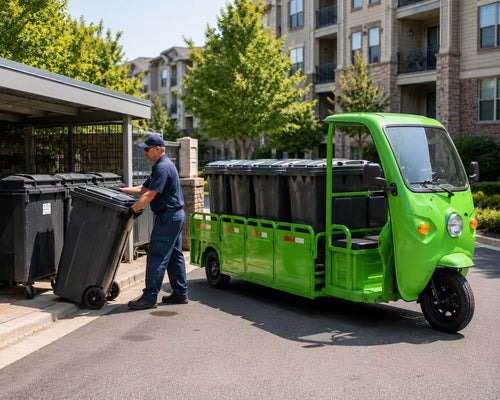
An electric farm utility trike can fit when the work is:
low-speed
short-distance
private-site
cargo-focused
light to moderate in load
close to a charging point
mostly on firm surfaces
not dependent on heavy towing
This can include:
moving feed bags
carrying tools
transporting crates
moving nursery trays
delivering boxes
carrying repair parts
moving buckets
property-maintenance work
An electric cargo trike for farm use does not need to copy every UTV feature.
Its value comes from doing a smaller job well.
The buyer may not need:
high speed
passenger seating
deep off-road ability
heavy suspension
four-wheel drive
a large engine
The buyer may simply need a practical electric utility trike with cargo bed.
That can be enough when the route matches the machine.
The Cost of Buying Capability You Rarely Use
A 4×4 UTV usually costs more than a simple electric farm cargo trike.
The buyer is paying for:
more mechanical systems
larger chassis
additional drivetrain components
higher-performance suspension
larger tires
more complex maintenance
greater off-road ability
Those features may be worth the cost.
But only when they are used.
A buyer should ask:
How many days each month do I actually need four-wheel drive?
How often do I enter deep mud?
How often do I climb steep routes?
How often do I tow heavy loads?
How often do I leave maintained paths?
If the answer is “rarely,” the buyer may be overbuying.
The strongest machine is not always the most useful machine.
The most useful machine is the one that fits the work completed every week.
The Route Should Decide the Drivetrain
A practical route inspection should happen before purchase.
The buyer should walk or drive the normal path and record:
surface type
slope
soft areas
standing water
turning points
gate width
route distance
normal cargo weight
winter conditions
rainy-season conditions
If the route remains firm through normal weather, four-wheel drive may not be necessary.
If the route becomes deeply muddy, steep, or unstable, a 4×4 UTV may be the better choice.
The buyer should not choose by image or habit.
The route should decide.
Firm Gravel Can Be Enough
A maintained gravel route can work well for short farm cargo movement.
The gravel should have:
a stable base
reasonable drainage
no deep loose sections
no severe washouts
enough width for safe travel
A simple farm utility trike can perform useful work on this kind of route.
The operator should still drive at low speed.
Cargo should remain low and balanced.
The route should be inspected after heavy rain.
A gravel path is not automatically perfect.
But it can provide a reliable surface without requiring four-wheel drive.
Concrete and Compacted Yards
Many farm jobs happen around buildings.
The vehicle may travel across:
concrete barnyards
warehouse aprons
packing areas
equipment yards
compacted dirt lanes
greenhouse access paths
These surfaces often favor a smaller, simpler cargo vehicle.
A large UTV may be more machine than the route needs.
An electric 3 wheel farm utility vehicle can move cargo efficiently in these areas when used within its limits.
The buyer should focus on:
turning room
braking distance
pedestrian traffic
load balance
surface condition
The drivetrain is only one part of the decision.
What About Grass?
Firm, dry grass can be suitable for light private-site travel.
But grass conditions can change quickly.
Wet grass may reduce traction.
Soft ground below the grass can allow wheels to sink.
Repeated traffic can create ruts.
The buyer should not assume that green grass means firm ground.
If the route crosses grass, the buyer should test:
after rain
under normal load
during the wet season
A short grass route may be acceptable.
A soft pasture route may require a different machine.
Mud Changes the Answer
Deep mud is where four-wheel drive can become important.
A three-wheel cargo trike is not designed to replace a 4×4 UTV in deep mud.
When the route regularly includes:
soft soil
deep ruts
standing water
mud under the full load
poor drainage
the buyer should not force a simple cargo trike through it.
The correct solution may be:
improving the route
adding gravel
creating drainage
choosing an alternate path
using a 4×4 UTV
using a tractor
A stronger drivetrain cannot always repair a bad road.
But when the work must continue through mud, four-wheel drive may be necessary.
Slope Also Changes the Decision
A maintained route with a mild grade is different from a steep hill.
Steep routes increase:
traction demand
braking demand
energy use
load movement
operator risk
A buyer should not choose a three-wheel utility trike for strong side slopes or steep rough ground.
A 4×4 UTV or other purpose-built machine may be more appropriate.
The buyer should evaluate the route in both directions.
Going uphill and coming downhill create different demands.
The route must be suitable for the loaded vehicle, not only the empty vehicle.
Snow Is Not One Condition
Light snow on a firm cleared route is different from deep snow.
A simple electric farm utility trike may still complete short work on a maintained winter path.
But deep snow, icy slopes, and uncleared routes can require:
four-wheel drive
appropriate tires
more ground clearance
greater stability
snow-removal equipment
The buyer should not purchase based on one mild winter day.
The real winter route should decide.
Heavy Towing Requires a Different Machine
Four-wheel drive is especially valuable when the vehicle must pull heavy loads.
A buyer who needs to tow:
loaded trailers
sprayers
spreaders
implements
large firewood loads
heavy equipment
should consider a towing-rated UTV, ATV, tractor, or compact tractor.
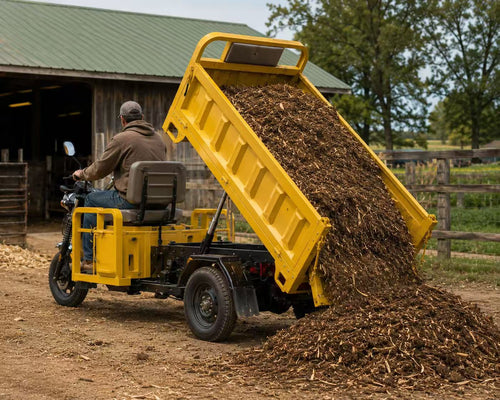
An electric utility trike with cargo bed is mainly a cargo-carrying machine.
It should not be treated as a heavy towing vehicle.
If the work is towing, buy a towing machine.
If the work is carrying, evaluate the cargo bed.
That distinction protects the buyer from choosing the wrong equipment.
A Large Cargo Bed Can Replace Many Small Trips
For short farm routes, a large cargo bed can create more value than four-wheel drive.
The operator can carry:
feed bags
tools
boxes
crates
buckets
nursery trays
repair parts
animal-care supplies
The bed should be:
long enough
easy to load
low enough for hand loading
large enough to combine items
capable of keeping cargo balanced
If one trip replaces several walking trips, the vehicle is doing useful work.
The buyer may not need extreme traction.
The buyer may need a practical cargo platform.
This is where an electric farm cargo trike can fit the job well.
The Buyer Should Not Pay for Fear
Some equipment purchases are based on fear.
The buyer imagines:
getting stuck
a future storm
a rare steep route
one heavy job
one muddy day
Then the buyer purchases a machine for that rare event.
But the normal work may be different.
The buyer should not ignore real risks.
But the buyer should separate regular work from rare conditions.
A backup plan may be better than buying a large machine for one exceptional day.
That backup plan may include:
waiting for dry conditions
using a tractor for one heavy job
using another route
renting equipment
asking a neighbor
improving the road
The daily vehicle should match daily work.
A Smaller Vehicle Can Be Easier to Use
A smaller electric farm utility tricycle may be easier to use in controlled areas.
It can require:
less turning room
less parking space
less storage space
less route width
This can matter around:
barns
greenhouses
nurseries
warehouses
small yards
market loading areas
The buyer should still measure the actual vehicle.
A smaller machine is not automatically suitable for every narrow route.
Gate width, turning radius, and cargo bed length should be checked before purchase.
But in many short-route environments, compact size creates more value than four-wheel drive.
Operator Convenience Matters
Farm work often involves frequent stops.
The operator may:
open a gate
check an animal
load a box
collect a tool
inspect a fence
deliver supplies
A vehicle that is easy to enter, stop, turn, and park may be used more often.
A large UTV can be useful, but it may also feel excessive for a five-minute task.
A simple farm utility trike can fit repeated short jobs.
The buyer should ask:
Will I actually use this machine for small daily tasks?
A machine that is easy to use may create more value than a machine with features that remain unused.
Range Is Usually Not the Main Problem on Short Routes
For short private-site routes, electric range may be less important than buyers expect.
The vehicle may return to the charging area several times each day.
The buyer can:
charge overnight
add energy during lunch
combine loads
avoid unnecessary trips
For this type of work, the practical range requirement may be modest.
The buyer should still calculate the normal route.
But a short route does not usually require the same battery capacity as a large electric UTV used far from the barn.
The machine should be selected for the route, not for the highest possible specification.
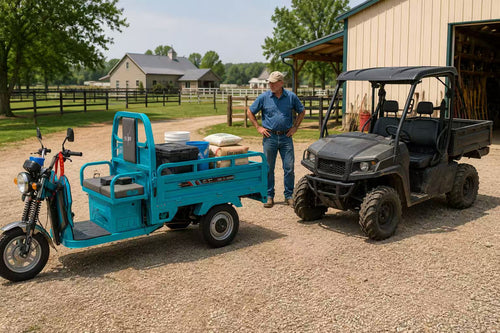
When the 4×4 UTV Is Clearly the Better Choice
A 4×4 UTV is the better choice when the buyer regularly needs:
deep mud capability
steep climbing
strong traction
deep snow travel
forest access
rough pasture travel
heavy towing
passenger seating
long off-road routes
continuous all-day operation
The buyer should not choose a simple electric cargo trike for these jobs.
The goal is not to force one product into every farm.
The goal is to match the machine to the work.
When the Electric Farm Utility Trike Is the Better Fit
An electric farm utility trike may be the better fit when:
the route is short
the surface is firm
the work is low-speed
the property is private
cargo matters more than passengers
towing is not required
charging is nearby
the load is moderate
turning space is limited
the buyer wants a simpler machine
This can be a strong match for:
small farms
homesteads
nurseries
greenhouses
warehouse yards
property-maintenance areas
private markets
The machine does not need to be a 4×4 UTV to be useful.
It needs to complete the daily work safely and consistently.
Questions to Ask Before Buying
Before paying for four-wheel drive, the buyer should ask:
What surface will I use every day?
How often is the route muddy?
How steep is the route?
Will I enter deep snow?
Do I need to tow?
How far is the normal round trip?
What is the normal cargo?
How many people need to ride?
How much turning space is available?
Can I improve the route instead?
Do I have a firm alternate path?
Will the vehicle return to charging regularly?
These questions help the buyer avoid paying for unnecessary capability.
Compare the Complete Job, Not One Feature
A buyer should not compare vehicles using only one specification.
Four-wheel drive is important, but it is not the whole vehicle.
A complete comparison should include:
purchase price
cargo bed
traction
route suitability
braking
turning radius
range
charging
maintenance
warranty
replacement parts
local repair support
The correct vehicle is the one that completes the work with the least unnecessary complexity.
Sometimes that is a 4×4 UTV.
Sometimes it is an electric cargo trike for small farm work.
A Better Buying Decision
The buyer can follow a simple process.
First, define the cargo.
Second, map the normal route.
Third, inspect the route after rain.
Fourth, identify slopes, mud, snow, and soft ground.
Fifth, decide whether heavy towing is required.
Sixth, calculate how often four-wheel drive would actually be used.
Seventh, compare the cost and complexity of each vehicle.
This process produces a more honest answer than starting with:
Every farm vehicle must be 4×4.
Final Thought
Do you really need a 4×4 UTV for short farm cargo routes?
Sometimes yes.
If the work includes deep mud, steep terrain, heavy towing, deep snow, rough pasture, or long off-road travel, a 4×4 UTV may be the correct machine.
But if the daily route is short, firm, low-speed, private, and focused on moving moderate cargo, four-wheel drive may add cost without adding much daily value.
In that situation, an electric farm utility trike may be enough.
The buyer should not choose by habit.
The buyer should choose by route.
A 4×4 system is valuable when the ground requires traction.
A large cargo bed is valuable when the work requires carrying.
The right machine is the one that matches the real job.