When a Wheelbarrow Is No Longer Enough for Daily Farm and Ranch Work
Share
A wheelbarrow is one of the most common tools on farms, ranches, horse stables, landscaping sites, and small properties. It is simple, affordable, and useful for light daily chores. For moving a few bags of feed, a small pile of mulch, garden tools, or loose leaves, a wheelbarrow can still be a practical choice.
But a wheelbarrow is not replaced because it stops working. It is replaced when the daily workload becomes too repetitive, too heavy, or too slow for one person to handle efficiently.
Many buyers do not start by searching for a hydraulic dump utility vehicle. They start with a problem: manual hauling is taking too much time. A worker may be pushing manure from stalls to a compost pile, moving soil across a small farm, carrying gravel for a driveway repair, transporting wood chips in a nursery, or hauling feed waste around a ranch. At first, a wheelbarrow works. After repeated trips every day, it becomes a bottleneck.
Is a wheelbarrow still enough for light farm work?
Yes, a wheelbarrow can still be enough for occasional light work. If the job involves short distances, small loads, and only a few trips per week, there may be no need to upgrade. Garden cleanup, small tool movement, dry leaves, light bedding, and minor yard work can often be handled with a manual cart or wheelbarrow.
The problem starts when the same task becomes a daily cycle. One trip may not feel difficult. Ten or twenty trips with wet soil, manure, mulch, gravel, compost, or animal bedding can quickly become exhausting. The issue is not only the weight of one load. It is the repetition.
When does manual hauling become too slow?
Manual hauling becomes too slow when workers spend more time walking, pushing, tipping, returning, and reloading than actually completing the main job. On farms and ranches, this often happens with barn cleanup, feed area maintenance, livestock bedding removal, fence repair supplies, and manure transport.
In landscaping work, the same problem appears when moving mulch, topsoil, gravel, branches, sod, or garden waste across a property. In property maintenance, workers may need to move debris, tools, plants, soil, and cleanup material between buildings, storage areas, and disposal points. If a worker is making repeated short-distance hauling trips every day, the wheelbarrow may no longer be the most efficient tool.
What jobs are too heavy for repeated wheelbarrow trips?
Some materials become difficult very quickly when moved by hand. Wet soil, clay, gravel, sand, manure, compost, firewood, bricks, broken concrete, and construction debris can create heavy loads even when the wheelbarrow is not full. These materials are not only hard to push; they are also hard to tip and unload repeatedly.
A farm worker may be able to handle a few loads in the morning. But after hours of repeated pushing and dumping, fatigue reduces speed and increases the chance of mistakes. For older operators, seasonal workers, or small teams with limited labor, repeated manual hauling can become one of the most tiring parts of the workday.
Can an electric dump cart replace a wheelbarrow?
An electric dump cart or hydraulic dump utility vehicle can replace a wheelbarrow for many short-distance hauling tasks, especially when the work involves loose bulk materials. The goal is not to replace every small hand tool. The goal is to reduce the repeated manual effort that slows down daily work.
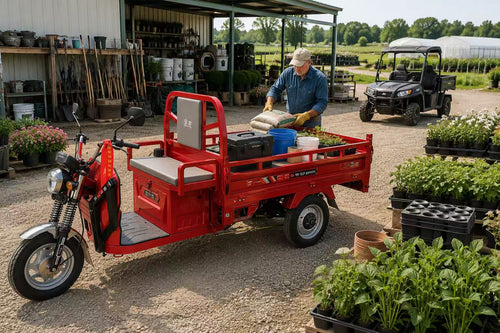
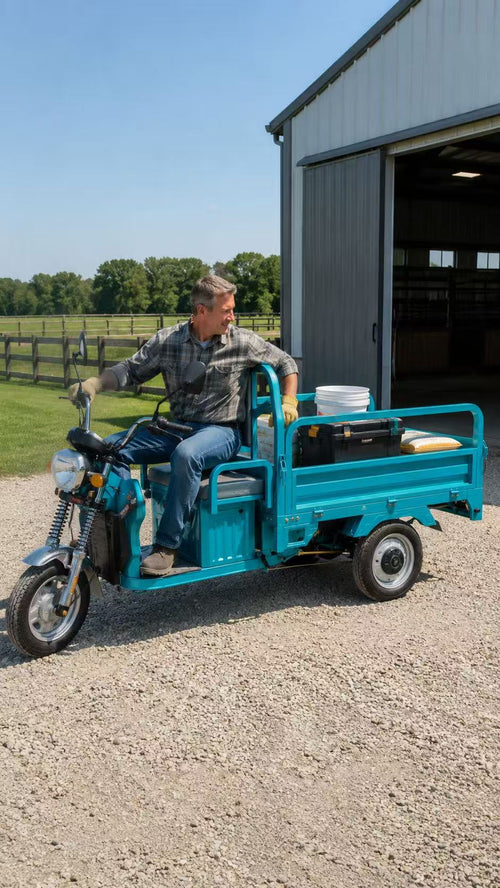
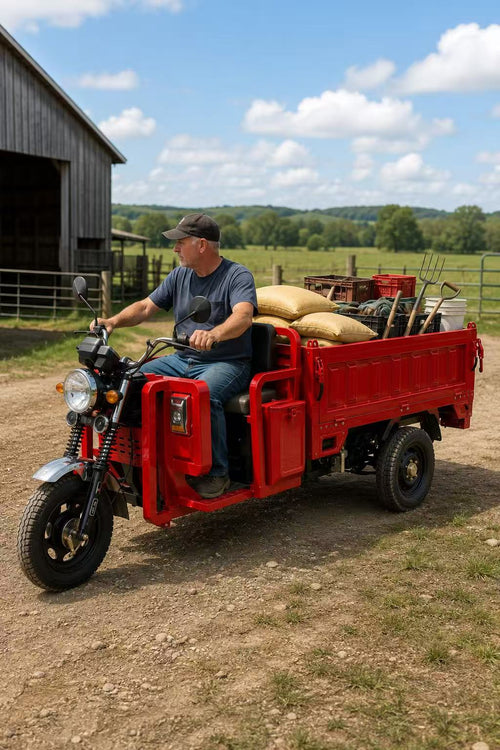
A compact electric dump utility vehicle can carry larger loads, move under battery power, and unload loose materials with a hydraulic dump bed. Instead of pushing and tipping by hand, the operator can transport soil, gravel, mulch, manure, compost, wood chips, bedding waste, or light construction debris more efficiently.
This is especially useful when the same route is repeated many times: barn to compost pile, feed storage to animal pen, gravel pile to driveway, mulch pile to landscape bed, nursery storage to planting area, or construction cleanup point to disposal area.
Is a hydraulic dump utility vehicle worth it for manure, soil, mulch, and gravel?
For occasional small loads, a wheelbarrow may still be enough. But for repeated daily hauling of manure, soil, mulch, compost, gravel, and similar loose materials, a hydraulic dump utility vehicle can become a practical investment.
The value comes from three areas: powered movement, larger carrying capacity, and easier unloading. The vehicle helps reduce walking fatigue, lowers the need for repeated hand tipping, and allows the operator to complete more loads with less physical strain. When used on firm ground and loaded correctly, the hydraulic dump bed allows material to exit from the rear of the cargo bed in a controlled way.
In real work, the vehicle may move forward very slowly while the raised dump bed allows loose material to slide out by gravity. This slow movement helps spread the material naturally instead of creating one difficult pile that needs extra cleanup. The motion should always be slow, controlled, and safe.
What makes a wheelbarrow alternative useful on farms and ranches?
A good wheelbarrow alternative should match the work environment. Farms and ranches often involve gravel roads, dirt lanes, barn aisles, feed storage areas, livestock pens, compost piles, fencing areas, and uneven outdoor routes. A useful electric farm utility vehicle should handle short-distance hauling, frequent stops, loose materials, and practical unloading tasks.
It should not be judged only by maximum payload. Buyers should also consider cargo bed size, material type, daily trip count, terrain, unloading method, and operator comfort. A vehicle that saves time in one repeated workflow may be more valuable than a larger machine that is difficult to maneuver in narrow work areas.
When should a small farm upgrade from a wheelbarrow?
A small farm, ranch, horse stable, nursery, or landscaping crew should consider upgrading when manual hauling becomes a daily limitation. If workers regularly move heavy or loose materials more than a few times per day, the cost of manual labor becomes hidden inside the workflow.
Signs that it may be time to upgrade include:
Workers are making repeated trips with manure, soil, compost, mulch, or gravel.
Manual unloading takes too much time.
The same route is repeated every day.
Older workers or small crews are becoming fatigued.
The work area is too large for efficient hand hauling.
A wheelbarrow load is no longer enough for the daily task.
Unloading loose material by hand slows down the next job.
When these problems appear consistently, the question is no longer whether the wheelbarrow still works. The real question is whether it is still the right tool for the workload.
Does an electric dump utility vehicle replace a tractor or UTV?
Not always. A compact electric dump utility vehicle is not designed to replace every tractor, UTV, pickup truck, or large piece of equipment. Its strongest role is short-distance material handling. It is useful when the task is too repetitive for a wheelbarrow but does not require a full-size tractor or gas utility vehicle.
This middle position is important. Many farms and ranches have jobs that are too small for heavy equipment but too tiring for manual tools. A battery powered dump cart or small electric work vehicle can fill that gap by improving daily movement without requiring oversized machinery.
What should buyers think about before upgrading?
Before replacing a wheelbarrow with an electric dump utility vehicle, buyers should think about the real work pattern. What materials are moved most often? How many trips happen each day? Is the ground firm enough for loaded movement? Does the vehicle need to enter barns, greenhouses, stables, or narrow paths? Will hydraulic dumping reduce unloading time?
The best buying decision comes from studying the daily workflow, not just the equipment category. A wheelbarrow is still useful for small tasks. But when the work becomes repeated, heavy, and time-consuming, a hydraulic dump utility vehicle can help turn manual hauling into a more efficient process.
A wheelbarrow is a tool for small loads. A hydraulic dump utility vehicle is a tool for repeated short-distance material handling. When the daily work grows beyond what one person can push, lift, and tip efficiently, it may be time to upgrade.