When a Wheelbarrow Becomes Too Slow for Daily Farm Work
Share
A wheelbarrow is useful until the work stops feeling small.
At first, it seems normal to move one load of feed, one box of tools, one bag of soil, or a few crates from the barn to the field. But on a real farm, those small loads do not happen once. They happen again and again. Morning feed, fence tools, seed bags, harvest crates, water buckets, repair parts, and clean-up materials all create short trips that quietly eat up time and energy.
That is when a small electric farm cargo trike starts to make sense. It is not trying to replace a tractor, a pickup truck, or a full-size UTV. It fits the space between hand labor and larger farm vehicles, where many daily farm jobs actually happen.
The Problem Is Not One Heavy Load
Many farm owners do not struggle because one load is impossible. They struggle because the same load has to be moved many times.
A wheelbarrow can move one bag. A person can carry one toolbox. A pickup can move across the property. But when the job is short-distance and repeated, each option has a weakness.
A wheelbarrow becomes tiring after several trips.
A pickup is too large for barn paths, gates, greenhouse rows, and tight work areas.
A gas ATV or UTV may feel excessive for short feed runs or light maintenance tasks.
Hand carrying wastes time and increases fatigue.
For small farms, hobby farms, ranch properties, nurseries, and rural homes with daily chores, the real question is not “Can this be moved?” The better question is: “How many times does this need to be moved today?”
That is where an electric cargo trike with an open rear bed can become a practical daily work tool.
Why an Open Cargo Bed Matters
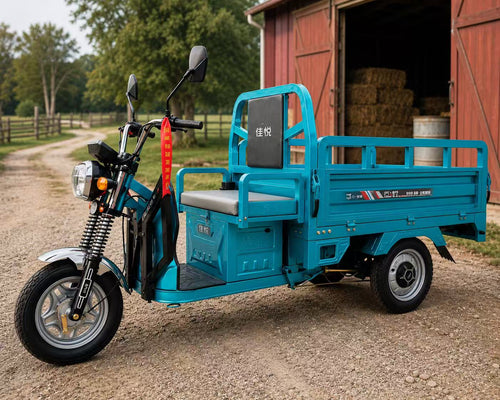
The blue electric cargo trike shown here uses an open rear cargo bed. That matters because many daily farm loads are not clean, uniform, or neatly packaged.
Farm work often involves mixed cargo:
feed bags
small tools
fencing supplies
seed trays
plastic crates
buckets
garden soil bags
light equipment
harvest boxes
maintenance materials
With an open cargo bed, the operator can load from the side, stack items quickly, and remove materials without climbing into a truck bed. For small daily routes, that convenience is more important than looking like a full-size utility vehicle.
A rear cargo bed also keeps the load separate from the driver. Compared with rear baskets on light electric trikes, a steel utility-style cargo bed gives the vehicle a more work-focused layout. It is easier to understand as a small farm hauler rather than a recreational electric bike.
Where This Type of Electric Farm Trike Fits Best
This type of vehicle works best when the job is short, repeated, and practical.
Good use cases include:
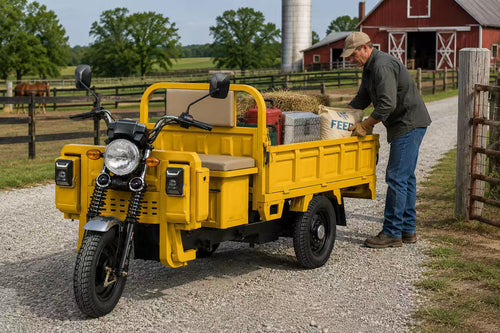
moving feed from storage to livestock areas
carrying tools from a shed to fence lines
hauling produce crates from garden rows to a packing area
transporting seed trays around a nursery or greenhouse area
moving supplies around a small ranch, orchard, or rural property
carrying repair parts, buckets, and hand tools for daily maintenance
The strongest use case is not one long trip. It is a daily route.
For example, a farm owner may need to move feed bags from a storage shed to a barn every morning. Later, they may carry tools to repair a gate. In the afternoon, they may move crates, buckets, or supplies to another part of the property. None of these jobs require a tractor. But doing all of them by hand or wheelbarrow becomes slow.
A compact electric farm cargo trike can turn those small jobs into simple trips.
Why Electric Makes Sense for Repeated Farm Routes
Electric power is useful for this kind of work because short farm routes do not always need gasoline equipment.
A gas ATV, UTV, or small tractor can do many jobs, but it also brings noise, fuel, engine maintenance, exhaust, and more operating cost. For short trips near barns, animals, gardens, and work sheds, those things may not be necessary.
An electric cargo trike is quieter, easier to start, and easier to use for light-to-medium hauling. The operator can move slowly around animals, buildings, and narrow paths without treating every small task like a major equipment operation.
For early morning work near horses, cattle, poultry, or residential areas, quiet movement can also be an advantage. Not every buyer is only thinking about payload. Some are also thinking about noise, convenience, and whether the vehicle is simple enough for everyday use.
When It Is Better Than a Wheelbarrow
A wheelbarrow is cheap and simple, but it depends completely on the operator’s body. That becomes a problem when the route is long enough, the load is repeated enough, or the ground is uneven enough.
An electric farm cargo trike can be better than a wheelbarrow when:
the same route is repeated every day
the load includes bags, crates, buckets, or tools
the work area has barns, fences, sheds, or narrow lanes
the operator wants to reduce pushing, lifting, and repeated walking
the job does not require a full-size UTV
the property has many small chores spread across different areas
This is not about replacing every hand tool. It is about removing the repeated hauling that slows down the whole day.
When It Is Not the Right Tool
A small electric cargo trike is not the right tool for every farm job.
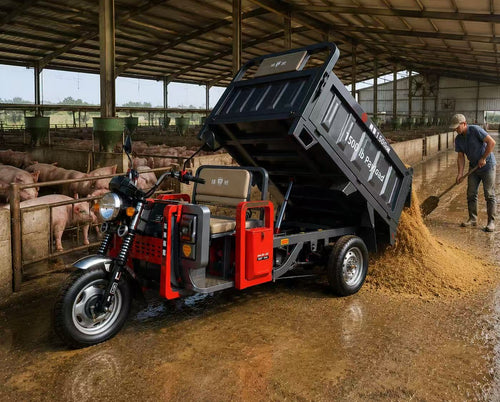
It is not a tractor. It is not designed to pull heavy implements. It is not the best choice for deep mud, steep hills, public road travel, or very heavy bulk material every day. If the job involves heavy dumping of wet soil, manure, gravel, or construction debris, a hydraulic dump model may be a better match.
The open-bed cargo trike is better for carrying and moving. The hydraulic dump trike is better for unloading loose heavy material.
That difference matters. Buyers should choose based on the job, not only the price.
How Buyers Should Think Before Choosing
Before choosing a small electric farm cargo trike, buyers should ask a few practical questions:
What do I move most often?
How heavy is the normal daily load?
Is the route flat, uneven, grassy, or gravel?
Do I need an open cargo bed or a hydraulic dump bed?
Will the vehicle be used near animals or people?
How narrow are the gates, barn doors, or work paths?
Is the job repeated every day or only occasionally?
These questions are more useful than only asking about motor size. Motor power, battery range, cargo bed size, tires, brakes, and frame strength all matter, but they only matter when matched to the actual route and load.
A Practical Middle Ground for Small Farm Work
Many farms do not need a large machine for every job. They need a simple way to move common materials without wasting labor.
That is why an electric farm cargo trike can be useful. It gives the operator a compact vehicle for the daily work that is too repetitive for a wheelbarrow but too small for a tractor or pickup.
For feed bags, tools, crates, buckets, and routine property maintenance, the value is not only in the cargo bed. The value is in reducing the number of hard, slow trips that happen every day.
A wheelbarrow still has a place on the farm.
But when the wheelbarrow becomes the reason work slows down, it may be time to consider a small electric farm cargo trike.