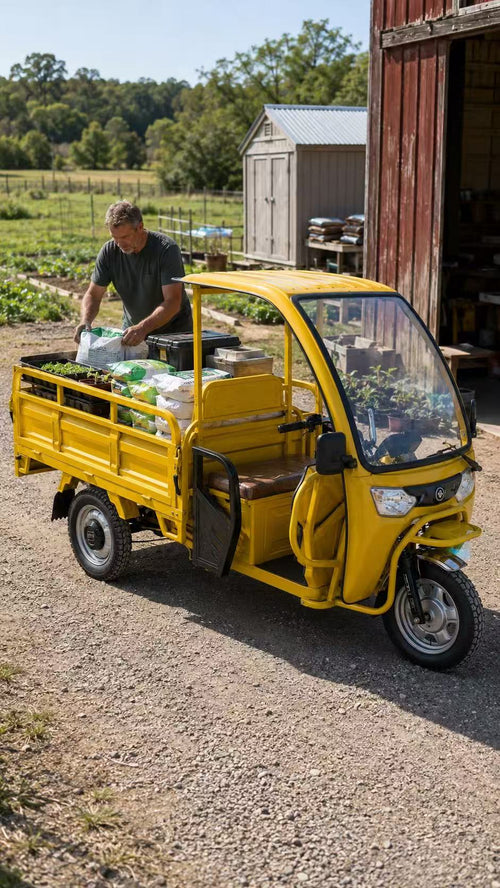
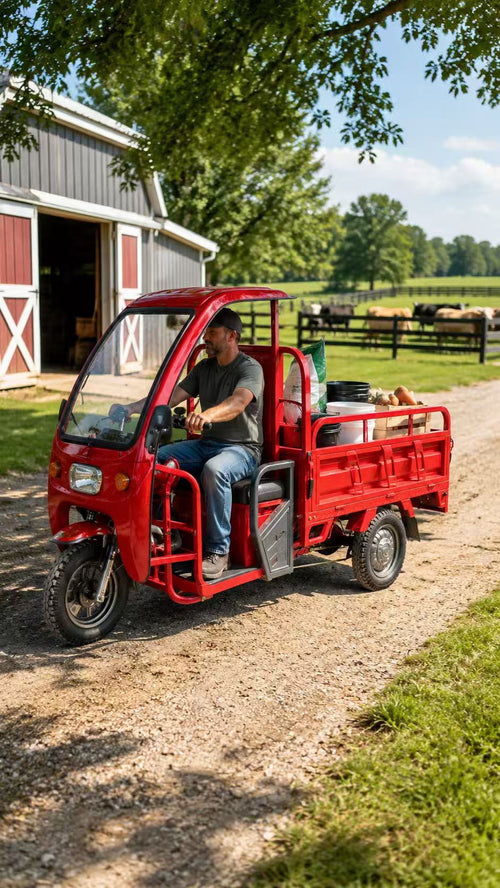
Electric Farm Cargo Trike for Feed, Tools, and Produce Hauling
Share
An electric farm cargo trike is a practical three-wheel work vehicle for farms, ranches, orchards, greenhouses, nurseries, and rural properties that need to move cargo every day.
For many farm owners, the real daily problem is not long-distance driving. It is repeated short-distance hauling: moving feed bags from storage to livestock areas, carrying tools to a fence line, transporting produce crates from the field, or moving supplies between barns, sheds, and work areas.
A compact electric farm cargo trike with an open rear cargo bed is designed for this kind of work.
It is not a full-size UTV. It is not a golf cart. It is not a family cargo bike. It is a simple electric cargo vehicle built around one job: moving farm materials across private property more efficiently.
Why Farms Use an Electric Farm Cargo Trike
Many small and mid-size farms have daily routes that repeat again and again.
A worker may need to move feed in the morning, tools during the day, and produce crates later in the afternoon. Doing this by hand or with a wheelbarrow can take time and energy. Using a pickup truck or UTV for every small load may be too large, too costly, or unnecessary.
An electric farm cargo trike fits between these options.
It can help move:
- feed bags
- hand tools
- vegetable crates
- fruit boxes
- buckets
- fencing supplies
- greenhouse supplies
- nursery trays
- small farm equipment
- maintenance items
- daily rural property supplies
The main value is not speed. The main value is reducing repeated manual hauling and making daily farm routes easier.
Open Rear Cargo Bed for Daily Farm Work
The open rear cargo bed is one of the most important parts of this vehicle.
For farm use, the cargo bed needs to be easy to load, easy to unload, and practical for mixed items. One trip may carry feed bags. The next trip may carry tools, buckets, or produce crates. A simple open-bed design makes this kind of mixed daily use easier.
An open cargo bed is especially useful for boxed, bagged, and tool-based loads.
It works well for farms that mainly carry:
- feed bags
- produce crates
- toolboxes
- fertilizer bags
- small containers
- hand tools
- nursery supplies
- greenhouse materials
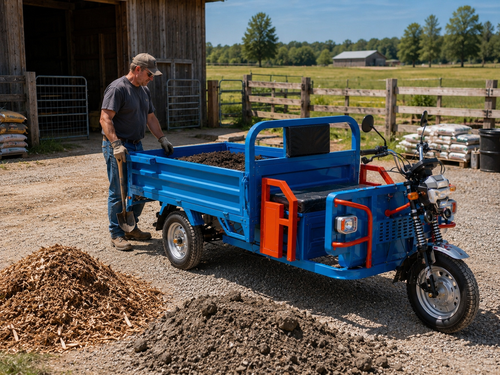
If a farm mainly moves loose material such as soil, compost, manure, gravel, or mulch, a dump bed may be a better choice. But for daily farm cargo, feed, tools, and produce, an open-bed electric farm cargo trike is often the more direct and convenient option.
Where This Type of Vehicle Fits Best
An electric farm cargo trike is most useful on short private-property routes.
It can fit well in:
- small farms
- ranch work areas
- horse stables
- poultry farms
- dairy support areas
- vegetable farms
- orchards
- vineyards
- nurseries
- greenhouses
- rural homes with barns or sheds
- private acreage properties
These are places where the operator may need to move moderate cargo many times a day, but does not always need a large off-road vehicle.
A compact three-wheel layout can also help in narrow spaces. Barn-side lanes, greenhouse paths, orchard rows, gravel farm roads, and storage areas may be easier to access with a small cargo trike than with a pickup truck or large UTV.
Electric Farm Cargo Trike vs. Wheelbarrow
A wheelbarrow is simple, cheap, and useful for small loads. But it requires physical effort every time.
For repeated farm hauling, the work adds up quickly.
An electric farm cargo trike helps reduce:
- repeated walking
- repeated lifting
- multiple small trips
- worker fatigue
- time spent moving basic supplies
This is especially useful when a farm worker needs to move the same type of load several times per day.
Electric Farm Cargo Trike vs. UTV
A UTV is still better for rough terrain, steep hills, passenger transport, towing, deep mud, and heavy off-road use.
An electric farm cargo trike is different. It is better understood as a compact daily hauling tool.
It may be a better fit when:
- the route is short
- the cargo is moderate
- the work happens on private property
- the farm has narrow paths
- the buyer wants lower operating cost
- the vehicle is mainly for cargo, not passengers
- the job is feed, tools, crates, and supplies
For many small farms, the question is not whether a trike can replace every UTV. It cannot. The better question is whether a smaller electric cargo vehicle can handle many of the daily hauling jobs that do not require a full-size machine.
That is where an electric farm cargo trike can make sense.
What Buyers Should Check Before Choosing One
Before buying an electric farm cargo trike, the buyer should think about the real daily workload.
The first question is: what will be carried most often?
A farm moving feed bags needs a different setup than a greenhouse moving trays or an orchard moving fruit crates. The most common load matters more than the largest possible load.
The second question is: how much weight needs to move per trip?
Payload is important, but it should be matched with motor power, battery setup, route conditions, and cargo bed size. A useful farm cargo trike is not just about one number. It needs the right balance between cargo capacity, stability, and daily usability.
The third question is: what kind of ground will it drive on?
Flat concrete, gravel roads, dirt paths, grass areas, orchard lanes, and slightly uneven farm roads all place different demands on the vehicle. Buyers should avoid choosing a vehicle only by appearance. The route matters.
The fourth question is: open bed or dump bed?
Open bed is better for feed, tools, boxes, crates, and daily supplies. Dump bed is better for loose materials. Choosing the wrong bed type can make daily work less convenient.
The fifth question is: how far will it travel each day?
For most farm cargo tasks, the route is short but repeated. Battery range should match the actual daily route, not just a maximum number on paper.
Best Use Cases
An electric farm cargo trike is a good fit for:
- morning feed transport
- moving tools between sheds and work areas
- carrying produce crates from field rows
- moving greenhouse supplies
- transporting nursery trays
- carrying fencing tools
- supporting stable maintenance
- moving small farm equipment
- carrying buckets, containers, and repair supplies
- short-distance property maintenance
It is not the best choice for every job. It is not designed for highway travel, passenger transportation, extreme off-road routes, or heavy towing. But for daily farm cargo movement, it can be a useful and affordable work tool.
Final Thought
An electric farm cargo trike is useful because it solves a simple problem: farms need to move things every day.
Feed, tools, produce, supplies, and small equipment all need to move across short distances. A compact open-bed electric cargo trike helps make that work easier without using a full-size UTV or pickup truck for every small task.
For small farms, ranches, orchards, greenhouses, nurseries, and rural properties, this type of vehicle can become a practical daily hauling tool.
May I know your location and what kind of work you plan to use the vehicle for?