Battery, Controller, Motor: Why Electric Transport Work Trikes Are Easier to Service Than Many Buyers Thin
Share
Many buyers worry about after-sales service before ordering electric transport work equipment.
That concern is understandable.
If a buyer is ordering a large electric work trike for farm, ranch, nursery, warehouse, market, or private-site material movement, they want to know what happens if something needs service later.
But there is one misunderstanding that should be corrected first:
An electric transport work trike is not a complicated road machine.
Its working principle is much simpler than many buyers imagine.
At its core, this type of equipment is built around three main electric parts:
battery
motor controller
motor
Around these three parts, the rest of the equipment is mainly basic mechanical structure and simple electrical accessories, such as brakes, lights, switches, wiring, tires, bearings, frame, cargo bed, and hardware.
That is why buyers should not think of this equipment as something that only a special factory technician can understand.
For many basic inspections and repairs, a local electric bike technician, golf cart repair shop, small equipment mechanic, farm equipment repair technician, ATV / UTV repair provider, motor technician, or independent mobile mechanic may already understand the basic service logic.
The key is not mystery.
The key is correct diagnosis, correct specifications, and safe handling.
The Core System Is Simple
The basic electric system can be understood in a simple way.
The battery stores power.
The motor controller manages how that power is sent to the motor.
The motor turns electrical power into movement.
This is the basic path:
battery to controller
controller to motor
motor to drive system
The buyer does not need to understand every wire to understand the principle.
This is not a fuel engine system.
There is no gasoline engine.
There is no oil change system.
There is no spark plug.
There is no carburetor.
There is no exhaust system.
There is no complex automotive transmission.
That is one reason electric transport work equipment can be easier to understand and service than many buyers expect.
The system still needs proper care, but the structure is not mysterious.
Battery: The Most Valuable Part
The battery is often the most valuable part of electric transport work equipment.
It affects range, power stability, charging, operating time, replacement cost, and long-term reliability.
That is why the battery should be treated carefully.
A buyer should not think of the battery as a random part that can be replaced without checking specifications.
Important battery details may include:
voltage
capacity
battery type
charging method
connector type
battery size
installation space
discharge ability
charger compatibility
wiring connection
If the equipment uses lead-acid batteries, the buyer should check voltage, capacity, wiring arrangement, terminal connection, and charger compatibility.
If the equipment uses lithium batteries, the buyer should also consider BMS protection, discharge rating, charger matching, connector type, and installation safety.
This is why OneClickChina support can help buyers identify the correct battery specification when replacement or diagnosis is needed.
The battery is valuable, but it is not impossible to understand.
It simply needs correct matching.
Motor Controller: The Electric Control Center
The motor controller is sometimes called the controller or motor controller.
In Chinese, buyers may call it 电控.
This part controls the power flow between the battery and the motor.
It may receive signals from the throttle, brake switch, reverse function, speed setting, and other control lines. Then it manages how much power goes to the motor.
A simple way to understand it is:
the battery provides power
the controller manages power
the motor uses power
The controller can affect starting, acceleration, torque feeling, speed control, reverse operation, and protection functions.
But buyers should not treat the controller as a mysterious part.
Many electric bikes, electric scooters, electric trikes, electric carts, and golf carts use a similar basic idea: battery, controller, motor.
What matters is specification matching.
A controller must match the battery voltage, motor power, wiring system, throttle signal, brake cut-off signal, and connector layout.
If a controller problem is suspected, a technician should not simply replace it without checking the rest of the system.
A weak battery, loose connector, damaged wire, shorted motor, incorrect throttle signal, or water-damaged connection can also cause symptoms that look like controller failure.
That is why diagnosis matters.
Motor: Simple Power Output
The motor is the part that turns electrical energy into motion.
Compared with a fuel engine, the motor system is much simpler.
There is no fuel system.
There is no engine oil system.
There is no air intake system.
There is no exhaust system.
There is no combustion process.
This makes the motor easier to understand for many technicians who already work with electric bikes, scooters, golf carts, small electric machines, or electric utility equipment.
However, the motor still needs correct matching and proper use.
Important motor details may include:
voltage
rated power
wiring type
mounting position
connector type
controller matching
load condition
heat condition
If the equipment has weak power, abnormal noise, overheating, or no movement, the motor is only one possible cause.
The issue may also come from the battery, controller, wiring, throttle, brake cut-off, connector, or load condition.
This is why OneClickChina prefers a step-by-step support process instead of guessing.
Basic Mechanical Parts Are Familiar to Local Technicians
Outside the battery, controller, and motor, many service points are very familiar.
Examples include:
tires
brake parts
bearings
brake cables or brake fluid systems
lights
turn signals
switches
wiring connectors
mirrors
fasteners
cargo bed hardware
frame inspection points
hinges
suspension parts
These are not unusual or highly secret parts.
Many local technicians understand tires, brakes, bearings, lights, wiring, switches, and hardware. A local repair person does not need to be the original factory engineer to inspect many of these items.
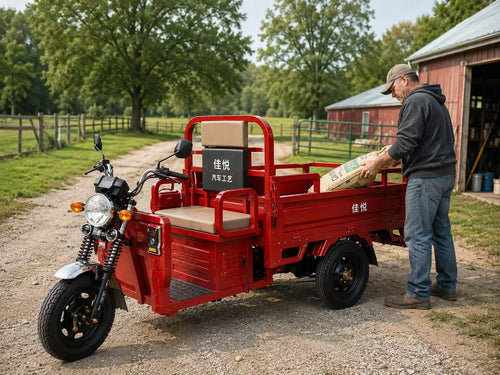
In simple words, this equipment is much closer to a strengthened electric work trike than to a complicated automobile.
It has more structure and load function than a bicycle, but the basic service logic is still direct.
There is one more wheel, a stronger frame, a cargo bed, brake lines, lights, turn signals, wiring, and electric drive components.
This is not something buyers should automatically imagine as impossible to repair locally.
Hydraulic Dump Models Add One More System
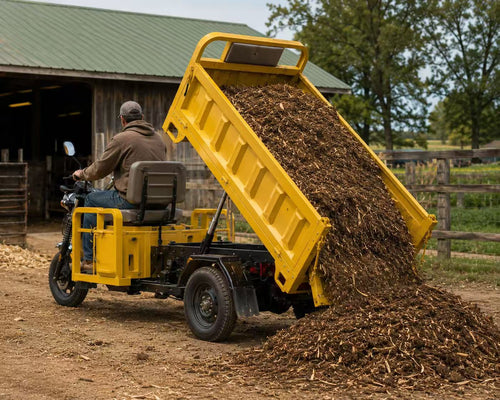
If the equipment is a hydraulic dump model, there is one additional system: the hydraulic dump system.
This may include:
hydraulic pump
hydraulic cylinder
hydraulic hose
dump switch
power wiring
hinge points
dump bed structure
This system adds function, but it does not make the entire equipment impossible to service.
A technician would usually check simple questions first:
Is the switch working?
Is power reaching the pump?
Is the connection loose?
Is the load too heavy?
Is the cylinder moving?
Is there any hydraulic oil leakage?
Are the hinges stuck?
Is the bed overloaded?
Hydraulic service should still be handled carefully by a qualified technician, especially when there are leaks, pressure issues, lifting problems, or damaged hoses.
But the idea is not mysterious.
It is a basic small hydraulic lifting system added to electric transport work equipment.
Why Local Service Is More Realistic Than Buyers Think
A buyer may imagine that if an imported electric work trike has a problem, no one nearby can help.
That is usually too pessimistic.
Many local technicians already work with similar service categories:
electric bikes
electric scooters
golf carts
small electric machines
farm equipment
ATV / UTV equipment
small trailers
electric motors
basic wiring
hydraulic lift systems
brakes and bearings
This does not mean every local shop can repair every problem.
It does not mean every technician can diagnose every electrical fault immediately.
But it does mean the equipment is not beyond local understanding.
Many basic inspections and repairs are within the experience of practical repair people.
The important part is giving them the right information:
photos
videos
symptom description
battery voltage
controller label
motor label
connector photos
wiring photos
part dimensions
order information
usage condition
With this information, OneClickChina can help identify the likely issue and provide guidance for the buyer and local technician.
Standard Compatible Parts Reduce Service Pressure
Another important point is replacement parts.
Many serviceable parts on this type of equipment are standard compatible parts, not locked proprietary parts that force the buyer to purchase every replacement only from the seller.
This is important for long-term ownership.
When compatible parts are available locally, buyers may be able to source them through normal market channels, local repair shops, electric equipment suppliers, farm equipment suppliers, golf cart shops, or other parts channels.
The buyer is not being pushed into a closed high-price parts system.
However, parts still need to match.
A brake part must fit correctly.
A tire must match size and load requirement.
A bearing must match dimensions.
A controller must match voltage, motor, wiring, and signal type.
A battery must match voltage, capacity, charger, connector, and installation space.
So the correct message is not “all parts can be bought anywhere.”
The correct message is:
many parts are standard or commonly available when the specification matches, and OneClickChina can help identify the correct specifications before replacement.
What OneClickChina Support Actually Does
OneClickChina’s after-sales support should be understood as practical support, not as a complicated closed repair system.
Support may include:
remote troubleshooting
reviewing buyer photos and videos
helping identify the problem area
checking whether the issue may be battery, controller, motor, wiring, brake, connector, or mechanical wear
helping confirm replacement part specifications
guiding communication with a local technician
supporting compatible parts selection when appropriate
providing warranty parts when the issue falls under warranty terms
helping search for nearby repair resources if the buyer cannot recommend a local technician
This support model fits the actual structure of the equipment.
Because the equipment is mechanically and electrically simple, many problems can be broken down into understandable modules.
Battery issue.
Controller issue.
Motor issue.
Wiring issue.
Brake issue.
Tire issue.
Bearing issue.
Switch issue.
Hydraulic issue.
Cargo bed hardware issue.
Once the problem is identified, the repair path becomes much clearer.
What Buyers Should Not Assume
Although this equipment is simpler than many buyers think, buyers should still avoid unsafe assumptions.
Do not assume any person can repair everything.
Do not replace the battery without checking specifications.
Do not replace the controller without checking motor, wiring, voltage, and possible short circuits.
Do not ignore overheating, burning smell, damaged wires, or water intrusion.
Do not overload the equipment and then treat the result as a normal parts failure.
Do not let unqualified people modify the electrical system.
Do not assume all parts are universal.
Do not continue operating the equipment if a brake, steering, battery, wiring, or structural issue appears unsafe.
Simple does not mean careless.
Simple means easier to understand, easier to inspect, and easier to support when the correct process is followed.
Warranty Still Matters
Service simplicity does not replace warranty.
For OneClickChina electric transport work equipment, the general warranty structure should be understood clearly:
vehicle body structure: 2-year limited warranty
motor: 1-year limited warranty
battery: 1-year limited warranty
Normal wear, consumable items, misuse, overloading, water damage, corrosion, unauthorized modification, accidents, and improper operation are generally not covered.
This is why diagnosis is important.
If something happens, the first step is not to argue about parts. The first step is to understand what failed, why it failed, and whether it falls within warranty terms.
Photos, videos, order information, and a clear description of the problem help make the process faster.
The Real Buyer Takeaway
The buyer should not overestimate the maintenance difficulty of electric transport work equipment.
This is not a complicated road machine.
It is a practical electric work tool built around a simple drive system:
battery
motor controller
motor
The remaining service points are mostly basic mechanical parts, basic electrical parts, cargo structure, and, on dump models, a small hydraulic lifting system.
For many common inspections and repairs, local technicians who understand electric bikes, scooters, golf carts, small equipment, farm equipment, ATV / UTV service, motors, brakes, bearings, or wiring may be able to help.
OneClickChina’s role is to support that process with remote diagnosis, specification identification, standard compatible parts guidance, warranty support, and local repair coordination when available.
Final Thought
A buyer should not think of an electric transport work trike as something impossible to repair locally.
The structure is much simpler than many people imagine.
The main value is in the battery, controller, and motor. The rest of the system is mostly understandable mechanical and basic electrical work.
That simplicity is part of the long-term ownership value.
When buyers understand the structure, after-sales service becomes less frightening.
The question is no longer:
Who can repair this strange imported machine?
The better question is:
Which part needs attention, what specification does it use, and which local technician can help inspect or replace it with OneClickChina support?
That is a much more practical way to understand electric transport work equipme