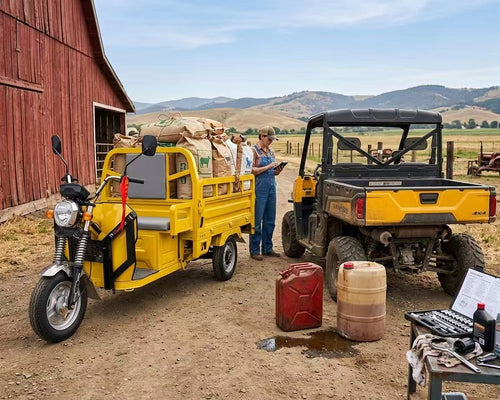
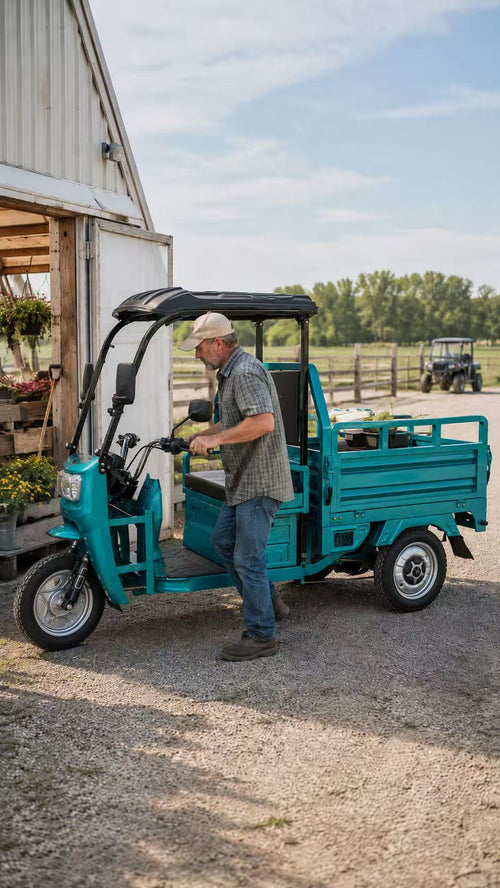
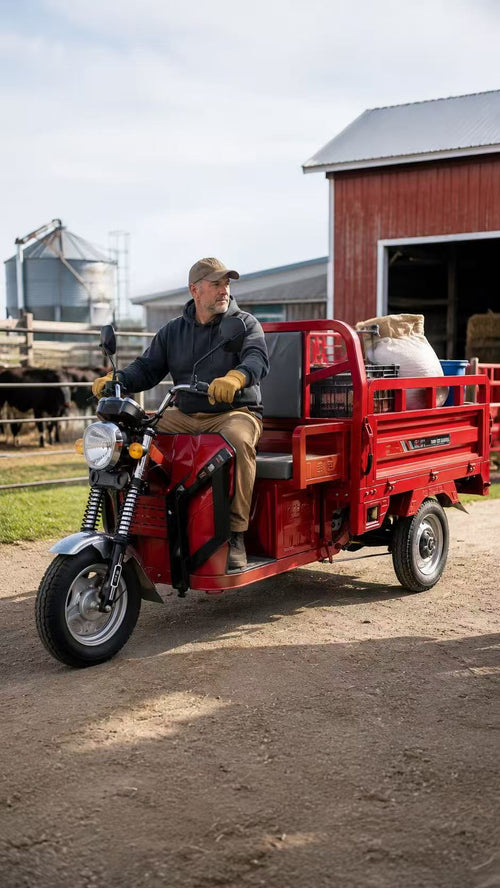
Farm Utility Trike for Agricultural Properties: Moving Produce, Feed, and Tools Around the Farm
Share
A farm utility trike is useful when an agricultural property needs a small work vehicle for daily movement, not a large machine for every job. Many farms, homesteads, nurseries, greenhouses, orchards, and rural properties have repeated short-distance transport tasks every day. Workers need to move produce, feed, tools, buckets, small equipment, irrigation parts, and supplies between barns, sheds, crop rows, packing areas, and storage zones.
These jobs are not always large enough for a tractor. They may not always require a UTV or ATV. A golf cart may be easy to drive, but it may not have the right cargo bed or working structure for farm materials. This is where a farm utility trike can become a practical middle option.
A farm utility trike should be understood as a three-wheeled work vehicle built around cargo movement. It is not a family cargo bike, not a commuter e-bike, and not a simple adult tricycle. For agricultural properties, the value comes from its ability to haul useful loads, move through farm routes, and support daily work without using a larger machine for every small trip.
Why Agricultural Properties Need Small Utility Vehicles
Farm work often includes many small movements that add up over the day. A worker may need to move feed bags from a storage area to a barn. Another worker may need to carry tools to a greenhouse. During harvest, produce crates may need to move from a field edge to a wash station or packing area. On a homestead, buckets, fencing supplies, hoses, or small repair parts may need to be carried around the property.
These movements are not dramatic, but they are repeated. Repeated walking and hand carrying wastes time. Starting a tractor or UTV for every small job can also be inefficient. A farm utility trike gives the property a right-sized vehicle for daily hauling.
The best use case is not extreme off-road work. The best use case is practical internal transport: moving moderate cargo over short routes many times per day.
What Makes a Farm Utility Trike Different from a Regular Tricycle
A regular electric tricycle may be designed for personal riding, shopping, light delivery, or passenger use. A farm utility trike needs to be judged differently.
For farm work, the cargo bed matters. The frame matters. The tires matter. The motor and payload matter. The route matters.
A farm utility trike should be able to carry real agricultural materials, such as produce crates, feed bags, hand tools, seed bags, buckets, sprayers, hoses, small boxes, irrigation fittings, and general supplies. The vehicle should also be easy to load and unload during a normal workday.
This is why the term farm utility trike has stronger value than a general electric tricycle. It points to a work vehicle used around agricultural properties, not a lifestyle vehicle used mainly for recreation or commuting.
The Core Farm Loads: Produce, Feed, and Tools
A good way to judge a farm utility trike is to start with the cargo.
Produce loads may include vegetable crates, fruit boxes, harvest tubs, nursery trays, or small packing supplies. These loads often need space and stability more than high speed.
Feed loads may include feed bags, buckets, small animal supplies, bedding materials, or mineral blocks. These loads can become heavy, especially when moved repeatedly.
Tool loads may include shovels, hand tools, fence repair tools, irrigation parts, sprayers, gloves, ropes, hoses, and small equipment. These items are often awkwardly shaped and need an open cargo area rather than a small basket.
If the vehicle can handle the farm’s common produce, feed, and tool routes, it is more likely to become useful every day.
Start with the Route, Not the Vehicle Photo
Before choosing a farm utility trike, the buyer should think about where it will actually run.
Some agricultural properties have gravel lanes, packed dirt paths, concrete barn areas, greenhouse aisles, nursery rows, orchard service paths, or crop row access lanes. These are ideal routes to evaluate because they represent normal daily movement.
Other properties may have deep mud, steep hills, large ruts, soft fields, or rough pasture trails. These routes may require a heavier vehicle, such as a UTV, ATV, tractor, or specialized off-road machine.
The buyer should ask:
Will the trike run mostly on gravel, packed dirt, pavement, or concrete?
Will it need to enter narrow crop rows or greenhouse paths?
Will it turn near barns, gates, packing stations, or storage corners?
Will the route be used several times per day?
Will the ground stay moderate, or does it become muddy and deeply uneven?
The route decides whether the trike will be convenient or frustrating.
Payload Should Match Daily Work, Not Just a Maximum Number
Payload capacity is important, but it should be connected to real farm work.
A product listing may mention a maximum load, but the buyer should calculate the normal daily load. That includes the driver, cargo, tools, and containers. A few feed bags, a toolbox, buckets, and produce crates can add up quickly.
A practical buyer should list the five most common loads on the property. For example:
Feed bags and buckets.
Vegetable crates or fruit boxes.
Hand tools and repair parts.
Seed bags and planting supplies.
Irrigation parts, hoses, and sprayers.
Once the normal load is clear, it becomes easier to decide whether the vehicle’s cargo bed, motor, tires, frame, and brakes match the job.
A farm utility trike is most valuable when it can carry moderate loads many times per day, not only when it can carry one heavy load once.
Cargo Bed Design Is the Working Center
The cargo bed is the most important part of a farm utility trike. For agricultural properties, the cargo bed should not be treated as decoration.
A useful cargo bed should be large enough for the materials moved every day. It should be easy to access from the side or rear. It should hold mixed farm supplies without forcing the worker to stack items dangerously. It should also be easy to clean when carrying dirty tools, bags, or produce containers.
An open cargo bed works well for feed, produce, tools, buckets, and general supplies.
Drop-side gates can help when workers load bags, crates, or tools from the side.
A dump bed may be useful if the farm frequently moves loose material such as soil, compost, mulch, bedding, manure, or gravel.
A covered cab or canopy can help with operator comfort, but the buyer should not confuse comfort with cargo function. If the job is moving produce, feed, and tools, the cargo bed is still the most important structure.
Why Maneuverability Matters on Farms
Large machines are useful, but they are not always convenient. A tractor or full-size UTV may be too large for some tight farm areas. Greenhouse lanes, nursery paths, barn-side routes, orchard rows, and packing area corners may need a smaller vehicle.
A farm utility trike can be useful when the property has narrow routes and repeated short trips. It can help move supplies into places where a larger vehicle would be awkward.
This is especially important for farms that need to move cargo through:
Greenhouse paths.
Nursery rows.
Crop row ends.
Barn-side lanes.
Packing area corners.
Small storage yards.
Wash station routes.
Tool shed access points.
Before buying, the property owner should measure the narrowest important routes. A vehicle that cannot fit the route will not be used regularly, no matter how good it looks online.
Electric Farm Utility Trike vs Gas-Powered Options
Many buyers compare an electric farm utility trike with gas-powered equipment. The right choice depends on workload, terrain, maintenance expectations, and daily use.
Electric farm utility vehicles can be quieter and lower maintenance than small gas-powered machines. They do not require engine fuel in the same way, and they can be convenient for repeated short trips. Around barns, greenhouses, livestock areas, and work zones, lower noise can also be helpful.
Gas-powered vehicles may still be better for heavier off-road work, long-distance use, high power demand, or rugged conditions. The point is not that electric always wins. The point is that electric can be a better fit for many short internal farm routes.
For daily produce, feed, and tool movement around agricultural properties, electric power can be practical when the route and payload match the vehicle.
How It Compares with Golf Carts and UTVs
A golf cart may be comfortable for moving people, but many golf carts are not designed around cargo work. They may not have the bed size, ground clearance, tires, or utility structure needed for farm materials.
A UTV is stronger and more capable for rough work, but it may be more expensive, louder, larger, and more machine than needed for smaller daily tasks.
A farm utility trike sits between those two categories. It is more cargo-focused than a golf cart and simpler than many UTVs. It can be useful when the job is low-speed hauling, not high-speed riding or heavy off-road work.
The buyer should not ask only, “Which vehicle is stronger?” The better question is, “Which vehicle fits the task I do every day?”
Terrain: Pavement, Dirt, and Mud
Google search results around farm utility trikes often bring up terrain questions because terrain changes everything.
If the property uses mostly pavement, concrete, gravel, packed dirt, or moderate farm lanes, a utility trike may be a good fit. If the property includes deep mud, steep slopes, large ruts, or soft fields, the buyer should be more cautious.
A farm utility trike is strongest on moderate working routes. It can help with daily hauling across agricultural properties, but it should not be presented as a replacement for a tractor or UTV in extreme conditions.
This honest boundary is important. It helps buyers choose the right tool and builds trust.
Motor, Frame, Tires, and Brakes
A farm utility trike should be judged as a working vehicle. That means the buyer should look beyond color and appearance.
Motor power should support loaded low-speed movement. Many farm buyers look for stronger motors because the vehicle may carry tools, feed, produce, and supplies over real property routes.
The frame should be strong enough for daily farm work. A weak frame may not hold up well when the vehicle is loaded repeatedly.
Tires should match the route. Rugged tires or utility tires may help with gravel, dirt, and uneven farm surfaces.
Brakes should be suitable for loaded stopping. A vehicle carrying cargo must be able to stop safely near barns, gates, people, animals, and equipment.
Together, these details decide whether the trike is only a light-use vehicle or a real farm utility tool.
When a Farm Utility Trike Makes Sense
A farm utility trike makes sense when the property needs to move cargo around agricultural work zones every day.
It fits best when:
The routes are private-property routes.
The loads are light to medium.
The trips are repeated often.
The cargo is produce, feed, tools, buckets, or supplies.
The route includes moderate dirt, gravel, pavement, or farm lanes.
The buyer wants a quieter and lower-maintenance option for daily hauling.
It is especially useful for homesteads, small farms, greenhouses, nurseries, orchards, produce farms, livestock support areas, and rural properties with regular hauling needs.
When It May Not Be the Right Fit
A farm utility trike may not be the best choice if the property needs heavy towing, deep mud performance, steep rough hills, large trailers, oversized loads, or long public road travel.
If the main work is extreme, heavy, or off-road, a UTV, ATV, tractor, or other heavy-duty machine may still be necessary.
A good buying decision comes from matching the vehicle to the job, not forcing one vehicle to do everything.
What Buyers Should Check Before Buying
Before choosing a farm utility trike, buyers should ask:
What do I move most often: produce, feed, tools, seed, buckets, or loose material?
How much total weight do I need to carry at one time?
Will the vehicle run on pavement, dirt, gravel, mud, or mixed surfaces?
Do I need an electric model or a gas-powered model?
Is the route private property or public road?
Do I need a cargo bed, a dump bed, or only a small basket?
Will the vehicle fit through farm lanes, gates, greenhouse paths, and storage areas?
Do the tires, brakes, and frame match the work?
These questions are more useful than comparing vehicles only by price or appearance.
Conclusion
A farm utility trike is a practical option for agricultural properties that need daily cargo movement. It can move produce, feed, tools, buckets, and supplies around barns, fields, greenhouses, nurseries, orchards, packing areas, and storage zones.
It should not be judged like a city tricycle or family cargo bike. It should be judged as a small farm work vehicle. The most important factors are cargo bed size, payload, route, terrain, motor strength, tires, brakes, and daily workload.
For farms that need quiet, low-speed, repeated hauling on private property, a farm utility trike can become a useful part of the daily work system. It does not replace every tractor, ATV, UTV, or truck. But it can handle the smaller daily movements that keep the property running.