Preventing Mixed Order Mistakes in Wholesale Market Loading
Share
Wholesale market loading is not only about moving goods quickly. In many seafood markets, produce terminals, meat distribution warehouses, restaurant supply buildings, cash-and-carry stores, and general wholesale markets, the bigger problem is making sure the right goods go to the right customer vehicle.
Mixed orders create this risk every day.
A restaurant customer may buy rice bags, oil cartons, sauce cases, takeout packaging, paper goods, frozen food cases, and cleaning supplies in one pickup. A produce buyer may collect fruit boxes, vegetable crates, and several loose cartons from different stalls. A seafood retailer may pick up foam boxes, sealed cartons, and ice-related supplies. A meat shop may collect packaged meat cartons and frozen food boxes. A small grocery customer may combine dry goods, cold-chain goods, paper supplies, and produce in one order.
When these goods are spread across different carts, floor areas, staging zones, and pickup lanes, mistakes become easier.
A missing carton, a wrong item, a wrong quantity, or a box loaded into the wrong vehicle can create customer complaints, extra labor, refunds, replacement trips, and trust problems. For a wholesale business, preventing mixed order mistakes is part of good material handling.
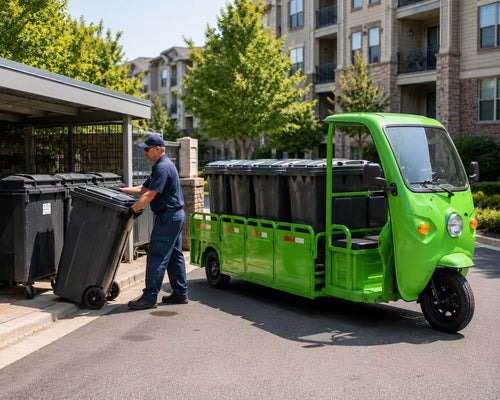
A cargo-bed electric utility vehicle can help by acting as a mobile order container.
Instead of leaving one customer order scattered across several hand carts or temporary floor spots, workers can group the order on one vehicle, check the cartons, move the order to the correct pickup area, and load it into the right customer vehicle.
Why Mixed Orders Create Loading Mistakes
Wholesale orders are often built from multiple areas.
One order may include items from warehouse aisles, cold rooms, vendor stalls, packing tables, dry goods shelves, and customer service areas. Workers may pick the goods in stages and then bring them to a pickup zone. During busy hours, several customer orders may be moving through the same space at the same time.
This creates several common problems:
wrong item loaded
wrong quantity loaded
missed carton
similar boxes mixed together
cold-chain goods separated from the rest of the order
one customer order placed near another order
goods moved twice before final loading
workers unsure which boxes are ready for pickup
These are not always technology problems. Often, they are workflow problems.
When an order is physically scattered, it is harder to check. When cartons are moved on several small carts, it is easier to lose track of one item. When goods sit in crowded pickup lanes, it is easier for workers to confuse orders.
A better physical handling process can help reduce these mistakes.
Using the Vehicle as a Mobile Order Container
A cargo-bed electric utility vehicle is useful because it can keep one customer order together.
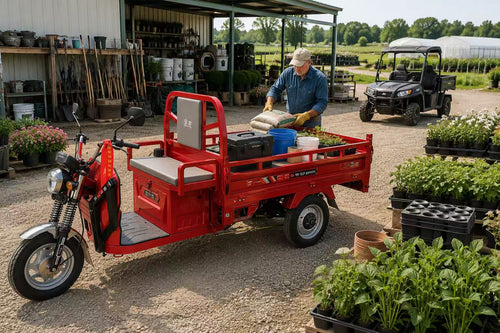
The cargo bed can hold mixed boxes, crates, foam containers, rice bags, oil cartons, paper goods, and packaging supplies in one place. Workers can load the order onto the vehicle, check it against the customer request, and move it as one grouped unit through the wholesale facility.
This turns the vehicle into more than a transport tool.
It becomes a mobile order staging platform.
For mixed order handling, that matters. The worker can see the full order in one place before loading. The vehicle can be moved to a quieter checking area, a pickup lane, or directly beside the customer vehicle. The order stays together from checking to loading.
This can help reduce confusion during peak pickup hours when several customers are waiting and multiple orders are being prepared.
Order Checking Before Loading
In wholesale market loading, the final check before loading is important.
Workers may need to confirm:
the correct customer order
the correct number of cartons
the correct product types
the correct temperature-sensitive items
the correct dry goods and packaging supplies
the correct pickup vehicle
whether any cartons are missing or damaged
If the order is spread across several carts or floor areas, this check becomes harder. If the order is grouped on one cargo-bed electric utility vehicle, the checking process becomes more visible and organized.
A worker can inspect the load, count boxes, separate cold-chain goods if needed, and confirm that the order is ready before moving it to the customer vehicle.
This is especially useful for non-palletized goods and mixed orders, where the order may not be wrapped together on one pallet.
Where This Helps in Wholesale Markets
This workflow can support many types of wholesale businesses.
In restaurant supply warehouses, mixed orders may include foodservice cartons, rice bags, oil boxes, paper goods, sauces, and cleaning supplies. A cargo-bed electric utility vehicle can keep the order grouped from picking to pickup.
In produce wholesale markets, fruit boxes and vegetable crates may come from several stalls or storage areas. The vehicle can help gather the order and move it to the correct customer vehicle.
In seafood markets, foam boxes and sealed seafood cartons can be grouped and moved to the pickup lane while keeping them separate from other customers’ orders.
In meat wholesale and frozen food areas, sealed cartons and frozen food cases can be moved as a grouped order from cold storage to pickup or loading areas. For cold-chain items, a refrigerated vehicle may be needed, but the same idea still applies: keep the order grouped, checked, and controlled before loading.
In general merchandise wholesale, many small cartons can look similar. Keeping one customer order together on a single vehicle can help prevent wrong-carton loading.
The Difference Between Speed and Accuracy
Moving fast is important, but fast movement alone does not solve loading mistakes.
A worker can move boxes quickly and still load the wrong carton. A pickup area can look active but still have poor order control. A business can have hand carts, pallet jacks, and forklifts but still struggle with mixed order accuracy if orders are scattered across the loading area.
The goal is not only speed.
The goal is controlled movement.
A cargo-bed electric utility vehicle supports both. It can reduce repeated manual movement, but it can also help keep each order physically grouped. This makes the loading process easier to manage, especially when the order includes different product types and different box sizes.
Reducing Customer Pickup Confusion
Customer pickup areas are often crowded.
Customers may arrive with vans, pickup trucks, small box trucks, or refrigerated vehicles. Workers may be loading several vehicles at once. Boxes may be staged near doors, carts, or lanes. During peak hours, confusion can happen quickly.
If one order is grouped on one vehicle, the pickup process becomes simpler.
The worker can drive or move the order to the correct customer vehicle. The customer can see the goods being delivered together. The worker can unload from the cargo bed and check the order as it moves into the vehicle.
This does not replace warehouse software, barcode systems, or order paperwork. It supports them with a clearer physical workflow.
The vehicle becomes the order’s temporary home until loading is complete.
A Practical Way to Improve Order Accuracy
Preventing mixed order mistakes does not always require a complicated system. For many small and mid-size wholesale businesses, the first improvement is physical organization.
Keep one order together.
Check it before loading.
Move it to the correct vehicle.
Avoid scattering cartons across different carts and floor spaces.
Separate dry goods, cold-chain goods, and special handling items when needed.
A cargo-bed electric utility vehicle can support this process because it gives workers a larger, mobile, visible space for mixed order handling.
Forklifts are still important for pallets. Pallet jacks are still useful for pallet movement. Hand carts still work for small loads. Refrigerated vehicles are still needed for cold-chain goods. But for mixed order checking, customer pickup accuracy, and short-distance movement from staging to loading, a cargo-bed electric utility vehicle can play a valuable role.
For seafood markets, produce wholesalers, restaurant supply warehouses, meat distributors, cash-and-carry stores, and general wholesale businesses, fewer mixed order mistakes can mean fewer customer complaints, fewer return trips, and smoother pickup operations.
When a wholesale business can keep orders grouped, checked, and moving toward the right vehicle, the loading process becomes more reliable.
That is why a cargo-bed electric utility vehicle is not only a hauling tool. It can become a practical mobile order checking platform for real wholesale market loading work.