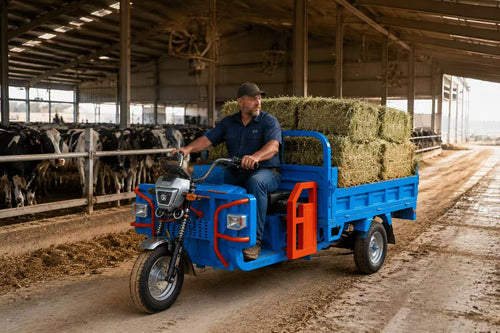
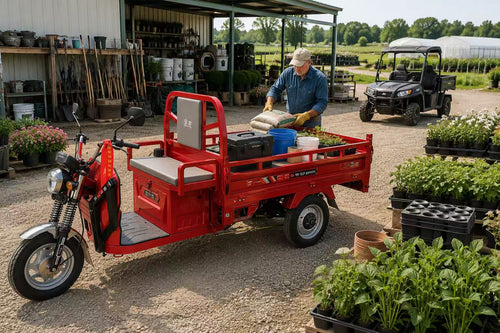
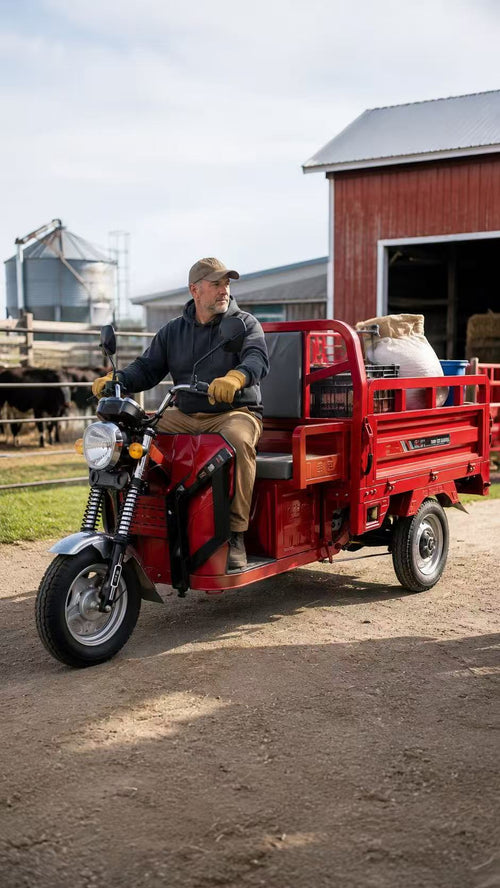
The Fastest Load Is Not Always the Fullest Load: Planning Partial Loads for Electric Dump Cart Work
Share
Many people judge a dump cart by one question first:
How much can it carry?
That question matters. Payload capacity is important when choosing an electric dump cart for farm work, ranch cleanup, horse stable maintenance, landscaping jobs, nursery work, property maintenance, and small construction hauling.
But in daily work, another question may be even more useful:
How much should it carry each trip?
The fastest load is not always the fullest load. In repeated short-distance hauling, the best load is the one that helps the whole workflow move smoothly. A slightly smaller, lower, and easier-to-control load can sometimes help workers load faster, turn easier, dump cleaner, return sooner, and repeat the route with fewer interruptions.
This does not mean capacity is unimportant. It means capacity is the upper limit, not always the daily target.
A practical electric dump cart workflow is not about proving that every trip can be full. It is about moving material efficiently all day.
Capacity is a limit, not a daily target
Payload capacity tells you what the vehicle is designed to handle under appropriate conditions. It helps buyers understand whether the vehicle is suitable for soil, gravel, manure, mulch, compost, wood chips, bedding waste, sand, tools, debris, or other materials.
But the rated capacity should not be treated as a goal for every trip.
Real work conditions change. The ground may be firm or soft. The route may be straight or tight. The material may be dry or wet. The loading area may be open or crowded. The dump zone may be wide or narrow. The operator may need to turn through a gate, pass a barn aisle, climb a mild grade, or stop near other workers.
A load that is acceptable in one condition may be too much in another condition.
The smarter approach is to choose a practical load size for the job, not automatically chase the maximum load every time.
Why full loads are not always faster
A full load may seem efficient because it reduces the number of trips. But if each full load takes longer to prepare, move, unload, and clean up, the total workday may not improve.
For example, workers may spend extra time trying to level the material, push down loose debris, shovel more carefully, clear material from the edges, or adjust the load so it does not spill. The operator may drive more slowly because the load feels heavy or tall. The vehicle may take more space to turn. Unloading may become less clean. The dump zone may require additional raking or spreading after each trip.
In that situation, a slightly smaller load may move through the whole loop faster.
The goal is not simply fewer trips. The goal is fewer delays.
Loading time matters
The first place where overfilling can waste time is the loading point.
When workers try to fill the cargo bed to the top every time, loading can become slower. They may need to shovel more carefully, rearrange material, push down loose mulch or wood chips, knock material away from the sides, or clean up what falls near the bed.
This is especially common with bulky or irregular materials such as mulch, wood chips, manure bedding waste, yard debris, branches, leaves, and mixed cleanup material.
A practical partial load can be faster because it does not require perfect shaping. Workers load the cart to a controlled level, keep the material inside the bed, and move on.
In repeated work, saving a small amount of loading time on each trip can matter more than squeezing extra material into one load.
Route control matters
The second place where load size matters is the route.
A lower and more controlled load is usually easier to move through tight or busy work areas. This matters on farms, horse stables, ranch lanes, nursery paths, landscaping sites, apartment communities, and small construction cleanup areas.
A vehicle may need to pass through gates, barn entrances, gravel roads, compacted dirt paths, driveway edges, tool areas, or narrow spaces near material piles. If the load is too high or too heavy, the operator may move more slowly, turn more carefully, or avoid certain paths.
That can reduce efficiency.
A partial load can make the vehicle easier to manage, especially when the route includes tight turns, mixed surfaces, or repeated stopping and starting.
Dumping cleaner matters
A dump cart is not only used to carry material. It must also unload material cleanly.
If the cargo bed is overfilled, loose material may pile too high, shift unevenly, or leave more residue after dumping. The material may land in a less controlled pile, spread too far, or require extra raking and cleanup after each trip.
This is especially important when placing material in a planned dump zone.
For mulch, compost, soil, manure, bedding waste, wood chips, sand, and gravel, the operator often wants the material to land in a practical location, not scatter across a path, block the next trip, or create a messy pile that must be moved again.
A controlled load often dumps cleaner than a forced full load.
Cleaner dumping can reduce follow-up labor.
Different materials need different load habits
Not all materials behave the same way.
Gravel and sand are dense. A load does not need to look full to become heavy. These materials are better handled in low, controlled loads that keep weight stable and reduce strain on the route.
Wet soil and compost can change quickly. A dry-looking pile may become much heavier after rain or irrigation. When moisture increases, a partial load may be more practical than filling the bed by volume.
Manure and bedding waste can be bulky and uneven. It may fill the bed quickly but weigh less than gravel. Still, if piled too high, it can fall from the sides or make unloading messy.
Mulch and wood chips are often lighter but bulky. Workers may be tempted to mound them above the bed. That can slow loading, increase loose material around the vehicle, and make the load less controlled.
Yard debris, branches, leaves, and mixed cleanup material may have irregular shapes. A smaller, better-contained load is often easier to move than a tall pile that catches on gates, tools, or surrounding objects.
The right load size depends on the material, not only the vehicle.
Partial loads can protect the workflow
Partial loads are not only about safety or comfort. They also protect the rhythm of the work.
In a repeated hauling loop, each trip includes several steps: approach the loading point, load material, leave the loading area, travel the route, reach the dump zone, unload, move away, return, and repeat.
If a full load creates delay in any part of that loop, the entire rhythm slows down.
A practical load keeps the loop repeatable.
The vehicle is easier to load. The route feels more predictable. The dump is cleaner. The operator returns sooner. The crew does not stop as often to fix spills, clear paths, reshape piles, or reposition the cart.
In daily work, repeatability is valuable.
When a fuller load does make sense
Partial loads are not always better.
A fuller load can make sense when the material is light, the route is firm and open, the dump zone is wide, the operator has clear space to turn, and the material stays inside the bed easily.
For example, dry mulch, dry wood chips, leaves, lightweight bedding, or loose yard debris may be carried in larger volumes if the load remains controlled and the route allows it.
The point is not to avoid full loads completely.
The point is to avoid assuming that full is always best.
The operator should choose the load size based on the day’s material, surface, route, dump zone, and available labor.
One overloaded trip can slow the next three
A common mistake is judging only one trip at a time.
A worker may think a heavy full load saves time because it carries more material once. But if that load causes a spill, leaves material stuck in the bed, blocks the dump zone, forces slow turning, or requires cleanup, the next trip may start late.
If this happens repeatedly, one overloaded trip can slow several trips after it.
Short-distance hauling is about total cycle time, not one impressive load.
The best load is the one that keeps the entire cycle smooth.
How small crews should choose load size
Small crews should choose load size by watching the workflow, not just the bed.
A practical load size should allow workers to load without excessive shaping or cleanup. The material should stay inside the cargo bed. The vehicle should turn comfortably. The route should remain clear. The dump should be controlled. The operator should be able to lower the bed, leave the dump area, and return without extra correction.
If a load creates repeated problems, it is too much for that work condition, even if it is below the rated capacity.
A good operator adjusts the load based on real conditions.
Questions to ask before filling the bed
Before filling the cargo bed completely, workers should ask a few practical questions.
Is the material dense or bulky?
Is it wet or dry?
Will it stay inside the bed?
Will the route require tight turns?
Is the ground firm enough?
Will the load dump cleanly?
Will a tall pile block visibility or control?
Will extra loading time save time or waste time?
Will this load make the next trip easier or harder?
These questions help workers choose a useful load, not just a maximum load.
The fastest load is the one that keeps moving
An electric dump cart is valuable because it reduces repeated manual hauling. It helps workers move soil, gravel, manure, compost, mulch, wood chips, bedding waste, sand, tools, and debris across short distances with less effort.
But the best results come from matching the load to the workflow.
A full load may be right in some situations. A partial load may be better in others. The decision should depend on material weight, route condition, loading time, turning space, dumping control, and how many times the trip must repeat.
Capacity tells you what the vehicle can carry.
Workflow tells you what the vehicle should carry.
The fastest load is not always the fullest load. It is the load that keeps the job moving smoothly from the first trip to the last.