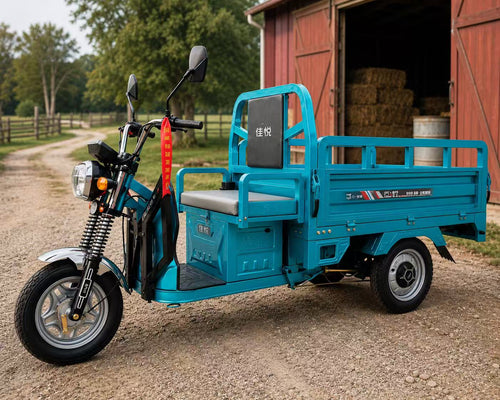
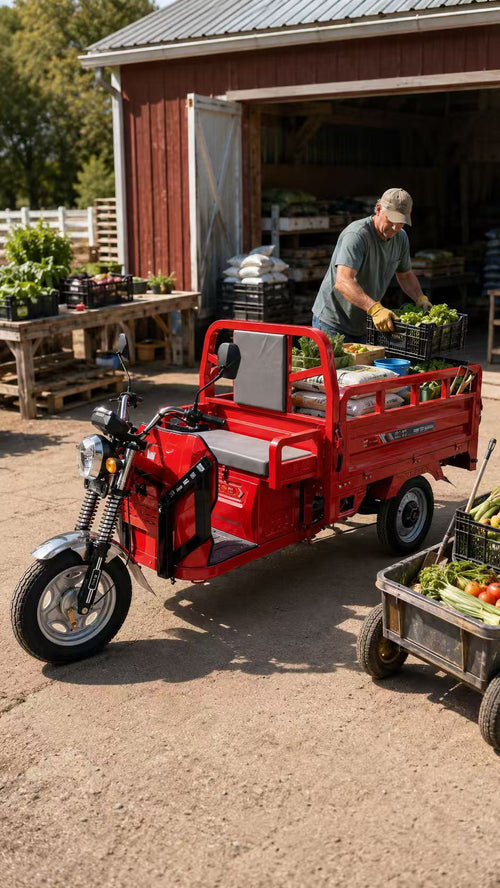
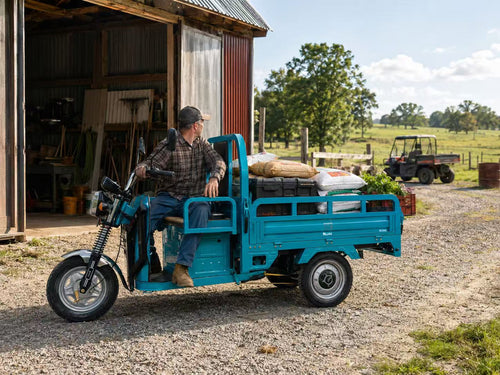
Wheelbarrow or 1500W Electric Dump Vehicle for Moving Mulch and Soil?
Share
A pile of mulch or topsoil may look manageable when it first arrives.
The real difficulty begins when the material must be moved from the driveway to garden beds, barns, fence lines, orchards, landscaping areas, or other work points across a large property.
For a small project, a wheelbarrow may be the simplest and most economical choice.
For repeated trips, heavier material, longer routes, or regular property maintenance, the better question is:
Should you continue using a wheelbarrow, choose a garden cart, or use a powered electric dump vehicle?
The answer depends on the amount of material, travel distance, ground conditions, unloading frequency, and how often the work must be repeated.
When Is a Wheelbarrow Still the Right Choice?
A wheelbarrow remains practical when the job is small, occasional, and close to the material pile.
It may be enough when:
The route is short.
Only a few loads are required.
The ground is firm and reasonably level.
The load can be controlled safely.
The user is comfortable lifting, balancing, pushing, and dumping the material.
A wheelbarrow is also useful in narrow spaces and around tight corners. It has a low purchase cost, requires little storage space, and does not need charging or mechanical maintenance.
There is no reason to buy powered equipment for a small flower bed or a one-time light landscaping project.
The limitation is not that a wheelbarrow cannot carry mulch or soil.
The limitation appears when the same trip must be repeated many times.
Why Do Mulch and Soil Jobs Become Difficult So Quickly?
Mulch is often bulky but relatively light.
Dry compost and wood chips may also be manageable in a manual cart.
Topsoil, wet compost, manure, gravel, and damp landscaping material can become much heavier.
The difficulty increases when:
The pile is far from the unloading area.
The route crosses grass, gravel, compacted soil, or uneven private paths.
The property has several work areas.
The load must be moved repeatedly throughout the day.
The user must lift the handles and balance the load on every trip.
The material must also be lifted or tipped again during unloading.
One trip may not be difficult.
Twenty, forty, or more repeated trips can turn a simple property project into a long and physically demanding job.
Would a Four-Wheel Garden Cart Be Enough?
A four-wheel garden cart can be easier to balance than a traditional single-wheel wheelbarrow.
It may work well for bags of mulch, plants, tools, branches, boxes, and moderate loose material on a relatively smooth route.
A manual dump cart can also make unloading easier.
However, the user still needs to pull or push the loaded cart. As the load, distance, slope, or number of trips increases, the cart does not remove the main source of effort.
A garden cart is therefore a useful middle option:
More stable than a wheelbarrow.
Less expensive than a powered vehicle.
Suitable for moderate loads and shorter private-property routes.
Still dependent on manual pulling, pushing, and repeated walking.
When Does a Powered Electric Dump Vehicle Make More Sense?
A powered electric dump vehicle becomes more practical when material movement is no longer a small one-time task.
It may be worth considering when:
Mulch, soil, compost, manure, wood chips, feed, tools, or landscaping materials are moved regularly.
The loading and unloading points are far apart.
The property includes several acres or multiple work zones.
Manual hauling is taking too much time.
Employees or family members are making repeated trips.
The buyer wants to reduce pushing, pulling, balancing, and manual dumping.
A powered vehicle does not load the material by itself.
The buyer still needs an appropriate loading method.
Its value is in carrying the load between work points and, when equipped with hydraulic dumping, reducing the effort required during unloading.
This makes it different from a wheelbarrow and also different from a loader or skid steer.
It is a short-distance material transport tool for private-property work.
Is a 60V 1000W Configuration Enough?
A 60V 1000W electric utility vehicle may be suitable for lighter or moderate work on reasonably firm and level private routes.
Possible uses include:
Moving bagged mulch and soil.
Transporting plants, tools, buckets, and garden supplies.
Carrying dry compost, wood chips, branches, and lighter loose material.
Supporting routine work around gardens, nurseries, barns, warehouses, and private properties.
A buyer should not choose a configuration based only on the motor number.
The actual result also depends on vehicle design, load weight, route slope, tire condition, ground resistance, battery condition, and how the cargo is distributed.
A 1000W configuration may be practical when the work is moderate and the route is suitable.
When Is a 72V 1500W Configuration More Appropriate?
A 72V 1500W configuration may be a better direction when the buyer expects more frequent hauling, heavier loose material, longer daily use, or routes with mild inclines.
It may better match work involving:
Wet soil.
Compost and manure.
Bulk mulch and wood chips.
Landscaping materials.
Gravel in controlled quantities.
Repeated hauling between distant work points.
The larger configuration should not be treated as permission to overload the vehicle or operate on unsafe terrain.
Motor power is only one part of the decision.
The buyer must also consider rated payload, cargo-bed dimensions, braking, route width, slope, ground conditions, battery capacity, and safe unloading space.
Do You Really Need Hydraulic Dumping?
Hydraulic dumping is most valuable when loose material is unloaded frequently.
It can reduce the need to shovel every load out of the cargo bed or manually lift a heavy dump body.
It is especially useful for:
Soil.
Mulch.
Compost.
Manure.
Wood chips.
Sand and small quantities of gravel.
A hydraulic bed does not guarantee that every material will slide out automatically.
Wet clay, compacted soil, tangled branches, and sticky material may still require manual assistance.
For bags, boxes, tools, plants, trays, and other packaged cargo, a fixed cargo bed may be enough.
The buyer should pay for hydraulic dumping when the unloading work justifies it, not simply because the feature looks more powerful.
Check the Route Before Choosing the Vehicle
The route can be more important than the motor specification.
Before purchasing, inspect:
The narrowest gate or passage.
The steepest part of the route.
Soft soil, mud, loose gravel, or deep grass.
Sharp turns.
Low branches and overhead obstacles.
Drainage ditches, holes, curbs, and uneven transitions.
The space available for turning and unloading.
A compact electric dump vehicle can work well on suitable private-property routes, but it is not a replacement for tracked construction equipment, a skid steer, or an off-road vehicle designed for extreme terrain.
Who May Not Need an Electric Dump Vehicle?
A powered dump vehicle may not be necessary when:
The project is small and will only happen once.
The hauling distance is very short.
Only lightweight material is being moved.
A wheelbarrow or manual cart already completes the work comfortably.
The route is too steep, muddy, rough, or narrow for the vehicle.
The buyer needs excavation, loading, towing, or heavy construction functions.
The buyer mainly needs public-road transportation.
In these situations, a wheelbarrow, garden cart, rental machine, compact loader, tractor, UTV, or another tool may be more appropriate.
The goal is not to sell the largest machine.
The goal is to match the equipment to the actual work.
A Simple Decision Guide
Choose a wheelbarrow when the job is small, close, occasional, and easy to control.
Choose a manual garden cart when greater stability and moderate carrying capacity are needed, but the route and workload are still manageable by hand.
Consider a 60V 1000W electric utility vehicle for lighter or moderate repeated transport on suitable private routes.
Consider a 72V 1500W electric dump vehicle when the work involves more frequent hauling, heavier loose material, longer routes, or regular hydraulic unloading.
Choose larger construction or agricultural equipment when the work involves excavation, extreme terrain, major towing, or continuous heavy-duty operation.
Final Answer
The easiest way to move mulch and soil is not the same for every property.
For a few short trips, a wheelbarrow may remain the best tool.
For moderate work, a four-wheel garden cart may reduce balancing effort.
When the job involves repeated hauling across a large yard, farm, nursery, ranch, landscaping property, or other private work area, a powered electric dump vehicle can reduce manual transport and make unloading more practical.
Before choosing between 60V 1000W and 72V 1500W, confirm the material weight, route distance, ground conditions, slope, required payload, cargo-bed size, and unloading method.
The right choice is not automatically the most powerful vehicle.
It is the vehicle that safely matches the work you perform most often.