Don’t Move It Twice: Planning the Loading Point Before Using an Electric Dump Cart
Share
An electric dump cart can reduce hauling labor, but only if the material starts in the right place.
Many farms, ranches, landscaping crews, horse stables, nurseries, and property maintenance teams focus on the vehicle itself. They compare payload, dump bed function, battery range, cargo bed size, and price. Those details matter. But one important part of the workflow often happens before the vehicle even moves.
Where will the material be loaded?
If soil, gravel, manure, compost, mulch, wood chips, bedding waste, or yard debris is staged poorly, workers may move the same material twice before the electric dump cart begins hauling. That extra handling wastes time, energy, and labor.
A good loading point helps the vehicle work efficiently. A bad loading point can turn a simple material handling job into unnecessary shoveling, dragging, repositioning, and cleanup.
The first labor-saving decision happens before the first load is placed in the cargo bed.
Why does the loading point matter?
The loading point is where the material enters the cargo bed. It may be beside a mulch pile, soil pile, gravel delivery area, compost pile, barn cleanup area, manure collection point, nursery supply zone, or construction cleanup area.
If the loading point is close, firm, open, and easy to approach, the operator can load the vehicle and leave directly. If the loading point is blocked, soft, too narrow, too far away, or poorly placed, workers may need to move material by hand before they can even load the cart.
That defeats part of the purpose of using a powered material handling vehicle.
An electric dump utility vehicle is most useful when the workflow is simple: material pile, loading point, route, dump zone, and return. The smoother that loop is, the more value the vehicle provides.
What is double handling in material hauling?
Double handling means the same material is moved more than once before it reaches the final destination.
For example, mulch may be delivered to the driveway, then shoveled into a temporary pile closer to the yard, then loaded into the electric dump cart, then unloaded near the landscape bed. Soil may be dumped near a barn wall where the vehicle cannot reach, forcing workers to shovel it to another spot before loading. Manure and bedding waste may be collected in small scattered piles before being loaded again for transport to the compost area.
In each case, workers handle the same material more than necessary.
Double handling is easy to miss because it may not look like a major problem. But when the same task repeats many times, the wasted effort becomes part of the workday.
What makes a bad loading point?
A bad loading point makes the vehicle harder to use.
Common problems include material piles placed too far from the route, piles placed against a wall or fence, piles located on soft mud, narrow areas where the vehicle cannot approach, loose material blocking the path, piles placed on a slope, or loading areas without enough turning space.
A bad loading point may also force the worker to shovel material a long distance into the cargo bed. The vehicle may be close, but the shovel distance may still be too long. That means the worker is still doing too much manual labor.
Another common issue is placing material where it blocks the next trip. If the source pile sits in the path, the operator may need to reverse, turn awkwardly, or clear the route before every load.
A good electric dump cart cannot fix a poor loading layout by itself.
What makes a good loading point?
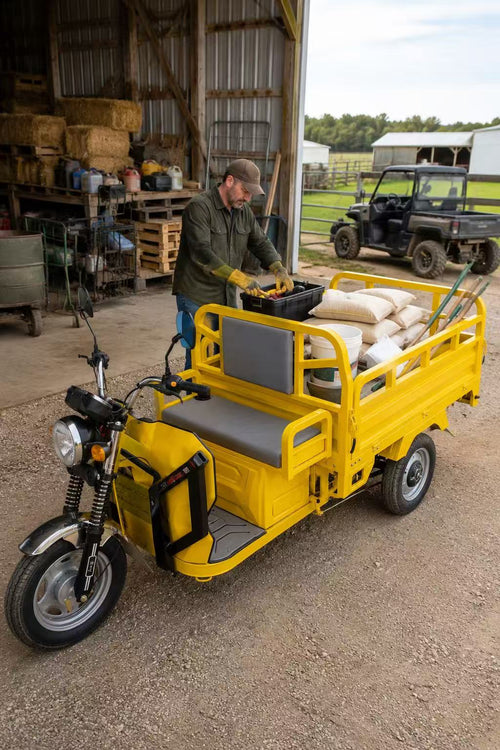
A good loading point should be firm, level, open, and close enough for practical loading.
The vehicle should be able to approach the material safely. The operator should have enough room to stand, shovel, load, turn, and leave. The route from the loading point to the dump zone should be clear and direct. The surface should be strong enough to support the vehicle and load without sinking into mud or soft ground.
A good loading point also keeps the shovel distance short. If workers are loading mulch, soil, compost, gravel, manure, or wood chips by hand, they should not need to carry each shovel load across several feet of wasted space.
The best loading point is not always the closest spot. It is the spot that allows loading, departure, and return without extra handling.
How should mulch and wood chips be staged?
Mulch and wood chips are bulky materials. They may not be as dense as gravel or wet soil, but they can still create a lot of repeated loading work.
For landscaping jobs, mulch should be staged where the electric dump cart can approach easily and leave without backing through tight areas. If the mulch pile is too far from the route, workers may lose time carrying material to the cargo bed. If the pile blocks the driveway or path, the crew may need to move around it during every trip.
Mulch and wood chips should also be kept away from low wet areas when possible. Wet mulch becomes heavier and more difficult to handle. A clean, firm staging area helps keep the loading process faster.
How should gravel and sand be staged?
Gravel and sand should be staged with weight in mind.
These materials are dense. Workers should avoid placing them in a location that requires long shovel throws or repeated manual transfer. A gravel pile should be close enough for controlled loading, but not so close to a wall, fence, ditch, or slope that the vehicle cannot approach safely.
For driveway repair, drainage work, ranch road maintenance, or small construction cleanup, the best gravel loading area is usually firm, level, and directly connected to the hauling route.
Because gravel and sand can become heavy quickly, the loading point should allow the operator to create low, controlled loads instead of forcing rushed or awkward loading.
How should soil and compost be staged?
Soil and compost can change depending on moisture. Dry material may be easier to load. Wet soil or compost can become sticky, heavy, and harder to handle.
A good loading point for soil and compost should avoid soft ground when possible. If the area around the pile becomes muddy, the vehicle may struggle to approach or leave cleanly. Workers may also track mud across the route, creating extra cleanup.
Soil and compost should be placed where the vehicle can get close enough for efficient loading without driving into the pile or blocking the return route.
If the material will be moved many times, a few minutes spent planning the loading point can save repeated effort throughout the day.
How should manure and bedding waste be staged?
Manure and bedding waste need practical staging because they are often moved every day.
In horse stables, livestock areas, poultry areas, dairy barns, and ranch work zones, manure and bedding waste should be collected where the electric dump cart can reach it without blocking animal movement, worker access, or barn exits.
The loading point should be close to the cleanup route and connected to the compost or dump zone route. If workers first move manure to scattered temporary piles and then reload it into the cart later, double handling increases quickly.
A better system is to collect material near a planned loading point, load the cart directly, then move it to the compost area or dump zone.
How should yard debris be staged?
Yard debris, branches, leaves, grass clippings, and cleanup material often become inefficient because they are spread across a large area.
Before using an electric dump cart, workers should gather debris into practical collection points that the vehicle can reach. The goal is not to create one huge pile that is hard to load. The goal is to create organized loading points that reduce walking, dragging, and repeated handling.
For property maintenance, landscaping cleanup, storm cleanup, and park work, several small loading points may be better than one pile placed far away from the route.
The key is to avoid moving debris by hand to a second temporary location unless it truly saves time.
How can small crews reduce wasted shoveling?
Small crews should plan the material flow before the first load.
The crew should identify the source pile, loading point, route, dump zone, and return path. If any part of that loop is blocked or awkward, the job will slow down.
A simple rule helps: do not place material where the vehicle cannot approach, where the worker must carry each shovel load too far, or where the pile blocks the next trip.
Small crews should also avoid creating unnecessary temporary piles. Every temporary pile may become another loading task later.
The more direct the flow, the less wasted shoveling.
Can loading point planning matter more than buying a bigger vehicle?
Yes, in some jobs.
A larger vehicle may carry more per trip, but if the loading point is poorly planned, workers may still waste time before each load. They may need to move material by hand, reposition the vehicle, clear the route, or shovel from an awkward angle.
A compact electric dump hauler with a well-planned loading point can sometimes work more efficiently than a larger vehicle used in a poor layout.
This is especially true for short-distance, high-frequency work. When the route repeats many times, small delays at the loading point become bigger labor costs.
What should buyers and operators check before starting?
Before using an electric dump cart, operators should ask a few practical questions:
Can the vehicle reach the material pile?
Is the loading surface firm enough?
Is there enough room to turn and leave?
Is the shovel distance short?
Is the pile blocking the route?
Will workers need to move the material twice?
Is the loading point connected to the dump zone route?
Will the same setup work for repeated loads?
These questions help the operator find problems before the hauling begins.
The best hauling workflow starts at the loading point
An electric dump cart is designed to reduce short-distance material handling labor. But the vehicle works best when the jobsite layout supports the workflow.
If the material starts in the wrong place, workers may waste time before the vehicle even begins moving. If the loading point is planned well, the cart can do what it is meant to do: carry material efficiently from the source area to the dump zone and return for the next load.
For soil, gravel, manure, compost, mulch, wood chips, bedding waste, sand, and yard debris, loading point planning is not a small detail. It is part of the material handling system.
Do not move the same material twice if one planned loading point can help you move it once.