Hard to Get On and Off? Why Operator Entry and Control Reach Matter in a Powered Dump Hauler
Share
A powered dump hauler is often judged by what it can carry.
Buyers look at the cargo bed, load capacity, dump function, battery range, tires, ground clearance, turning space, and whether the vehicle can handle farm, stable, nursery, greenhouse, ranch, landscaping, or property maintenance work.
Those details are important.
But there is another question many buyers forget:
Can the operator get on and off easily?
A powered dump hauler, electric dump cart, electric work trike, powered wheelbarrow, motorized wheelbarrow, battery-powered utility cart, or compact farm utility vehicle may be used many times in one day. The operator may stop, step out, open a gate, move a bag, check a load, unload tools, inspect the cargo bed, park near a barn, then get back in and continue.
If the operator area is awkward, the vehicle may not be used as often as expected.
A strong hauler on paper can still become frustrating if the seat position feels wrong, the step area is hard to use, the handlebar is not easy to reach, or the operator must twist, climb, or stretch every time they use it.
For daily work, operator access matters.
Entry and exit affect repeated use
One trip may not seem like much.
But daily hauling work is usually repeated.
A horse stable worker may clean bedding, move manure, return tools, carry feed bags, and make several short trips each morning. A farm worker may move supplies between a barn, shed, field edge, and storage area. A nursery worker may stop near plant rows, greenhouse doors, and supply stacks. A property maintenance worker may move around sidewalks, equipment rooms, courtyards, and landscape areas.
Each stop may require the operator to get on and off.
That is why entry and exit should be part of the buying decision.
If the operator can step in naturally, sit comfortably, reach the controls, and step out without effort, the vehicle feels easier to use. If every movement feels awkward, the operator may avoid using the vehicle for smaller jobs.
That reduces the value of the hauler.
A low-speed work vehicle still needs good ergonomics
Some buyers assume ergonomics only matter for cars, trucks, UTVs, or long-distance vehicles.
That is not true.
A low-speed powered dump hauler is still used by a person.
The operator still needs a comfortable position, clear reach, stable footing, and enough space to move safely. Even if the route is short, poor ergonomics can make repeated work tiring.
This matters especially for older farm owners, horse stable workers, property maintenance staff, nursery workers, landscaping crews, and anyone who uses the vehicle many times per day.
The vehicle does not need luxury seating.
It needs practical operator fit.
Seat height should match daily work
Seat height can affect how natural the vehicle feels.
If the seat is too high, the operator may feel like they are climbing in. If it is too low, standing up repeatedly may feel tiring. If the seat is too far from the controls, the operator may stretch. If the seat is too close, the body position may feel cramped.
The right seat position depends on the operator and the work.
A farm owner using the vehicle for a few trips may have different expectations than a stable worker using it all morning. A property crew with several workers may need a setup that works for different body sizes.
Before buying, the operator should imagine the full work cycle:
Sit down.
Reach the controls.
Check the route.
Drive slowly.
Stop.
Step out.
Load or unload.
Get back in.
Repeat.
If that cycle feels awkward, the vehicle may not fit the work as well as expected.
Step-in access can matter more than buyers expect
Step-in access is easy to overlook in product photos.
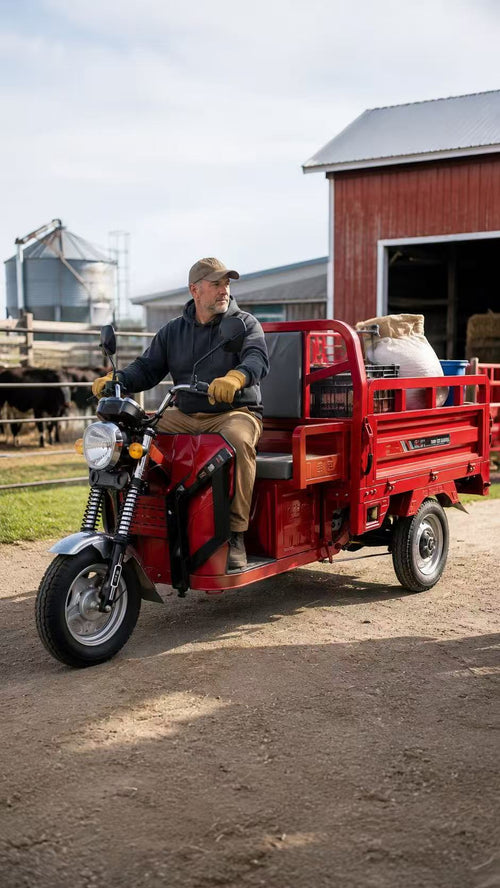
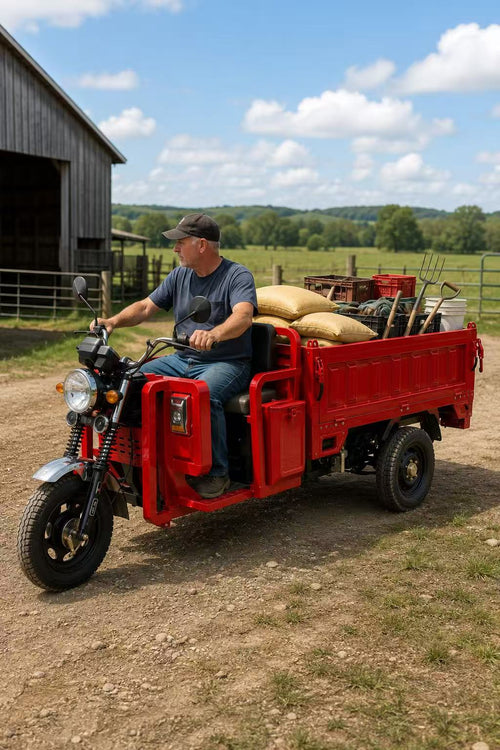
A buyer may look at the cargo bed and ignore the operator area. But in real use, the step, floorboard, side opening, handhold, seat edge, and handlebar position all affect entry and exit.
The operator should not need to climb awkwardly, squeeze past a rail, or twist around the seat every time they use the vehicle.
A practical powered dump hauler should allow the operator to enter and exit with controlled movement.
This is especially important when the work area has gravel, wet concrete, barn dust, mud, hay, or uneven ground. The operator may be wearing work boots. They may be carrying gloves, a small tool, a bucket, or a feed scoop.
The vehicle should make entry easier, not harder.
Control reach affects confidence
Control reach is one of the most important operator details.
The operator should be able to reach the handlebar, throttle, brake, switches, reverse control, and other basic controls without stretching or leaning too far.
If the controls feel too far away, the operator may sit forward in an uncomfortable way. If the controls are too close, turning may feel cramped. If switches are hard to find, the operator may lose focus while working.
Good control reach supports calm, low-speed operation.
This matters around barns, fences, animals, greenhouse lanes, property sidewalks, parked equipment, gates, trailers, and material piles.
A powered dump hauler is often used in tight work areas. The operator should not fight the control layout while also watching the route.
Handholds and side rails should support movement
When workers get on and off a vehicle, they often use nearby rails, handles, or body structure for balance.
A practical operator area should provide stable points that feel natural to use.
This does not mean the vehicle needs complex features. It means the operator should feel supported when entering and exiting.
Side rails, frame structure, arm supports, or open side access can help the operator move with better control.
This is useful when the vehicle is used on gravel, near barns, beside a manure pile, in a nursery yard, or around a property maintenance area where the ground may not be perfectly smooth.
A stable entry movement helps the operator start each trip with more confidence.
Older operators may notice access problems faster
Many powered dump hauler buyers are not young warehouse workers.
Some are farm owners, acreage owners, horse property owners, ranch workers, stable managers, nursery operators, or maintenance workers in their 50s, 60s, or beyond.
For these users, easy entry and comfortable reach can be more important than it looks.
A vehicle that is technically powerful but awkward to enter may not be the best choice for daily work. If the operator has knee stiffness, back discomfort, limited flexibility, or simply does not want to climb repeatedly, access design matters.
This does not mean the hauler is only for older users.
It means the buying decision should consider the real person who will use it.
A practical work vehicle should reduce labor, not add a new physical burden.
Frequent stop-and-go work changes the buying decision
Some jobs require long movement.
Other jobs require frequent stop-and-go work.
A horse stable worker may stop at every stall area. A nursery worker may stop at plant benches. A property maintenance worker may stop at several buildings. A farm worker may open and close gates. A landscaping crew may stop beside mulch piles, tools, and garden beds.
In stop-and-go work, entry and exit become part of the job.
If the operator needs to step out ten, twenty, or thirty times, the operator area becomes just as important as the cargo bed.
A buyer should not only ask whether the hauler can carry the load.
They should ask whether the operator can use it repeatedly without frustration.
The operator should see the work area clearly
Entry, seat position, and control reach connect directly with visibility.
If the operator sits too low, too far back, or at an awkward angle, it may be harder to see the front wheel, route edges, cargo bed area, gates, animals, people, or obstacles.
A powered dump hauler often works close to objects.
Barn posts.
Fence gates.
Greenhouse benches.
Plant trays.
Tool racks.
Parked equipment.
Feed rooms.
Stable doors.
Sidewalk edges.
Mulch piles.
Concrete pads.
Trailer ramps.
The operator should be able to look around naturally and understand where the vehicle is moving.
Good visibility makes low-speed work more predictable.
Cab and roof designs should not block access
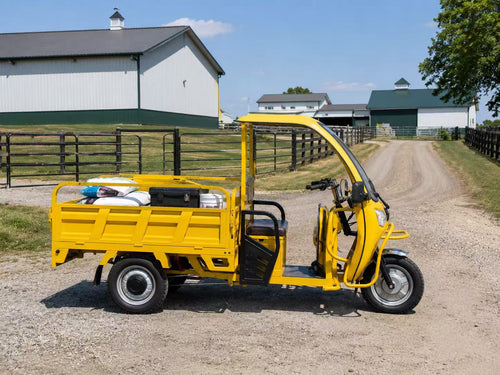
A roof, windshield, or partial cab can be useful for weather protection, sun protection, or low-light work.
But cab design should not make entry difficult.
If the operator must bend sharply, squeeze through a narrow side opening, or work around a poorly placed frame post, the cab may reduce daily convenience.
This does not mean cab protection is bad. It means the cab should support the operator, not block the operator.
The best design balances protection, visibility, and access.
A buyer should look at the side opening, seat position, floorboard, handholds, and controls together.
Operator comfort is a system, not one feature.
Cargo work should not fight the operator position
Many operators use the same vehicle for driving, loading, checking, and unloading.
They may sit down to move the vehicle, step out to check the cargo bed, adjust a feed bag, move a toolbox, unload supplies, open a gate, or inspect the dump area.
If the operator area makes it hard to move between driving and working, the job slows down.
For example, a worker who must climb out awkwardly just to check a load may skip the check. A worker who cannot reach controls naturally may rush. A worker who feels cramped may avoid using the hauler for quick tasks.
The vehicle should fit the work rhythm.
Drive.
Stop.
Step out.
Work beside the bed.
Step back in.
Move again.
When this rhythm feels natural, the hauler becomes more useful.
Different operators may share one hauler
On farms, stables, nurseries, and property maintenance teams, one powered dump hauler may be used by several people.
One operator may be tall. Another may be shorter. One may be older. Another may be stronger. One may use the vehicle for feed bags. Another may use it for tools or bedding waste.
That makes operator fit more important.
If only one person can use the vehicle comfortably, the hauler may become less flexible.
Before buying, a team should consider who will actually operate it.
Can different workers reach the controls?
Can they enter and exit safely?
Can they see the route?
Can they use the vehicle without special effort?
A work vehicle should support the team, not only the buyer who selected it.
Foot space matters during daily operation
Foot space is another detail that product photos may hide.
The operator needs a place to position their feet naturally. The floorboard or footrest should allow stable posture. Work boots should fit. The operator should not feel like their feet are sliding, cramped, or placed at an awkward angle.
This matters in real work conditions.
Boots may be wet. Gravel may be loose. Barn dust may be present. The operator may carry dirt or moisture into the foot area. The vehicle may be used in morning dew, light rain, or muddy yards.
Good foot space helps the operator maintain balance and control when entering, sitting, stopping, and stepping out.
Easy access can reduce small-task resistance
One reason people buy powered dump haulers is to reduce manual hauling.
But if the vehicle is annoying to use, workers may return to a wheelbarrow or hand carry for small tasks.
This is important.
A vehicle that is easy to access may be used for more jobs:
moving feed bags,
carrying tools,
hauling bedding,
transporting soil bags,
moving plant trays,
collecting yard debris,
carrying cleaning supplies,
moving mulch,
returning buckets,
organizing small repairs.
A vehicle that is hard to get on and off may only be used for larger jobs.
That means the buyer gets less value from the machine.
Easy entry can make the hauler part of daily routine.
Operator access is different from cargo loading height
Some buyers confuse operator access with cargo loading height.
They are different.
Cargo loading height is about how easy it is to put material into the bed.
Operator access is about how easy it is for the person to use the vehicle.
A cargo bed may be the right height, but the operator area may still feel awkward. Or the operator area may feel comfortable, but the cargo bed may be too high for certain loading tasks.
Both details matter.
A good buying decision considers the whole workflow:
How the operator gets in.
How they sit.
How they reach controls.
How they see.
How they load.
How they unload.
How they repeat the task.
Property maintenance work needs fast, clean access
Property maintenance teams often move between many small tasks.
They may carry tools, cleaning supplies, trash bags, mulch, soil, parts, or small equipment across apartment communities, HOA areas, schools, resorts, parks, or private estates.
In these settings, the operator may stop often.
Easy entry and exit can help the worker move efficiently without looking clumsy or struggling with the vehicle.
This matters because property work is often visible to residents, customers, visitors, or managers.
A practical powered dump hauler should look organized and be easy to use in public-facing private spaces.
The operator should be able to stop, step out, complete the task, and continue without difficulty.
Horse stable work needs calm movement
Horse stable work requires calm, predictable movement.
The operator may work near animals, stall doors, tack rooms, feed rooms, wash areas, riders, dogs, and other workers.
If the operator has to climb awkwardly, rush, or struggle to get in and out, the work feels less controlled.
A stable environment benefits from smooth routines.
The worker should be able to enter the vehicle, move slowly, stop clearly, step out, handle material, and continue calmly.
Easy access helps support that rhythm.
For horse stable buyers, operator access is not only comfort. It is part of safe, quiet daily handling.
Nursery and greenhouse workers need quick repeated stops
Nurseries and greenhouses often involve frequent stops in tight spaces.
Workers may move trays, soil bags, irrigation parts, tools, pots, and plant material between rows, benches, loading areas, and storage points.
The operator may need to step out many times.
A comfortable entry area, stable foot position, and easy control reach can make these repeated movements smoother.
If the hauler feels awkward in tight greenhouse or nursery routes, the worker may avoid it.
For this type of work, compact size and cargo capacity are not enough. Operator access also matters.
Farm and ranch routes may require gates and checks
Farm and ranch work often includes gates, fences, sheds, feeding areas, barns, equipment yards, and livestock spaces.
The operator may need to get on and off to open a gate, move a chain, check an animal area, inspect a load, or reposition material.
This is not continuous driving.
It is repeated work.
A powered dump hauler used on farms and ranches should make these small transitions easy.
If the operator can step out naturally and return quickly, the vehicle fits the route better.
If the operator has to climb or twist every time, the hauler may feel less practical.
Ask these operator access questions before buying
Before choosing a powered dump hauler, buyers should ask:
Can the main operator get on and off easily?
Is the seat height comfortable?
Is the step area stable?
Can work boots fit naturally?
Can the operator reach the handlebar and controls without stretching?
Can the operator see the route and cargo bed area?
Will several people share the vehicle?
Will the work require frequent stops?
Will the operator need to open gates, check loads, or step out often?
Does the roof, windshield, or cab make entry easier or harder?
Will older operators feel comfortable using it daily?
These questions help buyers choose for real use, not only product specifications.
A hauler must fit the person, not only the load
A powered dump hauler may have the right cargo bed, good tires, strong carrying ability, and useful dump function.
But if the operator does not like using it, the machine may sit more than expected.
Daily-use equipment must fit both the job and the person.
The operator should be able to enter, sit, reach, see, stop, step out, and repeat without unnecessary effort.
That is why entry, seat position, control reach, foot space, and visibility deserve attention before purchase.
A powered dump hauler is not only a vehicle for moving material.
It is a daily work tool.
When the operator can use it comfortably, the hauler is more likely to become part of the routine.
When access is awkward, even a strong machine may be used less.
Before buying, look beyond the load rating.
Look at the person who will use the vehicle every day.