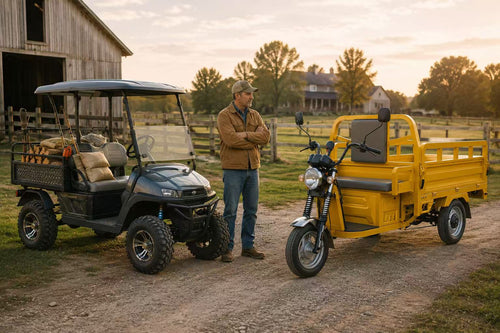
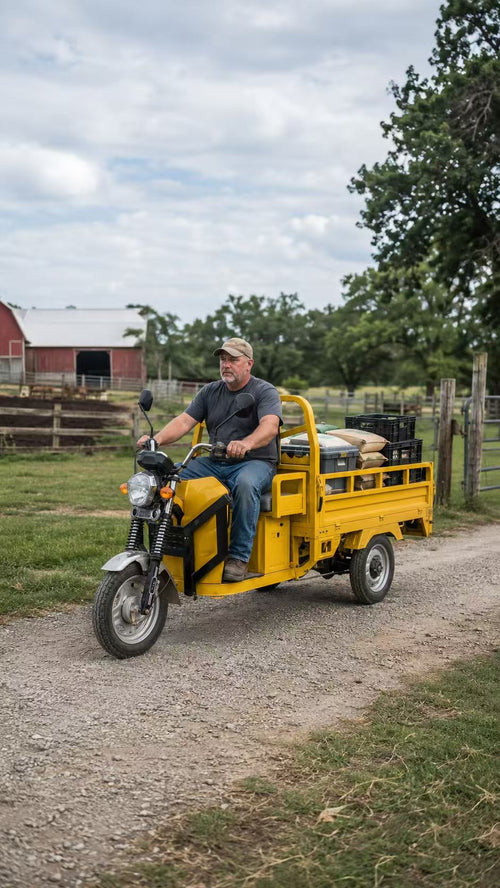
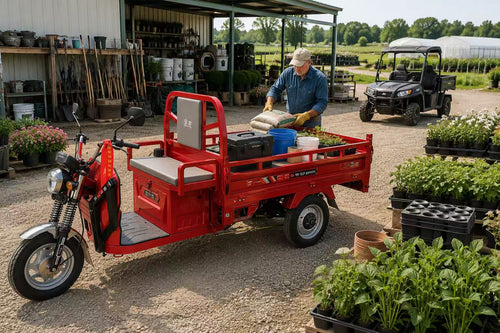
Open Cab or Enclosed Cab? Choosing Operator Weather Protection for a Powered Dump Hauler
Share
A powered dump hauler is usually purchased for material handling.
Buyers think about the cargo bed, dump function, load capacity, battery range, tires, route access, turning space, and daily work use.
Those details matter.
But the operator also matters.
A powered dump hauler, electric dump cart, electric work trike, powered wheelbarrow, motorized wheelbarrow, or battery-powered utility cart may be used for many short trips during a workday. The operator may move feed bags, mulch, compost, tools, manure bedding waste, soil bags, plant material, yard debris, or maintenance supplies across a farm, horse stable, nursery, greenhouse, ranch, landscaping job, or property maintenance route.
If the route is short and the weather is mild, an open operator area may be enough.
But if the work happens in rain, wind, dust, cold mornings, strong sun, animal areas, or long daily routes, a roof, windshield, or enclosed cab can become more valuable.
The question is not only:
How much can the vehicle carry?
The better question is:
How comfortable and protected will the operator be during repeated daily use?
Operator protection affects daily use
A work vehicle is only useful if workers are willing to use it consistently.
If the operator gets soaked during light rain, blasted by wind on open farm lanes, covered in dust on dry ranch roads, chilled during cold morning stable work, or exposed during long property maintenance routes, the vehicle may feel less practical.
A powered dump hauler with a covered or enclosed operator area can make certain jobs more comfortable.
This does not mean every buyer needs an enclosed cab.
It means buyers should match operator protection to the real work environment.
A farm in a dry warm region may need different protection than a horse stable in a rainy region or a property maintenance team working early mornings in cold weather.
Open cab designs can be simple and practical
An open cab or open operator area has advantages.
It can feel easy to enter and exit. It may offer better airflow in warm weather. It can make quick loading, checking, and repositioning feel simple. It may be enough for short trips in mild conditions.
For some farms, nurseries, landscaping yards, and private properties, this may be completely practical.
If the vehicle is used mainly during dry weather, on short routes, with one operator, and in low-exposure areas, an open design can work well.
Open cab designs can also be easier to clean around because the operator area is less enclosed.
The key is not to assume open is bad.
The key is to ask whether open is enough for the job.
Enclosed cab protection can matter in changing weather
An enclosed cab, roof, windshield, or covered operator area can help when the operator works in more exposed conditions.
Light rain.
Cold wind.
Dusty lanes.
Morning chill.
Long property routes.
Stable work before sunrise.
Open ranch lanes.
Nursery work in changing weather.
Apartment or HOA maintenance routes during drizzle.
These conditions can make repeated trips uncomfortable.
A covered operator area can help reduce direct wind and rain exposure. A windshield can help block airflow and light debris. Doors or side panels may provide more protection in cold or wet conditions.
For buyers who expect frequent outdoor use, operator weather protection may be worth considering before purchase.
Rain protection is different from wet-ground use
Rain protection and wet-ground use are related, but not the same.
Wet-ground use is about traction, route condition, electric equipment care, charging habits, and avoiding deep water.
Operator rain protection is about the person driving or guiding the vehicle.
A powered dump hauler may be able to work after light rain, but the operator may still be uncomfortable if there is no roof or windshield. A vehicle may move well on firm wet gravel, but wind-driven drizzle can still make work unpleasant.
That is why cab protection deserves its own buying decision.
Buyers should think about both the route and the operator.
Can the ground support the vehicle?
Can the operator stay comfortable enough to complete repeated trips?
Can the controls remain visible and easy to use?
Can the cab or windshield help without creating visibility problems?
Wind can make open routes tiring
Wind is easy to overlook.
On open farm lanes, ranch roads, orchard paths, nursery lanes, and property maintenance routes, wind can make low-speed work feel colder and less comfortable than expected.
This is especially true in early morning or late-season work.
A windshield or enclosed cab can reduce direct wind on the operator. That may make repeated short trips more tolerable.
Wind protection is not only about comfort.
If the operator is cold, distracted, or rushing to finish, the quality of the work may suffer. Slow control, careful turning, and proper load handling all depend on an operator who is comfortable enough to focus.
For exposed routes, cab protection can support better work habits.
Cold mornings change the value of a cab
Many farms and stables start early.
A horse stable worker may begin manure cleanup before the day warms up. A farm worker may move feed bags or tools in the early morning. A property maintenance crew may start before residents are active. A nursery team may move supplies before customers arrive.
In these conditions, cold air can affect operator comfort.
A roof, windshield, and enclosed cab can make cold morning work more practical.
This does not mean the vehicle should be treated like a heated truck. Most compact utility vehicles are still work vehicles, not comfort vehicles.
But even basic wind and weather protection can make repeated short-distance hauling less tiring.
For buyers in colder regions, cab protection may matter more than they first expect.
Dust protection can matter on farms and ranches
Dry farm lanes, ranch roads, gravel yards, nursery paths, and landscaping material areas can create dust.
A powered dump hauler may move at low speed, but repeated trips through dusty areas can still affect the operator.
A windshield and cab structure may help reduce direct dust exposure compared with a fully open operator area.
This is useful when moving feed bags, tools, fencing supplies, compost, gravel, mulch, or soil around dry private work areas.
Dust protection is not only about comfort. It can help the operator keep better visibility and focus.
However, buyers should also remember that enclosed areas need cleaning.
A cab or windshield that collects dust should be wiped or cleaned so visibility stays clear.
Visibility is still more important than protection
A cab, roof, or windshield should not reduce safe visibility.
The operator must still see the route, cargo bed area, nearby people, animals, gates, posts, tools, plants, buildings, and unloading area.
This matters especially in horse stables, greenhouses, nurseries, apartment properties, HOA communities, and crowded farm work areas.
A windshield should be clean. Side windows or panels should not create blind spots. Mirrors, if included, should be useful and properly positioned. The operator should still be able to judge turns, reverse movement, and rear clearance.
More enclosure is not always better if it makes the vehicle harder to operate.
The best cab design protects the operator while keeping visibility practical.
A roof helps with sun as well as rain
Many buyers think about roofs only for rain.
But sun exposure also matters.
In hot or sunny regions, a roof can reduce direct sunlight on the operator. This can help during repeated trips across nurseries, farms, orchards, landscaping jobs, ranch lanes, and property maintenance areas.
A roof does not make outdoor work effortless.
But it can reduce exposure during daily operation.
For buyers in warm climates, operator protection may be less about cold weather and more about shade.
A covered operator area can make the vehicle feel more practical during long summer workdays.
Enclosed does not always mean better for every job
An enclosed cab can be useful, but it is not automatically the best choice for every buyer.
In hot climates, a very enclosed operator area may feel warm if airflow is limited. In jobs with constant entry and exit, doors or panels may slow the operator down. In dusty work, enclosed surfaces may need regular cleaning. In tight spaces, cab width and door clearance may matter.
A buyer should not choose enclosed only because it looks more complete.
They should choose it because the work environment supports it.
For some farms and properties, an open operator area may be easier and more practical. For others, roof and windshield protection may improve daily use.
The right choice depends on the route, weather, operator time, and work frequency.
Cab protection may matter more on long routes
If the route is only a few yards, operator weather protection may not be a major issue.
But if the vehicle makes repeated trips across a large property, a farm lane, a ranch road, a nursery route, a greenhouse complex, an apartment community, or an HOA maintenance path, comfort matters more.
Small discomfort becomes bigger when repeated.
A little wind on one trip may not matter. A cold breeze for twenty trips may matter. A short drizzle may not matter. A full morning of damp work may matter. A dusty path once may not matter. A dusty path every day may matter.
A powered dump hauler is often valuable because it reduces repeated manual labor.
The operator protection should support that repeated use.
Horse stables may benefit from calmer operator movement
Horse stables are sensitive work environments.
Operators may move manure bedding waste, clean bedding, feed bags, buckets, tools, or stable supplies near horses, riders, visitors, dogs, and workers.
A covered or enclosed operator area can help in certain stable routines, especially in wind, cold mornings, or light rain.
However, stable use also requires visibility and calm operation.
The cab should not make the vehicle feel bulky or difficult to control around stall doors, gates, wash areas, feed rooms, or narrow barn entrances.
For horse stable buyers, the decision is not only comfort.
It is whether the cab supports calm, predictable, low-speed daily work.
Nurseries and greenhouses need both protection and access
Nursery and greenhouse work often includes narrow lanes, plant benches, trays, irrigation lines, damp ground, and frequent stopping.
A roof or windshield may help when workers move between outdoor and covered areas, especially in drizzle, wind, sun, or cold mornings.
But access still matters.
If the operator needs to get in and out often, handle plant trays, check loads, or move through narrow greenhouse service lanes, the cab design should not make work slower.
The vehicle must still fit the route.
The operator must still see plants, benches, workers, customers, and supplies.
A protected cab is useful only when it works with the greenhouse or nursery workflow.
Property maintenance teams may value weather protection
Apartment properties, HOA communities, resorts, schools, parks, and private estates often require visible, organized work.
Maintenance teams may move tools, cleaning supplies, landscape material, trash bags, branches, mulch, soil bags, and repair parts across the property.
These routes may be used in early mornings, light rain, wind, or hot sun.
An enclosed cab or roof can help the operator stay more comfortable and professional-looking during repeated trips.
This can matter on customer-facing properties.
A worker who arrives dry, focused, and organized may make a better impression than one struggling with weather exposure.
However, property teams should still follow slow-speed rules, private-property boundaries, and approved routes.
Cab protection does not change the basic work rules.
Cab design should match loading and unloading habits
The operator area should not interfere with loading and unloading.
Some workers load from the side. Some inspect the cargo bed before every trip. Some use the vehicle for tools, feed bags, mulch, plant trays, or maintenance supplies. Some need to step out frequently to open gates, check animals, move buckets, or organize material.
A more enclosed cab may be comfortable, but the buyer should consider entry and exit.
Can the operator get in and out easily?
Can they check the cargo bed?
Can they reach tools?
Can they open gates?
Can they work beside the vehicle without cab doors or panels getting in the way?
A powered dump hauler should protect the operator without making the work process awkward.
Windshield care is part of daily use
A windshield can be useful, but it must stay clear.
Dust, mud, rain marks, hay dust, pollen, manure area residue, greenhouse moisture, and fingerprints can reduce visibility.
Operators should keep the windshield clean enough for safe low-speed work.
This is especially important when working near people, animals, plants, vehicles, buildings, gates, and equipment.
A dirty windshield can make a protected cab less useful.
For buyers, the question is not only whether the vehicle has a windshield.
The question is whether the windshield remains practical in the daily work environment.
Cab protection does not replace proper clothing
A roof, windshield, or enclosed cab can help, but it does not replace appropriate work clothing.
Farm, stable, landscaping, nursery, and property maintenance workers still need suitable jackets, gloves, boots, rain gear, sun protection, or cold-weather clothing depending on the job.
A powered dump hauler is still outdoor work equipment.
Cab protection reduces exposure during operation, but the operator may still need to step out, load material, open gates, unload supplies, clean the bed, or inspect the route.
The best result comes from matching the vehicle, operator clothing, route, and weather.
Enclosed cab models can support longer work sessions
If a worker uses the vehicle for only a few minutes per day, cab protection may not be a major purchase factor.
If the worker uses it repeatedly for hours, the value changes.
A farm worker carrying feed and tools across a large property.
A stable worker moving bedding and manure several times each morning.
A nursery worker moving supplies between growing areas.
A property maintenance worker covering multiple apartment buildings.
A landscaping crew moving materials across a customer property.
These users may benefit more from operator protection because they spend more time with the vehicle.
The more frequent the trips, the more operator comfort matters.
Open cab models can support fast entry and exit
Open operator areas can still be a strong choice.
They may suit jobs where the operator gets on and off often, moves only short distances, works mostly in dry weather, or needs maximum airflow.
For example, a worker moving tools around a small farmyard, a greenhouse worker making short movements inside a covered area, or a landscaping crew using the vehicle only in dry conditions may not need an enclosed cab.
In these cases, simplicity can be an advantage.
A buyer should not assume the most enclosed option is automatically the most useful.
The best option is the one that matches daily work.
Compare cab needs by material type and route
The material being carried can also influence cab decisions.
A worker carrying clean feed bags in early morning rain may appreciate better protection. A worker moving dusty compost or dry soil on open farm lanes may benefit from a windshield. A worker carrying mulch on a sunny landscaping route may value shade. A worker moving manure bedding waste in a stable may value easy entry and good visibility more than full enclosure.
The load, route, and operator exposure all connect.
Before choosing a powered dump hauler, the buyer should think about where the operator will sit or stand during the work cycle, how often the route repeats, and what weather the operator will face.
Ask these cab protection questions before buying
Before choosing an open cab or enclosed cab powered dump hauler, buyers should ask:
Will the vehicle be used in rain, wind, dust, sun, or cold mornings?
How many trips will the operator make each day?
Is the route open and exposed or mostly covered?
Will the operator enter and exit often?
Will the cab affect visibility in barns, greenhouses, or tight areas?
Will the windshield need frequent cleaning?
Will the vehicle work near animals, residents, customers, or plants?
Is airflow important in hot weather?
Is weather protection more important than fast access?
Does the cab support the actual work routine?
These questions help buyers avoid choosing by appearance alone.
The right cab choice should support the work.
Operator protection can improve consistency
A powered dump hauler is not only a machine for moving materials.
It is also a daily tool used by a person.
If the operator is more comfortable, focused, and protected, the work may become more consistent. The operator may be more willing to use the vehicle for repeated trips instead of returning to a wheelbarrow or hand carrying.
This matters for farms, horse stables, nurseries, greenhouses, landscaping crews, property maintenance teams, and rural properties.
Cab protection is not only about comfort.
It can affect whether the vehicle is used often enough to justify the purchase.
Choose the cab style for the real workday
An open cab may be right for short, dry, simple jobs.
A roof and windshield may be better for sun, wind, light rain, or dusty lanes.
A more enclosed cab may help in colder mornings, longer routes, or more exposed work areas.
There is no single correct answer for every buyer.
A powered dump hauler should match the operator, route, climate, material, and daily work pattern.
Before buying, do not only look at the cargo bed.
Look at the person using it.
If the operator needs protection from rain, wind, dust, sun, or cold mornings, cab design becomes part of the buying decision.
The right choice can make the hauler more practical, more comfortable, and more likely to be used every day.