Muddy Paths, Gravel Roads, or Flat Dirt: What Farm Terrain Fits an Electric Cargo Trike?
Share
Before buying an electric cargo trike for agricultural use, many buyers first ask about motor power, battery range, or cargo capacity.
Those questions matter, but they are not the best place to start.
For farm use, the better question is:
What kind of ground will this vehicle drive on every day?
A cargo trike that works well on a flat gravel lane may not be the right choice for deep mud, steep hills, or rocky off-road trails. A farm with wide, dry paths has different needs from a farm with narrow gates, wet soil, livestock areas, or soft ground after rain.
That is why farm terrain should be checked before choosing an electric cargo trike.
Flat Dirt Roads Are Usually the Best Fit
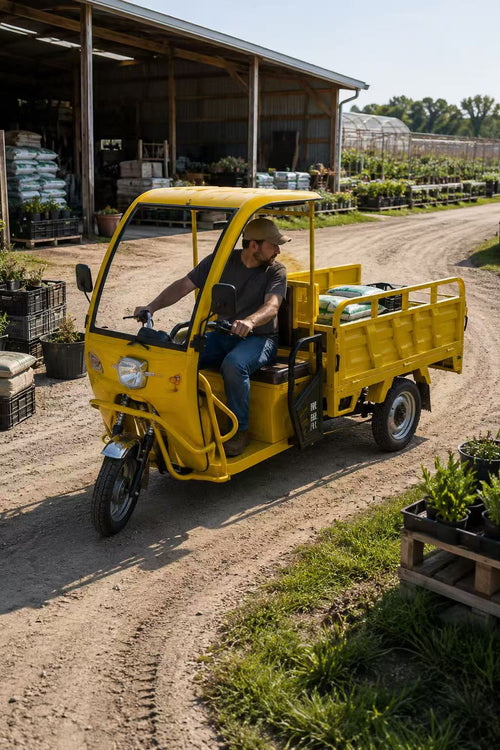
Flat dirt roads are one of the most suitable routes for an electric cargo trike.
On this type of surface, the vehicle does not need extreme off-road ability. It mainly needs stable low-speed movement, enough cargo space, reliable braking, and a frame that can handle repeated daily loads.
Flat dirt roads are common around:
barns
feed rooms
greenhouses
orchards
nurseries
packing areas
garden rows
livestock sheds
tool storage areas
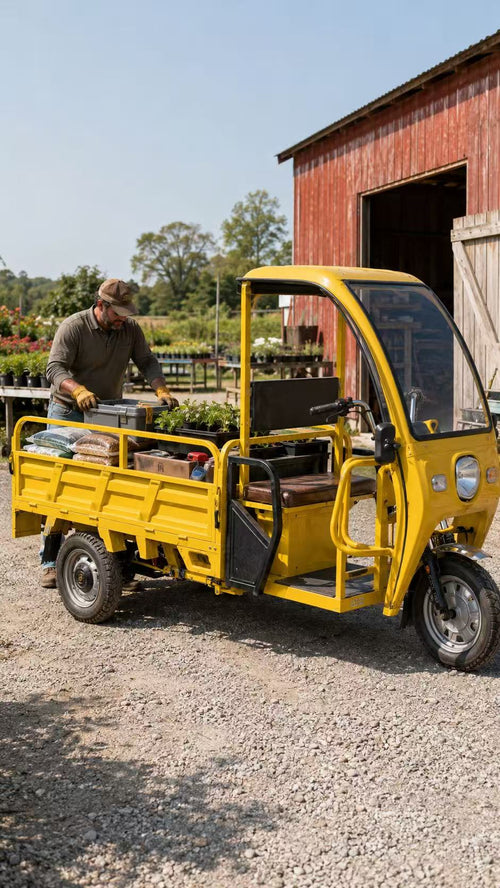
On these routes, an electric cargo trike can be useful for moving feed bags, tools, harvest crates, buckets, seed trays, and farm supplies without starting a larger gas vehicle for every small trip.
The key is not speed.
For farm work, controlled movement is more important than top speed. A loaded farm trike should move slowly, predictably, and safely from one work point to another.
Gravel Farm Lanes Need Stability and Braking
Gravel lanes are also a common farm surface. They are usually suitable for an electric cargo trike if the road is reasonably firm and not too steep.
But gravel changes the buying decision.
On gravel, the buyer should pay attention to:
tire grip
braking control
rear axle stability
cargo balance
frame strength
turning space
load height
A vehicle carrying a few feed bags or toolboxes across a gravel lane does not behave the same as an empty vehicle. The load adds weight, and the surface may shift under the tires.
That is why the cargo should be kept low and balanced in the bed.
A tall load may look efficient, but it can make the vehicle feel less stable when turning or stopping. For gravel routes, lower and better-organized cargo is usually safer than a high stack.
Muddy Paths Require More Caution
Muddy paths are more complicated.
An electric cargo trike may handle light mud or damp farm paths, but deep mud is a different situation. Mud can reduce traction, increase rolling resistance, and make a loaded vehicle harder to control.
Before using a cargo trike on muddy farm paths, buyers should ask:
How deep does the mud get?
Is the mud only seasonal?
Does the route have drainage?
Will the vehicle be loaded when crossing the muddy area?
Can the route be improved with gravel?
Is there another path after heavy rain?
For light muddy spots, careful low-speed use may be possible. But if the farm route often becomes deep, soft, and rutted, a larger off-road vehicle, tractor, or UTV may be more suitable.
The electric cargo trike should not be presented as a machine for extreme mud.
Its best value is repeated short-distance hauling on manageable farm routes.
Slight Hills Are Possible, But Load Matters
Many farms are not perfectly flat. Some have small slopes between barns, fields, storage sheds, and animal areas.
Slight hills may be manageable, but the load changes everything.
A hill that feels easy when the trike is empty may feel very different when the cargo bed carries feed bags, tools, crates, or supplies.
For sloped farm routes, buyers should look beyond motor wattage.
They should consider:
motor power
battery voltage
controller strength
braking system
rear axle design
tire traction
load weight
load height
road surface
The question is not only whether the vehicle can climb.
The question is whether it can climb, stop, turn, and come back down safely while loaded.
For farm use, braking and control on the way down can be just as important as power on the way up.
Narrow Gates and Barn Lanes Are an Advantage
One reason farms consider electric cargo trikes is size.
A pickup truck may be too large for some daily routes. A UTV may still be bigger than necessary for small repeated hauling. A tractor may be too slow or inconvenient for simple daily transport.
A compact electric cargo trike can fit better in:
narrow barn lanes
greenhouse paths
garden rows
feed storage areas
orchard edges
nursery aisles
small farm roads
tight gates
This is where a three-wheel cargo vehicle can be useful.
But buyers should still check actual space. The vehicle width, turning radius, cargo bed length, and canopy height all matter.
A roof canopy can be useful for sun and light rain, but the buyer should make sure it can pass under low roofs, tree branches, greenhouse entrances, or barn door frames.
Greenhouse and Nursery Paths Need Slow Control
For greenhouse and nursery use, the terrain question is less about rough ground and more about control.
A vehicle may need to move near plants, trays, irrigation lines, workers, and narrow paths. In this environment, slow movement is better than high speed.
The buyer should think about:
path width
turning space
ground firmness
floor protection
braking sensitivity
cargo height
visibility
operator comfort
A compact electric cargo trike can help move seed trays, nursery pots, bags, tools, and supplies without using a larger vehicle.
But it should not damage the ground, block aisles, or become difficult to turn in tight spaces.
For this type of work, low-speed handling is more valuable than maximum speed.
Livestock Areas Benefit from Quiet Operation
Around animals, quiet movement can be a real advantage.
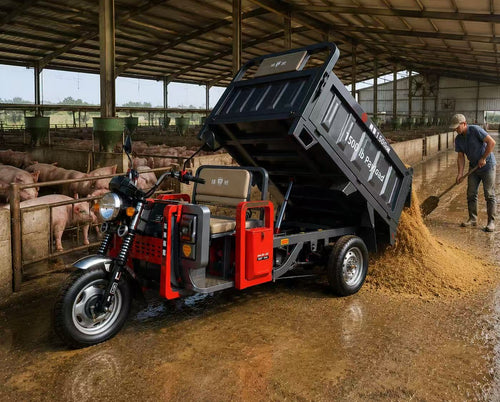
Gas vehicles can create noise, exhaust, and sudden movement that may disturb livestock. An electric cargo trike can be more comfortable for repeated work near barns, feed areas, poultry houses, horse stables, or dairy lanes.
It may help with carrying:
feed
buckets
tools
cleaning supplies
animal care items
small equipment
But terrain still matters.
Livestock areas may have wet spots, uneven ground, manure, gravel, gates, and tight corners. The route should be stable enough for loaded movement.
Quiet operation is useful, but it does not replace the need for safe ground conditions.
What Terrain Is Not a Good Fit?
An electric cargo trike is not the best answer for every farm route.
Buyers should be careful if the main route includes:
deep mud
steep hills
rocky trails
large ruts
soft pasture after rain
heavy towing
extreme off-road work
long-distance field travel
very uneven ground
In those conditions, a tractor, UTV, ATV, or larger farm vehicle may be more suitable.
This is important because a good buying guide should not oversell the vehicle.
An electric cargo trike is best for short, repeated, practical farm routes. It is not meant to replace every heavy-duty farm machine.
Why Top Speed Is Not the Main Number
Some buyers compare vehicles by top speed. For farm use, that can be misleading.
On a farm, the vehicle is often used near people, animals, buildings, fences, crates, tools, and uneven surfaces. High speed is rarely the main need.
More important features include:
stable low-speed movement
smooth starting
safe braking
easy turning
good visibility
balanced loading
comfortable operation
predictable handling
A farm cargo trike should help the worker move more efficiently without making the job harder or less safe.
The best farm route is not the fastest route. It is the route the vehicle can travel repeatedly while loaded.
How Cargo Changes Terrain Performance
Terrain cannot be judged without cargo.
An empty trike may move easily across gravel or dirt. A loaded trike may feel different, especially when carrying heavy bags, stacked crates, or tools.
Before buying, the buyer should combine two questions:
What ground will I drive on?
What cargo will I carry on that ground?
For example:
Feed bags on flat dirt may be easy.
Harvest crates on gravel may need careful stacking.
Tools on narrow barn lanes may need easy access and low speed.
Seed trays in a nursery may need smooth control.
Heavy loose material on a muddy route may need a different vehicle or a dump model.
Cargo and terrain must be judged together.
The Best Routes for an Electric Cargo Trike
An electric cargo trike fits best when the farm route is short, repeated, and reasonably firm.
Good routes include:
barn to feed room
tool shed to fence line
orchard row to storage area
nursery aisle to loading area
garden to produce wash station
livestock area to supply shed
farm stand to storage area
These routes do not require extreme off-road power. They require a practical vehicle that can move useful loads many times per day.
That is where this type of vehicle makes the most sense.
A Simple Terrain Checklist Before Buying
Before choosing an electric cargo trike for farm use, walk the route first.
Check:
Is the route flat, sloped, gravel, dirt, grass, or mud?
What is the worst section of the route after rain?
How wide are the gates and paths?
Are there low roofs, branches, or barn doors?
Will the vehicle turn easily near buildings?
Will the cargo be loaded high or low?
Will the vehicle stop safely when loaded?
Will the route be used near livestock?
How many trips will happen each day?
Can the path be improved with gravel or better drainage?
This checklist is more useful than choosing only by motor power or range.
The Right Terrain Makes the Vehicle More Useful
An electric cargo trike for agricultural use works best when the buyer matches the vehicle to the real farm route.
Flat dirt roads, gravel lanes, barn paths, greenhouse routes, nursery aisles, and short farm roads are usually the strongest fit.
Light mud and small slopes may be possible with the right load and careful operation.
Deep mud, steep hills, rocky trails, and heavy towing are not the best use cases.
The right question is not simply:
Can this vehicle work on a farm?
The better question is:
Can this vehicle work on my daily farm route while carrying my normal load?
That is the question buyers should answer before choosing an electric cargo trike.