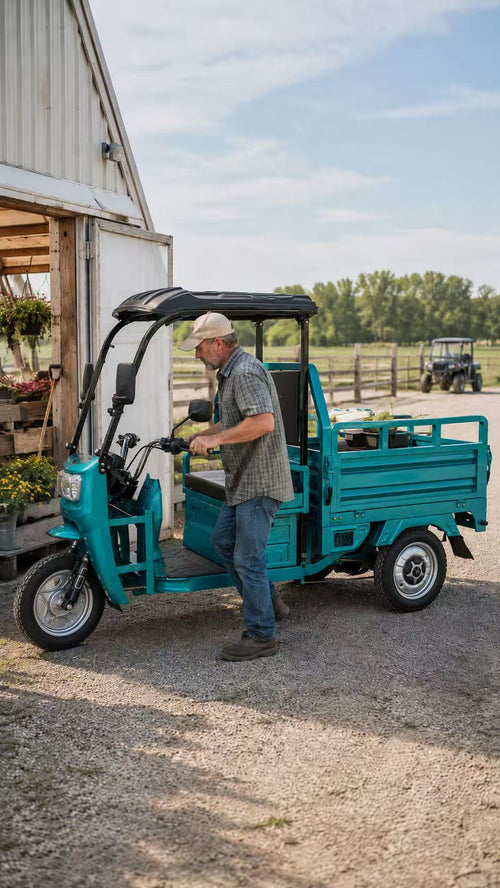
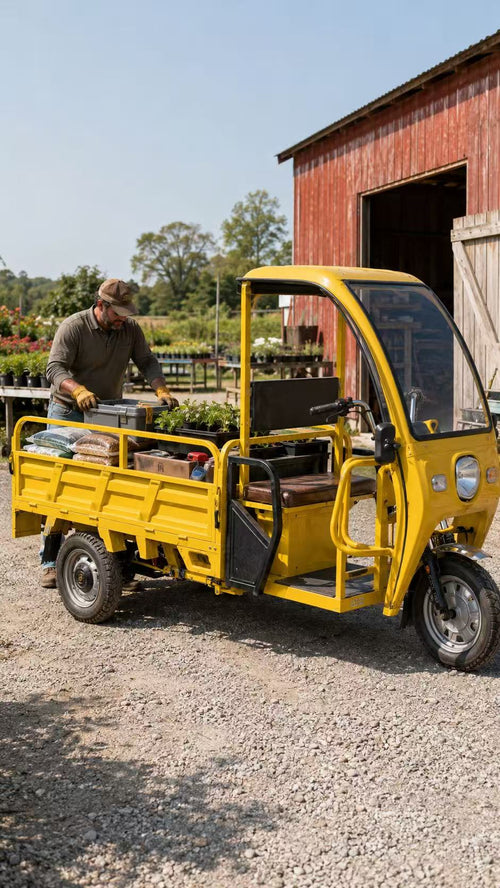
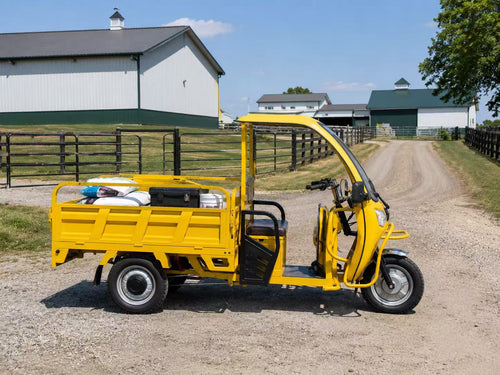
Electric Cargo Trike for Small Farms: A Buyer’s Guide to Crate Fit, Produce Capacity & Daily Loads
Share
For a small produce grower or independent farmers-market vendor, choosing an electric cargo trike should not begin with motor wattage, advertised range, or even maximum payload.
It should begin with a much more practical question:
Will the harvest crates, produce boxes, and daily crop loads you already use actually fit the cargo bed efficiently?
A vehicle can advertise a 1,000 lb payload and still be a poor farm vehicle if its cargo bed is too narrow for two rows of your harvest totes. A large cargo box can also be misleading if wheel wells, hinges, corner posts, or a narrow tailgate opening destroy the usable flat-floor area.
For growers moving vegetables from field to wash-pack station, cooler, roadside stand, or farmers market, the useful capacity of an electric cargo trike is determined by three things working together:
1. The geometry of the cargo bed.
2. The weight and volume of the crops being carried.
3. The amount of work the motor, brakes, tires, and chassis must perform every day.
This guide explains how to evaluate those factors before buying.
1. Start With Your Harvest Crates, Not the Vehicle Brochure
Many commercial vehicle specifications begin with outside cargo-bed dimensions.
Farmers should work in the opposite direction.
Measure the containers that already move through your operation first.
Small U.S. farms may use vented harvest crates, agricultural nesting totes, plastic produce crates, collapsible RPC containers, bulb crates, picking tubs, waxed produce boxes, corrugated boxes, or several different systems at the same time.
There is no single crate footprint that represents every American small farm.
A common produce crate may be close to 24 × 16 inches, but another nesting tote can have a larger projecting rim. Two containers that look almost identical can therefore require different amounts of floor space.
That difference matters.
Imagine that your normal harvest tote is approximately 16 inches wide. A cargo bed with slightly less than 32 inches of true internal floor width cannot accept two crates side by side.
The brochure may describe the vehicle as having a “wide cargo bed,” but the grower loses an entire row.
That is why crate compatibility should be treated as a buying specification, not an afterthought.
2. Measure the True Internal Cargo-Bed Dimensions
Do not calculate crate capacity from the outside dimensions of the utility box.
Measure the usable internal bed.
The important dimensions include:
Usable internal bed length
Measure from the closed tailgate to the inside surface of the front bulkhead.
Usable internal bed width at the floor line
Measure the narrowest point, not simply the distance between the upper side rails.
Flat-floor dimensions
Check whether wheel wells, battery housings, structural braces, bolt heads, hinges, or corner posts intrude into the load platform.
Tailgate opening clearance
A cargo box can be wider inside than its rear opening. In that case, a row of crates may technically fit in the bed but cannot slide directly through the tailgate.
Side-wall height
This determines how much lateral support stacked crates receive and whether workers can comfortably reach the lower containers.
Loading height
Measure from the ground to the cargo floor. This affects both worker ergonomics and vehicle ground clearance.
The result is the vehicle’s true agricultural cargo envelope.
That number is much more useful than an attractive external dimension printed on a product page.
3. Run a Crate-Fit Test Before Buying
Once the internal dimensions are known, calculate the number of crates that fit on one flat layer.
Test the containers in both orientations.
For example, a rectangular harvest tote may fit better with its long side parallel to the vehicle, while another bed may use the floor more efficiently when the crates are rotated 90 degrees.
The basic calculation is simple:
Crates along bed length × crates across bed width = crates per layer.
But the calculation is only the beginning.
Look at the remaining space.
A small amount of clearance may make loading easier. Large unused gaps, however, allow containers to move unless they are restrained with dunnage, floor tracks, rails, or cargo straps.
There is no universal “perfect” clearance that applies to every farm.
A smooth HDPE nesting tote on a rough farm track behaves differently from a corrugated produce box traveling across pavement. Route condition, floor friction, crate design, speed, and restraint method all influence how much movement is acceptable.
The correct question is therefore not:
“How much empty space should be left around every crate?”
It is:
“After my normal crates are loaded, can I prevent them from moving independently of the vehicle during braking, turning, and travel over uneven ground?”
4. Watch for the Cargo-Bed Specification Traps
Several small dimensional details can turn a seemingly large cargo box into an inefficient produce bed.
The tapered-box trap
Some cargo boxes are wider at the upper rail than at the floor. A published width may therefore exaggerate the space available for rectangular harvest totes.
The wheel-well trap
A low cargo bed may look attractive for easy loading, but wheel housings that protrude into the bed break the flat-floor layout and create dead space.
The flange trap
Stack-and-nest totes often have projecting rims. Measuring only the container body can make a two-crate arrangement look possible on paper even though the upper flanges interfere with each other or the side walls.
The tailgate trap
The internal floor may accommodate a full row, but hinges, latches, or rear corner structures can make the opening narrower than the cargo box.
The fixed-side trap
Tall permanent side walls can secure bulky loads, but they can also force workers to lift heavy containers over the wall instead of loading from the side.
For market gardens that load and unload many individual crates every day, drop-down or removable sides can be more valuable than additional decorative bodywork.
5. Payload Rating Is Not the Same as Produce Capacity
A second major buying mistake is treating maximum payload as the amount of produce the vehicle will actually transport.
Payload is a mechanical limit.
Produce capacity is an operational limit.
The two are not the same.
Leafy greens are a good example. They occupy substantial space without necessarily using the vehicle’s full structural payload. A grower can fill the cargo bed before coming close to the maximum weight rating.
Potatoes, carrots, onions, and other dense root crops create the opposite problem. The bed may look half empty while the vehicle is already approaching its safe payload.
Tomatoes, peaches, berries, and other delicate crops introduce a third limit: damage sensitivity. The vehicle may have enough weight capacity and physical space for another layer, but the produce itself should not necessarily be stacked higher.
This creates three different capacity questions:
How much weight can the vehicle safely carry?
How much physical cargo volume does the bed provide?
How much of that volume can this particular crop safely use?
A serious farm buyer should answer all three.
6. Match Cargo-Bed Geometry to the Crop Mix
Different crops make different vehicle specifications important.
Leafy greens
The limiting factor is usually volume rather than extreme payload. A generous bed footprint, useful side-wall support, good crate organization, and appropriate protection from sun and weather can matter more than purchasing the highest possible payload rating.
Root vegetables
Dense crops can reach the vehicle’s weight limit before filling the cargo box. Frame strength, braking performance, tires, motor workload, and a low practical loading height become more important.
Tomatoes and soft fruit
These crops are sensitive to poor packing, crate movement, harsh driving, and rough routes. A smooth load platform, secure tie-down points, sensible speed, appropriate tires, and suspension behavior deserve more attention than maximum payload alone.
Berries
High-frequency vibration and repeated movement are particularly undesirable. Packing method and cargo restraint remain critical; suspension should not be treated as a magic solution for poorly secured containers.
Mixed farmers-market loads
This is where flexible cargo geometry becomes especially valuable. Heavy root crops should normally remain low, while lighter and bulkier products can occupy higher positions without unnecessarily raising dense weight above the vehicle’s center of mass.
For a diversified market grower, the best vehicle is therefore rarely the one with the largest single specification.
It is the one whose usable load platform matches the farm’s real mix of crates, crop densities, loading methods, and routes.
7. Think About Daily Working Load, Not Just Maximum Load
Maximum payload should be treated as a boundary, not as the ideal target for every trip.
The same principle applies to motor selection.
Consider a cargo trike rated to carry approximately 1,000 lb. If its normal work consists of substantially lighter daily loads, a properly matched 1,000W drive system may be appropriate for the intended short-distance work.
But a buyer expecting frequent heavy loads should not choose the power system by asking only whether the vehicle can move that load once.
The better question is:
“What will this vehicle carry repeatedly, every day, on my actual route?”
Frequent heavy starts, slopes, rough surfaces, repeated stop-and-go operation, and operation close to maximum payload create a very different duty cycle from carrying lighter produce loads across level farm or market property.
For heavier regular duty, stepping up to a 1,500W or 2,000W configuration may provide a more appropriate operating margin when the chassis, controller, battery, gearing, brakes, and rated payload are also designed for that duty.
Motor wattage should never be considered in isolation.
A larger motor does not make an overloaded chassis safe.
The objective is to match the complete vehicle to the normal working load rather than buying to an impressive maximum number.
Loading Height Can Save Labor — or Create More of It
Cargo-bed height is another specification that cannot be judged as simply “higher is better” or “lower is better.”
The correct height depends on where the crates come from.
During field harvesting, containers may begin close to ground level. A relatively low load platform reduces the vertical distance workers repeatedly lift harvest totes.
At a wash-pack station, the situation can reverse.
If packed produce is already sitting on a sorting table or rolling rack, a cargo floor closer to that working height may allow workers to slide containers horizontally rather than lowering them and lifting them again.
This is why buyers should measure their existing infrastructure:
Wash and packing table height
Walk-in cooler door dimensions
Greenhouse aisle width
Greenhouse bench height
Pickup or loading platform height
Farmers-market unloading space
The vehicle should become part of the existing workflow rather than creating an additional lifting step.
There is also a trade-off.
Lowering the bed can improve loading ergonomics but reduce ground clearance. Raising it can improve clearance over ruts and obstacles but increase lift height and raise the loaded center of gravity.
A buyer operating mainly on rough field lanes may reach a different conclusion from a grower moving packed produce between a washhouse, cooler, and paved market area.
9. Drop-Down Sides Can Matter More Than a Bigger Box
Cargo capacity is not useful if workers cannot reach the cargo efficiently.
Consider a deep box with fixed side walls.
It may provide excellent containment, but workers loading heavy produce totes from the field must repeatedly lift each container over the side. Reaching the front bottom corner becomes increasingly difficult as the bed fills.
Drop-down sides change the workflow.
Workers can approach the load platform from the left, right, or rear, place crates directly onto the flat floor, and close the sides afterward.
For mixed farm work, removable or folding panels can also allow the same load platform to carry produce crates, empty nesting totes, market tables, tents, tools, or other bulky equipment.
Buyers should therefore compare usable access, not just cubic volume.
10. Protect Produce by Controlling Movement
Delicate produce does not care how impressive the suspension specification sounds.
It responds to the forces actually reaching the crop.
Those forces are influenced by packing, route condition, speed, cargo restraint, tire behavior, suspension, acceleration, braking, and the way containers interact with the cargo floor.
For this reason, produce protection should be approached as a system.
Start with proper crop packaging.
Then prevent crates from sliding or bouncing independently.
Choose the smoothest practical route.
Reduce speed on rough surfaces.
Use appropriate tire pressure within the tire and vehicle manufacturer’s safe operating specifications.
Evaluate suspension behavior under both loaded and unloaded conditions.
Use smooth acceleration and braking.
A premium suspension cannot compensate for loose crates repeatedly striking each other.
Likewise, a basic work vehicle traveling slowly with properly restrained produce over a reasonable route may protect cargo better than a sophisticated vehicle driven aggressively.
Claims that a particular suspension, tire, or motor controller will reduce crop damage by a specific percentage should be treated cautiously unless supported by controlled testing.
11. The Empty Return Trip Is Part of the Buying Decision
Farm-to-market transport does not end when the produce is unloaded.
The vehicle still has to return.
This is especially important for growers using stack-and-nest totes, collapsible RPCs, market displays, folding tables, tents, and other reusable equipment.
Empty containers behave differently from full ones.
They are lighter, easier to bounce, and more affected by wind. A suspension designed around heavy loads may also feel considerably firmer when the cargo bed is empty.
Before buying, consider how empty crates will be nested, restrained, and protected from leaving an open bed.
A flexible bed with useful tie-down points and removable or drop-down sides can make the return trip much easier than a cargo box designed only around the outbound produce load.
12. Inspect Tie-Down Points Before You Inspect Accessories
Cargo restraint is easy to overlook on a showroom photograph.
Look closely at where straps actually attach.
Top-rail-only anchor points may force straps downward across the upper layer of cardboard boxes or delicate plastic crate rims. Tightening those straps can damage packaging before the vehicle even moves.
Lower anchor points, recessed tie-downs, or properly designed cargo rails can allow the load to be restrained without crushing the produce containers.
The exact solution depends on the load, but the principle is simple:
The restraint system should stop cargo movement without transferring damaging force through fragile boxes.
13. Sanitation and Washability Need Technical Verification
Produce vehicles inevitably collect soil, leaves, plant residue, moisture, and sometimes damaged fruit or vegetable material.
The cargo area should therefore be easy to inspect and clean.
Smooth, non-porous surfaces, accessible corners, practical drainage, and removable liners can simplify routine sanitation.
However, buyers should distinguish between a washable cargo bed and a completely washdown-safe electric vehicle.
Before directing pressurized water toward the motor, controller, battery enclosure, connectors, throttle, display, or wiring, verify the manufacturer’s water-ingress specifications and cleaning instructions.
A product page saying “water resistant” does not automatically mean every electrical component can be pressure washed.
For produce operations, this is a specification worth confirming before purchase rather than discovering during the first deep cleaning.
14. Measure the Route as Carefully as the Cargo Bed
Crate compatibility solves only half the problem.
The loaded vehicle still needs to travel through the farm.
Measure the narrowest greenhouse paths, gates, cooler entrances, packhouse passages, market access areas, and turning points.
On uneven farm routes, inspect ruts, raised centers, gravel, slopes, and abrupt transitions.
Then compare those conditions with:
Overall vehicle width
Turning radius
Wheelbase
Track width
Ground clearance
Loaded braking capability
Tire configuration
Rated gradeability
Do not assume that a narrow vehicle automatically turns tightly.
A long wheelbase can fit through a narrow passage yet still require repeated reversing at a tight intersection.
Similarly, extra ground clearance can be useful on rutted lanes, but raising the entire cargo platform can make loading more difficult and alter loaded stability.
Every dimension creates a trade-off.
15. Nine Expensive Mistakes to Avoid Before Ordering
A practical pre-purchase audit should eliminate these problems before money is spent:
1. The bed fits the crates, but the tailgate opening does not.
2. The internal width misses a second crate row by a small amount.
3. The vehicle has a high advertised payload but insufficient cargo volume for bulky produce.
4. Tall fixed sides make repetitive field loading unnecessarily difficult.
5. Wheel wells or structural components destroy the usable flat-floor layout.
6. Cargo-floor height does not match the farm’s dominant loading workflow.
7. The farm uses several incompatible crate footprints, but the bed was selected around only one.
8. Tie-down locations force straps across fragile produce boxes.
9. The farm chooses a vehicle around maximum payload while ignoring the much more important normal daily working load.
These are not glamorous specifications.
They are exactly the details that determine whether the vehicle saves labor every day or becomes another piece of equipment the farm works around.
16. A Simple Pre-Purchase Audit for Small Produce Growers
Before comparing brands, place your normal containers on the ground and reproduce the cargo-bed footprint you are considering.
Then answer these questions:
How many of my primary harvest crates fit per layer?
Do they fit in both orientations?
Are there wheel wells or structural intrusions?
Can the full crate arrangement pass through the tailgate?
Can workers reach the front crates without climbing into the bed?
Do I need drop-down sides?
What is my normal load per trip, rather than my theoretical maximum load?
Am I primarily transporting bulky greens, dense root crops, delicate fruit, or mixed loads?
How high will the crates actually be stacked?
Where are the heavy containers positioned?
How will I secure the load without crushing boxes?
How high is the cargo floor relative to my field, wash-pack tables, cooler, and market setup?
What terrain will the vehicle travel every day?
What happens on the empty return trip?
Can the cargo area be cleaned without exposing unverified electrical components to unsafe washdown?
What motor, battery, controller, braking, tire, and chassis configuration is appropriate for that daily duty cycle?
Only after answering these questions should maximum payload, motor wattage, range, and accessories become the deciding specifications.
17. Where a 1,000 LB Electric Cargo Trike Fits
A compact 1,000 lb-class electric cargo trike can occupy a useful middle ground for small farms.
It provides substantially more powered cargo capability than a hand cart or wheelbarrow while remaining smaller and simpler than many full-size farm utility vehicles.
For lighter and moderate daily produce loads, a 1,000W configuration can be appropriate when matched correctly to the route and vehicle design.
Growers expecting frequent heavier duty should evaluate 1,500W or 2,000W configurations rather than assuming that a base power system should spend every working day near its maximum duty.
The important distinction is between occasional capacity and routine workload.
A machine that can perform a demanding task occasionally should not automatically be specified around doing that task continuously.
For operations requiring substantially heavier loads, the buyer should move into a higher-capacity vehicle class rather than attempting to compensate for overload simply by increasing motor power.
The motor, battery, controller, frame, axle, tires, suspension, and brakes must remain a matched system.
18. Final Buyer Decision: Buy for Usable Farm Capacity
The best electric cargo trike for a small produce farm is not necessarily the vehicle with the highest payload, biggest motor, longest advertised range, or deepest cargo box.
It is the vehicle that fits the farm’s actual containers and workflow.
Start with your harvest crates.
Measure their real outside dimensions.
Measure the cargo bed at its narrowest usable points.
Calculate crates per layer.
Identify dead space and intrusion points.
Check the tailgate.
Evaluate loading height.
Separate payload capacity from usable cargo volume.
Match the load platform to the crops you actually grow.
Then calculate the normal daily working load and select the complete powertrain and chassis around that duty.
For a farmers-market operator, one extra usable row of harvest totes can be more valuable than hundreds of pounds of unused theoretical payload.
For a root-crop grower, the opposite may be true: the cargo box can still have plenty of empty space when the vehicle has already reached its safe weight limit.
That is the central buying principle:
Do not buy an electric cargo trike by asking how much the manufacturer says it can carry.
Buy it by determining how much of your produce, in your crates, over your route, through your daily workflow, it can move safely and efficiently.