Electric Cargo Trike vs UTV for Small Farm Hauling
Share
For many small farms, ranches, orchards, greenhouses, and rural properties, a UTV is the first utility vehicle people consider when daily hauling becomes too difficult for a wheelbarrow or hand cart.
That makes sense. A working UTV can carry people and cargo, tow trailers, cross rough terrain, and cover a large property quickly. But those capabilities come with a higher purchase price, greater mechanical complexity, and features that some small farms rarely use.
The better buying question is not simply, “Is a UTV useful?”
It is: “What does my daily farm work actually require?”
If most trips involve one worker moving feed bags, tools, fencing supplies, fertilizer, harvest crates, irrigation parts, or maintenance materials over short distances, a compact electric utility vehicle or electric cargo trike may provide the working capacity that matters without paying for capabilities that remain unused most of the time.
The comparison should therefore start with actual workload: payload, cargo-bed needs, terrain, towing, trip distance, stop-and-go frequency, maintenance, and service support.
What a UTV Does Well
A working UTV is designed to handle jobs that demand more than simple cargo movement.
Four-wheel drive, strong traction, higher ground clearance, suspension travel, towing capacity, passenger seating, and higher travel speed all have real value when the farm requires them.
A UTV is usually the better choice for:
rough or deeply rutted farm roads
muddy pastures
steep or uneven terrain
frequent trailer towing
heavy outdoor loads
long-distance property travel
multiple workers or passengers
snow, difficult weather, and demanding year-round operation
Payload alone does not tell the whole story. A vehicle carrying a heavy load must also start, climb, turn, brake, and remain controllable under that load.
Motor output, low-speed torque, gearing, drivetrain, suspension, braking, tire traction, and vehicle stability all influence real working capability.
This is especially important on slopes. Being powerful enough to climb a hill does not automatically mean a vehicle is suitable for descending that same hill fully loaded. Braking, handling, traction, and vehicle stability become equally important.
If daily work genuinely requires 4WD, heavy towing, rough-terrain capability, multiple passengers, or long-distance travel, buying a UTV is not overbuying. Those capabilities are being purchased for work that actually needs them.
An electric cargo trike should not be presented as a replacement for that kind of operation.
Where Small Farms Often Overbuy
The situation changes when the UTV’s strongest capabilities are rarely used.
Many small farms spend most working hours on mature farm lanes, packed dirt paths, gravel areas, barn yards, greenhouse routes, orchard rows, and other established working surfaces.
The daily routine may involve:
moving feed from storage to livestock
carrying fencing tools and repair supplies
transporting vegetable or fruit crates
moving fertilizer and soil bags
delivering irrigation fittings
carrying tools between barns and work areas
moving greenhouse trays
transporting cartons, bins, and maintenance supplies
These are farm chores, but they are not necessarily heavy-duty off-road work.
A worker may travel only a few hundred feet before stopping, unloading something, completing a task, and moving again. This high-frequency stop-and-go pattern places more value on easy access, compact dimensions, cargo capacity, and low-speed maneuvering than on high top speed.
The same distinction applies to towing. There is a major difference between thinking “I might tow something someday” and regularly towing a water tank, implement, trailer, or other heavy equipment.
If nearly everything normally fits directly into the cargo bed, heavy towing capacity may be an expensive capability that sees little actual use.
For this type of short-distance hauling, an electric cargo trike begins to make economic and operational sense.
What an Electric Cargo Trike Does Well
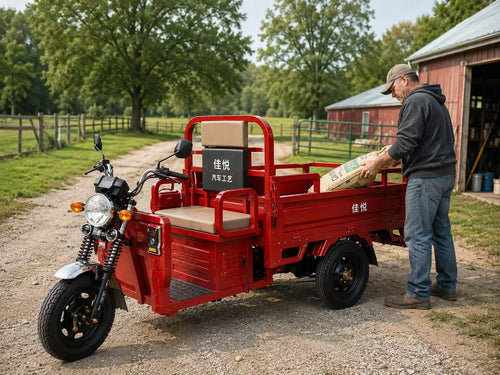
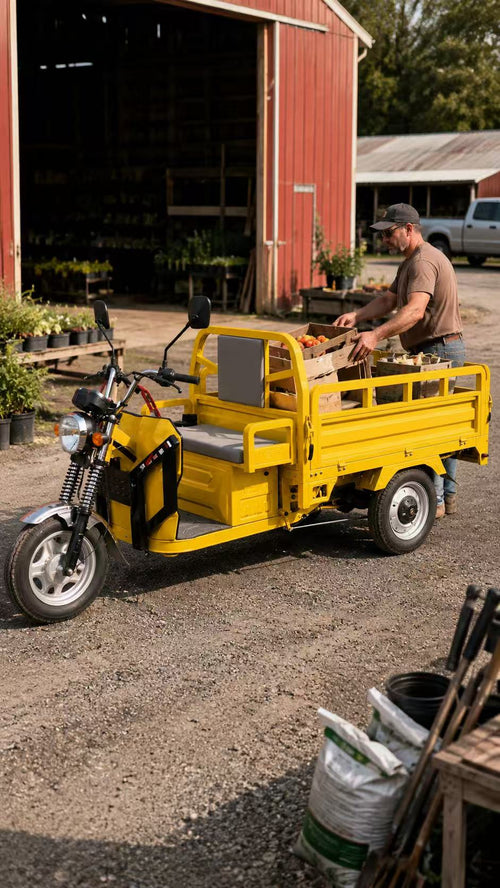
An electric cargo trike is a compact battery-powered utility vehicle built around material movement rather than recreational riding or passenger transport.
For appropriate routes and loads, its strengths are simplicity, compact size, quiet operation, low-speed maneuverability, lower routine maintenance, and lower purchase cost.
Typical daily loads include:
feed bags
toolboxes
fencing materials
vegetable and fruit crates
fertilizer bags
irrigation components
small equipment
greenhouse trays
cleaning supplies
packaging materials
maintenance parts
For these jobs, the important question is not only rated payload. Buyers should also consider how the vehicle performs fully loaded.
Payload, motor power, torque, gearing, rear axle strength, suspension, braking, terrain, and working range all interact.
A published range figure, for example, should not be considered independently of load and terrain. A fully loaded vehicle working on repeated grades will use energy differently from an unloaded vehicle traveling on level ground.
The same principle applies to motor power. More watts alone do not answer every question. Starting under load, low-speed torque, gearing, traction, braking, and the actual route all influence whether a vehicle is appropriate for a particular job.
For small farms that mainly need repeated cargo movement on suitable working surfaces, this simpler combination can be more practical than using a full-size UTV for every small transport task.
Cost Difference Matters
Purchase price is one reason many small farm owners begin comparing a UTV with a smaller electric utility vehicle, but purchase price should not be considered alone.
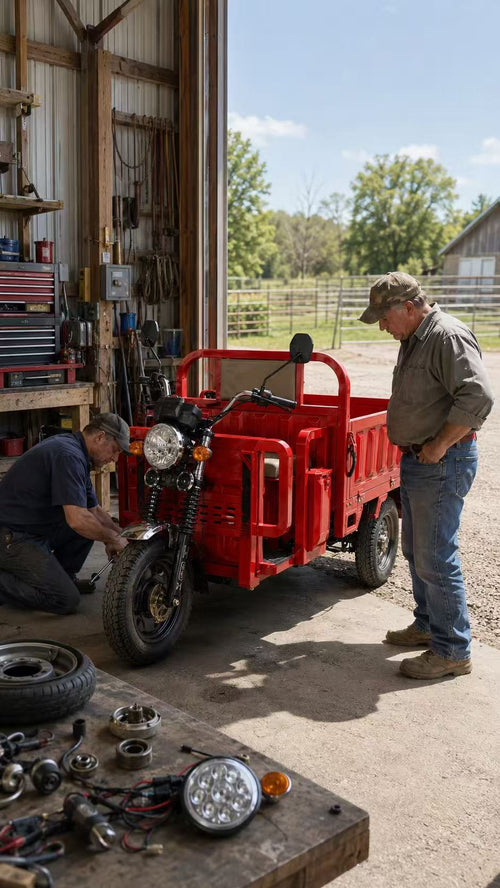
Total ownership also includes fuel or electricity, routine maintenance, replacement parts, service access, and downtime.
A traditional UTV may justify its higher cost when its 4WD system, towing capability, passenger capacity, speed, and rough-terrain performance are used regularly.
But if most work consists of low-speed, short-distance cargo movement, the buyer may be paying for capability that remains unused.
The OneClick China Multi-Purpose Electric Utility Vehicle starts from $2,499 and is intended for practical short-distance cargo movement rather than recreational or extreme off-road operation.
For work involving loose material, the OneClick China Hydraulic Dump Utility Vehicle starts from $3,333 and adds a dump bed for soil, gravel, manure, compost, mulch, and similar material.
The correct comparison is therefore not simply “cheap vehicle versus expensive vehicle.”
It is the cost of the capability the farm actually uses.
Cargo Bed vs Passenger Layout
A UTV is designed to balance several functions: passenger seating, off-road travel, towing, cargo transport, speed, and sometimes accessory mounting.
That versatility is valuable, but many small-farm jobs are much simpler.
If one worker spends most of the day moving materials rather than passengers, cargo-bed usefulness can matter more than extra seating.
The real questions are:
What normally goes into the bed?
How much does the typical load weigh?
How often is the bed actually filled?
Does the work require a dump bed?
Does the vehicle regularly tow something that cannot simply be carried?
Feed transport, harvest movement, greenhouse work, barn maintenance, fencing repair, property maintenance, and packing-area transport are primarily cargo tasks.
A cargo-focused electric utility vehicle concentrates more of the machine around that purpose.
Electric Cargo Trike vs UTV in Narrow Areas
Vehicle width and turning space can become important on smaller farms.
Greenhouse aisles, orchard rows, barn entrances, nursery paths, packing areas, storage zones, and narrow routes between buildings may leave little room for a larger side-by-side.
A compact electric cargo trike can provide a smaller footprint, tighter turning space, and controlled low-speed movement around these working areas.
Frequent stops also change the calculation.
Fence repair, feeding, inspection, greenhouse work, and maintenance may require an operator to travel a short distance, stop, get off, complete a task, and repeat the cycle many times.
In this kind of stop-and-go work, high travel speed contributes little. Easy access and low-speed maneuverability may contribute much more.
A UTV remains preferable when those same routes become steep, deeply muddy, heavily rutted, or otherwise unsuitable for a three-wheel work vehicle.
Noise and Daily Work Comfort
Electric utility vehicles also offer an advantage where quiet, fume-free operation matters.
Examples include:
horse stables
poultry operations
greenhouses
barn areas
produce markets
warehouses
campuses
property maintenance areas
indoor-outdoor work zones
Electric drive eliminates engine idling during repeated stops and reduces noise around animals, workers, customers, and buildings.
Instant electric torque can also be useful for controlled low-speed starts with cargo.
However, electric drive introduces its own considerations. Charging access, battery condition, working range, temperature, payload, and route conditions should all be considered.
A farm operating many miles from charging infrastructure or working continuously in severe conditions may still benefit more from a conventional UTV.
When the Multi-Purpose Electric Utility Vehicle Fits Best
The OneClick China Multi-Purpose Electric Utility Vehicle is intended for cargo that can normally be loaded and unloaded by hand.
Its current base configuration uses a 1000W motor and 60V battery system, with a rated payload of up to 1,000 lb and an approximate range of 55 km under appropriate operating conditions.
Those numbers should be interpreted through the work being performed.
A 1,000 lb payload rating is useful only when the actual cargo, terrain, route, braking requirements, and operating conditions remain within the vehicle’s intended use.
Typical applications include:
feed bags
tools
fencing supplies
vegetable and fruit crates
fertilizer
cleaning supplies
garden materials
cartons
maintenance equipment
small farm supplies
This vehicle is most relevant to buyers whose work is short-distance, repetitive, cargo-focused, and primarily performed on established working surfaces.
It is not intended to imitate a 4WD UTV. Its value is doing a narrower category of work with a simpler and lower-cost vehicle.
When the Hydraulic Dump Utility Vehicle Fits Better
Loose materials create a different handling problem.
Soil, gravel, sand, manure, compost, mulch, poultry litter, landscaping material, and jobsite debris can be easy to load but physically demanding to unload by hand.
For these jobs, the OneClick China Hydraulic Dump Utility Vehicle adds a powered dump function that reduces repeated manual unloading.
This can be useful for:
barn and stable cleaning
manure movement
compost handling
landscaping
soil transport
poultry-house cleanup
property maintenance
small construction and cleanup work
A dump bed should therefore be selected because the work repeatedly requires dumping, not simply because a powered dump feature sounds useful.
This follows the same buying principle as the UTV comparison: pay for capabilities that will actually be used.
Who Should Choose an Electric Cargo Trike
An electric cargo trike or small electric utility vehicle deserves consideration when most of these statements describe the operation:
Routes are relatively short.
Daily work involves frequent stops.
One operator mainly transports cargo rather than passengers.
Most routes are established farm paths, hard-packed surfaces, gravel, concrete, or relatively level working areas.
Heavy trailer towing is not a routine requirement.
The vehicle needs to work around barns, greenhouses, orchards, markets, warehouses, or other compact spaces.
Quiet operation is useful.
The buyer wants simpler routine maintenance.
A wheelbarrow or hand cart is no longer efficient, but a full UTV provides more capability than the daily job requires.
In this situation, the electric cargo trike occupies a useful gap between manual material handling and a larger utility vehicle.
Who Should Still Choose a UTV
A working UTV remains the stronger choice when the operation regularly requires:
4WD traction
deep mud capability
rough or uneven terrain
steep hill work
heavy trailer towing
long-distance property travel
multiple passengers
higher travel speed
heavy-duty outdoor operation
severe-weather capability
accessory-based work such as towing or other demanding attachments
Local parts availability and service should also influence the decision.
Farm equipment creates little value while it is waiting for repair. Buyers should consider where replacement parts come from, who can perform service, how warranty support works, and how much downtime a failure could create.
This is one reason established UTV dealer networks remain valuable to many farms.
For an imported electric work vehicle, the after-sales plan should therefore be evaluated before purchase, not after a problem occurs.
OneClick China coordinates repair support with suitable local repair providers where possible and supplies warranty support according to the applicable after-sales terms.
Final Buying Thought
Start with the job, not the vehicle.
Write down the heaviest load you move regularly, the roughest route you actually use, the longest normal trip, how often you tow, how many people need to ride, and how frequently you stop and get off.
Then compare the vehicle around those real conditions.
If the farm regularly needs 4WD, rough-terrain performance, heavy towing, passenger seating, long-distance travel, and severe-weather capability, a working UTV is likely worth the additional cost.
If the work is mainly feed, tools, fencing supplies, crates, fertilizer, maintenance materials, and other cargo moving repeatedly over short routes, a compact electric utility vehicle may be the more practical investment.
For small farms, greenhouses, orchards, poultry operations, ranch work areas, produce markets, warehouses, and property maintenance teams, an electric cargo trike can provide a lower-cost way to solve a specific material-handling problem without pretending to replace every capability of a UTV.
The right vehicle is not the one with the longest specification sheet.
It is the one whose capabilities match the work you actually do.