Electric Farm Trike with Hydraulic Dump for Manure, Soil, and Heavy Daily Loads
Share
For many small farms, ranches, stables, nurseries, and rural properties, the hardest part of daily hauling is not always moving the load. It is unloading it again and again.
That is where an electric farm trike with hydraulic dump becomes useful.
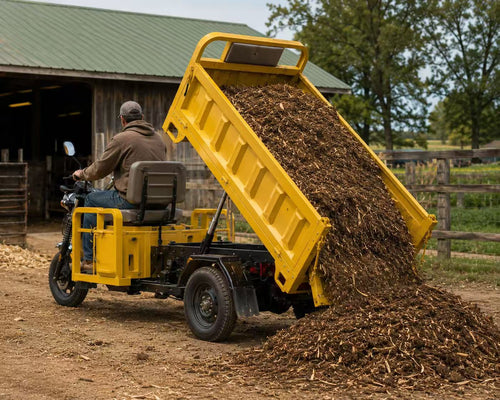
A regular cargo bed can carry tools, feed bags, harvest crates, fencing supplies, and small equipment. But when the load is loose, heavy, wet, or difficult to shovel out by hand, a hydraulic dump bed can save time and reduce repeated labor. Manure, compost, wet soil, mulch, gravel, bedding material, and barn waste are the kinds of loads where a hydraulic dump system makes the biggest difference.
This type of vehicle is not meant to replace a full-size tractor or heavy 4x4 UTV. It is designed for repeated short-distance hauling around private farmland, barns, greenhouses, orchards, horse stables, and work areas where a larger vehicle may be too expensive, too wide, or unnecessary for daily chores.
Why Hydraulic Dump Matters on a Farm
A flat cargo bed is enough when the load can be lifted out by hand. For example, feed bags, hand tools, buckets, small boxes, or produce crates do not always need a dump system.
A hydraulic dump bed becomes more valuable when the cargo is loose and heavy.
Common examples include:
manure from horse stalls or livestock areas
wet bedding material from barns
compost and mulch
soil and garden material
small gravel loads
greenhouse waste
orchard cleanup material
property maintenance debris
With these materials, the operator does not want to shovel every load out of the bed. A hydraulic lift allows the cargo bed to rise and tip the material out from the rear, making unloading faster and more controlled.
For a farm worker making many short trips in one day, this can matter more than top speed.
What Kind of Buyer Searches for This Vehicle?
Someone searching for an electric farm trike with hydraulic dump is usually not just browsing.
They already understand that a normal electric tricycle, cargo bike, golf cart, or small trailer may not solve the unloading problem. They are likely comparing:
a wheelbarrow
a small dump cart
a golf cart with trailer
a gas UTV
a compact electric utility vehicle
a three-wheel hydraulic dump trike
The key question is not only “how much can it carry?” The better question is:
How many times per day does the operator need to load, move, and unload loose material?
If the answer is many times, hydraulic dump becomes more important.
Where This Type of Electric Farm Trike Fits Best
An electric hydraulic dump farm trike works best on short, repeated work routes.
It is especially suitable for:
horse farms and stables
small livestock properties
greenhouses and nurseries
orchards and vineyards
vegetable farms
private rural properties
landscaping yards
barn-to-compost routes
property maintenance routes
The best use case is a work area where the vehicle travels between barns, storage areas, stalls, gardens, compost piles, feed zones, and material dumping points.
It is not designed for high-speed road use. It is best understood as a low-speed farm work vehicle for private property and controlled work areas.
Hydraulic Dump vs. Regular Cargo Bed
A regular cargo bed is simple and useful. It is usually better for clean cargo, boxed cargo, or items that should not be dumped.
Choose a regular cargo bed if you mainly move:
tools
feed bags
buckets
small machines
produce crates
nursery trays
fencing tools
boxed supplies
Choose hydraulic dump if you often move:
manure
soil
mulch
compost
wet bedding
gravel
loose farm waste
heavy cleanup material
A hydraulic dump bed adds value when unloading is the real problem.
Important Features to Check Before Buying
When comparing electric farm trikes with hydraulic dump, do not look only at the product photo. The frame, motor, bed, and dump system need to match the real workload.
Check these details before buying:
1. Dump Bed Structure
The cargo bed should have strong steel panels, a stable rear hinge, and enough depth to hold loose material without spilling during movement.
For farm use, a shallow or weak bed may not be practical.
2. Hydraulic Lift Design
The hydraulic cylinder should be clearly visible and positioned to lift the bed safely. A good dump system should raise the bed smoothly, not shake, twist, or lean to one side.
For repeated daily unloading, the hydraulic system is one of the most important parts of the vehicle.
3. Motor Power
Farm hauling needs torque, not just speed.
A motor around 1000W to 1500W is commonly used for this kind of vehicle class. For heavier material, slopes, wet ground, or frequent stop-and-go work, stronger torque is more important than a higher top speed.
4. Battery System
A farm trike should have enough battery capacity for daily short-distance routes. The real working range depends on load weight, terrain, tire pressure, slope, battery type, and how often the bed is used.
A buyer should estimate the daily route first, then choose the battery setup.
5. Payload and Real Load Type
Payload numbers should be treated carefully.
A dry crate load is different from wet manure, soil, gravel, or compost. Loose material can become heavy quickly, especially after rain or barn cleaning.
The best buying decision is not based only on the maximum number. It should be based on the real material being moved every day.
6. Tires and Ground Conditions
Farm paths are not always smooth. Gravel, dirt, mud, grass, and barnyard surfaces require stable tires and a strong chassis.
If the route includes steep hills, deep mud, or rough pasture, a larger UTV or tractor may still be better.
7. Brakes and Low-Speed Control
Because the vehicle may carry heavy loads, braking and low-speed control are important. A farm trike should feel stable when turning slowly, stopping near animals, and moving through tight work areas.
When a Hydraulic Dump Trike Is Better Than a UTV
A UTV is stronger for rough terrain, steep hills, long-distance driving, and high-speed movement.
But for some farms, a UTV may be more vehicle than the job requires.
A hydraulic dump electric farm trike may be better when:
the work route is short
the surface is mostly flat or moderate
the job is repeated many times per day
fuel cost is a concern
the farm needs quiet operation
the work area is narrow
the buyer wants a lower-cost utility vehicle
the main job is hauling and unloading loose material
This is why many buyers look at electric dump trikes as a smaller, quieter, and more affordable alternative for daily chores.
When It May Not Be the Right Vehicle
This vehicle is not for every farm.
It may not be the best choice if:
the land is very steep
the route is deeply muddy
the buyer needs road-speed travel
the load is extremely heavy
the work requires towing large trailers
the vehicle must replace a tractor
the buyer mainly carries clean boxes or tools
In those cases, a larger UTV, tractor, skid steer, or trailer setup may be more suitable.
Best Buyer Question Before Choosing
Before choosing an electric farm trike with hydraulic dump, the buyer should answer five simple questions:
What material will be moved most often?
How heavy is a typical load?
How many trips are made per day?
Is unloading by hand the biggest problem?
Is the route flat, muddy, gravel, or sloped?
If the main job is moving loose, heavy material and unloading it repeatedly, a hydraulic dump electric farm trike can be a practical daily work vehicle.
Final Thought
An electric farm trike with hydraulic dump is not just a cargo trike with a lifting bed.
It is a short-distance farm unloading tool.
For manure, compost, soil, mulch, bedding, and other loose materials, the hydraulic dump system can be the feature that makes the vehicle worth buying. The right buyer is not only looking for transportation. They are looking for a way to reduce repeated manual unloading and make daily farm hauling easier.