Electric Cargo Trike for Farm Buyers: Payload, Motor Power, and UTV Alternative Use
Share
An electric cargo trike for farm work should be judged by real daily hauling needs, not only by its appearance or three-wheel layout. For many farms, homesteads, ranch properties, nurseries, greenhouses, orchards, and private agricultural sites, the real question is simple: can this vehicle move feed, tools, produce, and supplies every day without the cost, size, and maintenance of a full UTV?
A good electric farm cargo trike is not a toy and not just a bicycle with a box. It should be treated as a compact farm utility vehicle. Buyers need to look at the cargo bed, payload, motor power, battery range, route conditions, and the type of work the vehicle will do most often.
Why Farm Buyers Compare Cargo Trikes with UTVs
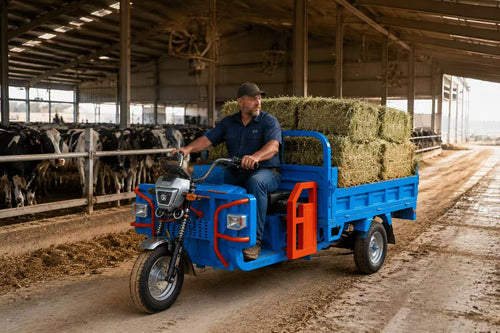
A UTV can be useful, but not every farm job requires a full-size utility vehicle. Many daily jobs happen within a short distance: moving feed from storage to animal areas, carrying hand tools to a fence line, transporting produce crates to a packing table, or moving buckets, seed, parts, and supplies between work zones.
For these repeated short trips, an electric cargo trike for farm use can be a practical lower-cost UTV alternative. It is smaller, easier to store, quieter, and often more suitable for narrow farm lanes, barn areas, greenhouse paths, and private property routes.
The value is not only in the purchase price. The real value is in reducing repeated walking, reducing small pickup truck trips, and giving one worker a simple way to move materials several times per day.
What the Cargo Bed Needs to Handle
The cargo bed is the most important part of the vehicle.
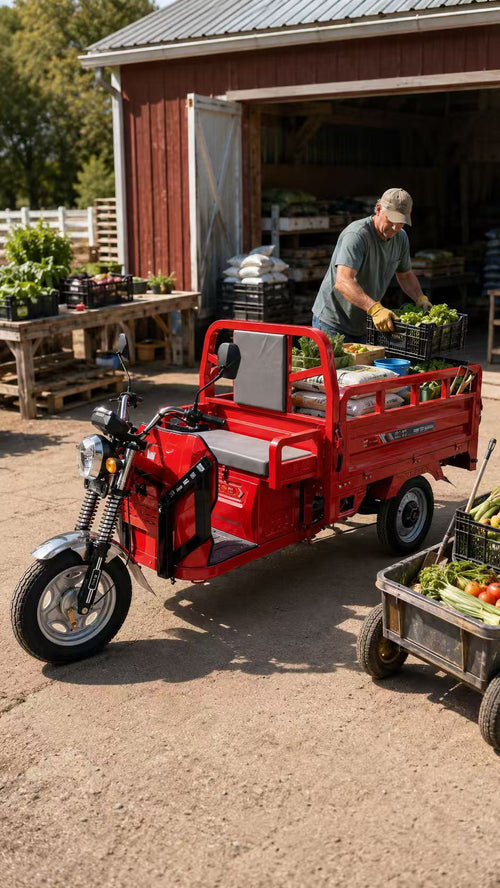
A farm buyer should first ask what the vehicle will carry most often. If the daily load is feed bags, produce crates, toolboxes, buckets, small equipment, fencing supplies, irrigation parts, seed, or packaged materials, an open cargo bed can be very useful.
A long open bed gives more loading flexibility than a passenger-focused design. It allows the operator to load from the side, separate different materials, and keep tools or supplies organized during short routes.
Before buying, check:
Cargo bed length
Cargo bed width
Side panel height
Loading height
Whether cargo can be tied down or balanced easily
Whether the bed is open, cab-covered, canopy-covered, flatbed, or hydraulic dump
For bagged, boxed, and containerized loads, an open cargo bed model is often enough. For loose materials such as manure, mulch, gravel, compost, wet soil, or bedding, a hydraulic dump model may be better.
Payload Is Not Just a Number
Many buyers look at payload first, but payload must match the real work.
A vehicle may advertise a strong load rating, but the load type matters. A stack of empty crates uses space but may not be heavy. Wet feed, water containers, dense bags, packed produce, or metal tools can become heavy quickly.
The buyer should think about:
How many feed bags are moved per trip?
How many produce crates are carried at one time?
Is the route flat, sloped, muddy, grassy, or gravel?
Will the operator stop and start often?
Will the load be balanced inside the cargo bed?
Does the vehicle need to turn inside narrow areas?
A proper electric cargo tricycle for farm use should carry loads low and balanced. It should not require the operator to overload one side of the cargo bed or stack materials so high that visibility and stability are affected.
Motor Power for Real Farm Routes
Motor power should match the route, not just the label.
Many farm buyers see numbers such as 1000W, 1500W, 2000W, or higher. These numbers matter, but they do not tell the whole story. A farm route may include gravel lanes, packed dirt, grass edges, barn entrances, orchard rows, greenhouse lanes, storage yards, and small slopes.
For farm work, slow control is often more important than high speed. The vehicle should be able to start smoothly with a load, move steadily across uneven ground, climb small slopes when needed, and stop safely near workers, animals, gates, and equipment.
A buyer should not choose an electric cargo trike only because it is fast. On a farm, the better question is whether it has enough torque and control for daily hauling.
Battery Range as Work Range
Battery range should be understood as work range, not just road distance.
A farm cargo trike may only travel short distances, but it may do that many times per day. Repeated starting, stopping, turning, and loaded driving use energy differently from open-road riding.
Before buying, map the daily route:
Where will the vehicle start?
Where will it load?
Where will it unload?
How many trips happen in one day?
Where can it be charged safely?
Will it be used in the morning, afternoon, and evening?
A simple routine may look like this:
Morning: feed, tools, and animal-area supplies
Midday: produce crates, greenhouse items, or nursery stock
Afternoon: maintenance parts, buckets, small equipment, or cleanup supplies
Evening: park and charge near a safe power source
This is why battery planning should be connected to actual farm work, not only maximum advertised range.
Open Bed, Canopy, Cab, or Dump Model?
Different farm buyers need different setups.
An open cargo bed model is practical when the main goal is simple daily hauling. It is easy to load, easy to see around, and suitable for feed bags, tools, buckets, produce crates, and farm supplies.
A canopy model may help when the operator wants shade or light weather protection.
A cab-covered model may be better for colder weather, more operator protection, or longer daily use.
A hydraulic dump model is better when the main work is unloading loose material such as manure, soil, mulch, compost, gravel, or bedding.
The buyer should not choose a more complex model unless the work actually needs it. If the main job is organized hauling of bags, crates, and tools, an open-bed electric farm cargo trike can be a practical choice.
When an Electric Cargo Trike Fits Farm Work
An electric cargo trike is most useful when the work is short-distance, repetitive, and cargo-focused.
It may fit well when:
The vehicle is mainly used on private property
The farm has repeated daily hauling routes
The load includes feed, tools, produce, buckets, or supplies
The buyer wants a smaller UTV alternative
The work area has narrow gates, barns, rows, or lanes
The goal is low-noise, low-maintenance daily transport
The operator does not need high-speed public road use
It may not be the best choice when the buyer needs deep mud performance, long-distance road travel, heavy towing, passenger transport, or full UTV capability.
Route Planning Before Buying
Before buying an electric cargo trike for farm use, walk the route first.
Check:
Gate width
Barn aisle width
Turning space
Ground firmness
Slope angle
Loading area
Unloading area
Parking area
Charging location
Shared paths with animals, people, tractors, or trucks
A vehicle that fits the route will be used every day. A vehicle that is too wide, too long, too tall, or hard to turn may not solve the real problem, even if it looks strong in photos.
Private Property Use and Local Rules
Most electric cargo trikes for farm work are best understood as private-property work vehicles. They are commonly used inside farms, ranches, nurseries, greenhouses, warehouses, private lots, and internal work areas.
If a buyer wants to use the vehicle on public roads, sidewalks, bike lanes, or shared streets, local rules should be checked before purchase. Road-use requirements vary by state, city, vehicle category, speed, lighting, registration, and insurance rules.
For many buyers, the safest and clearest use case is private property hauling.
Final Buying Thought
An electric cargo trike for farm use should be chosen by the work it must complete every day. The most important questions are not only color, speed, or appearance. The buyer should check cargo bed size, payload, motor power, battery range, ground conditions, route width, and load type.
For farms, homesteads, ranch properties, nurseries, greenhouses, orchards, and private agricultural sites, the right electric cargo trike can become a practical daily hauling tool for moving feed, tools, produce, and supplies without using a larger vehicle for every small job.