Electric Utility Trike with Cargo Bed: Payload, Power, and Worksite Use
Share
An electric utility trike with cargo bed is not the same as a regular adult tricycle, mobility scooter, or family cargo bike. For buyers who need a small work vehicle for daily hauling, the most important question is not only whether the vehicle has three wheels. The real question is whether the cargo bed, payload rating, motor power, battery system, and frame design match the work it needs to do.
This type of vehicle sits between several categories. It is smaller and simpler than a full-size UTV or pickup truck, but it can carry more practical work loads than most consumer e-bikes or passenger trikes. For farms, ranches, warehouses, construction sites, nurseries, campuses, and private properties, that middle position can make it useful for short-distance transport.
The key is to look at the vehicle as a work trike with a cargo bed, not just as an electric trike.
Why the Cargo Bed Matters
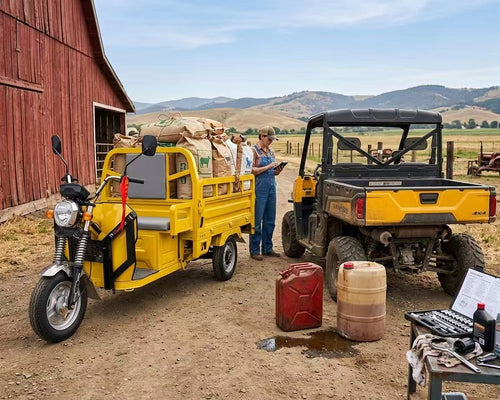
The cargo bed is the main reason buyers consider this type of vehicle. A useful electric utility trike should have enough bed length, width, and side support to carry real materials instead of only small personal items.
For daily work, buyers may need to move feed bags, produce crates, tools, buckets, repair supplies, small equipment, nursery trays, boxes, parts, or light construction materials. If the cargo bed is too short, too narrow, or too low, the vehicle may look convenient online but become limited in real use.
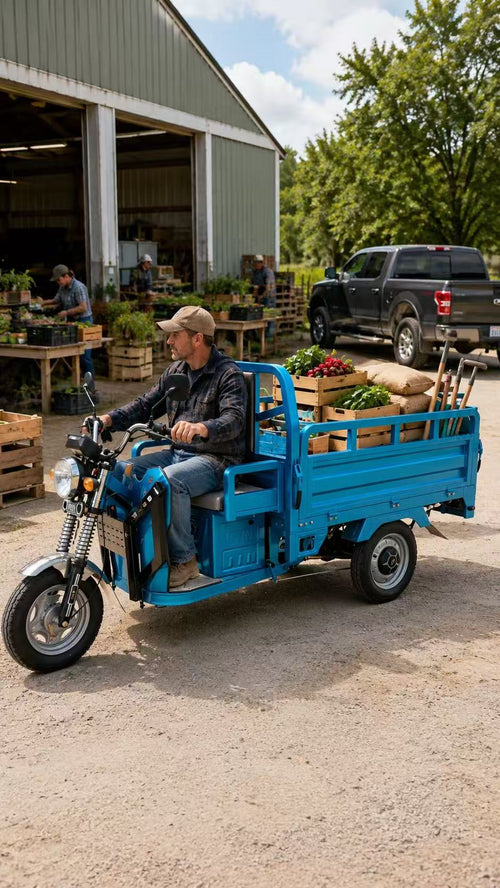
A longer open cargo bed gives the operator more flexibility. It allows mixed loads such as crates, tools, bags, and small containers to sit more naturally without stacking everything too high. A cargo bed with side rails can also help keep materials stable during low-speed movement around private property or work areas.
This is why the phrase “with cargo bed” is important. It separates a practical work trike from many enclosed commuter trikes, pedal-assist cargo bikes, or small mobility vehicles that are mainly designed for passengers, errands, or neighborhood travel.
Payload Should Match Daily Work, Not Just the Biggest Load
Payload is one of the first specifications buyers should check. Some electric cargo trikes in this category advertise load capacities around 500 kg or 1,100 lb, while heavier-duty models may show higher ratings depending on the frame, axle, motor, and cargo bed design.
However, buyers should not only ask, “What is the maximum payload?” They should ask, “What do I carry every day?”
A farm may need to move feed bags, produce, tools, fencing supplies, and small equipment between barns, storage areas, greenhouses, and field edges. A warehouse may need to move cartons, parts, maintenance tools, or supplies across short internal routes. A construction or property maintenance site may need to move buckets, hand tools, small materials, and debris over short distances.
For this type of work, balanced loading matters. A lower, even load is usually safer and more practical than a tall, unstable stack. Buyers should check whether the cargo bed gives enough usable space for everyday materials, not just whether the advertised number sounds large.
Motor Power and Battery System
Search results for this vehicle category often show examples such as 1000W or 1200W motors, 60V battery systems, and cargo tricycle trucks designed for practical load movement. These details matter because an electric utility trike with cargo bed is often used in places where the vehicle starts, stops, turns, and carries weight many times per day.
A higher-power motor can help with loaded starts, mild slopes, gravel lanes, and heavier daily work. A suitable battery system helps the vehicle complete repeated short-distance trips without constant charging.
For buyers, the better question is not simply “How fast does it go?” For work use, speed is usually less important than torque, control, range, and reliability under load.
A farm, ranch, or warehouse buyer should ask:
How much weight will the vehicle carry most days?
Will it run on pavement, gravel, dirt, or mixed surfaces?
Will it need to climb slopes or move across uneven ground?
How far will it travel during a normal workday?
Can the battery support repeated loaded trips?
A good electric cargo trike should be selected around the route and workload, not only around a top speed number.
Open Cargo Bed vs Enclosed Utility Trike
Some buyers compare an open cargo bed trike with an enclosed electric utility trike. Both can be useful, but they serve different needs.
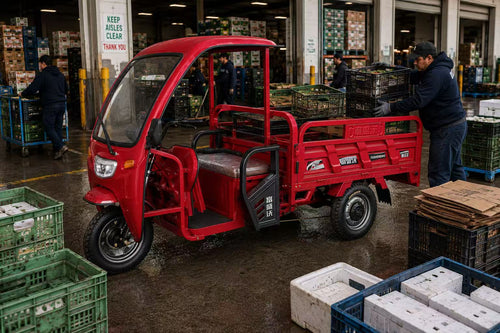
An enclosed electric utility trike can offer weather protection for the driver and may be attractive for commuting, local delivery, campuses, or light-duty transport. But an open cargo bed often gives better access for loading and unloading work materials.
If the main job is carrying tools, feed, produce, boxes, buckets, or mixed work supplies, an open cargo bed may be more practical. Workers can load from the side, tie down items more easily, and see the cargo clearly.
If the main job is driver comfort, weather protection, or light local delivery, an enclosed model may be worth considering. But for farm, ranch, warehouse, and worksite hauling, the cargo bed design should remain the main decision point.
Where an Electric Utility Trike with Cargo Bed Fits Best
This type of vehicle is most useful where the work happens within a limited area and does not require highway travel. It can be a practical fit for private-property routes, farm lanes, ranch yards, warehouse areas, nursery paths, greenhouse access roads, campuses, markets, and light commercial worksites.
On agricultural properties, it can help move produce crates, feed bags, small tools, buckets, and supplies between storage areas and work zones.
On ranch properties, it can support daily trips between barns, fencing areas, feed storage, and maintenance points.
In warehouses or commercial sites, it can move boxes, parts, cleaning tools, and small materials across short internal routes.
On private properties, it can reduce the need to use a pickup truck or UTV for every small hauling task.
The advantage is not that it replaces every larger vehicle. The advantage is that it can handle repeated short-distance hauling tasks with a smaller footprint, lower noise, and simpler operation.
When It May Not Be the Right Choice
An electric utility trike with cargo bed is not the right solution for every buyer. It may not be suitable for highway driving, very steep terrain, deep mud, oversized pallets, very heavy construction materials, or long-distance travel between public roads.
Buyers should also be careful if they need a vehicle for rough off-road recreation rather than work transport. A cargo trike is normally designed for utility hauling, not aggressive trail riding.
If the work requires high ground clearance, four-wheel traction, passenger seating, towing large implements, or extreme terrain capability, a UTV, ATV, compact truck, or tractor may be more suitable.
The best use case is practical, repeated movement of moderate cargo around a defined property.
What Buyers Should Check Before Choosing One
Before choosing an electric utility trike with cargo bed, buyers should check the full work route and daily load, not only the product photo.
Important points include:
Cargo bed size and side rail height
Payload rating and real daily load
Motor power and battery voltage
Tire size and surface conditions
Turning space around barns, sheds, aisles, gates, and narrow lanes
Whether the vehicle will carry loose items, crates, bags, tools, or boxes
Whether open cargo access is more important than an enclosed cab
Charging access and daily operating distance
After-sales support, replacement parts, and local repair options
A buyer who understands these points can choose a vehicle based on real work needs instead of only comparing appearance or price.
Final Thought
An electric utility trike with cargo bed is best understood as a compact work vehicle for short-distance hauling. It can serve farms, ranches, warehouses, campuses, markets, construction areas, and private properties where people need to move tools, supplies, produce, feed, boxes, or materials without using a larger vehicle every time.
The cargo bed is the center of the decision. If the bed size, payload, motor power, battery system, and route conditions fit the work, this type of trike can become a practical daily-use vehicle for light and medium-duty hauling.