Electric 3 Wheel Farm Utility Vehicle for Private Farmland: Payload, Range, and Low-Speed Use
Share
An electric 3 wheel farm utility vehicle is not designed to replace every tractor, UTV, pickup, or gas-powered truck on a farm. Its real value is different. It works best as a quiet, low-speed, cargo-focused vehicle for private farmland, livestock areas, barns, greenhouses, nurseries, orchards, and internal farm routes.
For many farm owners, the daily problem is not long-distance driving. The daily problem is moving feed, tools, produce, fertilizer, buckets, repair parts, and small equipment from one work area to another. These jobs happen repeatedly. They may not require a full-size UTV or gas truck every time.
A 3 wheel electric farm utility vehicle can help fill that gap when the route, payload, cargo bed, motor, battery, and terrain match the work.
What Makes a 3 Wheel Farm Utility Vehicle Different?
A 3 wheel farm utility vehicle is different from a personal electric trike, family cargo bike, or city delivery bike. It is built around utility work.
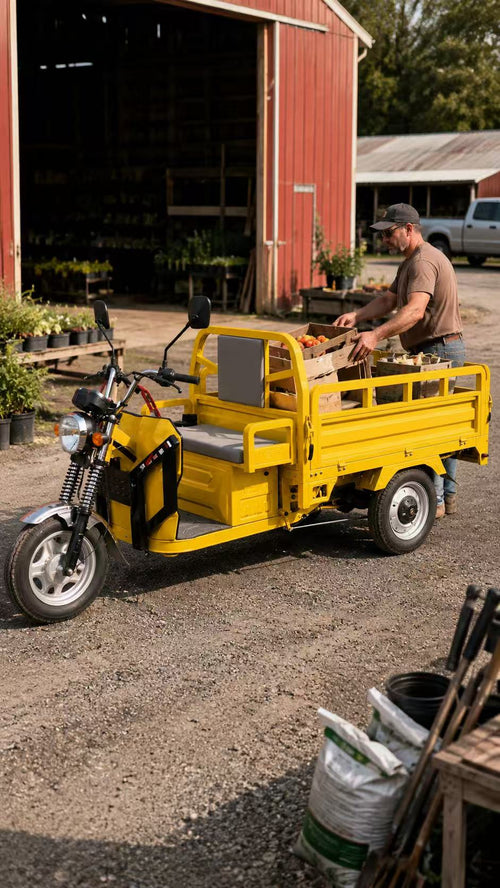
The most important part is the rear cargo bed. A farm utility vehicle needs to carry real work materials such as feed bags, hand tools, produce crates, small fencing supplies, irrigation parts, buckets, and farm maintenance items.
The vehicle should also have enough frame strength, braking control, motor power, and tire support for private-property routes. These routes may include gravel roads, packed dirt paths, concrete barn areas, greenhouse lanes, orchard service paths, and livestock working zones.
For farm use, the question is not only “Can it drive?” The better question is: “Can it carry the daily farm load safely and repeatedly?”
A Quiet Alternative to UTVs or Gas-Powered Trucks
Search results for electric 3 wheel farm utility vehicles often describe them as cost-effective, quiet, and eco-friendly alternatives to traditional UTVs or gas-powered trucks.
That does not mean they replace every larger machine. It means they can reduce the need to use a larger vehicle for smaller daily trips.
For example, a farm worker may need to move feed from storage to a barn, carry tools to a greenhouse, transport produce crates to a packing area, or bring repair parts to a fence line. Starting a full-size gas truck or UTV for every small trip may not always be necessary.
A smaller electric utility vehicle can handle many of these internal farm tasks quietly and with lower daily maintenance.
This is especially useful around livestock, greenhouses, barns, and work areas where noise, exhaust, and repeated short trips matter.
Why Low-Speed Use Matters
A farm utility vehicle does not need to be fast to be useful. Many farm routes are short, private, and repetitive. The vehicle may move between barns, sheds, storage areas, livestock pens, garden rows, packing zones, and equipment areas.
For this kind of work, low-speed control is often more important than top speed.
A useful electric 3 wheel farm utility vehicle should be able to:
Start smoothly with cargo.
Move steadily on private farm roads.
Turn in tight work areas.
Stop safely when loaded.
Operate near people, animals, gates, and equipment.
Carry cargo without unnecessary speed.
Some farm trikes operate at lower speeds, often around private-property utility ranges rather than road-vehicle speeds. Buyers should always check local rules if they plan to use the vehicle on public roads, but the clearest use case is internal farm transport on private farmland.
Payload: What Will You Carry Every Day?
Payload is one of the most important buying points.
Search results often mention rear cargo beds supporting several hundred kilograms of feed, tools, or produce. Some models may be lighter-duty, while larger utility versions may carry more. But the right payload is not only the highest advertised number. It should match the real daily load.
A farm owner should list the normal cargo:
Feed bags.
Produce crates.
Hand tools.
Buckets.
Fertilizer bags.
Seed trays.
Irrigation parts.
Small equipment.
Fence repair supplies.
Livestock care items.
A vehicle that carries the normal daily load comfortably is more useful than one that only looks strong in a photo.
The buyer should also remember that real payload includes the driver, cargo, containers, tools, and any added equipment. If the vehicle will be used all day with repeated loads, comfort and control matter as much as the maximum rating.
Rear Cargo Bed Design
The cargo bed decides how practical the vehicle feels in daily farm use.
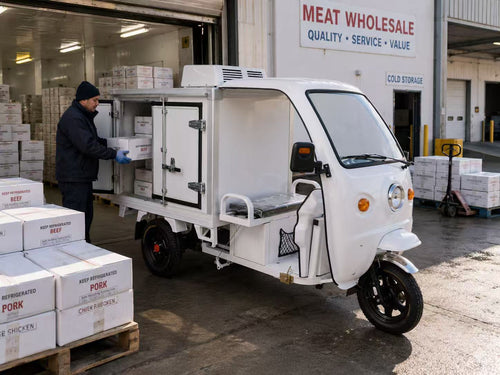
A rear cargo bed should be easy to load, easy to unload, and suitable for the cargo type. Open beds are useful for mixed farm materials such as feed bags, tools, crates, buckets, and supplies. Higher side panels help keep cargo contained. Drop-side or open-access designs can make loading easier from the side.
For produce farms, the bed should support crates without tipping or crushing. For livestock farms, it should carry feed, buckets, bedding supplies, and tools. For greenhouses and nurseries, it should carry trays, pots, hoses, and small equipment.
If the farm moves loose material such as soil, compost, manure, mulch, or gravel, a dump-style bed may be useful. But if most work involves bags, crates, and tools, a standard cargo bed may be more practical.
The cargo bed should fit the work, not just the product category.
Motor Power and Torque
For farm utility use, motor power should be judged by loaded movement, not only by speed.
Many electric farm trikes and utility vehicles use motor systems around 1000W to 1500W or stronger, depending on the model. The purpose is to provide enough power for carrying cargo across private farm routes.
A farm buyer should think about:
How heavy the normal load is.
Whether the route is flat or sloped.
Whether the vehicle will run on gravel, pavement, dirt, or uneven ground.
How often it will start and stop with cargo.
Whether it will move near barns, animals, or tight work areas.
Torque and control are more important than racing speed. A farm vehicle that moves slowly but steadily with cargo can be more useful than one that is fast but weak under load.
Battery and Range
Battery range depends on battery size, route, cargo weight, terrain, and driving pattern. Search results often mention ranges such as 25 to 45 miles per charge for some electric 3 wheel farm utility vehicle examples, but real use depends on the farm.
A vehicle carrying light tools on flat pavement will use power differently from one carrying feed bags over gravel or dirt. A farm with repeated short trips may need reliable all-day support more than one long-distance number.
Before choosing a model, estimate:
Distance per trip.
Number of daily trips.
Average cargo weight.
Route surface.
Slope or uneven ground.
Charging location.
If the vehicle returns near a barn, shed, greenhouse, or equipment area during the day, charging may be easier. If the route is long and remote, battery capacity becomes more important.
Near Livestock: Quiet and Zero-Emission Operation
One important advantage of an electric 3 wheel farm utility vehicle is quiet operation.
Around livestock, noise and exhaust can matter. A gas-powered vehicle may be powerful, but it also creates sound, fumes, and more mechanical maintenance. An electric utility vehicle can be quieter and cleaner for use near barns, feed areas, stables, livestock pens, and greenhouse spaces.
This does not mean electric vehicles are right for every heavy-duty ranch job. But for repeated feed runs, tool transport, barn-side chores, and produce movement, quiet operation can be a practical advantage.
Low maintenance also matters. Fewer engine-related maintenance tasks can make the vehicle easier to manage for daily farm support.
Terrain: Flat Pavement or Steep Uneven Ground?
Terrain should be checked before buying.
An electric 3 wheel farm utility vehicle may work well on:
Gravel farm lanes.
Concrete barn areas.
Packed dirt paths.
Greenhouse access roads.
Nursery aisles.
Orchard service paths.
Moderate private-property routes.
More caution is needed on:
Deep mud.
Loose sand.
Steep slopes.
Large rocks.
Severe ruts.
Soft pasture after rain.
A three-wheel layout can be useful and compact, but it still needs a realistic route. If the farm has extreme off-road conditions, a UTV, ATV, tractor, or four-wheel vehicle may be better.
The buyer should match the vehicle to the route, not only to the product description.
Covered Cab and Weather Protection
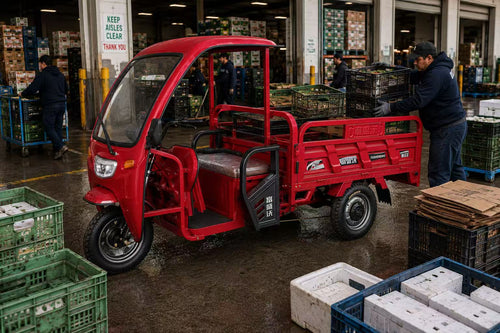
Some electric 3 wheel farm utility vehicles include a covered cab, windshield, roof, or weather protection. This can matter when the vehicle is used frequently across open farm areas.
A covered setup can help protect the driver from sun, wind, dust, or light rain. It may be useful for farms with long internal routes or all-season chores.
However, weather protection should not come at the cost of cargo usefulness. A covered vehicle still needs a practical cargo bed, enough payload, stable handling, and easy loading access.
A buyer should decide whether operator protection or open cargo flexibility matters more for the job.
Private Farmland and Road Rules
For many buyers, the clearest use case is private farmland. These vehicles are often best suited for internal farm transport, not highway driving.
Private-property uses may include:
Barn-to-feed storage routes.
Greenhouse-to-packing area movement.
Nursery supply transport.
Orchard row support.
Livestock area chores.
Farm maintenance tasks.
Tool and parts movement.
If a buyer wants to use the vehicle on public roads, they should check local laws and restrictions. Requirements can vary by state, county, road type, speed, lighting, registration, and vehicle classification.
This distinction is important. A vehicle can be very useful on private farmland even if it is not intended for public road use.
When It Makes Sense Instead of a UTV or Gas Truck
A 3 wheel electric farm utility vehicle makes sense when the farm has repeated short-distance cargo tasks that do not require a full-size UTV, tractor, or truck.
It is especially useful when:
The route is private property.
The cargo is light to medium farm material.
The farm wants quiet operation.
The vehicle works near livestock or greenhouses.
The route is repetitive.
The cargo bed fits the daily load.
The farm wants lower maintenance for small transport jobs.
It may reduce unnecessary use of larger gas-powered equipment.
When a Larger Vehicle May Be Better
A 3 wheel electric farm utility vehicle is not the answer for every job.
A larger vehicle may be better for:
Heavy towing.
Deep mud.
Steep hills.
Large field work.
Long-distance public road travel.
Major hauling loads.
Loader or attachment work.
Extreme ranch terrain.
The electric 3 wheel farm utility vehicle is best understood as a practical internal transport tool. It supports daily hauling, but it does not replace every piece of farm machinery.
What to Check Before Buying
Before choosing an electric 3 wheel farm utility vehicle, ask:
How much weight do I need to carry or haul daily?
Will I move feed, tools, produce, fertilizer, or supplies?
Do I need an open cargo bed, covered cab, or dump bed?
Is the route flat pavement, gravel, dirt, or uneven terrain?
Will the vehicle operate near livestock?
How many miles or trips will it make per day?
Where can I charge it?
Will it stay on private farmland?
Do I need to check public road restrictions?
Would this reduce small trips with a gas truck or UTV?
These questions help match the vehicle to the farm’s real daily work.
Conclusion
An electric 3 wheel farm utility vehicle can be a practical choice for private farmland when the route, payload, cargo bed, motor, battery, and terrain match the job. It works best for low-speed internal farm transport, carrying feed, tools, produce, fertilizer, buckets, and supplies around barns, greenhouses, nurseries, orchards, livestock areas, and farm work zones.
It is quiet, low-maintenance, and useful for repeated short-distance work. It can reduce the need to use a UTV or gas-powered truck for every small farm task.
The best model is not always the fastest one. The best model is the one that carries the real daily load safely, fits the private farm route, and supports the work that happens again and again.