Customer Pickup Area Transport in Wholesale Markets
Share
Wholesale markets are not only places where goods are stored, sorted, or sold. They are also pickup environments where business customers arrive throughout the day to collect products, check orders, load vehicles, and leave quickly.
For many seafood markets, produce terminals, meat wholesalers, restaurant supply warehouses, cash-and-carry stores, and general merchandise wholesale buildings, the customer pickup area is one of the busiest parts of the operation.
A restaurant owner may arrive with a van. A small grocery store may bring a pickup truck. A seafood retailer may use a small refrigerated vehicle. A butcher shop may collect sealed meat cartons. A convenience store owner may pick up beverage boxes, paper goods, and mixed supplies. These customers often do not buy full pallet loads. They buy mixed orders that need to be moved from storage, cold rooms, packing areas, vendor stalls, or checkout zones to the customer vehicle.
This creates a daily material handling problem.
The distance may be short, but the work is repeated many times. Workers may move cartons, produce crates, foam boxes, rice bags, oil boxes, packaged goods, and restaurant supply items across crowded pickup lanes. Hand carts can help, but they often require multiple trips. Forklifts are useful for pallets, but they are not always suitable for small mixed orders near customers and parked vehicles.
A cargo-bed electric utility vehicle can help fill this gap.
It provides a flexible short-distance transport solution for wholesale customer pickup areas, especially when goods are mixed, non-palletized, and handled in smaller business orders.
Why Customer Pickup Areas Need Better Short-Distance Transport
Customer pickup is different from warehouse storage.
Inside a warehouse, goods may move between racks, pallets, and receiving areas. In a customer pickup zone, the work is more dynamic. Workers need to prepare orders, move them to the correct vehicle, check product counts, handle customer timing, and avoid blocking loading lanes.
The pickup area may include:
customer vans and pickup trucks
box trucks and small refrigerated vehicles
mixed order staging zones
cold room exits
checkout or order confirmation areas
vendor stalls and packing stations
loading doors and warehouse aisles
In this type of environment, movement is constant. The same worker may make many short trips between storage and pickup vehicles during a busy morning or afternoon.
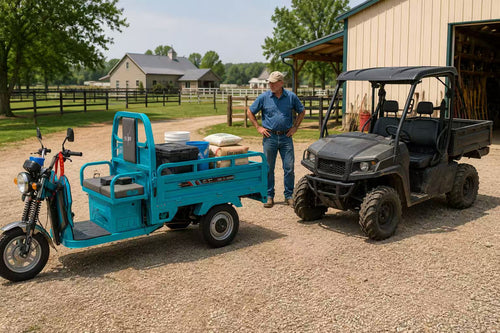
A compact electric utility vehicle can reduce repeated walking and manual hauling. It gives workers a small powered vehicle that can carry more than a hand cart but still operate in tight wholesale spaces.
The Problem with Mixed Customer Orders
Many wholesale customers do not collect one perfect pallet.
A restaurant may buy rice bags, sauce cartons, takeout packaging, cleaning supplies, and frozen food cases in one visit. A produce buyer may collect fruit boxes, vegetable crates, and several small cartons. A seafood retailer may pick up foam boxes, sealed seafood cartons, and ice-related supplies. A general merchandise buyer may load several different cartons into a van.
These are mixed orders.
Mixed orders often require human checking, sorting, and careful loading. They may include different box sizes, different weights, and different handling requirements. A forklift may not be the best tool for moving this kind of order to a customer vehicle, especially when the vehicle is not positioned at a standard dock.
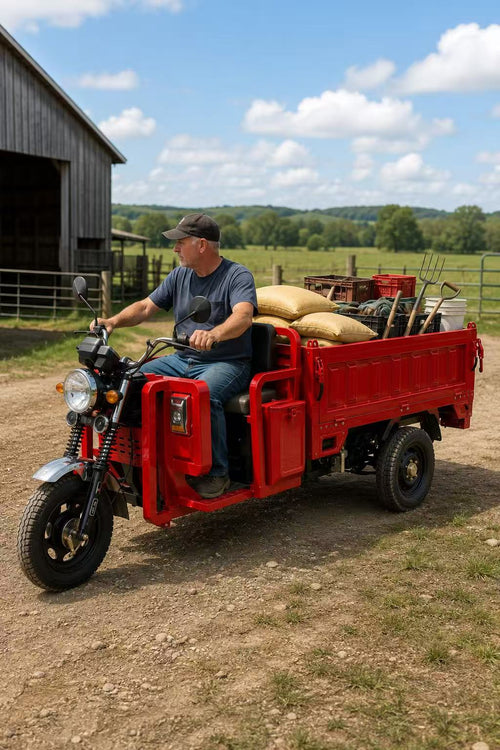
A cargo-bed electric utility vehicle gives workers a practical way to move the complete order together. The cargo bed can hold cartons, crates, foam boxes, bags, and supplies in one trip. This helps reduce repeated cart movement and makes the pickup process easier to organize.
How an Electric Utility Vehicle Supports Pickup Zones
A cargo-bed electric utility vehicle can support customer pickup area transport in several ways.
It can move completed orders from a packing area to a customer van. It can carry mixed cartons from a warehouse aisle to a pickup lane. It can help workers transfer produce crates from a stall to a truck. It can move sealed cold-chain cartons from a cold room entrance to a refrigerated vehicle. It can also support short-distance movement between checkout, staging, and loading areas.
The vehicle is especially useful when the route is short and repeated.
For pickup area work, the value comes from:
carrying mixed goods in fewer trips
reducing repeated manual cart movement
supporting faster customer service
moving through tight wholesale areas
handling non-palletized cartons and crates
helping workers organize small business orders
supporting pickup vehicles that are not at a standard dock
It is not a replacement for forklifts or pallet jacks. It is a practical support tool for the smaller, mixed, and frequent movements that happen around customer pickup areas.
Seafood, Produce, Meat, and Restaurant Supply Pickup
Customer pickup area transport is common across many wholesale categories.
In seafood wholesale markets, customers may collect foam boxes, sealed seafood cartons, and refrigerated goods from vendors or cold rooms. A compact electric utility vehicle can help move these goods to the pickup area without requiring workers to hand-carry each box.
In produce wholesale markets, fruit boxes and vegetable crates may need to move from vendor stalls or cooler areas to customer vehicles. A cargo-bed electric vehicle can carry mixed produce orders through market lanes and loading zones.
In meat wholesale and cold storage areas, the vehicle should be used for sealed cartons and packaged goods. It can help move boxed products from storage to pickup vehicles without positioning the article as direct contact with unpackaged food.
In restaurant supply warehouses, customer orders often include rice bags, cooking oil cartons, paper goods, takeout packaging, cleaning products, and dry goods. These loads are often mixed and repeated, making them a strong fit for cargo-bed transport.
A Practical Link Between Warehouse and Customer Vehicle
The customer pickup area is the final short-distance link before goods leave the wholesale market.
If this link is slow, workers spend too much time walking, carrying, sorting, and moving small loads by hand. If it is organized well, the business can serve customers faster and reduce unnecessary labor during busy pickup periods.
A cargo-bed electric utility vehicle helps create that link.
It can move goods from warehouse to vehicle, from stall to pickup zone, from cold room to customer loading area, and from checkout staging to the correct truck or van.
For small and mid-size wholesale businesses, this can be especially useful because not every operation has a perfect dock setup, large staff, or full warehouse equipment system. A compact electric vehicle gives the business a flexible tool for the real movement that happens every day.
Choosing the Right Tool for Pickup Area Work
A strong wholesale operation uses different tools for different jobs.
Forklifts are still important for palletized goods. Pallet jacks are still useful for floor-level pallet movement. Refrigerated trucks are still needed for longer cold-chain delivery. Hand carts still work for very small loads.
But customer pickup areas often need something in between.
When the order is too mixed for forklift-only handling, too heavy for repeated hand carts, and too short-distance for a truck-based workflow, a cargo-bed electric utility vehicle becomes a practical option.
It helps workers move mixed orders, non-palletized goods, cartons, crates, foam boxes, bags, and supplies from the wholesale operation to the customer vehicle with less repeated effort.
For seafood markets, produce markets, meat wholesalers, restaurant supply warehouses, cash-and-carry stores, and general merchandise wholesale businesses, customer pickup area transport is not a small detail. It is part of the daily customer experience.
A compact electric utility vehicle can help make that final movement faster, cleaner, and easier to manage.