Who Should Operate It? Setting Simple Crew Rules for a Powered Dump Hauler
Share
A powered dump hauler is not only a machine.
It becomes part of a daily work routine.
On a farm, ranch, horse stable, nursery, greenhouse, landscaping job, apartment property, HOA maintenance route, or controlled job site, the same vehicle may be used by different people during the week.
One worker may use it for manure bedding waste.
Another may use it for mulch.
Another may carry feed bags.
Another may move tools.
Another may use the dump bed for compost, gravel, soil, or yard debris.
That is why simple crew rules matter.
A powered dump hauler, electric dump cart, electric work trike, powered wheelbarrow, motorized wheelbarrow, or battery-powered utility cart works better when every operator understands the same basic rules for driving, loading, dumping, charging, cleaning, and parking.
The question is not only:
Can the vehicle do the job?
The better question is:
Can the crew use it the same way every day without confusion?
Good equipment can still be misused
A strong work vehicle can become frustrating if the team uses it carelessly.
One person may overload the bed.
Another may leave the battery low.
Another may park it in the wrong place.
Another may leave manure residue in the cargo bed before someone uses it for feed bags.
Another may drive too fast near animals, residents, plants, or tools.
Another may move the vehicle with the dump bed raised.
Another may let loose tools slide around in the bed.
These problems are not always product problems.
Sometimes they are crew-rule problems.
A powered dump hauler is most useful when the owner or manager creates a simple daily use routine.
The rules do not need to be complicated. They just need to be clear.
Not everyone should operate it immediately
A new worker should not be expected to use a powered dump hauler under full load on the first minute.
Even if the vehicle is easy to operate, the worker still needs to understand the controls, route, load limits, reverse function, braking response, dump bed operation, charging location, and areas where the vehicle should not go.
This matters on farms, stables, landscaping crews, nurseries, greenhouses, ranches, and property maintenance teams.
A new operator should first learn:
How to start and stop.
How to move forward slowly.
How to use reverse carefully.
How the brakes respond.
How to keep the bed lowered during movement.
Where to load.
Where to dump.
Where to charge.
Where to park.
Which routes are approved.
The first lesson should happen with an empty or light load in an open, firm area.
A new operator should not learn by carrying wet soil, gravel, manure bedding waste, or a heavy pile of tools through a tight route.
Approved operators make daily use easier
For many workplaces, it helps to have approved operators.
This does not mean only one person can ever use the vehicle. It means the team knows who has been shown how to operate it properly.
Approved operators help reduce confusion.
They know where the vehicle belongs.
They know how to charge it.
They know the daily route.
They know how to keep the load low and stable.
They know not to carry passengers in the cargo bed.
They know when to use reverse.
They know where the dump bed can be raised.
They know when to report an issue.
This is useful when the vehicle is shared by farm hands, stable workers, nursery employees, landscaping crews, apartment maintenance staff, HOA workers, or ranch workers.
Shared equipment needs shared responsibility.
The cargo bed is for materials, not passengers
One simple rule should be clear:
The cargo bed is for materials, not passengers.
A powered dump hauler is not a golf cart. It is not a passenger cart. It is not designed for workers, children, visitors, residents, or helpers to ride in the cargo bed.
The bed should be used for work materials such as mulch, compost, gravel, soil, manure bedding waste, feed bags, tools, plant debris, branches, yard waste, and maintenance supplies.
This rule should be understood by everyone on the crew.
It is especially important on farms, stables, apartment properties, schools, HOA communities, parks, landscaping jobs, and customer-facing sites.
If the job requires moving people, use a vehicle designed for passengers.
A dump hauler should move work material.
Keep the dump bed lowered during normal movement
Another important crew rule is simple:
Move with the cargo bed lowered.
The dump bed should be fully lowered and level during normal driving, loading, parking, and repositioning. A raised bed changes visibility, balance, height, and clearance.
The bed should only be raised when the vehicle is stopped, positioned correctly, and ready for controlled unloading.
This matters near barns, greenhouse lanes, compost piles, manure areas, landscaping beds, property sidewalks, trailers, fences, walls, animals, and workers.
The rule should be easy for every operator to remember:
Drive with the bed down.
Dump only when stopped.
Lower the bed before moving away.
This habit protects the workflow and makes the vehicle easier to manage.
Set clear loading rules
A powered dump hauler is useful because it can carry real work materials.
But every crew should follow basic loading rules.
Heavy material should stay low.
Loose material should stay below the bed edges.
Bags should be stacked flat and stable.
Tools should not hang over the sides.
Branches should not block the operator’s control area.
Wet soil and gravel should not be treated like lightweight mulch.
Dirty materials should not be mixed with clean supplies unless planned.
The crew should understand that load capacity is not only a number.
The right load depends on the material, route, ground condition, operator, slope, stopping distance, and dumping area.
A load that looks fine on flat concrete may feel different on gravel, grass, dirt, barn thresholds, greenhouse lanes, curb cuts, or soft ground.
Good crew rules help operators load for the actual route, not just for the size of the bed.
Do not make every trip a maximum-load trip
A common mistake is trying to fill the cargo bed as much as possible every time.
That is not always efficient.
Dense material such as gravel, wet soil, compost, and manure bedding waste can become heavy quickly. A full-looking load of mulch may be bulky but lighter than a half-bed of wet soil. Feed bags and tools may need stable placement more than maximum volume.
The crew should understand that productivity comes from repeated controlled trips, not reckless loading.
A moderate load that moves smoothly may save more time than an overloaded bed that spills, shifts, stops, or damages the ground.
This is especially true when the route includes narrow paths, soft ground, animals, residents, curb cuts, door thresholds, trailer ramps, or tight backing areas.
The best crew rule is practical:
Load what the route can handle today.
Make reverse a controlled movement
If the vehicle has reverse, the crew should know how to use it properly.
Reverse is useful for repositioning, backing away from compost piles, leaving barn aisles, adjusting in greenhouse lanes, moving near trailers, or exiting tight side yards.
But reverse should not be rushed.
Every operator should check behind the vehicle, move slowly, and avoid backing toward people, animals, vehicles, plants, walls, gates, or equipment.
A reverse function gives the operator more control, but it does not replace route planning.
The crew should know where backing is allowed, where a helper is needed, and where the route should be changed instead of forcing the vehicle into a bad position.
Reverse is a work tool.
It should be used carefully.
Dumping needs its own rules
The dump function is one of the biggest advantages of a powered dump hauler.
It can reduce manual shoveling and make unloading mulch, compost, gravel, soil, wood chips, manure bedding waste, and yard debris easier.
But dumping should follow a routine.
The vehicle should be stopped.
The ground should be firm.
The rear discharge area should be clear.
No people or animals should stand behind the vehicle.
The load should be suitable for dumping.
The bed should be raised slowly and only in the planned dump area.
The bed should be lowered again before moving.
The crew should know where dumping is allowed.
A compost pile, manure area, soil station, mulch bed, gravel patch, debris area, or controlled job site unloading zone is different from a random corner near a gate, sidewalk, stall door, driveway, or customer area.
Good dumping rules prevent cleanup problems.
The route should be approved before work starts
A powered dump hauler should not go everywhere just because it can move.
The team should know the approved work routes.
On a farm, this may include barn-to-compost routes, feed storage routes, gravel lanes, equipment paths, and material staging areas.
At a horse stable, it may include stall aisles, manure routes, bedding storage, wash area access, and service paths.
At a nursery or greenhouse, it may include service lanes, potting areas, plant waste routes, and soil stations.
For landscaping or property maintenance, it may include side access, mulch routes, dumpster routes, sidewalk service paths, and approved internal lanes.
The crew should also know which routes are not approved.
Avoid public roads unless local rules and vehicle classification allow it. Avoid soft ground after rain if the surface will be damaged. Avoid crowded resident areas. Avoid tight dead-end routes without backing space. Avoid steep or unstable paths. Avoid routes with animals, children, customers, or visitors in the way.
A clear route rule makes the vehicle more dependable.
Slow speed should be the normal rule
A powered dump hauler is a work vehicle, not a racing vehicle.
Crew rules should make low-speed control the normal habit.
This matters when moving near barns, stables, greenhouses, nurseries, sidewalks, apartment buildings, HOA lawns, landscaping beds, trailers, fences, tools, animals, and people.
Slow movement gives the operator time to stop, turn, back up, and protect the load.
It also makes the vehicle look more professional in customer-facing environments such as apartment properties, HOA communities, schools, parks, resorts, landscaping jobs, and private estates.
Fast movement may save a few seconds, but it can create spills, ground damage, complaints, or unsafe situations.
A simple rule works well:
Move slowly enough to stop calmly.
Assign charging responsibility
A battery-powered utility vehicle depends on charging habits.
If everyone uses the vehicle but nobody is responsible for charging it, the next worker may start the day with a low battery.
The crew should have a clear charging rule.
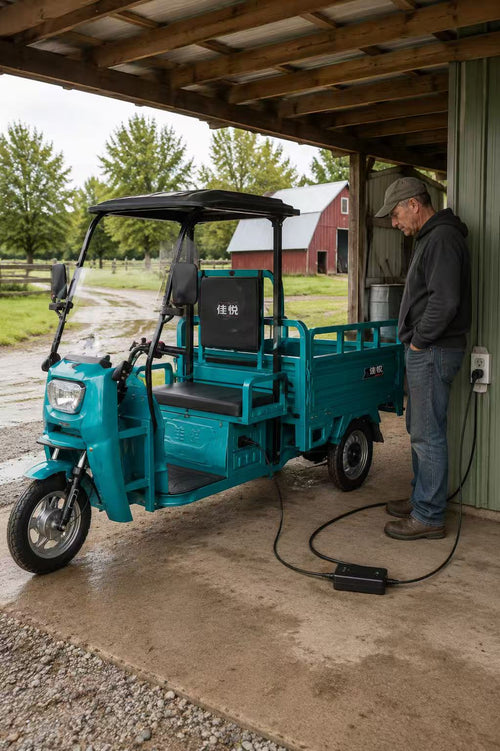
After use, the operator should park the vehicle in the assigned location, turn it off, lower the bed, remove loose material if needed, and connect charging equipment according to the seller’s instructions.
The charging area should be dry, organized, and out of the main work route.
Cords should not lie across paths where workers, animals, carts, vehicles, or residents may pass.
This rule matters for farms, stables, nurseries, greenhouses, warehouses, apartment maintenance rooms, landscaping yards, and job sites.
A good charging routine keeps the vehicle ready for the next worker.
Set parking rules
Where the vehicle is parked matters.
A powered dump hauler should not be left blocking a barn aisle, gate, greenhouse lane, sidewalk, driveway, stall door, shed entrance, trailer ramp, feed room, parking space, or customer area.
The crew should know the assigned parking area.
The cargo bed should be lowered.
The vehicle should be on firm, level ground.
The load should be removed if the day is done.
The charging cable should be handled properly.
The vehicle should not block emergency access, animals, workers, or customers.
Parking rules are simple, but they prevent daily frustration.
A vehicle that is parked correctly is easier to find, easier to charge, easier to inspect, and easier to use the next day.
Cleanout should be part of crew responsibility
The person who uses the vehicle should not leave a dirty problem for the next person.
If the cargo bed carried manure bedding waste, wet compost, soil, gravel, mulch, leaves, or debris, the operator should decide whether the bed needs cleaning before the next use.
This is especially important when the next load may be feed bags, tools, clean supplies, plant trays, or packaged material.
A dirty cargo bed can create contamination, odor, slipping, bag damage, or extra cleanup.
The rule does not need to be complicated.
If the material will affect the next load, clean the bed or report that it needs cleaning.
A powered dump hauler stays more useful when every operator respects the next operator.
Report problems immediately
Small problems should be reported early.
A weak brake feel, damaged tire, loose part, unusual noise, low battery issue, slow response, damaged cargo bed, stuck material, broken tool, charging problem, or unusual dump bed movement should not be ignored.
The operator who notices the issue should tell the owner, manager, supervisor, or responsible person.
This is especially important when several people share the vehicle.
If nobody reports a problem, the next worker may discover it under load, far from the storage area, or near animals, customers, residents, or expensive property.
A powered dump hauler does not need complicated management.
But it does need a basic rule:
If something feels wrong, stop and report it.
Do not use the vehicle outside its purpose
A powered dump hauler is built for material handling.
It should not be used for horseplay, passenger riding, racing, pulling unauthorized loads, pushing objects, climbing unsafe obstacles, driving on public roads without approval, or moving with a raised bed.
The crew should understand the purpose of the vehicle.
It is for moving work materials through approved routes at controlled speed.
That purpose may include farm hauling, stable cleanup, ranch maintenance, nursery work, greenhouse supply movement, landscaping material transport, property maintenance, warehouse support, or job site cleanup.
When the crew uses the vehicle within its purpose, it becomes reliable.
When the crew invents other uses, problems become more likely.
Match the operator to the task
Not every task needs the same experience level.
A simple tool run across a flat property route may be easier than backing a loaded hauler out of a narrow greenhouse lane. Moving mulch across firm ground may be easier than dumping wet soil near a slope. Carrying feed bags may be easier than positioning a gravel load beside a tight edge.
The manager should match the operator to the task.
A new operator can start with light loads and open routes.
A more experienced operator can handle tighter routes, reverse positioning, heavier materials, or controlled dumping.
This does not mean the machine is difficult.
It means good teams build skill gradually.
A powered dump hauler becomes more valuable when workers know which tasks match their experience.
Use a helper when needed
Some work is easier with a second person guiding.
A helper may be useful when backing near a trailer, entering a tight barn aisle, working near greenhouse benches, dumping near a pile, passing through a narrow gate, or moving near residents, animals, or parked vehicles.
The helper should not stand behind the vehicle in the backing path or near the dumping area.
The helper should stand where the operator can see them and communicate clearly.
Crew rules should explain when a helper is recommended.
This can prevent damage in tight areas and make difficult routes feel more controlled.
A helper is not always needed, but it is useful in high-risk or narrow spaces.
Keep rules simple enough to follow
Crew rules fail when they are too complicated.
A farm, stable, nursery, greenhouse, landscaping crew, or property maintenance team does not need a long manual for every small trip.
It needs simple rules that workers can remember.
Only approved operators use the vehicle.
No passengers in the cargo bed.
Drive slowly.
Keep the bed lowered when moving.
Load low and stable.
Use approved routes.
Dump only in planned areas.
Check behind before reversing.
Park in the assigned place.
Charge after use.
Clean or report dirty beds.
Report problems immediately.
These rules are practical.
They cover most daily misuse problems without slowing the crew down.
Crew rules make ownership easier
A powered dump hauler is often bought to reduce repeated labor.
It should not create new confusion.
When a team has no rules, the owner may spend time asking who used it, why the battery is low, why the bed is dirty, why the vehicle is blocking a gate, why material spilled, or why the dump zone is messy.
When the team has simple rules, the vehicle becomes easier to manage.
The owner knows who is responsible.
Operators know what to do.
The vehicle stays ready.
Loads are more controlled.
Charging is more predictable.
Dumping is cleaner.
Routes are safer.
The workday runs smoother.
Good crew rules protect the value of the equipment.
A shared hauler should have a daily routine
The best routine is simple.
Before use, check the vehicle.
During use, follow the approved route.
When loading, keep the load stable.
When dumping, stop and clear the rear area.
When reversing, look behind and move slowly.
After use, lower the bed, park correctly, clean if needed, and charge.
This routine can fit many work environments.
Horse stables can use it for manure and bedding work.
Farms can use it for feed, soil, gravel, and tool hauling.
Nurseries can use it for plant material and potting supplies.
Greenhouses can use it for trays, soil bags, and cleanup.
Landscaping crews can use it for mulch, soil, branches, and yard debris.
Apartment and HOA teams can use it for tools, trash bags, cleaning supplies, and maintenance material.
The details change, but the rule stays the same:
Use the vehicle with a repeatable routine.
Ask these crew-rule questions before buying
Before buying a powered dump hauler, electric dump cart, electric work trike, powered wheelbarrow, motorized wheelbarrow, or battery-powered utility cart, the buyer should ask:
Who will operate it?
Will several workers share it?
Who will train new operators?
Where will new operators practice?
Will the cargo bed be used only for materials?
Who is allowed to raise the dump bed?
Which routes are approved?
Where is dumping allowed?
Who checks the battery?
Who charges it after use?
Where should it be parked?
Who cleans the cargo bed?
Who reports damage or problems?
Are passengers clearly prohibited?
Are public road boundaries clear?
These questions help the buyer think beyond the purchase.
They show how the vehicle will actually enter the daily workflow.
The right operator rules turn a vehicle into a work system
A powered dump hauler is most valuable when it becomes part of a controlled work system.
The vehicle can carry material.
The dump bed can reduce unloading labor.
Reverse can help with repositioning.
The electric drive can support low-speed work.
The cargo bed can handle daily supplies.
But the crew determines how well those features work in real life.
Simple operator rules help prevent misuse, reduce confusion, improve readiness, and make daily hauling more predictable.
The goal is not to create paperwork.
The goal is to make sure every worker uses the vehicle in a way that protects the load, the property, the operator, and the workday.
When the crew understands the rules, the powered dump hauler becomes more than a machine.
It becomes a reliable daily material-handling tool.