Choosing the Right Electric Utility Vehicle for Wholesale Market Workflows
Share
Not every wholesale market needs the same type of electric utility vehicle. A seafood wholesaler, produce vendor, meat distributor, restaurant supply warehouse, general merchandise wholesaler, and cash-and-carry store may all move goods every day, but the workflow behind that movement can be very different.
Some businesses mainly move cartons, crates, bags, and mixed customer orders. Some handle temperature-sensitive goods between cold rooms and loading areas. Some struggle with truck-bed height because they do not have a standard loading dock. Some need a small vehicle to reduce repeated walking between aisles, staging areas, and customer pickup zones.
This is why choosing the right electric utility vehicle matters.
A wholesale business should not choose a vehicle only by looking at load capacity or price. The better question is: which workflow problem does the vehicle need to solve?
In wholesale market material handling, the main choices usually fall into three practical categories:
cargo-bed electric utility vehicle
refrigerated electric cargo trike
electric lift tricycle with hydraulic platform
Each one fits a different type of work.
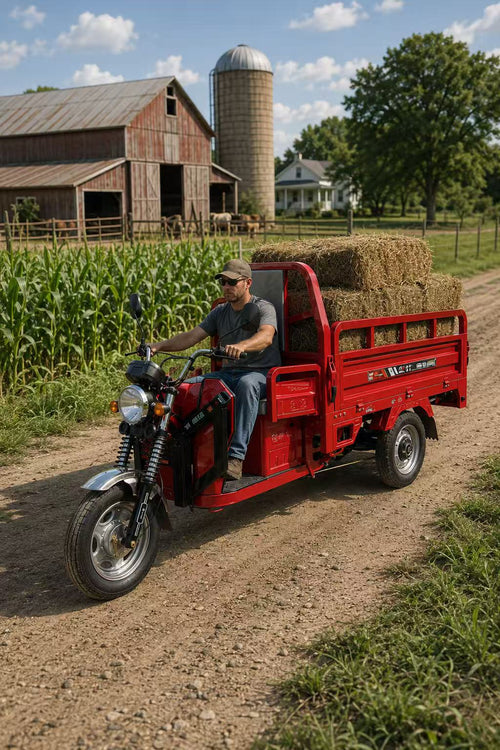
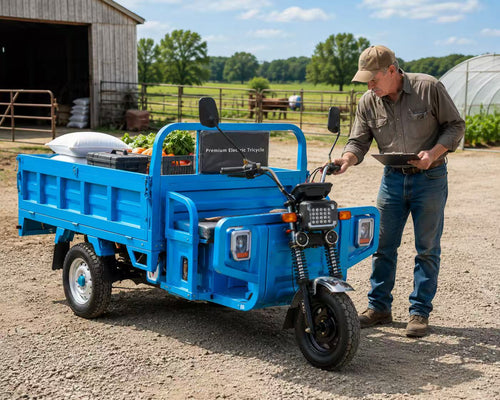
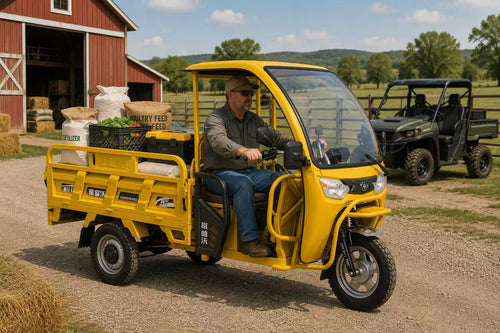
A cargo-bed electric utility vehicle is best for mixed boxes, crates, dry goods, customer pickup orders, and repeated short-distance hauling. A refrigerated electric cargo trike is better for sealed cold-chain goods such as seafood boxes, packaged meat cartons, frozen food cases, dairy products, and temperature-sensitive produce. An electric lift tricycle with a hydraulic platform is better when the problem is truck-bed height, loading dock height difference, or working at a raised platform level.
The goal is not to make one vehicle do every job. The goal is to match the vehicle to the real daily workflow.
Start With the Goods You Move Every Day
The first step is to look at the goods.
If the business mostly moves dry goods, produce crates, sealed cartons, paper goods, bags, packaging materials, restaurant supply boxes, or general merchandise, a cargo-bed electric utility vehicle is often the most practical starting point.
This type of vehicle works well for non-palletized goods and mixed orders. It can carry goods that are too much for one hand cart trip but not large enough to justify forklift handling. It also helps workers move products between warehouse aisles, vendor stalls, order staging zones, loading doors, and customer pickup vehicles.
Common cargo-bed vehicle loads include:
closed cartons
produce crates
foam boxes
rice bags
flour bags
cooking oil boxes
paper goods
takeout packaging
cleaning supply cartons
mixed customer orders
For seafood, produce, restaurant supply, and general wholesale businesses, this is often the first vehicle to consider because it fits the broadest daily movement.
When a Refrigerated Electric Cargo Trike Makes More Sense
If the business handles temperature-sensitive goods, the decision changes.
Seafood wholesalers, meat distributors, frozen food suppliers, dairy warehouses, and fresh food businesses often need to move sealed products between cold rooms, loading docks, customer pickup areas, and short-distance delivery vehicles. In this case, an open cargo-bed vehicle may not be the best choice for every task.
A refrigerated electric cargo trike is more suitable when the goods need enclosed, temperature-aware movement over short distances.
This does not mean it replaces full-size refrigerated trucks. Large refrigerated trucks are still needed for long-distance delivery and larger cold-chain routes. The refrigerated electric cargo trike fits the smaller route inside or near the wholesale market.
It can support:
cold room to loading dock transport
cold storage to customer pickup
seafood foam box movement
sealed meat carton transfer
frozen food case handling
dairy order movement
temperature-sensitive produce transport
nearby market district delivery
The key is to use it for clean, sealed, packaged goods. It should not be presented as a vehicle for exposed raw food. Its value is in supporting short-distance cold-chain movement between storage and the next handling point.
When a Hydraulic Lift Tricycle Is the Better Choice
Sometimes the main problem is not distance or temperature. It is height.
Many small and mid-size wholesale businesses do not have the perfect loading dock for every truck. A box truck, pickup truck, small refrigerated vehicle, or delivery trailer may arrive with a cargo floor that is higher than the ground. If the goods are not palletized, workers may need to lift cartons up into the truck or pass boxes down by hand.
That is where an electric lift tricycle with a hydraulic platform becomes useful.
This vehicle is not only for carrying goods. It provides a mobile platform that can rise closer to truck-bed height. It is especially useful when workers need to handle mixed boxes, sealed cartons, foam containers, or non-palletized goods near a vehicle that is not positioned at a standard loading dock.
A hydraulic lift tricycle is most useful for:
truck-bed height handling
loading dock height difference
non-palletized box loading
small truck loading assistance
customer vehicle loading at different heights
worker-access platform tasks
facility inspection and overhead maintenance work
This vehicle should not be compared only with a regular cargo trike. It solves a different problem. A cargo-bed vehicle moves goods across short distances. A refrigerated vehicle protects cold-chain goods. A lift platform vehicle helps handle height differences.
If You Already Have Forklifts and Pallet Jacks
Many wholesale businesses already use forklifts, pallet jacks, hand carts, and platform carts. That does not mean a small electric utility vehicle has no place.
Forklifts are excellent for pallets. Pallet jacks are useful for floor-level pallet movement. Hand carts are practical for small and light loads. But many wholesale market tasks are not full pallet jobs.
A restaurant supply order may include rice bags, sauce cartons, takeout containers, and cleaning supply boxes. A seafood order may include foam boxes and sealed cartons. A produce order may include different fruit boxes and vegetable crates. A meat wholesaler may move sealed cartons from cold storage to a pickup vehicle. A cash-and-carry customer may buy mixed goods that need to be moved from checkout to a van.
These are mixed, short-distance, and often non-palletized workflows.
A small electric utility vehicle fits the space between manual carts and large warehouse equipment. It can reduce repeated walking, reduce repeated cart trips, and help move mixed orders through pickup, staging, and loading areas.
Match the Vehicle to the Workflow
The best way to choose is to match the vehicle to the workflow.
For mixed dry goods and general wholesale orders, choose a cargo-bed electric utility vehicle.
This is the best fit when workers move cartons, bags, crates, packaging supplies, produce boxes, restaurant supply goods, and customer pickup orders. It is the broadest option for daily short-distance hauling.
For seafood, meat, frozen food, dairy, and fresh food cold-chain movement, choose a refrigerated electric cargo trike.
This is the better fit when goods need enclosed movement between cold storage, loading areas, and customer pickup vehicles. It is especially useful for sealed cartons, foam boxes, frozen cases, and temperature-sensitive packaged products.
For truck-bed height and loading dock problems, choose an electric lift tricycle with a hydraulic platform.
This is the better fit when the business has no standard loading dock, different truck heights, manual box loading, or worker-access platform needs.
If the business has all three types of workflows, then one vehicle may not be enough. A cargo-bed vehicle can handle general movement. A refrigerated vehicle can support cold-chain tasks. A lift platform vehicle can handle height differences and loading assistance.
This is how a small wholesale business can build a practical equipment system without relying on one oversized solution for every task.
A Simple Decision Guide
A business can ask a few practical questions before choosing.
What goods move every day?
If the answer is mixed cartons, crates, dry goods, packaging supplies, bags, and customer orders, start with a cargo-bed electric utility vehicle.
Do the goods need cold-chain protection?
If the answer is seafood, meat, frozen food, dairy, or temperature-sensitive packaged goods, consider a refrigerated electric cargo trike.
Is the biggest problem truck height or loading dock height difference?
If the answer is yes, consider an electric lift tricycle with a hydraulic platform.
Are workers walking the same route many times per day?
If the answer is yes, a cargo-bed electric utility vehicle can help reduce repeated walking and repeated hand cart trips.
Are most loads already palletized?
If the answer is yes, forklifts and pallet jacks may still be the main tools. But a small electric utility vehicle can still help with non-palletized goods, pickup orders, and short-distance mixed loads.
Is the pickup area crowded?
If the answer is yes, a compact electric utility vehicle may be easier to use than larger equipment for small business orders and customer vehicle loading.
Why the Right Choice Improves the Whole Workflow
The right vehicle improves more than transportation. It improves the way goods move through the wholesale business.
A cargo-bed electric utility vehicle can improve mixed order picking, order staging, customer pickup, restocking, and short-distance hauling. A refrigerated electric cargo trike can improve cold room to loading dock transport and temperature-sensitive pickup support. An electric lift tricycle can improve loading assistance when truck-bed height creates a problem.
Each vehicle supports a different link in the wholesale workflow.
For a seafood market, the right choice may include both a refrigerated cargo trike and a cargo-bed utility vehicle. For a restaurant supply warehouse, the cargo-bed vehicle may be the main work tool. For a meat distributor, a refrigerated cargo trike may be more important. For a small wholesale warehouse without a good loading dock, the lift platform vehicle may solve the hardest problem.
Choosing the right vehicle is not about buying the biggest equipment. It is about removing the specific bottleneck in the workflow.
A Practical Starting Point for Wholesale Businesses
For many wholesale businesses, the practical starting point is the cargo-bed electric utility vehicle.
It handles the widest range of daily work: cartons, crates, bags, dry goods, packaging supplies, mixed orders, customer pickup, and order staging. It is the most flexible choice when the business needs one vehicle to support many ordinary tasks.
From there, specialized vehicles can be added when the workflow requires them.
Add a refrigerated electric cargo trike when cold-chain goods are a major part of the business. Add an electric lift tricycle with a hydraulic platform when truck-bed height, loading dock height difference, or raised worker access becomes a regular problem.
This creates a clear equipment logic:
cargo-bed vehicle for general mixed goods
refrigerated vehicle for cold-chain boxed goods
hydraulic lift vehicle for height-difference handling
Wholesale markets need practical tools that match real movement. The best vehicle is not always the most expensive or the largest. It is the one that fits the route, the load, the space, and the daily workflow.
When a business chooses the right electric utility vehicle, it can reduce repeated manual movement, organize mixed orders more efficiently, support customer pickup, and keep goods moving through the market with less wasted effort.