Complete Warranty & Local After‑Support Guide for All‑Purpose Electric Utility Trikes Across US Industries
For U.S. buyers considering an electric utility trike for farms, warehouses, wholesale markets, construction sites, property maintenance, landscaping, or other commercial work, after-sales support is an important part of the buying decision.
The practical question is not simply how long a warranty lasts. Buyers also need to know what the warranty covers, what happens when a problem occurs, whether replacement parts can be identified and supplied, and how a repair can actually be completed when the vehicle is located hundreds or thousands of miles from the seller.
For this reason, a useful after-support system should combine clear warranty terms, practical troubleshooting, access to correctly matched replacement parts, technical assistance from the seller, and qualified local repair resources when hands-on service is required.
Understanding the Warranty
OneClick China provides warranty support according to the covered component and applicable warranty terms.
The vehicle frame is covered for two years. The motor and battery are covered for one year.
Warranty coverage is intended for eligible failures or defects that occur under normal use. Normal wear items, damage caused by misuse, overloading, unauthorized modification, accidents, improper maintenance, water-related damage outside the intended operating conditions, corrosion caused by harsh environments, and other non-warranty conditions should be evaluated separately.
The important point is that warranty coverage and routine maintenance are not the same thing.
Tires, brake components, bearings, switches, connectors, and other parts exposed to normal wear may eventually require inspection, adjustment, or replacement as part of normal vehicle ownership. A working vehicle should be maintained according to its actual workload and operating environment.
Different Work Environments Create Different Maintenance Needs
Electric utility trikes can operate in very different commercial environments, and maintenance requirements should reflect those conditions.
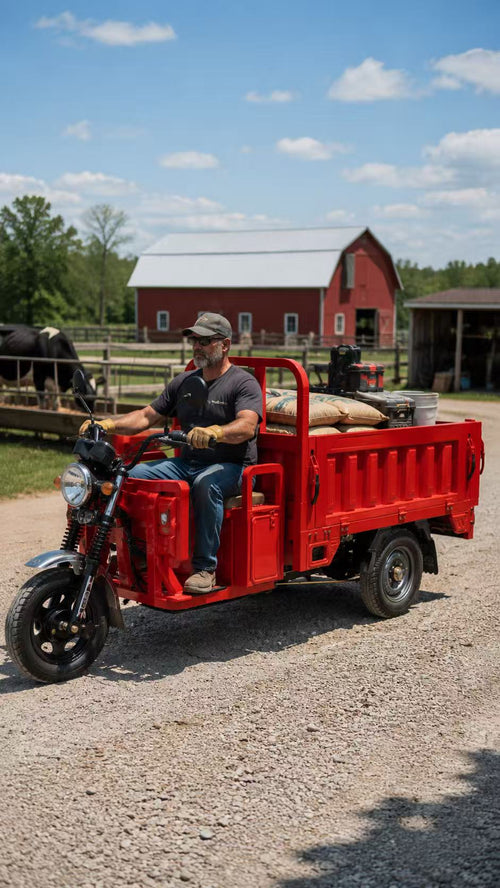
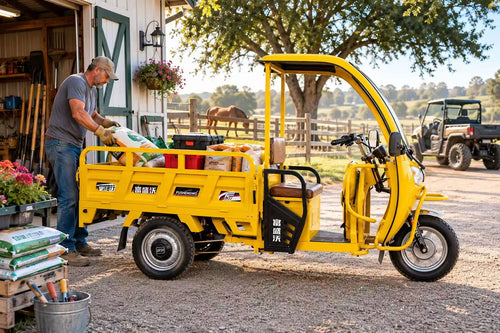
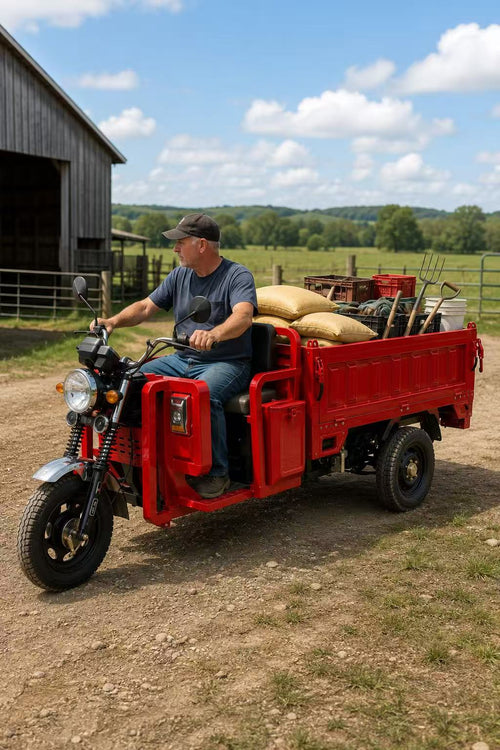
On farms and ranches, dust, mud, uneven surfaces, feed residue, and frequent loading can increase the need for cleaning and inspection of brakes, tires, bearings, wiring connections, and cargo-bed hardware.
In greenhouses, nurseries, and livestock facilities, moisture and repeated short-distance operation make regular inspection of electrical connections and mechanical components especially useful.
Construction, landscaping, and property-maintenance work can expose a vehicle to dirt, gravel, heavy materials, and repeated loading and unloading. Fasteners, tires, brakes, suspension components, and cargo or dump-bed mechanisms should therefore be checked periodically.
Cold-storage, warehouse, and wholesale-market operations may involve frequent starts and stops, narrow routes, repeated daily trips, and changes in temperature. Battery condition, charging practices, tires, brakes, and electrical connections become important parts of routine maintenance.
Coastal or highly corrosive environments require additional attention. Salt, moisture, fertilizer, chemicals, and other corrosive materials should be cleaned from exposed surfaces, and electrical connectors and metal components should be inspected more frequently.
The same vehicle can therefore have very different maintenance requirements depending on where and how it is used.
What Happens When a Problem Occurs?
A practical repair process should begin with diagnosis rather than immediately replacing major components.
When a problem is reported, useful information may include photos, video, the circumstances under which the problem occurred, whether the vehicle powers on, unusual sounds, charging behavior, dashboard or indicator information, and basic electrical measurements when appropriate.
This information helps narrow the possible cause.
For an electrical drive problem, diagnosis may involve the battery, fuse, switches, throttle, wiring connections, controller, motor, or related components.
For a mechanical problem, the cause may involve brakes, tires, bearings, alignment, suspension, frame hardware, or cargo-bed components.
Not every symptom means that a major component has failed. Identifying the actual cause before ordering parts can reduce unnecessary replacement, cost, and downtime.
How Local Repair Coordination Works
A common concern for U.S. buyers is whether an imported electric work trike can be repaired locally if there is no same-brand dealership nearby.
In many cases, the repair does not require a technician who has previously worked on the exact same brand. What matters more is finding a technician with experience relevant to the actual problem.
Depending on the repair, appropriate local resources may include electric bike or scooter technicians, golf cart repair businesses, small electric vehicle technicians, farm or small-equipment repair shops, electrical machinery technicians, or other qualified repair providers.
The repair process can work as a coordinated system.
First, the owner reports the problem and provides available information.
OneClick China can then assist in reviewing the symptoms and identifying the area that should be inspected. When necessary, relevant specifications, wiring information, component information, photos, or testing guidance can be provided to support diagnosis.
If a replacement component is required, the correct part must be identified according to the vehicle configuration and technical specifications.
A suitable local technician can then perform the physical inspection, installation, adjustment, or repair when appropriate.
This approach combines product-specific support from the seller with hands-on service available near the vehicle.
Replacement Parts Must Be Correctly Matched
Electric utility trikes use a combination of electrical and mechanical components. Some service parts may use commonly available specifications, while other components are specific to the vehicle configuration and must be matched correctly.
For electrical components, important factors can include system voltage, power rating, connector type, wiring configuration, dimensions, controller compatibility, and other technical specifications.
Mechanical components must also match the required dimensions, mounting points, load requirements, and operating conditions.
For this reason, buyers and technicians should not assume that a visually similar component is automatically compatible.
When a warranty-related component requires replacement, OneClick China can assist in identifying the correct part according to the vehicle model and configuration and coordinate applicable warranty support.
Local Repair Does Not Mean the Buyer Is Left Alone
Using a local technician is not intended to transfer the seller's responsibility to the buyer.
The purpose of local repair coordination is to solve a practical geographic problem: the vehicle may be located far from the seller, while a qualified technician may already be available near the customer.
The seller can provide product-specific information and parts support, while the local technician provides hands-on inspection and repair.
For a routine mechanical issue, the solution may be relatively straightforward. For a more complicated electrical issue, additional testing and technical communication may be required before a component is replaced.
The level of support should therefore depend on the actual problem rather than assuming that every service situation can be handled in exactly the same way.
Shipping Damage and Delivery Inspection
After delivery, the vehicle should be inspected before regular use.
If visible transportation damage is discovered, buyers should document the condition with clear photos or video as soon as possible. Packaging condition, damaged components, and other relevant details should also be recorded.
This documentation helps distinguish transportation damage from later operating or maintenance issues and makes it easier to determine the appropriate next step.
Buyers should avoid operating a vehicle if the damage may affect safe operation until the affected area has been evaluated.
Routine Maintenance Helps Prevent Downtime
Warranty support is important, but preventive maintenance remains one of the most effective ways to reduce unexpected downtime.
Regular checks should reflect the vehicle's workload and environment. Depending on the application, these may include:
Battery condition and charging practices;
electrical connectors and visible wiring;
brakes and brake adjustment;
tire condition and pressure;
bearings and moving components;
fasteners and frame hardware;
lights and switches;
cargo-bed or dump-bed mechanisms;
and cleaning after exposure to mud, salt, fertilizer, chemicals, or other corrosive materials.
A vehicle used several hours every day in a warehouse or wholesale market should not necessarily follow the same inspection schedule as a vehicle used occasionally on a small property.
Maintenance should follow actual use.
A Practical After-Support Model for U.S. Buyers
For commercial electric utility trikes, effective after-sales support is not defined by a warranty statement alone.
A workable system requires several elements to function together:
clear warranty coverage;
accurate diagnosis;
correctly matched replacement parts;
technical information from the seller;
qualified local repair assistance when necessary;
and routine preventive maintenance by the owner.
This model is particularly useful for vehicles operating across a large country such as the United States, where requiring every customer to return a vehicle to a distant centralized repair facility would be inefficient.
The objective is to make the service process practical.
When a problem occurs, the owner should know who to contact, what information to provide, how the fault will be evaluated, how the correct part will be identified, and how hands-on repair can be coordinated locally when needed.
For buyers using electric utility trikes in farms, warehouses, wholesale markets, construction sites, commercial properties, nurseries, landscaping operations, and other working environments, this combination of warranty coverage, technical support, parts coordination, local repair resources, and preventive maintenance provides a more realistic foundation for long-term vehicle ownership.