Best Side by Side UTV for Farm Work: Do You Need a Full UTV or a Simpler Dump Work Vehicle?
Share
Best Side-by-Side UTV for Farm Work: What Do You Really Need?
If you are searching for the best side-by-side UTV for farm work, the most useful question is not which machine has the highest horsepower or the longest feature list. The better question is what your farm actually needs the vehicle to do every day.
For a working farm, the best UTV usually depends on cargo capacity, towing ability, low-speed control, ground clearance, maneuverability, durability, terrain, and the type of loads you move.
A full-size farm UTV can be the right choice for rough ground, heavy towing, long property routes, multiple passengers, and repeated 4x4 work. But if most daily jobs involve hauling feed, tools, bedding, manure, mulch, soil, produce, or supplies over short internal routes, a simpler work vehicle may accomplish the same job with less size, cost, and complexity.
That is why choosing the best UTV for farm work should start with the work, not the vehicle category.
What Makes a Good UTV for Farm Work?
A farm UTV should be evaluated as a working machine. Speed and recreational performance matter far less than whether the vehicle can carry the required load, move safely at low speed, turn where the work happens, and remain dependable through repeated daily use.
Cargo Bed and Payload Capacity
For feed, tools, fencing supplies, bedding, soil, or harvested material, bed utility matters more than appearance.
Look at both the physical cargo bed and its rated payload capacity. A large-looking bed is not automatically a high-capacity bed. Bed construction also matters when the vehicle will regularly carry gravel, manure, firewood, tools, or other heavy materials.
For loose loads, a dump bed can reduce repeated manual unloading.
Towing Capacity and Low-Speed Control
Farm towing is different from recreational driving. A machine may have plenty of engine power but still be uncomfortable when creeping with a trailer, working beside livestock, or maneuvering into a barn area.
For trailer work, consider towing rating, low-range gearing, low-speed drivability, braking, and stability under load.
A working farm often needs controlled movement more than high top speed.
Ground Clearance, 4x4, and Rough Terrain
Mud, ruts, uneven pasture, gravel lanes, slopes, and field entrances can quickly expose the limitations of a light-duty vehicle.
For regular rough-terrain transport, ground clearance, 4x4 traction, suspension, tire choice, and low-range control become more important.
On loaded downhill routes, controlled braking and engine braking can also matter. The goal is not simply to climb the hill. The machine also needs to remain predictable while carrying a load back down.
Maneuverability
Farm work frequently happens in places where a large vehicle becomes inconvenient.
Barn lanes, livestock areas, gates, sheds, orchard paths, greenhouse surroundings, and equipment storage areas may reward a shorter wheelbase and tighter turning radius more than additional horsepower.
Power steering can also become valuable when the operator repeatedly turns, reverses, loads, and unloads throughout the day.
Long-Term Durability
The best side-by-side for farm work should be judged by repeated daily use, not a short recreational test.
A working farm vehicle may start and stop dozens of times, carry loads at low speed, sit in dust and mud, and operate around feed, soil, bedding, and livestock.
Long-term durability, maintenance access, parts availability, and service support therefore deserve as much attention as the specification sheet.
Match the UTV to the Farm Job
Different farm jobs place very different demands on a vehicle.
Hauling feed and tools requires useful cargo space and adequate payload.
Pulling a small trailer requires towing capacity, low-speed torque, and stable braking.
Moving gravel, mulch, manure, or bedding makes a dump bed more useful.
Checking fences rewards maneuverability and easy entry and exit.
Spot spraying and fence-line weed control require stable low-speed operation.
Seed spreading or light attachment work may require towing and accessory compatibility.
Livestock checking often favors smooth control, predictable movement, and lower noise.
Rough pasture work places greater emphasis on 4x4, clearance, tires, and suspension.
This task-first approach is more useful than simply asking which farm UTV has the most features.
Best UTV for Rough Farm Terrain
If most of your work happens on mud, deep ruts, slopes, rough pasture, or uneven field roads, a full utility UTV begins to make more sense.
For rough terrain, pay particular attention to:
Ground clearance
4x4 capability
Low-range gearing
Suspension travel
Tire selection
Loaded stability
Braking on grades
Engine braking
Under these conditions, the stronger off-road design of a traditional farm UTV can justify the additional size and cost.
However, farms with mostly firm internal roads, barn lanes, greenhouse routes, or maintained orchard paths may not need the same level of off-road capability.
When a Dump Bed Matters on a Farm UTV
A farm UTV with a dump bed can save labor when the work involves loose or bulk material.
Typical examples include manure, gravel, soil, mulch, bedding, compost, feed, and cleanup material.
The important question is not simply whether the vehicle has a dump bed. Consider the load you actually carry, bed construction, payload capacity, dump angle, and how often you unload during a normal workday.
Hydraulic dump beds are especially useful when unloading is frequent or the material is heavy. For occasional light loads, a simpler dumping system may be sufficient.
A dump bed is therefore a useful farm feature, but it should be selected because the task requires it, not simply because it appears on the specification list.
Small Farm vs. Larger Farm: How Much UTV Do You Need?
Property size changes the vehicle decision.
On a smaller farm, daily routes may be short and repeated. Maneuverability, compact dimensions, low operating cost, easy loading, and simple maintenance can matter more than maximum towing capacity.
A larger property may place greater value on longer travel distance, higher towing capacity, rough-terrain performance, multiple-passenger seating, weather protection, and driver comfort.
The important point is that farm size alone does not determine the best utility vehicle for farm work.
A 20-acre property with steep, muddy terrain may require more capability than a much larger farm with firm internal roads.
The work route and load should come before acreage alone.
When a Full-Size UTV Is the Right Choice
A full-size work UTV makes sense when several demanding requirements occur regularly.
Choose the stronger UTV route when you repeatedly need:
Heavy trailer towing
4x4 traction
High ground clearance
Long travel across a large property
Rough or muddy terrain
Steep grades
Multiple passengers
High daily operating hours
Strong suspension and loaded stability
A full utility UTV is especially valuable when the same machine must carry people, tow equipment, cross difficult terrain, and travel longer distances during the same workday.
In these conditions, paying for greater capability is paying for capability you actually use.
When a Full-Size UTV May Be More Machine Than You Need
Many farm owners do not perform those jobs every day.
Their repeated work may be much simpler:
Moving feed from storage to livestock areas
Carrying tools and fencing supplies
Transporting bedding or manure
Moving mulch, soil, compost, or produce
Traveling between barns
Working around greenhouses
Following maintained orchard paths
Performing short-distance property maintenance
For these jobs, a large side-by-side may provide towing, speed, suspension, passenger capacity, and off-road capability that rarely gets used.
That does not make the UTV a bad machine. It means the machine and the job may not be well matched.
A smaller work-focused vehicle can sometimes provide the cargo bed, dump function, low-speed operation, and maneuverability the job actually requires without carrying the cost and complexity of a larger recreational-style platform.
Full-Size UTV vs. Simpler Electric Work Vehicle
The best choice depends on where the vehicle will work and what it will carry.
Full-size farm UTV:
Better for rough terrain
Better for heavy towing
Better for long property routes
Better when 4x4 is frequently required
Better when several workers must ride together
Better for higher-speed movement between distant areas
Compact electric work vehicle:
Better for short internal routes
Better around barns and narrow work areas
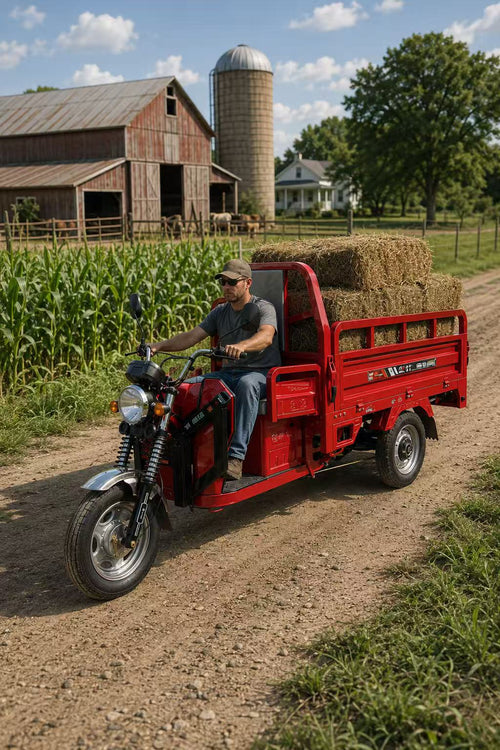
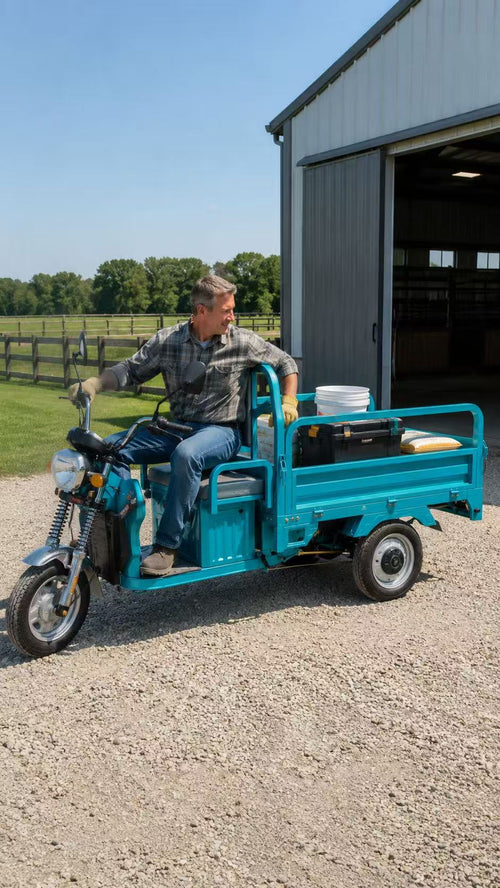
Useful for feed, tools, bedding, manure, soil, mulch, and produce
Can provide a practical dump bed without a full-size UTV platform
Typically operates with less noise around livestock and workers
Can simplify daily low-speed material transport
May reduce the amount of vehicle capability purchased but rarely used
This is the key decision behind choosing the best side-by-side UTV for farm use: buy enough machine for the work, but do not automatically assume that every farm task requires the largest machine available.
When a Tractor Is Still the Better Machine
A UTV should not be treated as a replacement for every piece of farm equipment.
If the work depends on PTO implements, 3-point attachments, repeated heavy plowing, deep tilling, or tractor-level pulling force, a tractor remains the more appropriate machine.
This distinction is important because farm equipment should be matched to the job.
A tractor is designed for implement-driven field work.
A full-size UTV is designed for mobility, towing, cargo, passengers, and rough-property travel.
A simpler work vehicle is designed primarily for repetitive transport, carrying, and unloading.
Trying to make one category perform every job usually means paying for compromises.
Safety and Real Farm Use
Vehicle capability should always be considered together with safe operation.
The U.S. National Institute for Occupational Safety and Health has emphasized the importance of seat belts, appropriate riding practices, terrain awareness, and weather conditions when ATVs and UTVs are used on farms and rural properties.
Penn State Extension also recommends selecting agricultural off-road vehicles according to the work and operating conditions rather than treating every farm application as identical.
These recommendations reinforce an important buying principle: the right farm vehicle is not simply the most powerful option. It is the vehicle whose design matches the load, terrain, passengers, and daily operating conditions.
What We Learned From Real Farm UTV Selection
Looking across successful farm UTV buying guides and real farm-use evaluations, the same priorities appear repeatedly.
Farm owners care about whether the vehicle can work every day.
They want to know:
Can it carry the load?
Can it tow what I actually use?
Can it move slowly and predictably?
Can it handle my terrain?
Can it fit through my gates and work areas?
Can I unload material without excessive manual labor?
Will it remain comfortable during repeated daily use?
Will maintenance and service become a problem?
These questions are more valuable than comparing horsepower alone.
Quick Farm UTV Decision Checklist
Before buying, answer these questions.
What do you carry most often?
What is the heaviest normal load?
Do you regularly tow a trailer?
How rough are your normal routes?
Do you truly need 4x4?
Do you frequently work on steep grades?
Do you need to carry passengers?
Would a dump bed save labor?
How narrow are your barns, gates, or work routes?
How far does the vehicle travel each day?
Do you need PTO or 3-point equipment?
Are you paying for capabilities you will rarely use?
If your answers point toward heavy towing, rough terrain, multiple passengers, and long routes, a full-size farm UTV is probably the right machine.
If your answers point toward short routes, material hauling, dumping, narrow access, and repeated low-speed work, a simpler utility vehicle may be the more efficient choice.
Frequently Asked Questions
What is the best side-by-side UTV for farm work?
The best side-by-side UTV for farm work is the one that matches the farm's actual cargo, towing, terrain, passenger, and daily-use requirements. For demanding rough-terrain work, a full utility UTV is usually appropriate. For shorter hauling routes on maintained surfaces, a smaller work vehicle may provide enough capability.
What should I look for in a farm UTV?
Start with payload capacity, cargo-bed utility, towing capacity, low-speed control, ground clearance, maneuverability, durability, braking, and service support. Then match those features to the jobs performed most often.
Do I need 4x4 for farm work?
Not always. Regular mud, steep grades, rough pasture, deep ruts, or poor field access can justify 4x4. Farms operating mainly on maintained lanes, barn areas, greenhouse routes, or firm orchard paths may not need the same off-road capability.
Do I need a full-size UTV for everyday farm hauling?
Not necessarily. If daily work mainly involves feed, tools, manure, bedding, mulch, soil, produce, or other material moved over short internal routes, a smaller utility or electric work vehicle may handle the work without the additional size and complexity of a full UTV.
Final Takeaway
The search for the best side-by-side UTV for farm work should not begin with a brand name or horsepower number.
Begin with the work.
Define the load, towing requirement, terrain, route length, access width, passenger needs, and unloading method.
Then buy the vehicle that matches those requirements.
For some farms, that will clearly be a full-size 4x4 UTV.
For others, especially where the daily job is short-distance hauling and dumping around barns, livestock areas, orchards, or other maintained work routes, a simpler electric utility vehicle can be the more practical tool.
The best farm vehicle is not the machine with the most capability.
It is the machine whose capability you actually use.