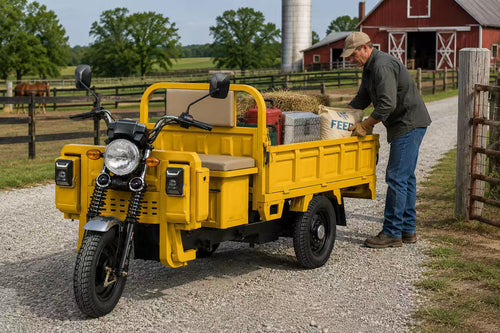
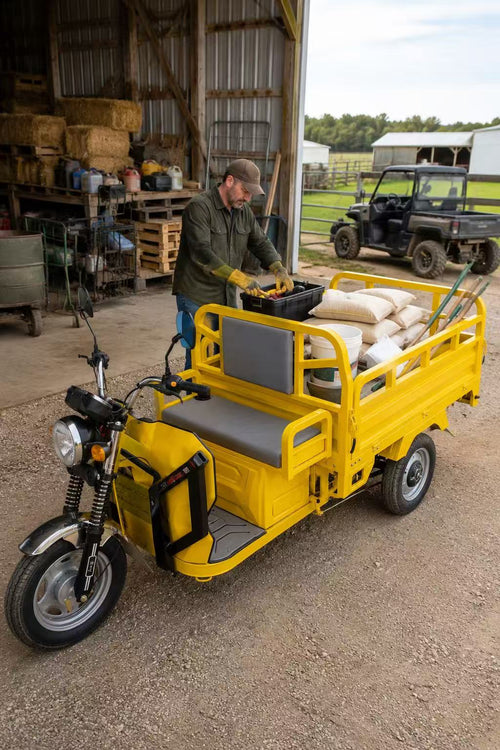
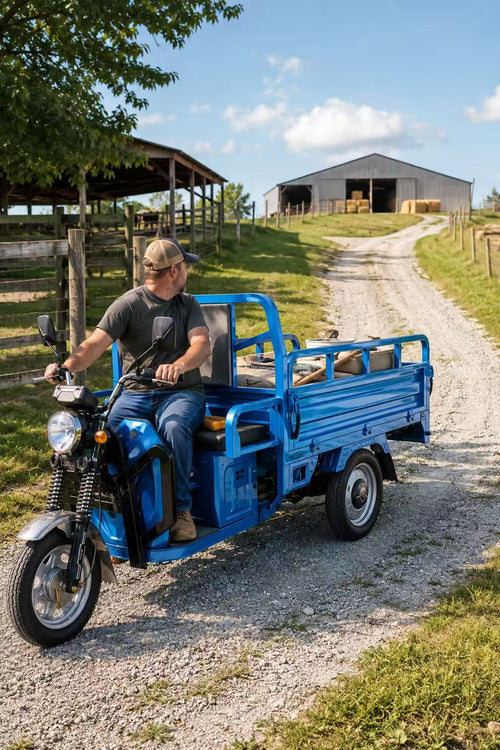
Greenhouse and Nursery Cargo Trike: Moving Plant Trays, Soil Bags, and Supplies in Tight Work Areas
Share
Greenhouse and nursery work looks simple from the outside, but daily material movement can take a lot of time.
Workers move plant trays, soil bags, fertilizer, irrigation parts, tools, plastic bins, packaging materials, and small equipment between growing areas, storage sheds, loading zones, and packing tables.
Many of these routes are short.
But they are repeated all day.
That is why the right small utility vehicle can matter. The goal is not always to buy a large UTV, pickup truck, or forklift. In many greenhouse and nursery operations, the real need is a compact cargo vehicle that can move useful loads over controlled short routes.
A greenhouse and nursery cargo trike can be a practical option for this kind of work.
It is not designed to replace every farm machine. It is designed to reduce repeated walking, hand carrying, wheelbarrow trips, and small-load movement around growing and staging areas.
Why Greenhouse and Nursery Transport Is Different
Greenhouse and nursery operations often have different transport needs from open-field farms.
The work is usually more controlled, more repetitive, and more space-sensitive.
Instead of crossing large acreage, workers may move supplies between:
greenhouse entrances
nursery rows
shade house areas
potting stations
soil storage areas
fertilizer storage
irrigation repair points
plant staging areas
packing tables
loading zones
The distance may not be long, but the movement is constant.
A worker may move plant trays in the morning, soil bags before potting, fertilizer and tools during the day, and packed plants or supplies near the end of the shift.
A small electric cargo trike can help with these repeated routes.
The Real Problem: Too Many Small Trips
Many greenhouse and nursery jobs do not require one large load.
They require many small trips.
That is the hidden labor problem.
A worker may carry trays by hand.
Another worker may push a cart.
Someone else may use a wheelbarrow for soil bags or supplies.
These tools are simple, but they can become inefficient when the same route is repeated many times.
A cargo trike helps one worker move more items per trip without using a large machine for every small task.
This can be useful when the work involves:
plant trays
potted plants
soil bags
fertilizer bags
plastic bins
irrigation fittings
hoses
hand tools
packaging supplies
labels and containers
small nursery equipment
The value is not only about payload.
The value is reducing repeated walking and manual handling.
Plant Trays and Bulky Light Cargo
Plant trays are a good example of greenhouse cargo.
They are not always extremely heavy, but they can take up space quickly.
The same is true for nursery trays, plastic bins, foam containers, packaging materials, and lightweight market supplies.
This kind of cargo may benefit from a practical flat cargo bed or high-side cargo bed because the items need organized space and containment.
A cargo trike can help workers move several trays or boxes at once between the greenhouse, nursery yard, staging area, and packing zone.
For bulky but lighter items, the buyer may also consider cargo bed size and layout.
The important question is not only:
How much weight can it carry?
The better question is:
How many trays, bins, or boxes do I need to move per trip?
This helps determine whether the standard cargo bed is enough or whether a longer or deeper custom bed would be more useful.
Soil Bags, Fertilizer, and Dense Loads
Greenhouse and nursery work also involves dense loads.
Soil bags, compost bags, fertilizer, wet growing media, and tools can become heavy quickly.
For these loads, bigger is not always better.
A very large cargo bed may encourage overloading. That can affect handling, braking, tire wear, and long-term vehicle life.
For heavier materials, a compact and practical cargo bed is often more useful than an oversized box.
This is why buyers should match the cargo bed to the actual work.
If the main cargo is soil bags and fertilizer, the bed should be practical and controlled.
If the main cargo is trays, bins, and potted plants, the buyer may want more bed space.
Different cargo needs different cargo bed thinking.
Where a Cargo Trike Fits Best
A greenhouse and nursery cargo trike fits best in controlled work areas.
It can be useful for:
nursery yards
greenhouse exterior routes
plant staging areas
potting soil storage zones
packing and loading areas
farm stand preparation areas
shade house paths
storage-to-workstation routes
small warehouse or back-room supply movement
It is especially useful when the route is short, repeated, and cargo-focused.
A cargo trike is not the right tool for every greenhouse or nursery.
If the work area has extremely narrow internal aisles, deep mud, steep grades, soft wet ground, or very tight turns, the buyer should check route width and ground conditions carefully before ordering.
The best use case is a practical work route with enough clearance, reasonable ground, and repeated material movement.
Cargo Bed Height and Loading Comfort
Loading comfort matters in greenhouse and nursery work.
Workers may load by hand many times per day.
If the bed is too deep or too high for the cargo type, daily use can become tiring.
For trays and light boxes, workers may want easy side access.
For soil bags and fertilizer bags, workers may want a practical loading height and stable bed position.
For potted plants, the bed should allow careful placement without crushing or tipping.
The cargo bed should help the work, not make the work more difficult.
This is another reason buyers should think about the real cargo before choosing a vehicle.
Flat Bed, High-Side Bed, or Dump Bed?
Different greenhouse and nursery jobs may require different bed styles.
A flat or standard cargo bed can work well for:
plant trays
boxes
tools
fertilizer bags
plastic bins
packing supplies
potted plants
A high-side cargo bed can help contain:
bags
bins
loose containers
tools
mixed supplies
A hydraulic dump bed may be useful if the work involves repeated loose material unloading, such as soil, compost, mulch, or growing media.
But not every greenhouse buyer needs dump capability.
If the work is mostly trays, boxes, potted plants, and bagged material, a standard cargo bed may be enough.
If the work involves loose material that must be unloaded often, the buyer may consider the OneClickChina Hydraulic Dump Utility Vehicle.
Choosing the right bed style matters more than choosing the biggest vehicle.
Electric Cargo Trike vs Wheelbarrow
A wheelbarrow is simple and low-cost, but it has limits.
It usually carries less per trip.
It requires physical pushing.
It can become tiring over repeated routes.
It may not be ideal for trays, boxes, tools, and mixed supplies.
A cargo trike can move more cargo with less manual effort, especially on repeated routes between storage, growing areas, and packing stations.
The goal is not to eliminate every hand tool.
The goal is to reduce the number of small manual transport trips.
For greenhouse and nursery operations, that can improve daily workflow.
Electric Cargo Trike vs Hand Cart
Hand carts are useful in tight areas, but they still depend on manual pushing and pulling.
They also have limited load space.
For very narrow indoor greenhouse aisles, a hand cart may still be the better option.
But for outdoor nursery paths, greenhouse exterior routes, storage-to-staging movement, and packing-area transport, an electric cargo trike can carry more supplies with less physical effort.
The buyer should choose based on route width, turning space, floor conditions, and cargo type.
A hand cart may be best inside very tight spaces.
A cargo trike may be better for repeated movement between work zones.
Electric Cargo Trike vs UTV
A full-size UTV may be useful for large properties, rough terrain, towing, passenger seating, and longer-distance travel.
But many greenhouse and nursery operations do not need a full UTV for every small transport job.
If the daily work is mostly plant trays, soil bags, tools, fertilizer, and packaging supplies, a smaller electric cargo trike may be more practical and lower-cost.
The OneClickChina Multi-Purpose Electric Utility Vehicle starts from $2,499 and is designed for daily short-distance cargo movement.
For buyers who do not need high speed, rough off-road performance, towing, or passenger seating, this type of vehicle can be a focused work tool.
Custom Cargo Bed Options
Greenhouse and nursery buyers often move cargo that varies in shape and volume.
That is why cargo bed customization can be useful.
Some buyers may need a practical standard bed for bags and tools.
Some may need more length for trays and boxes.
Some may need more depth for bulky but lighter supplies.
OneClickChina can discuss cargo bed length, depth, and layout based on the buyer’s real work.
This is especially useful when cargo is bulky but not extremely heavy.
For example:
plant trays may need more floor space
foam containers may need more volume
packaging supplies may need a deeper bed
soil bags may need a controlled, practical bed
The best cargo bed is not always the largest one.
It is the bed that matches the load.
When a Canopy Model May Help
Some greenhouse and nursery routes are outdoors.
Workers may move between greenhouses, shade houses, storage areas, and packing tables under direct sun.
If the driver spends a lot of time outdoors, a canopy model may be useful.
The OneClickChina Canopy Utility Cargo Vehicle starts from $2,599 and provides basic sun and light-rain protection for the driver.
This does not make it a full cab.
It is not designed for severe weather.
But for daily outdoor routes in sunny areas, a canopy can make short-distance work more comfortable.
If stronger weather protection is needed, buyers can consider a cab model instead.
Who This Vehicle Fits Best
A greenhouse and nursery cargo trike may be a good fit for buyers who:
move plant trays and supplies daily
carry soil bags and fertilizer between work zones
need short-distance repeated cargo transport
work around greenhouse exterior routes or nursery yards
want a lower-cost alternative to larger vehicles
need more capacity than a hand cart or wheelbarrow
want a cargo bed that can match the load type
work on controlled paths with enough clearance
This type of vehicle is best when the daily job is practical cargo movement.
Who Should Be Careful
This vehicle may not be the right fit if:
the greenhouse aisles are extremely narrow
the ground is soft, muddy, or deeply rutted
the route has steep slopes
the buyer needs high speed
the buyer needs trailer towing
the work requires a full-size UTV
the buyer must operate indoors with very tight turning space
In these cases, buyers should review dimensions, route width, ground conditions, and work requirements before choosing a model.
Final Buying Thought
Greenhouse and nursery work depends on repeated movement.
Plant trays, soil bags, fertilizer, tools, bins, packaging materials, and supplies need to move between growing areas, storage, staging zones, and packing areas every day.
A cargo trike can help reduce repeated walking and manual hauling when the route is suitable.
The OneClickChina Multi-Purpose Electric Utility Vehicle starts from $2,499 and fits many short-distance cargo jobs.
For outdoor routes with sun exposure, the Canopy Utility Cargo Vehicle starts from $2,599.
For loose material unloading, the Hydraulic Dump Utility Vehicle starts from $3,333.
The best choice depends on the cargo, route, and daily workflow.
A greenhouse and nursery cargo trike is not about buying the largest vehicle.
It is about choosing a practical tool that fits the actual work.