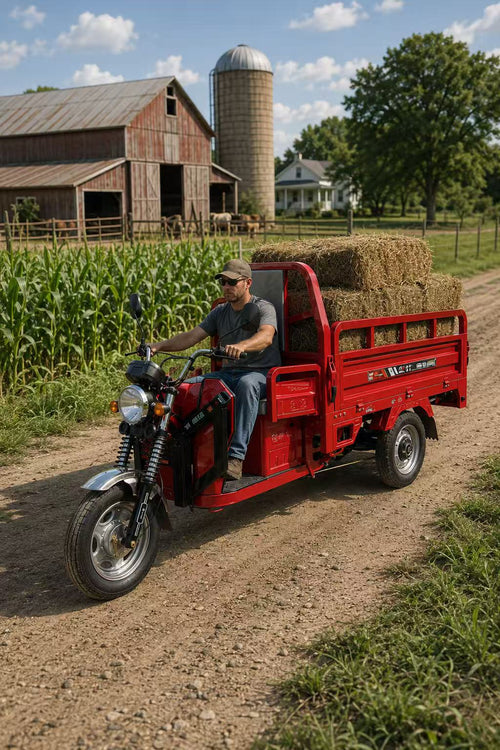
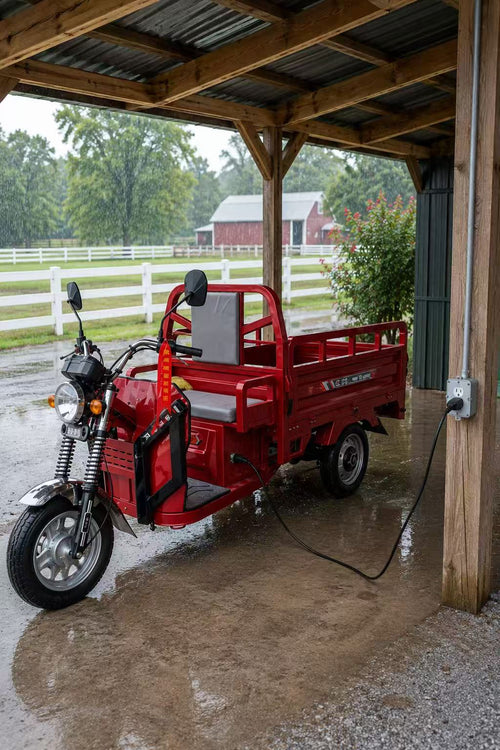
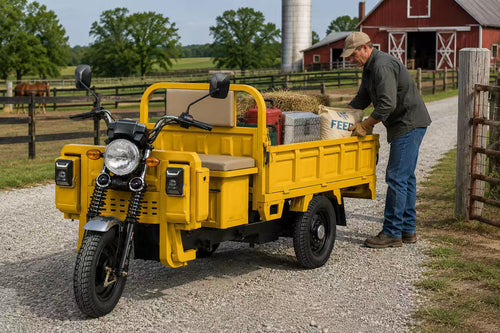
Electric Cargo Trike for Orchard Rows: A Lower-Cost UTV Alternative
Share
Choosing a work vehicle for an orchard should start with the work route, not the vehicle category. A grower may spend the day moving pruning tools, irrigation parts, fertilizer, empty containers, small fruit loads, and maintenance supplies between orchard blocks. Each trip may be short, but repeated trips can consume significant working time.
For these jobs, a full-size pickup may be unnecessarily large, while a UTV may provide more off-road, towing, and passenger capability than the job actually requires. An electric cargo trike can fill the space between a hand cart and a larger utility vehicle when the route, terrain, and load are suitable.
For growers comparing an electric utility vehicle for orchard and farm transport, five factors matter most: route, surface, load, trip frequency, and required capability.
Why Orchard Route Design Matters
There is no single standard orchard layout in the United States. High-density apple orchards may have relatively tight working alleys, while other commercial orchards are designed around tractors, sprayers, harvesters, trailers, and larger equipment.
That means a vehicle should never be selected simply because it is marketed as an orchard vehicle.
Start by measuring the usable row width, not just the planted row spacing. Tree canopies, trellis posts, irrigation equipment, stakes, branches, and other obstacles can reduce the actual clearance available to a vehicle.
Headland space matters too. A vehicle that fits between two rows is not useful if it cannot comfortably turn into the next row. Turning radius therefore matters almost as much as overall width.
This is one reason a compact 3 wheel utility vehicle may be useful on certain orchard routes. A smaller footprint can make repeated movement between work areas easier where a pickup or larger UTV feels oversized.
What Are You Actually Hauling?
Vehicle selection becomes much easier when the grower defines the load before comparing machines.
Typical daily loads may include pruning tools, irrigation repair parts, hand tools, fertilizer bags, small containers, fencing supplies, maintenance equipment, or harvested fruit in smaller crates. These are different jobs from moving full harvest bins or towing heavy trailers.
An electric cargo trike is most relevant when one operator needs to move a useful cargo load repeatedly over relatively short distances. A rear cargo bed keeps tools and supplies on the vehicle instead of requiring workers to carry them back and forth.
For this type of farm transportation, the advantage is not simply that the vehicle is electric. The important question is whether its size and cargo capacity match the work being performed.
An electric cargo vehicle that is compact enough for the route but large enough for the normal load can reduce unnecessary walking and repeated trips back to a shed, barn, service area, or pickup.
Where an Electric Utility Trike Can Make Sense
A three-wheel work vehicle is not a smaller UTV in every respect. The two machines solve overlapping but different problems.
An electric utility trike makes the most sense when the job has several characteristics at the same time:
The operator usually travels alone.
Most trips carry tools, supplies, or relatively small agricultural loads.
Routes are short and repeated throughout the working day.
The operating surface is reasonably firm and predictable.
The orchard does not require four-wheel drive for normal access.
Heavy trailer towing is not a routine requirement.
The vehicle must regularly enter spaces where a wider machine is inconvenient.
Under those conditions, a 3 wheel electric truck with a cargo bed can function as a practical work vehicle rather than an undersized substitute for a UTV.
The distinction matters. Buying the smallest vehicle is not the goal. Buying enough vehicle for the actual job is.
Ground Conditions Can Change the Answer
Orchard floors vary considerably. A vehicle may operate on mowed grass alleys, dry packed soil, gravel service lanes, smooth harvest floors, or combinations of these surfaces. Conditions can also change after irrigation or heavy rain.
A compact cargo trike that works well on a firm, relatively level route should not automatically be expected to perform the same way in deep mud, severe ruts, loose soil, or steep terrain.
This is where an electric UTV or another electric off-road utility vehicle may be the better choice. Four-wheel traction, greater ground clearance, heavier suspension, and more aggressive tires become valuable when access is difficult rather than merely narrow.
Before choosing a vehicle, walk the actual route after poor weather as well as during dry conditions. Look for soft areas, wheel ruts, drainage problems, slopes, irrigation crossings, and locations where a loaded vehicle must turn.
A vehicle should be selected for the worst conditions it will routinely encounter, not only for the easiest day of the season.
Electric Cargo Trike vs. UTV for Orchard Work
A farm UTV is an extremely capable machine. That does not mean every orchard task requires one.
UTVs are generally the stronger choice when operators need four-wheel drive, substantial towing capacity, passenger seating, higher ground clearance, rough-terrain capability, or the ability to carry larger loads over difficult routes.
An electric cargo trike targets a different operating pattern: one worker, a cargo bed, repeated short trips, relatively predictable routes, and work areas where compact dimensions are useful.
Consider an irrigation repair job. A worker may need pipe fittings, hand tools, replacement emitters, hose, and other supplies at several locations across an orchard block. The load is useful but not enormous. The route may be traveled repeatedly during the day. If the ground is firm and the vehicle can turn comfortably at row ends, using a large UTV for every trip may provide capabilities that are rarely used.
The same logic can apply to pruning crews, general maintenance, small-load farm equipment transport, and movement of supplies between barns, sheds, service roads, and orchard rows.
However, the comparison changes immediately when the job requires pulling a loaded trailer through soft ground or carrying multiple workers over rough terrain. In that situation, the additional capability of a UTV is doing real work and is worth paying for.
Lower Cost Should Mean Right-Sized Capability
A lower-cost UTV alternative should not be judged only by purchase price.
The better question is: Which capabilities are you paying for, and how often will you use them?
UTV price and UTV cost can reflect features such as four-wheel drive, suspension travel, passenger capacity, towing capability, higher ground clearance, and recreational or severe-terrain performance. Those features have real value when the work requires them.
But a grower whose daily route consists mainly of firm orchard alleys and short supply runs may not need every one of those capabilities.
In that situation, a smaller electric farm vehicle can be economically sensible because its design is closer to the actual task. The objective is not to replace a more capable machine where that capability is necessary. It is to avoid using a larger and more expensive vehicle for jobs that consistently require less.
Do Not Use a Cargo Trike for Every Orchard Job
An electric cargo trike is not a replacement for tractors, harvest platforms, bin trailers, full-size pickups, or heavy-duty UTVs.
Choose a more capable vehicle when routine work involves deep mud, severe ruts, steep grades, heavy trailer towing, multiple passengers, substantial off-road travel, or large harvest loads.
Full fruit bins are another important dividing line. Commercial orchard harvest systems may use tractors, trailers, specialized bin-handling equipment, platforms, or other machinery to move large volumes of fruit. A compact cargo vehicle should not be presented as a substitute for that system.
The trike is better understood as a tool for the smaller movements that occur around those larger operations: carrying tools, parts, supplies, smaller containers, and maintenance materials where deploying a larger machine may be inefficient.
Five Things to Check Before Buying an Orchard Work Vehicle
1. Route
Measure usable row width, gateways, service lanes, headlands, and the tightest turning points. Include clearance for tree canopies, trellis posts, irrigation equipment, and other obstacles.
2. Surface
Identify the normal and worst routine conditions. Firm grass, packed soil, and maintained gravel are very different from deep mud, steep slopes, and heavily rutted ground.
3. Load
Record what workers actually carry during a normal week. Consider both weight and cargo dimensions. Tools and irrigation parts require a different vehicle from full harvest bins or bulk material.
4. Frequency
Count trips, not just distance. A short route traveled twenty times a day can justify a different solution from a longer route traveled once.
5. Capability
Decide whether the operation genuinely requires four-wheel drive, towing, passenger seating, high ground clearance, a dump bed, or other specialized features.
These five checks make comparisons between an electric cargo trike, electric farm cart, UTV, pickup, or tractor much more useful than choosing from vehicle names alone.
The Best Vehicle Depends on the Job
For orchard work, bigger is not automatically better and smaller is not automatically more efficient.
A compact electric cargo trike can be a practical lower-cost UTV alternative when the job consists mainly of repeated short-distance hauling, one operator, manageable cargo loads, firm routes, and limited working space.
A UTV remains the better choice when terrain, towing, passengers, traction, or heavier work demand its additional capability.
The most useful decision is therefore not “Which vehicle is best for an orchard?” It is “Which vehicle matches this orchard route and this daily workload?”
Measure the route. Examine the ground. Define the load. Count the trips. Identify the capabilities the work actually requires.
That is the simplest way to choose the right electric utility vehicle for farm transport without paying for too little vehicle—or more vehicle than the job needs.