Electric Farm Trike Warranty, Parts Support and Local Repair Coordination
Share
Buying an electric farm trike is not only about the vehicle itself. For many farmers, orchard owners, greenhouse operators, livestock workers, produce vendors, and rural property owners, after-sales support is one of the most important questions before purchase.
A buyer may ask:
What happens if a part fails?
Can the vehicle be repaired locally?
Do I need to ship the whole trike back?
Who helps identify the problem?
Can replacement parts be supplied?
What is covered by warranty?
What is considered normal wear or routine maintenance?
These are reasonable questions for a work vehicle used in daily hauling, farm transport, orchard work, greenhouse movement, livestock chores, and rural property maintenance.
Our support model is built around three practical parts:
remote troubleshooting support
warranty parts support
local repair coordination when available
We do not promise nationwide on-site repair by our own technicians. Instead, we help customers solve service needs through clear warranty rules, technical guidance, replacement parts support, and coordination with local independent repair options whenever possible.
Our After-Sales Support Principle
Our support principle is simple: help the customer solve the problem as close to the vehicle as possible.
For many electric farm trike issues, the fastest solution is not shipping the whole vehicle across the country. A more practical solution is to identify the problem, confirm whether it is related to warranty coverage, and then repair or replace the affected component locally when possible.
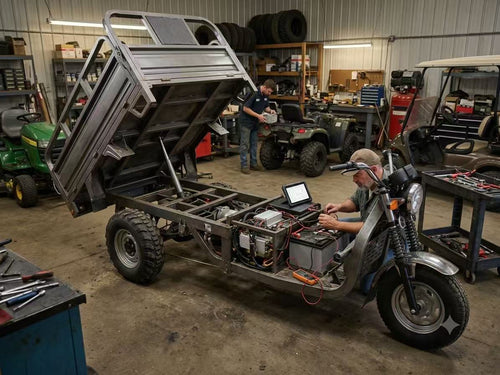
Many electric farm trike components can be checked by local technicians who already understand farm equipment, electric motors, batteries, controllers, brakes, wiring, rear axles, and small machinery systems.
When service is needed, the customer may first choose a trusted local farm equipment technician, electric motor technician, small machinery repair person, golf cart technician, ATV/UTV repair shop, or independent repair shop in their area.
This is often the most convenient option because the technician is nearby and can respond according to the customer’s local schedule.
If the customer does not already have a local repair contact, we can help search for nearby independent repair options based on the customer’s location and coordinate technical guidance when available.
Official Limited Warranty
This limited warranty applies only to the original purchaser who bought the vehicle directly from us. It starts from the vehicle delivery date and is non-transferable.
If the vehicle is resold, transferred, gifted, or used by a second owner after the original purchase, the warranty will no longer apply.
The warranty covers confirmed factory manufacturing defects under normal use and reasonable maintenance.
Warranty coverage includes:
Vehicle body and frame: 2-year limited warranty
Drive motor: 1-year limited warranty
Standard vehicle battery: 1-year limited warranty
Other electrical components, chargers, controllers, wiring, brakes, tires, lights, and normal wearing parts are handled according to the specific issue, product condition, usage situation, and warranty terms.
Warranty coverage applies only to confirmed manufacturing defects. It does not cover normal wear, routine maintenance, misuse, overload, unauthorized modification, improper charging, water damage, corrosion, accident damage, or damage caused by poor maintenance.
Normal Wear, Maintenance and Consumable Parts Are Not Covered
The warranty does not cover normal wear, routine maintenance, consumable parts, or damage caused by regular use over time.
The following items are considered normal wear, consumable parts, or maintenance-related items and are not covered by warranty:
tires
brake pads
light bulbs
headlights
turn signals
seat covers
door panels
paint scratches
rubber parts
chains or belts when applicable
fasteners and adjustment parts
brake adjustment
routine lubrication
minor electrical connection maintenance
normal mechanical wear caused by driving and daily operation
battery capacity reduction from normal use
For example, if a tire wears out from use, a brake pad becomes thin, a light bulb or headlight burns out, a seat cover or door panel becomes worn, or the battery capacity gradually decreases from normal daily use, these are considered normal maintenance or normal wear items.
They are not considered factory manufacturing defects.
Warranty coverage does not mean free lifetime maintenance. It applies only to confirmed manufacturing defects within the warranty period.
Battery Warranty Clarification
The standard vehicle battery has a 1-year limited warranty for confirmed factory manufacturing defects only.
Normal battery capacity reduction from daily use is not covered.
Battery damage caused by improper charging, deep discharge, impact, water exposure, incorrect charger use, long-term storage without charging, extreme temperature exposure, unauthorized modification, or poor maintenance is not covered.
Customers should charge, store, and maintain the battery according to the recommended usage guidance.
Motor Warranty Clarification
The drive motor has a 1-year limited warranty for confirmed factory manufacturing defects.
Motor damage caused by overload, water exposure, impact, unauthorized wiring modification, incorrect voltage use, poor maintenance, or abnormal operating conditions is not covered.
If a motor issue occurs, we will review photos, videos, fault descriptions, and usage information to help determine whether the issue may be related to a covered manufacturing defect.
Vehicle Body and Frame Warranty Clarification
The vehicle body and frame have a 2-year limited warranty for confirmed factory manufacturing defects.
This does not include normal scratches, paint wear, dents caused by impact, corrosion from environmental exposure, damage caused by overload, accident damage, or wear caused by regular driving and daily operation.
The warranty is designed to cover manufacturing defects, not normal cosmetic wear or damage caused by use conditions.
Warranty Exclusion Rules
To avoid misunderstanding, some situations are not covered by the warranty.
The warranty does not cover damage caused by:
overload
improper use
unauthorized modification
private disassembly
impact or accident
water soaking
improper charging
incorrect charger use
long-term storage without maintenance
corrosion or rust caused by environment
seawater or salt-air exposure
flood damage
extreme weather exposure
poor maintenance
normal mechanical wear
routine maintenance needs
Consumable parts and normal maintenance items are not covered.
This includes tires, brake pads, lights, bulbs, seat covers, paint wear, rubber parts, adjustment parts, and other parts that naturally wear during regular use.
How Local Repair Coordination Works
Our local repair coordination model is flexible.
First, the customer may recommend a local technician or repair shop they trust. This may be a farm equipment repair person, electric motor repair technician, small machinery mechanic, golf cart technician, ATV/UTV repair shop, or other qualified local service provider.
Second, we help review the technical issue. The customer can send photos, videos, fault descriptions, order information, and local technician feedback. We review the information and help identify the likely problem.
Third, if the issue is related to a warranty-covered manufacturing defect, we can discuss replacement parts support according to the warranty terms.
Fourth, if local repair assistance is needed and the customer does not have a local technician, we may help identify nearby independent repair options through local search and coordinate repair guidance when available.
This model is designed to reduce unnecessary whole-vehicle returns and help customers repair the vehicle closer to where it is used.
Warranty Parts Support
For confirmed warranty-related component issues, we focus on solving the problem through parts support and technical guidance.
In many cases, the full vehicle does not need to be returned. Instead, the affected component can often be inspected, confirmed, and replaced locally when appropriate.
Warranty parts support may include original replacement parts, component guidance, wiring diagrams when available, maintenance instructions, repair videos when available, or remote troubleshooting assistance.
The exact solution depends on the confirmed fault, warranty coverage, product condition, customer usage, and available local repair resources.
Labor Cost and Local Repair Cost
Local repair labor cost is handled based on the actual case.
Warranty coverage does not automatically mean all local labor, travel, towing, transportation, inspection, storage, or service call fees are covered.
If a repair is related to a confirmed warranty-covered manufacturing defect, we can discuss a reasonable solution with the customer according to the warranty terms and the confirmed repair requirement.
Any local repair arrangement should be discussed and confirmed before repair work begins.
Simple Warranty Claim Process
The warranty process is designed to be clear and practical.
Step 1: Send your order number, vehicle photos, fault videos, and a short description of the problem.
Step 2: Our support team reviews the information and helps identify whether the issue may be related to a covered manufacturing defect.
Step 3: We discuss the solution with the customer. This may include troubleshooting guidance, replacement parts support, or coordination with a local independent technician when available.
Step 4: If parts replacement is required and the issue is confirmed under warranty, we support the parts solution according to the warranty terms.
Step 5: The customer or local technician completes the repair based on the confirmed solution.
This process helps avoid unnecessary delays and keeps the repair path clear.
Return and Transit Damage Policy
The 30-day return period starts from the vehicle delivery date.
If a part is damaged during transit, the customer should provide photos and videos as soon as possible after delivery. We will review the case and provide a parts solution when the damage is confirmed.
For non-quality returns, the buyer may be responsible for return shipping, handling cost, packaging cost, inspection cost, and related fees according to the return policy.
For many service situations, replacing the affected part is faster and more practical than returning the entire vehicle.
Common After-Sales Questions
Question: What if there is no dealer near my farm?
Answer: Our model does not depend only on a dealer network. Customers may work with local farm equipment technicians, electric motor repair technicians, small machinery mechanics, golf cart technicians, ATV/UTV repair shops, or independent repair shops. If needed, we can help search for nearby repair options and provide technical guidance when available.
Question: Do you send your own technicians for on-site repair across the United States?
Answer: We do not promise nationwide on-site repair by our own technicians. Our support is based on remote troubleshooting, warranty parts support, and local repair coordination.
Question: Do I need to ship the whole trike back if one part fails?
Answer: In many component-related cases, the whole trike does not need to be returned. The affected part can often be checked, confirmed, and replaced locally when appropriate.
Question: Who pays for warranty-related parts?
Answer: If the issue is confirmed as a warranty-covered manufacturing defect, warranty parts support is handled according to the warranty terms.
Question: Are tires, lights, brake pads, bulbs, seat covers, and normal wear covered?
Answer: No. These are considered consumable parts, routine maintenance items, or normal wear items. They are not covered by warranty.
Question: Is battery capacity reduction covered?
Answer: Normal battery capacity reduction from daily use is not covered. Battery warranty applies only to confirmed factory manufacturing defects within the warranty period.
Question: Can my own local repair person work on the trike?
Answer: Yes. If you already have a trusted local farm equipment technician, electric motor technician, small machinery mechanic, golf cart technician, ATV/UTV repair shop, or independent repair shop, that is often the fastest and most convenient option. We can provide technical guidance and parts support according to the case.
Question: Does warranty continue if I sell the vehicle to another person?
Answer: No. The warranty applies only to the original purchaser who bought the vehicle directly from us. It is non-transferable and does not continue after resale, transfer, gift, or second-owner use.
Extra Support for Daily Use
We can also provide practical support materials to help customers maintain the vehicle.
These may include:
basic maintenance guidance
battery charging guidance
part identification help
circuit diagrams when available
repair tutorial videos when available
remote troubleshooting support
replacement parts support
This support is useful for farmers, orchard workers, greenhouse operators, livestock workers, produce vendors, and rural property owners who use the vehicle regularly.
A Practical Support Model for Farm Work Vehicles
An electric farm trike is a working vehicle. It should be supported in a way that matches real farm use.
For many customers, the most practical service path is local repair coordination supported by remote technical guidance and warranty parts support.
This allows the vehicle to be checked and repaired closer to the farm, instead of relying only on long-distance shipping or centralized service.
Our goal is to make after-sales support clear, practical, and realistic.
Customers should know what is covered, what is not covered, how to report a problem, how replacement parts are handled, and how local repair support can be coordinated when needed.
This gives buyers a more practical way to manage long-term electric farm trike ownership.