Private Property or Public Road? Understanding Where a Powered Dump Hauler Should Be Used
Share
Many buyers see an electric utility vehicle and immediately ask one question:
Can I drive it on the road?
That question is understandable.
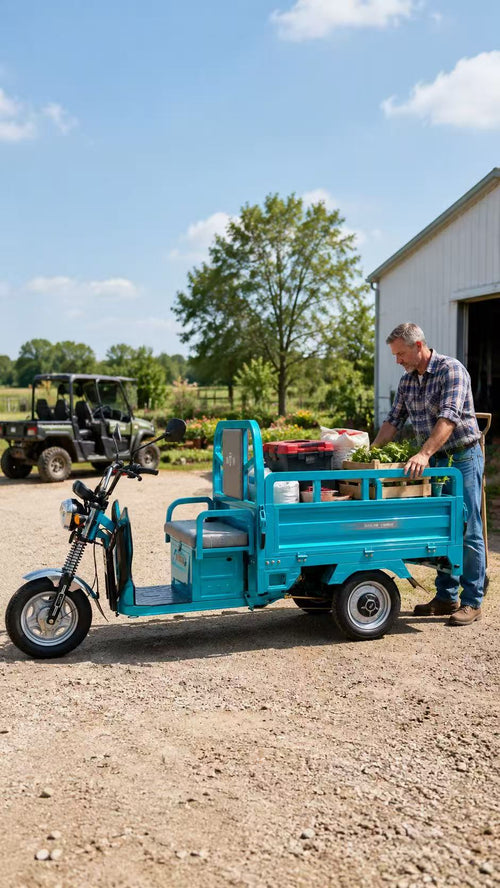
A powered dump hauler, electric dump cart, electric work trike, battery-powered utility vehicle, or compact material hauling vehicle may look more capable than a garden cart. It may have a cargo bed, electric drive system, reverse function, work tires, lights, and a strong frame. It may move around farms, ranches, horse stables, nurseries, greenhouses, apartment properties, HOA communities, landscaping jobs, and maintenance yards.
But that does not automatically make it a public road vehicle.
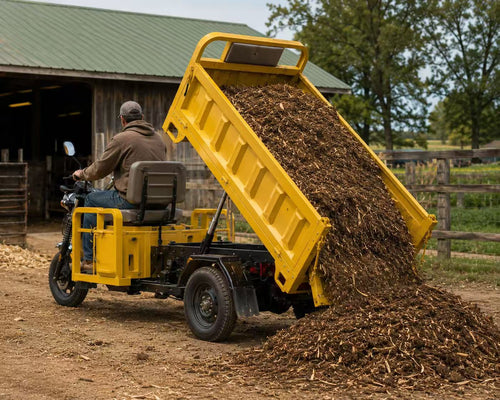
A powered dump hauler should be understood first as a private-property work vehicle for short-distance material transport. It is mainly designed to move mulch, compost, gravel, soil, manure bedding waste, tools, feed bags, plant material, yard debris, and maintenance supplies inside real work areas.
That is different from being a street-legal vehicle.
Before buying, customers should understand where this type of vehicle fits best, where it may need caution, and when local road rules become important.
Electric does not automatically mean street legal
The word “electric” can create confusion.
Many buyers are familiar with electric golf carts, low-speed vehicles, neighborhood electric vehicles, e-bikes, UTVs, and small electric carts. Because of that, they may assume any electric utility vehicle can travel on public roads.
That is not a safe assumption.
A powered dump hauler should not be treated as street legal unless the seller, vehicle documentation, and local rules clearly support that use. Public road operation may involve vehicle classification, lighting, mirrors, speed capability, VIN, registration, insurance, braking requirements, and state or local rules.
These requirements vary.
A material hauling vehicle that works well inside a farm, stable, nursery, or job site may not meet public road requirements.
The buyer should separate two questions:
Can the vehicle work on my private property?
Can the vehicle legally operate on public roads?
Those are not the same question.
Private property is the main use case
The strongest use case for a powered dump hauler is private-property work.
That includes farms, ranches, horse stables, dairy areas, poultry farms, nurseries, greenhouses, orchards, vineyards, landscaping yards, apartment properties, HOA communities, resorts, schools, parks, warehouses, rural properties, and job sites.
In these areas, the vehicle can serve as a short-distance material transport tool.
It can move material from a loading point to a dumping point. It can help workers reduce wheelbarrow trips. It can support daily hauling routes that are too repetitive for hand carrying but too small or tight for larger equipment.
A farm owner may use it between a barn and compost area.
A stable worker may use it for manure bedding waste.
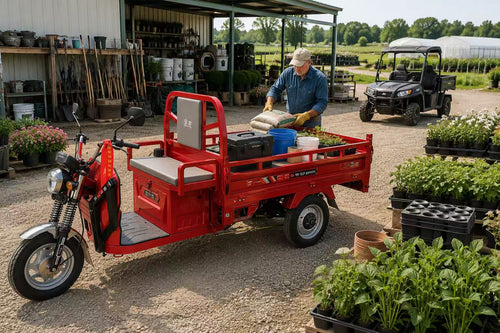
A nursery may use it for potting mix and plant debris.
A landscaping crew may use it for mulch and soil.
A property maintenance team may use it for yard debris and tools.
These are private work routes.
That is where the powered dump hauler makes the most sense.
Farm lanes and ranch roads are not the same as public roads
Many farms and ranches have internal roads.
These may include gravel lanes, dirt paths, barn roads, pasture access roads, feed routes, equipment paths, and private service lanes. A powered dump hauler may be useful on these routes when the ground is firm, the load is practical, and the operator controls speed carefully.
But an internal farm lane is different from a public road.
A private ranch road may be part of the work area. A public road may involve state or local vehicle rules. A farm driveway may be private. A county road outside the gate may not be.
Buyers should understand this boundary.
If the vehicle is used only on private farm or ranch property, the buying decision focuses on route width, ground condition, load type, dump bed use, tires, storage, charging, and operator control.
If the vehicle must travel on public roads, the buyer should check local requirements before purchase.
A powered dump hauler should not be marketed or used as a public road vehicle unless it is properly classified and equipped for that purpose.
It is not the same as a golf cart
Some buyers compare a powered dump hauler with a golf cart.
That comparison can be useful, but only to a point.
A golf cart is usually designed mainly for moving people. It often has passenger seats, a simple cargo area, and light-duty property transport use. Some golf carts may be modified or classified for limited road use depending on local rules and equipment.
A powered dump hauler is different.
Its value is material handling.
The cargo bed is the main reason to choose it. The dump function, load area, work tires, short-distance hauling ability, and farm or property maintenance use are the core of the vehicle.
A golf cart may move a worker around the property.
A powered dump hauler moves the work itself.
That difference matters for buyers. If the main need is passenger movement, a golf cart or LSV may be more relevant. If the main need is mulch, compost, gravel, manure, tools, soil, feed bags, and yard debris, a powered dump hauler is more closely matched to the job.
It is not automatically an LSV
A low-speed vehicle, often called an LSV, is a specific vehicle category in many regulatory discussions.
Buyers should not assume a powered dump hauler is an LSV just because it is electric or low-speed.
LSV rules usually involve vehicle classification, equipment, speed range, lighting, mirrors, identification, and road-use limitations. These are not the same as simply owning an electric utility cart for private work.
This distinction is important.
A powered dump hauler may be useful in private work areas even if it is not intended for public road use. It may support farm lanes, stable routes, property maintenance paths, greenhouse service lanes, nursery paths, landscaping jobs, and internal job site movement.
But that does not make it a street-legal LSV.
If a buyer specifically needs public road use, they should look for a vehicle clearly sold, documented, and equipped for that purpose, and they should verify local rules before purchase.
Private roads still need practical judgment
Even on private property, operators should use practical judgment.
A private road can still be narrow, uneven, wet, crowded, or poorly maintained. A ranch road may have loose gravel. A farm lane may have mud after rain. A stable route may pass animals. A property maintenance path may cross sidewalks or resident areas. A nursery lane may be narrow and lined with plants.
Private does not mean risk-free.
The buyer should still think about:
Ground firmness.
Route width.
Turning space.
Reverse control.
Load weight.
Stopping distance.
Animals nearby.
Pedestrians nearby.
Storage and charging location.
Dumping area.
Weather and visibility.
A powered dump hauler should be used as a controlled work vehicle, not as a casual road vehicle.
The best use is planned, slow, and matched to the work route.
HOA and apartment properties need clear boundaries
HOA communities and apartment properties are common use cases for electric maintenance vehicles.
A property team may move tools, trash bags, mulch, soil, branches, cleaning supplies, repair parts, and yard debris between buildings, storage rooms, dumpsters, sidewalks, landscape beds, and parking areas.
These routes may be private property, but they often include shared spaces.
Residents, visitors, parked cars, children, pets, maintenance workers, and delivery drivers may be nearby. That means the vehicle should move slowly, predictably, and only where property management allows.
A powered dump hauler can be useful for this kind of work because it carries materials instead of just moving people. But the team should define where it can operate.
Is it allowed on sidewalks?
Is it allowed near resident parking?
Can it cross internal drives?
Should it stay on service routes?
Can it be stored and charged safely?
Can it operate during quiet hours?
These are property management questions, not just vehicle questions.
Job sites are not public roads, but they still need rules
Construction support sites, landscaping jobs, estate maintenance projects, and farm service jobs may use a powered dump hauler inside a temporary work area.
The vehicle may move gravel, soil, debris, mulch, tools, bags, small materials, or cleanup loads.
This does not mean the hauler should be driven on public roads between jobs.
For mobile crews, the better plan is usually trailer transport. The hauler can be transported to the job site, unloaded on firm ground, used inside the work area, and then loaded again after the job.
This separates job site use from public road use.
A landscaping crew does not need to treat the hauler as a road vehicle if it is transported by trailer and used inside private customer properties or controlled work areas.
The buyer should think about how the vehicle gets to the job and where it operates after arrival.
Crossing a public road is different from driving on it
Some properties may require crossing a public road.
For example, a farm may have work areas on both sides of a road. A ranch may have a gate across a lane. A property maintenance route may approach a public street. A landscaping job may involve unloading from a trailer near a public roadway.
This creates a separate question.
Briefly crossing a public road may still be regulated differently depending on location, vehicle type, road type, visibility, and local rules. Buyers should not assume it is allowed simply because the distance is short.
This article cannot replace local legal advice.
The practical guidance is simple:
If the route touches a public road, check local rules first.
For many buyers, the best solution is to keep the powered dump hauler inside private work areas and transport it by trailer when moving between locations.
Public road use requires more than lights
Some buyers think adding lights makes a vehicle road-ready.
That is not enough.
Public road use may require more than headlights or a rear light. Depending on the location and vehicle category, road use can involve mirrors, reflectors, brake lights, turn signals, speed limits, VIN, registration, insurance, windshield requirements, seat belt requirements, warning devices, and other equipment or documentation.
A powered dump hauler should not be described as street legal unless that status is clearly supported.
This matters for trust.
Overpromising road use can create customer complaints, legal confusion, and safety problems. A professional seller should clearly position the vehicle for the work areas it is designed to serve.
For this type of vehicle, the strongest positioning is private-property material handling.
A dump bed is a work feature, not a road feature
The dump bed is one of the key reasons to buy a powered dump hauler.
It helps with unloading mulch, compost, gravel, manure bedding waste, soil, wood chips, and yard debris. It makes sense in farms, stables, landscaping jobs, nurseries, greenhouses, ranches, and property maintenance areas.
But a dump bed does not make the vehicle road legal.
Road classification is about vehicle category and compliance, not only usefulness.
The dump bed should be understood as a worksite feature.
It is valuable because it helps workers unload material inside the work area. It does not change the vehicle into a passenger vehicle, golf cart, UTV, or LSV.
Buyers should choose the vehicle for what it does best:
short-distance material transport and controlled unloading inside private or managed work spaces.
If road use is required, ask before buying
Some buyers genuinely need a road-legal vehicle.
That is a different purchasing path.
If the buyer needs to travel on public roads, the buyer should ask the seller direct questions before purchase:
Is this vehicle intended for public road use?
Does it have a VIN or required identification?
Is it classified for street use?
What lighting and safety equipment does it include?
Can it be registered locally?
Does it meet state or local requirements?
Is insurance available?
What roads, speeds, and conditions are allowed?
If the seller cannot clearly answer those questions, the buyer should not assume the vehicle is road legal.
A powered dump hauler can still be a strong private-property tool, but buyers who need public road travel should choose a vehicle built and documented for that use.
For most material hauling, private routes are enough
Many buyers do not actually need public road use.
They need a machine that can move material around one property or job site.
A horse stable may need stall-to-compost transport.
A farm may need barn-to-field hauling.
A ranch may need gravel patching and feed movement.
A nursery may need soil and plant waste movement.
A greenhouse may need short service-lane transport.
A landscaping crew may need backyard mulch movement.
An apartment maintenance team may need tool and debris transport.
An HOA crew may need landscape material movement inside the property.
These are not public-road jobs.
They are short-distance work routes.
A powered dump hauler is well matched to these routes because it is designed around cargo, material handling, and controlled low-speed work.
The buyer should identify the real work route instead of assuming the vehicle must behave like a road vehicle.
This vehicle is closer to a worksite hauler than a passenger cart
A powered dump hauler should be positioned as a worksite hauler.
That means the buyer should think about:
Material type.
Cargo bed size.
Dump function.
Load capacity.
Ground condition.
Route access.
Reverse control.
Stopping distance.
Charging location.
Storage.
Cleanout.
Operator habits.
Worksite safety.
These are different from passenger cart questions.
A passenger cart is judged by seats, comfort, speed, road classification, passenger capacity, and street use.
A powered dump hauler is judged by how well it moves and unloads work materials.
That distinction helps customers choose correctly.
If they need to move people, this may not be the right tool. If they need to move material, it may be a strong fit.
Private-property use still needs operator rules
Even when a vehicle stays on private property, operators need clear rules.
Who is allowed to drive it?
Where can it go?
How fast should it move?
Can it operate near animals?
Can it enter sidewalks or resident areas?
Can it cross wet ground?
Where should it dump material?
Where should it be charged?
Can it be used after dark?
Can it carry passengers?
These rules matter because private property often has workers, animals, residents, tools, gates, equipment, plants, and buildings nearby.
A powered dump hauler should be used with the same practical discipline as other work equipment.
Private-property use does not mean careless use.
It means the owner has more control over the work environment, routes, and operating rules.
Do not carry passengers unless the vehicle is designed for it
A powered dump hauler is primarily a material transport vehicle.
The cargo bed is for work material, not passengers.
Buyers should not confuse it with a golf cart or people mover. Carrying passengers in a cargo bed can be unsafe and may not be allowed by the vehicle design, seller guidance, or local rules.
This is especially important on farms, stables, ranches, landscaping jobs, and property maintenance sites.
The purpose of the vehicle is to move material such as mulch, compost, gravel, soil, manure bedding waste, tools, feed bags, plant debris, and maintenance supplies.
If the buyer needs passenger transport, they should look at vehicles designed for passenger use.
A dump hauler should be used for hauling work, not people.
Roads inside large properties still need signs and routine
Large private properties may have internal roads.
These can include resorts, schools, estates, farms, ranches, industrial yards, apartment communities, nurseries, and parks.
A powered dump hauler may use these internal roads for work, but the property should still manage movement.
Clear routes, storage areas, charging areas, dumping points, and speed expectations help the vehicle become part of daily operations. If employees, residents, guests, students, or visitors share the area, the crew should be even more careful.
Internal roads are often where people assume everything is fine.
But shared private routes still need attention.
The hauler should move slowly, stay visible, avoid crowded areas when possible, and operate only where the property owner or manager allows.
Weather can change where it should be used
Rain, wet ground, mud, snow, and poor visibility can change the best operating area.
A powered dump hauler may be useful outdoors, but wet conditions affect traction, stopping, ground damage, electrical caution, and operator visibility. A private route that works well in dry weather may become unsuitable after heavy rain.
This matters for farms, ranches, horse stables, nurseries, greenhouses, landscaping jobs, and property maintenance areas.
Public road use in poor weather adds even more concerns.
For most buyers, the better approach is to keep the hauler on controlled private routes and adjust the load, route, and schedule based on conditions.
A good work vehicle is not only about capability.
It is also about knowing when and where to use it.
Buyers should define the use area before comparing models
Before comparing models, buyers should define the use area.
This simple step prevents confusion.
The buyer should write down:
Will it stay on private property?
Will it be used on farm lanes or ranch roads?
Will it operate inside a barn, stable, nursery, greenhouse, or warehouse?
Will it serve apartment or HOA maintenance routes?
Will it travel between job sites by trailer?
Will it need to touch or cross a public road?
Will it need to be street legal?
Will it carry people or only material?
Will it be used during daylight only?
Will it operate near pedestrians, animals, or customers?
Once the use area is clear, the buying decision becomes easier.
A powered dump hauler is strongest when the use area matches private-property material handling.
Ask these questions before buying
Before choosing a powered dump hauler, electric dump cart, electric work trike, battery-powered utility vehicle, or compact property hauler, buyers should ask location-based questions.
Will the vehicle be used only on private property?
Will it stay inside a farm, ranch, stable, nursery, greenhouse, warehouse, or maintenance area?
Will it be used on apartment, HOA, school, park, or resort property?
Will the route include public streets or public crossings?
Does the buyer need street-legal status?
Is the vehicle intended for passenger movement or material hauling?
Does the work require a dump bed?
Will the vehicle travel between jobs by trailer?
Are local rules clear for the intended use?
Will operators be trained for the property route?
These questions help the buyer avoid misunderstanding.
They also help match the machine to the job.
The right place makes the hauler more valuable
A powered dump hauler becomes more valuable when it is used where it fits best.
That usually means private work areas, farm lanes, ranch paths, horse stables, nurseries, greenhouses, landscaping jobs, apartment properties, HOA maintenance routes, parks, schools, resorts, warehouses, and controlled job sites.
In these places, the hauler can reduce repeated manual carrying, move heavy or bulky material, support dump-bed unloading, and help workers complete short-distance transport more efficiently.
It should not be confused with a street-legal vehicle unless properly classified, equipped, and approved for that use.
The buyer should not ask only:
Can it drive?
The better question is:
Where is it designed to work?
When the answer is private-property material handling, the powered dump hauler becomes a practical and focused work tool.