Is the Bed Too High? Why Loading Height Matters in a Powered Dump Hauler
Share
Many buyers compare payload first.
That is understandable. A powered dump hauler, electric dump cart, motorized wheelbarrow, or battery-powered farm utility cart must be able to carry the materials the job requires.
But payload is not the only thing that decides whether the machine is easy to use.
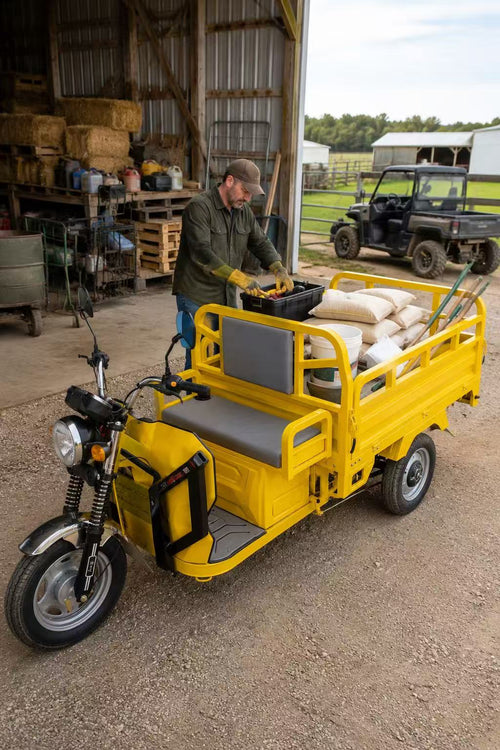
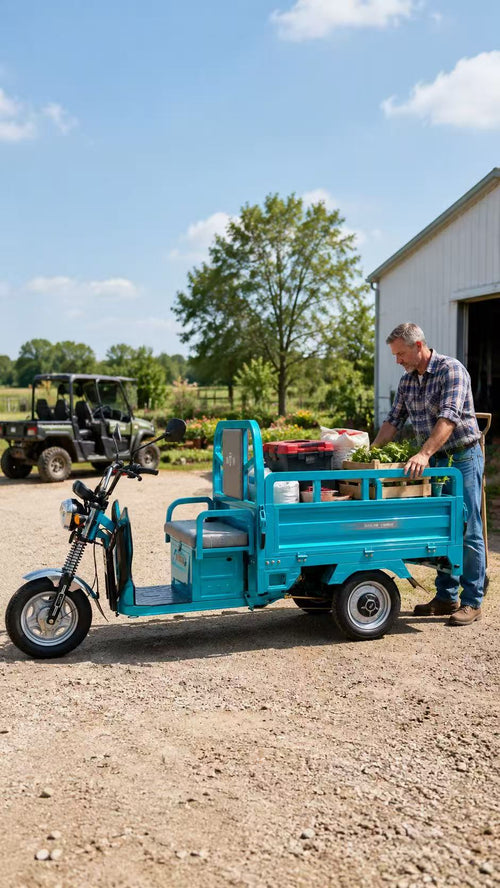
A hauler may carry enough weight on paper, but workers still need to load the material into the cargo bed. They may lift feed bags, shovel compost, fork manure, dump buckets, load mulch, carry soil bags, move tools, or handle wet bedding waste many times a day.
That means loading height matters.
If the bed is too high for the material and the worker, loading can become tiring. If the bed is too low for the way the material is handled, workers may bend too much. If the bed shape does not match the tools, material, or work routine, the machine may carry the load but still feel inconvenient.
A good dump hauler should not only move weight.
It should fit the way people actually load, unload, and repeat the work.
Payload does not tell the whole story
Payload tells buyers how much material a hauler may carry.
It does not tell them how easy that material is to put into the bed.
Two machines may have similar rated capacity, but one may feel easier to load during daily work because its bed height, side height, cargo shape, and access are better matched to the task.
For example, lifting a 50-pound feed bag into a cargo bed is different from shoveling mulch. Loading wet bedding waste is different from placing tools. Moving loose compost is different from carrying buckets. Loading gravel is different from loading plant trays.
The buyer should not only ask:
How much can it carry?
The buyer should also ask:
How will workers load it all day?
That second question is often closer to the real labor problem.
Loading height affects every trip
Loading height is not a one-time detail.
It affects every trip.
A farm worker may load feed bags in the morning. A stable worker may fork manure and wet bedding into the bed several times a day. A landscaping crew may shovel mulch, compost, soil, or gravel into the hauler at one property after another. A nursery worker may load potting mix, plant waste, trays, tools, and soil bags. A property maintenance worker may load branches, trash bags, buckets, repair supplies, and yard debris.
Each load requires body movement.
Workers may lift, bend, twist, reach, scoop, shovel, carry, toss, or dump material into the bed. When that motion repeats, small differences in height become more important.
A cargo bed that looks fine in a product photo may feel different after twenty trips.
This is why loading height belongs in the buying decision.
The best height depends on the material
There is no single perfect loading height for every job.
The right height depends on what is being moved.
Bagged materials such as feed bags, bedding bags, soil bags, fertilizer bags, and mulch bags require lifting. If the bed side is too high, workers may need to raise the bag above a comfortable level before setting it down.
Loose materials such as compost, mulch, soil, manure, wood chips, and gravel are often loaded with a shovel, fork, scoop, or bucket. For those materials, the worker needs a bed height that allows repeated loading without awkward bending or overreaching.
Tools and supplies are different again. Toolboxes, buckets, ladders, repair parts, and cleaning supplies need to be placed in the bed without tipping, sliding, or forcing the worker to reach too far.
The best loading height depends on the material, the tool, the worker, and the number of trips.
A serious buyer should think about the actual daily load, not only the rated capacity.
Bagged materials need lift-friendly access
Many farm, stable, nursery, and property maintenance jobs involve bags.
Feed bags, bedding bags, soil bags, compost bags, fertilizer bags, ice melt bags, seed bags, and mulch bags may all need to be lifted into a cart or hauler.
This is where bed height becomes very practical.
If the bed is too high, a worker may need to lift the bag too far. If the bed side is awkward, the worker may twist while placing the bag. If the bed is too deep or hard to reach into, removing the bag later may also be inconvenient.
A powered dump hauler can help move the bag across the property, but it does not remove the loading step.
Before buying, ask:
Will bags be loaded from the ground?
Will bags be loaded from a pallet?
Will workers carry them from a storage room?
Will one person load them alone?
Will the bags need to be unloaded by hand later?
How many bags are moved in a normal day?
A hauler that fits bag handling can save more than travel time.
It can make the whole material movement process easier.
Loose material needs shovel-friendly loading
Loose material creates a different loading problem.
Mulch, compost, soil, gravel, manure, wet bedding, wood chips, sand, and plant waste are often loaded with tools. Workers may use a shovel, manure fork, scoop, bucket, or loader.
If the bed side is too high for repeated shoveling, the worker may need to lift each scoop higher than necessary. If the bed is too low, the worker may bend more than needed. If the bed is narrow, material may spill over the sides. If the bed is too deep, cleaning corners may take extra time.
A powered dump hauler should match the way the material is loaded.
For horse stable work, manure and bedding waste may be loaded with a fork. For landscaping, mulch and soil may be shoveled. For farms and nurseries, compost and potting mix may be moved repeatedly. For property maintenance, leaves, branches, and debris may be loaded by hand or with tools.
The best hauler is not only the one with a strong motor.
It is the one that makes repeated loading practical.
Wet material changes the loading experience
Wet material is harder to handle than it looks.
Wet soil, soaked bedding, manure, damp compost, muddy gravel, and wet leaves can feel much heavier than dry material. They may stick to tools, clump in the bed, and require more effort to load.
Loading height matters more when the material is wet.
A worker who can easily toss dry mulch into a bed may feel very different after lifting wet bedding or shoveling heavy compost. Repeated wet loads can make awkward height, reaching, and twisting more noticeable.
This is another reason not to choose a hauler by payload alone.
Payload may tell the buyer what the vehicle can carry.
Loading height helps the buyer understand what the worker must do to get the material into the vehicle.
For daily stable, farm, landscaping, and nursery work, that difference matters.
Loading height affects unloading too
Loading height is connected to unloading.
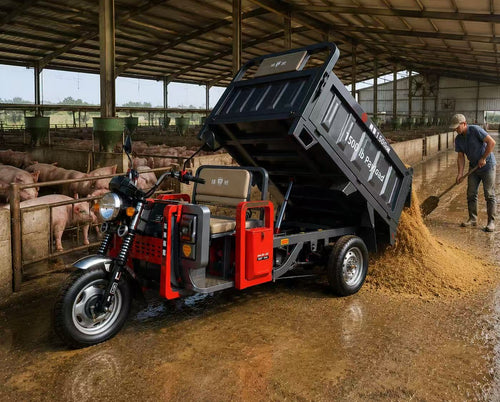
A dump hauler may reduce hand unloading, especially when loose materials can slide out of the bed. But not every load is dumped. Some loads must be removed by hand.
Tools, feed bags, clean bedding bags, buckets, plant trays, repair parts, and packaged supplies may need to be lifted out carefully. If the bed is too deep or awkward, unloading by hand can become tiring.
Even with loose material, the worker may still need to rake, shovel, level, or clean remaining material after dumping.
That means the buyer should think about both sides of the job:
How does material get into the bed?
How does material leave the bed?
Does the dump function reduce the hardest part?
Will some items still need to be lifted by hand?
Can workers reach the bed safely and comfortably?
A good powered dump cart supports the full loading and unloading cycle.
The “power zone” idea belongs in equipment choice
Manual material handling guidance often recommends keeping lifts close to the body and within a comfortable working range when possible.
For real work, this means workers should avoid unnecessary high lifting, deep bending, long reaches, and twisting while carrying weight.
A dump hauler cannot remove every lifting task.
But a good equipment choice can reduce awkward movements.
When choosing a battery-powered dump hauler, powered wheelbarrow, electric dump cart, or farm utility cart, the buyer should think about whether the bed height supports a reasonable working posture for the materials used most often.
This is especially important for repeated jobs.
One awkward lift may not seem serious. Repeating the same awkward lift all day can make the equipment feel less helpful.
The goal is not perfect ergonomics in every situation.
The goal is to avoid buying a machine that moves material but makes the loading motion harder than necessary.
A low bed is not always better
Some buyers may assume that a lower bed is always better.
That is not always true.
A very low bed may reduce how high a bag must be lifted, but it may increase bending when workers load small tools, buckets, or loose material by hand. It may also make it harder to shovel efficiently depending on the tool and material.
A low bed may work well for some tasks, especially when materials are heavy and loaded from the ground.
But if workers are repeatedly bending down into the bed, cleaning corners, or placing and removing tools, the benefit may be reduced.
The right loading height is about balance.
The bed should be low enough to load practical materials, but not so awkward that workers spend the day bending and reaching.
This is why buyers should think in terms of real tasks, not only bed height numbers.
A high bed is not always better either
A higher bed may offer ground clearance, larger tire placement, or a different vehicle design.
But if the side height makes loading difficult, daily use may suffer.
For example, lifting feed bags, soil bags, fertilizer bags, bedding bags, or buckets into a high bed can become tiring. Shoveling wet compost, manure, gravel, or mulch into a high bed may take more effort. Shorter workers may find the bed less comfortable to load repeatedly.
A high bed may still make sense if material is loaded from a dock, platform, pallet level, loader bucket, or raised material pile.
But if most loading happens from ground level by hand, the buyer should pay close attention.
The question is not whether the bed is high or low in general.
The question is whether the bed height fits the way material enters the hauler.
Wheelbarrows have their own loading tradeoffs
A traditional wheelbarrow is often low enough to load with a shovel.
That is one reason it remains useful.
But a wheelbarrow also requires balancing, lifting the handles, pushing, steering, and controlling the load by body effort. On uneven ground, wet material, repeated routes, or longer distances, the operator may still work hard even if loading height is manageable.
A powered wheelbarrow can reduce pushing effort, but the operator may still walk behind the load. A garden cart may be more stable, but it may not dump material efficiently. A utility cart may carry tools and supplies well, but it may not be ideal for loose material unloading.
A ride-on or driveable dump hauler changes the route and unloading problem, but loading height still matters.
This is why buyers should compare the full job:
How material is loaded.
How material is moved.
How material is unloaded.
How often the cycle repeats.
No single equipment type solves every part of the job equally.
Horse stable work needs loading comfort
Horse stable work is a strong example of repeated loading.
Workers may move manure, wet bedding, clean bedding, feed bags, buckets, grooming supplies, tools, and compost material every day. Some material is forked in. Some is lifted by hand. Some is dumped. Some must be removed carefully.
A stable owner choosing a powered dump hauler should not only ask whether it can carry manure.
They should ask how workers will load wet bedding, how often they will lift bags, whether the bed is reachable, and whether the dump function reduces the most tiring part of the route.
A hauler that is easy to drive but awkward to load may not solve the full stable problem.
For barn and stable work, loading height should match the daily cleaning and bedding routine.
Landscaping crews handle mixed material
Landscaping crews often move many different materials in one day.
Mulch, soil, compost, gravel, plants, tools, branches, leaves, sod pieces, buckets, and debris may all pass through the same cart or hauler.
This makes loading height even more important.
A crew may shovel mulch in the morning, load soil bags at noon, carry branches in the afternoon, and move tools between work zones all day. The hauler must support different loading motions, not just one type of material.
For landscaping work, the best powered dump cart is usually not only the one with the highest payload.
It is the one that workers can load, unload, and repeat without slowing the job down.
The more mixed the materials are, the more practical bed access becomes.
Nurseries and greenhouses need easy reach
Nurseries and greenhouses often involve frequent small moves.
Workers may move potting mix, soil bags, plant trays, empty pots, fertilizer, compost, mulch, tools, plant waste, and watering supplies. These items may need careful handling because plants, trays, and containers can tip or spill.
A bed that is too high may make loading trays awkward. A bed that is too deep may make smaller items harder to reach. A bed that is too low may require frequent bending.
In nursery and greenhouse work, loading height should support careful placement, not only bulk hauling.
The buyer should ask whether workers can reach the bed easily, keep materials organized, and unload items without unnecessary strain.
A compact electric hauler should fit the rhythm of plant and material handling.
Property maintenance teams move tools and debris
Property maintenance work often combines tools, supplies, and waste.
A maintenance team may carry toolboxes, cleaning supplies, branches, trash bags, soil, mulch, repair parts, buckets, and small equipment across apartments, HOA communities, schools, parks, resorts, or large private properties.
Some items are placed in the bed by hand. Others are tossed or stacked. Some should not be mixed with dirty material. Some must be removed without damage.
Loading height affects all of this.
A hauler that is too awkward to load may become a problem for workers who use it multiple times a day. A cargo bed that is easy to reach can help the vehicle become part of the daily maintenance routine.
For property maintenance, bed access may be just as important as payload.
Loading from pallets is different from loading from the ground
Buyers should think about where the material starts.
Loading from the ground is different from loading from a pallet, shelf, truck bed, dock, platform, compost pile, feed room, or material bin.
If feed bags or soil bags are stored on pallets, the loading height may be easier than lifting from the floor. If material is shoveled from a ground pile, the worker may need to lift every scoop into the bed. If tools are stored on shelves, the worker may carry them at waist height. If material comes from a truck, the loading process may be different again.
Before buying, walk through the normal work path.
Where is the material stored?
How is it picked up?
Who loads it?
How high must it be lifted?
How many times does that happen?
Does the hauler bed height match the storage height?
The best hauler fits the real loading source.
Bed side height matters too
Loading height is not only about the floor of the bed.
The side height matters.
A deep bed can hold loose material better, but it may require more lift height when loading by hand. A low side can be easier to load, but it may not contain loose material as well. A bed with strong sides may work well for mulch, compost, manure, and yard debris, but workers still need practical access.
For a dump hauler, side height must balance containment and loading comfort.
Loose material needs to stay inside the bed. Bags and tools need to be easy to place. Workers should not need to fight the side wall every time they load.
The buyer should look at the bed as a working area, not only as a container.
The best load is not always the maximum load
A machine may be rated for a large load, but daily work does not always require filling the bed to the top.
Sometimes a lower, balanced, moderate load is better.
This is especially true with wet soil, gravel, manure, compost, bedding waste, or mixed landscaping material. Overfilling can make loading harder, movement less stable, and unloading messier.
Loading height and load size work together.
If workers try to fill a tall or deep bed completely every time, the last part of loading may require more effort. A practical load that stays low and balanced may be faster and safer for daily work.
The buyer should think about normal load size, not only maximum capacity.
A hauler should support repeatable work, not just one impressive load.
Ask workers how they load
Owners and managers should not choose equipment only from a specification sheet.
They should ask the people who will use it.
Stable workers, farm owners, ranch hands, landscapers, nursery workers, greenhouse staff, and property maintenance crews often know exactly where the difficult part of the job is.
They may say:
The bags are hard to lift.
The compost is too heavy when wet.
The wheelbarrow is too low to clean easily.
The cart is hard to shovel into.
The bed is too deep to reach tools.
The route is fine, but loading takes too long.
The unloading is easy, but getting material in is tiring.
These comments are valuable.
They show whether the equipment problem is weight, distance, loading height, unloading method, or repeated motion.
A good buyer listens before choosing.
Questions to ask before buying
Before choosing a powered dump hauler, electric dump cart, motorized wheelbarrow, or farm utility cart, ask practical loading questions.
What materials will be loaded most often?
Are they bagged, loose, wet, dry, bulky, fragile, or mixed?
Will workers lift by hand, shovel, fork, scoop, or dump buckets?
Where does the material start: ground, pallet, shelf, bin, truck, or pile?
How many times per day will the bed be loaded?
Will one person load alone?
Will workers need to reach into the bed often?
Does the bed height fit the tools used most often?
Can the bed contain loose material without making loading awkward?
Will unloading be dumped, hand-removed, or mixed?
These questions help buyers see beyond payload.
They connect the machine to the real work.
Loading height is part of long-term value
A dump hauler is not useful only because it can carry weight.
It is useful when workers can load it, move it, unload it, clean it, and repeat the job without making every trip harder than necessary.
For occasional use, a slightly awkward loading height may not matter much.
For daily work, it can matter a lot.
Horse stables, farms, ranches, nurseries, greenhouses, landscaping crews, and property maintenance teams repeat material handling tasks week after week. If the hauler fits those motions, it becomes part of the routine. If it does not, workers may avoid using it or use it only for limited tasks.
Loading height is not a small detail.
It is part of how the vehicle earns its place in daily work.
Do not only compare the number
When buying a powered dump hauler, payload is important.
But it is not enough.
A buyer should also compare loading height, bed access, side height, unloading method, material type, worker posture, storage source, and daily repetition.
A machine with a large capacity but awkward loading may not be the best tool for the job. A machine with a practical bed height, useful dump function, stable cargo area, and good daily access may be more valuable even if the buyer has to think beyond the headline number.
The real question is not only:
How much can it carry?
The better question is:
Can workers load it comfortably enough to use it every day?
For farms, horse stables, landscaping crews, nurseries, greenhouses, ranches, and property maintenance teams, that question may be the difference between a machine that looks good online and a hauler that actually supports daily work.