Hand Carts vs Motorized Carts for Wholesale Market Material Handling
Share
Wholesale markets depend on constant short-distance movement. Cartons arrive at receiving areas, goods move into storage or selling spaces, inventory is restocked, and customer orders must be moved again for pickup or loading. Hand carts, platform carts, push carts, and dollies remain practical tools for many of these jobs. They are inexpensive, simple to maintain, and effective when loads are light, travel distances are short, and movement is only occasional.
The situation changes when the same routes must be repeated throughout the working day. As load weight, travel distance, and frequency of use increase, a manual cart can become less efficient. Repeated pushing and pulling may increase worker fatigue, while dozens of small trips can consume time that could otherwise be used for picking, restocking, loading, or serving customers.
This is where a motorized cart or motorized hand cart can fill the gap between basic manual equipment and larger material-handling machinery. The goal is not to replace every hand cart. It is to match the equipment to the actual workload.
When Hand Carts Still Make Sense
Manual hand carts are still one of the most practical choices for light goods and short distances. A vendor moving a few cartons from a nearby storage area may gain little from adding powered equipment.
Hand carts are especially suitable when:
Loads are light enough for comfortable manual movement.
Travel distances are short.
Only a small number of trips are required.
Aisles or work areas require simple, highly maneuverable equipment.
The cart is used occasionally rather than continuously.
This is an important distinction in warehouse material handling and wholesale market work. Not every movement requires a motorized solution. Hand carts, pallet jacks, forklifts, and electric utility vehicles each serve different types of material-handling tasks.
Where Hand Carts Start to Reach Their Limit
The limits of a manual hand cart usually become clearer as the workload changes. A trip that is easy once or twice may become a different task when it must be repeated 20 or 30 times.
Three factors are especially important: load capacity, travel distance, and frequency of use.
Heavier loads require more manual force to start, stop, and control. Longer routes increase walking and transport time. Frequent trips repeat the same physical effort throughout the day. In a busy wholesale market, these factors can combine when workers repeatedly move cartons, crates, bags, produce, tools, or mixed goods between receiving areas, storage spaces, selling areas, and loading points.
At that stage, the issue is not simply whether a hand cart can carry the load. The more useful question is whether repeated manual movement remains the most efficient way to handle the work.
Worker fatigue and physical strain also become part of the decision. Repetitive pushing and pulling of heavy carts can increase physical workload, particularly when workers follow the same routes throughout a shift.
Where a Motorized Cart Becomes More Practical
A motorized cart becomes more useful when material movement is frequent, loads are heavier, or workers must repeatedly cover longer internal routes.
A motorized hand cart uses powered movement to reduce the manual force needed to transport a load. A motorized material handling cart can therefore be useful where a conventional hand cart still performs the right type of task but the weight, distance, or number of trips has increased.
Typical conditions include:
Frequent movement between receiving and storage areas.
Repeated restocking during busy periods.
Heavier mixed loads that are difficult to push manually.
Longer travel distances inside a market or warehouse.
Repeated trips between inventory, sales, and loading areas.
The benefit is not simply that the cart has a motor. Powered movement can reduce physical effort, help workers maintain more consistent movement, and make repeated material transport easier to manage.
Manual vs Motorized Carts: What Actually Changes?
The difference between manual vs motorized carts becomes clearer when the comparison is based on the work rather than the equipment alone.
A manual hand cart has a lower initial cost, requires little maintenance, and remains highly practical for light, occasional movement. A motorized cart has a higher initial cost and introduces a drive system, battery, charging, and additional maintenance, but it can reduce manual force when material must be moved frequently.
Load requirements matter. Light loads usually favor manual carts. As load weight increases, powered assistance becomes more useful.
Travel distance matters. A few short movements may not justify powered equipment. Repeated movement over longer internal routes changes that calculation.
Frequency of use matters. Occasional movement and continuous movement create very different labor requirements.
Physical effort matters. Repetitive pushing and pulling can contribute to worker fatigue, especially when heavy loads are moved throughout the day.
For this reason, the choice is rarely as simple as saying that one type of cart is better than the other. The right choice depends on load capacity, distance, trip frequency, working environment, and how the equipment fits into the overall material-handling workflow.
Electric vs Manual Material Handling Carts
The same decision can be viewed more broadly as electric vs manual material handling carts.
Manual material handling carts depend on human force for movement. They work well when the job involves light loads, short distances, and relatively few trips. An electric material handling cart or powered material handling cart becomes more relevant as the workload requires repeated movement with less dependence on manual pushing.
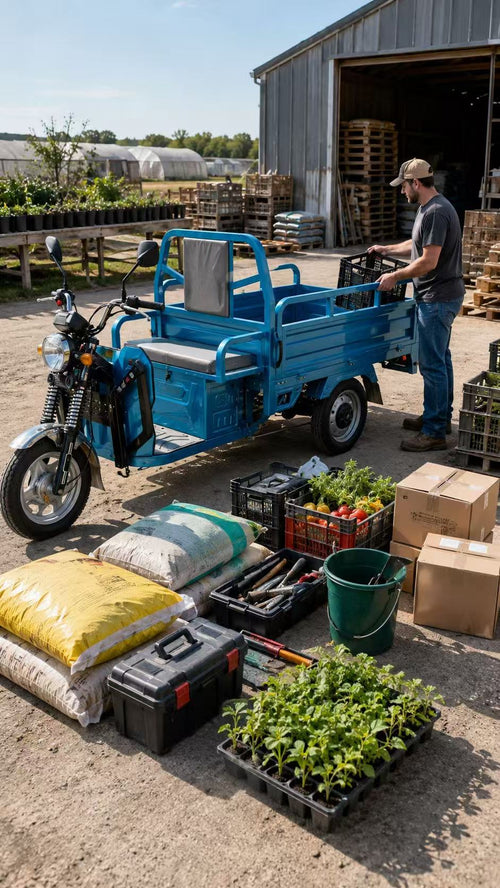
In wholesale markets, many loads are not palletized. Workers may handle mixed cartons, crates, bags, packages, tools, or other goods that need to move quickly between several work areas. This is one reason an electric utility vehicle can fit the middle ground between a basic hand cart and equipment designed primarily for pallet handling.
For repeated mixed-load movements, the vehicle functions as a short-distance material handling tool rather than simply as a means of transportation.
How Motorized Carts Fit Wholesale Market and Warehouse Work
The value of a warehouse cart depends on where it fits into the daily workflow. Wholesale market transport often consists of several connected stages rather than one long trip.
Receiving is the first stage. Cartons, crates, bags, and other goods must move away from the unloading area.
Inventory movement follows. Goods may need to travel from receiving to storage, cold-storage areas, stalls, shelves, or other selling spaces.
Restocking creates another cycle. During busy periods, the same route may be repeated many times as inventory is replenished.
Order preparation and customer pickup create additional movement. Goods may then travel from inventory or selling areas toward loading points or customer vehicles.
A manual cart can handle many of these individual movements. The question is what happens when repeated trips become a significant part of the working day.
For businesses with frequent material movement, a motorized cart can reduce the amount of manual pushing required across these repeated routes. This makes warehouse material handling and internal material transport important parts of the equipment decision.
Labor, Productivity, and Repeated Trips
Labor efficiency is not determined only by how fast a cart moves. The number of trips, amount of cargo moved per trip, travel distance, loading time, and physical effort all influence productivity.
Repeated manual cart trips can require workers to walk the same route again and again while pushing heavy or bulky loads. When the workload grows, reducing physical effort may also help workers maintain a more consistent pace throughout the day.
A motorized cart may allow heavier or larger mixed loads to be moved with less manual force. Depending on the task, this can mean fewer trips and less time spent repeatedly moving between the same locations.
The result can be improved operational efficiency, but the benefit should be evaluated in the context of the actual workflow. A business making only a few light movements each day may see little advantage. A business performing frequent internal transport may see a much larger difference in material throughput and labor use.
This is also why customer service can be affected by material movement. Time spent repeatedly pushing carts between storage, sales, and loading areas is time that employees cannot spend picking orders, restocking, preparing goods, or helping customers.
Cost, Maintenance, and Total Cost of Ownership
Purchase price is only one part of the manual-versus-motorized decision.
A manual hand cart normally has a lower purchase price and minimal maintenance requirements. There is no traction battery to charge and fewer mechanical or electrical components to maintain.
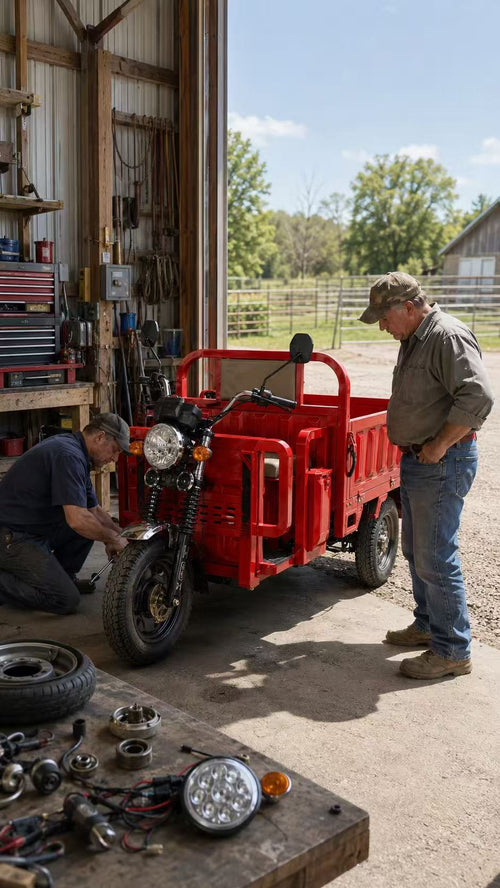
A motorized hand cart or other powered cart costs more initially. Battery charging, battery condition, drive components, tires, brakes, and routine maintenance become part of operating cost.
However, businesses with frequent material movement should also consider labor time and repeated trips. If powered movement reduces the amount of time or physical effort required for a recurring task, those differences become part of the total cost of ownership.
The calculation therefore depends heavily on utilization.
For occasional light-duty work, a manual cart may remain the lower-cost choice.
For frequent movement of heavier loads over repeated routes, labor savings, reduced travel time, and productivity can become more important when evaluating long-term ROI.
The objective is not to justify motorization in every situation. It is to determine whether the workload is large enough for powered assistance to provide practical value.
Choosing the Right Tool for Each Material-Handling Task
A well-organized wholesale market or warehouse does not need to choose one type of equipment for every job.
Hand carts are practical for small loads, short distances, and occasional movements.
Motorized hand carts are more appropriate when a similar cart-based task becomes heavier, more frequent, or more demanding for the operator.
Pallet jacks are designed around palletized loads and remain a logical choice when goods already move on pallets.
Forklifts are suited to heavy pallet movement, lifting, stacking, and tasks that require capabilities beyond those of a cart.
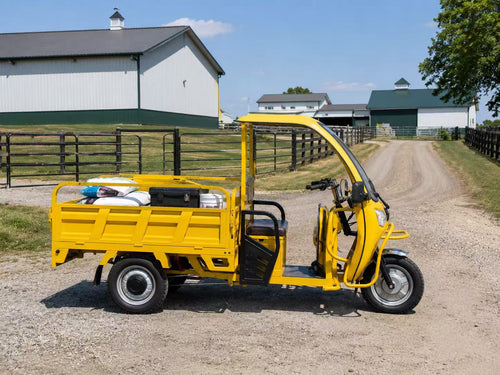
Electric utility vehicles can serve repeated mixed-load transport where cartons, crates, bags, tools, supplies, or other non-palletized goods need to move between work areas.
This task-based approach helps avoid both under-equipping and over-equipping a material-handling operation. The right equipment depends on load requirements, travel distance, frequency of use, aisle conditions, workflow, and the type of goods being moved.
A Practical Upgrade, Not a Replacement for Every Cart
Moving from a manual cart to a motorized cart should be viewed as a workload decision rather than an automatic equipment upgrade.
Hand carts continue to make sense for light loads and occasional short-distance movement. They are inexpensive, simple, and useful in areas where compact manual equipment is all that is required.
As loads become heavier, routes become longer, or trips become more frequent, the balance can change. Worker fatigue, physical strain, transport time, and repeated manual effort become more important factors.
In those conditions, a motorized cart or motorized hand cart can provide powered assistance while preserving the basic flexibility of cart-based material movement. For larger mixed loads, an electric utility vehicle can extend that same principle to higher-capacity short-distance transport.
The practical question is therefore not whether manual carts or motorized carts are universally better. It is which option matches the actual material-handling workload.
For wholesale markets and warehouses, that means looking at what is being moved, how heavy it is, how far it travels, how often the trip is repeated, and how much manual effort the workflow requires.
Hand carts remain useful for small loads. Pallet jacks remain useful for pallets. Forklifts remain appropriate for heavy pallet handling and lifting. Motorized carts and electric utility vehicles become more relevant when repeated mixed-load movement begins to consume too much labor, time, or physical effort.
Used in the right application, a motorized cart is not simply a powered replacement for a hand cart. It is a short-distance material handling tool for workloads where repeated manual movement has become the limiting factor.