Electric Utility Vehicle for Orchard Harvest and Farm Road Transport
Share
Orchard work is not one single heavy transport job. It is a long series of small and repeated movement tasks that happen every day across tree rows, farm roads, sheds, irrigation points, packing areas, and loading zones.
During harvest season, workers may move fruit crates and small harvest bins many times a day. Outside harvest season, the same orchard still needs tools, pruning supplies, irrigation parts, fertilizer, mulch, repair materials, and small equipment moved from one place to another.
For this reason, the value of an orchard utility vehicle is not only about how much it can carry one time. The real value is whether it can reduce repeated manual hauling, shorten small transport trips, and make daily orchard work more organized. A compact electric utility vehicle can fit this role when the job involves short-distance movement inside an orchard rather than highway travel or very heavy field towing.
Why Orchard Transport Is Different from General Farm Transport
Orchards have a different working environment from open fields. A vegetable farm, ranch, or construction site may have more open space for larger vehicles. An orchard often has tree rows, narrow farm lanes, uneven ground, soft soil areas, irrigation lines, and limited turning space near loading areas.
This means the most useful vehicle is not always the largest one. A full-size pickup truck may be powerful, but it may be too large for repeated short trips between rows. A large UTV may work well in some orchards, but the price can be high if the main job is only moving crates, tools, and supplies across short distances. A wheelbarrow or hand cart is simple and low-cost, but it becomes slow and tiring when workers repeat the same route many times each day.
An electric orchard utility vehicle sits between these choices. It is not meant to replace every farm vehicle. It is meant to handle the daily middle-range transport work that is too repetitive for manual hauling but too small for a pickup truck.
What Orchard Workers Actually Move
The most obvious orchard transport task is moving fruit. During harvest, workers may need to carry fruit crates from picking areas to collection points, move empty containers back into the rows, and transport small supplies between different work zones. If every crate depends on hand carrying, the work becomes slow and labor-heavy.
But orchard transport is not only about harvest. Throughout the year, workers also move pruning tools, irrigation fittings, sprayers, small pumps, tree supports, fencing materials, fertilizer bags, mulch, compost, repair parts, and general farm supplies. These materials may not be extremely heavy one by one, but the repeated trips take time and energy.
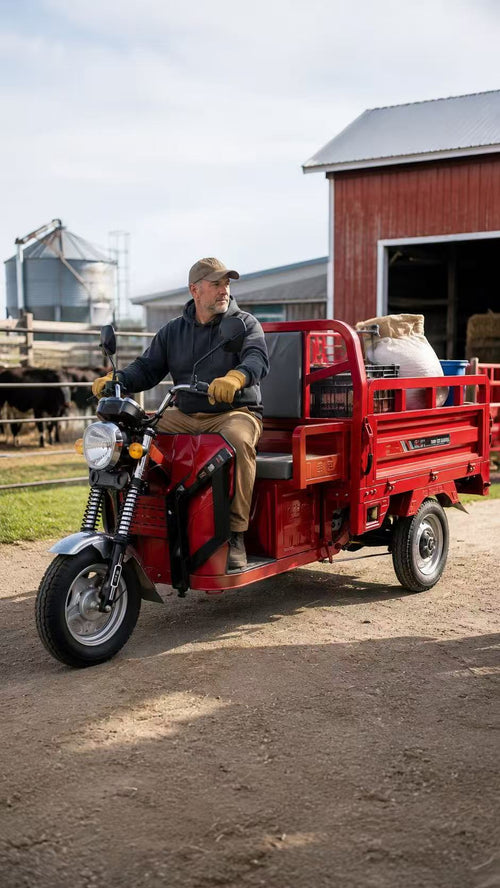
A compact electric utility vehicle helps by giving workers a dedicated short-distance transport tool. Instead of using a pickup truck for every small movement, or pushing a wheelbarrow across long rows, workers can load several items at once and move them more efficiently between orchard zones.
Why Narrow Farm Roads Matter
Many orchards are built around narrow internal roads. These roads may be wide enough for a small utility vehicle but not comfortable for larger trucks in repeated daily use. During busy seasons, there may also be workers, crates, equipment, hoses, and temporary loading areas around the orchard.
A vehicle used inside an orchard should be easy to control at low speed. It should be able to stop frequently, turn in limited space, and move carefully around workers and materials. In this situation, top speed is not the most important specification. Practical cargo space, stable handling, low-speed control, and simple operation are more important.
Electric utility vehicles are especially useful in this type of environment because they can operate quietly and smoothly during repeated short trips. Low noise can also be helpful when work happens near farm buildings, livestock areas, residential edges, or early morning harvest operations.
Orchard Utility Vehicle vs Pickup Truck
A pickup truck is still important for many farms. It is useful for road travel, heavy hauling, towing, and longer-distance transport. But inside an orchard, a pickup truck may not always be the most efficient tool for small daily movement.
For example, if workers only need to move tools, crates, irrigation parts, or several bags of supplies between rows, using a pickup truck can be excessive. It may require more space to turn, may be inconvenient around trees and narrow paths, and may not be worth starting and moving for every small task.
An orchard utility vehicle is better suited for repeated internal trips. It can support workers who need to move materials often but do not need a full-size truck each time. This does not make the pickup truck unnecessary. It simply means the pickup truck can be saved for larger jobs, while the smaller electric utility vehicle handles everyday orchard movement.
Orchard Utility Vehicle vs ATV or UTV
Many orchard owners consider ATVs or UTVs for farm work. These vehicles can be useful, but they are not always the most cost-effective choice if the main purpose is moving materials at low speed. A UTV may offer speed, off-road suspension, and passenger comfort, but those features may not be the main requirement for moving crates and supplies around an orchard.
If the job is mainly daily hauling, buyers should compare the actual work requirement with the price and features of each vehicle. A compact electric utility vehicle may provide the cargo function needed for short-distance orchard transport at a lower operating cost and with simpler daily use.
The key question is not “Which vehicle is more powerful?” The better question is “Which vehicle matches the daily transport task?” For orchards that need repeated movement of moderate loads, a simple cargo-focused electric vehicle may be more practical than a recreational-style utility vehicle.
Orchard Utility Vehicle vs Wheelbarrow
Wheelbarrows and hand carts are still useful. They are inexpensive, simple, and easy to use in very tight spaces. But they become less efficient when the distance increases or the number of trips becomes too high.
In orchard work, the problem is often repetition. One trip may not be difficult. Ten or twenty trips during a day can become tiring and time-consuming. Manual hauling also depends heavily on worker strength and weather conditions. During harvest season, fatigue can affect productivity and consistency.
An electric utility vehicle reduces the need for repeated pushing, pulling, and carrying. It allows workers to move more items in one trip and reduces the physical effort needed for routine transport. This is especially useful when the same routes are used every day between tree rows, storage sheds, collection points, and loading areas.
When a Hydraulic Dump Model Makes Sense
Not every orchard needs a hydraulic dump bed. If the vehicle will mainly carry fruit crates, boxed supplies, tools, or packaged materials, a standard cargo bed may be enough. A flat cargo bed is simple and practical for items that are loaded and unloaded by hand.
However, some orchards also handle loose materials. These may include soil, mulch, compost, gravel, wood chips, pruning debris, leaves, or cleanup waste. In that case, a hydraulic dump utility vehicle can save time during unloading. Instead of shoveling or lifting everything out of the cargo bed, the operator can raise the dump bed and unload loose material more easily.
The best choice depends on the workload. If the orchard mostly moves crates and tools, a cargo model may be more suitable. If the orchard also handles loose material, cleanup work, and maintenance debris, a hydraulic dump model may offer more value.
Important Specifications for Orchard Buyers
Before choosing an orchard utility vehicle, buyers should look beyond the product name. The right vehicle depends on the actual work environment.
Cargo bed size is important because orchard materials can vary in shape. Fruit crates, toolboxes, fertilizer bags, irrigation parts, and small equipment all need usable cargo space. Load capacity also matters, but it should match realistic daily loads rather than only the maximum possible number.
Battery range should be considered based on daily routes. An orchard vehicle may not need long highway range, but it should handle repeated trips across the property during a workday. Motor power should match the ground conditions, including slopes, soil, gravel paths, and loaded movement.
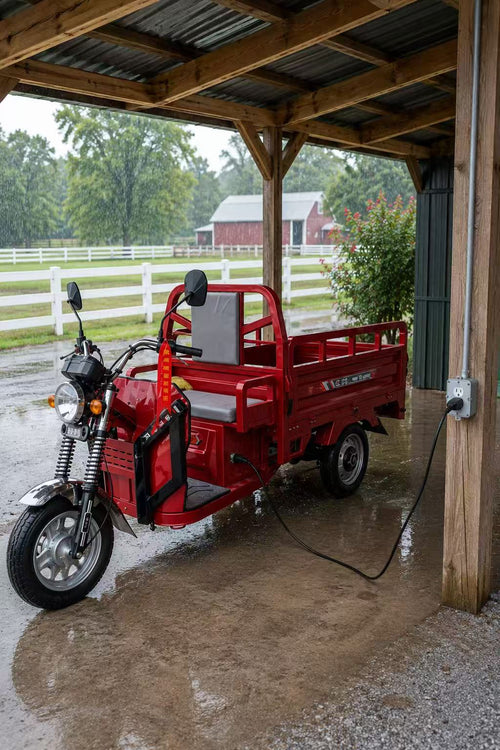
Tire type and vehicle stability are also important. Orchard roads can be uneven, wet, or soft after rain or irrigation. A vehicle should feel stable under normal loaded conditions and should not be oversized for narrow roads.
Buyers should also consider how the vehicle will be serviced. For imported electric utility vehicles, parts support, electrical components, battery support, motor support, and local repair coordination are important. A low purchase price is only useful if the buyer can also receive practical support after delivery.
Who This Type of Vehicle Is Best For
An electric orchard utility vehicle is best for orchards that have repeated short-distance hauling tasks. It is suitable for moving fruit crates, small harvest bins, tools, irrigation parts, fertilizer, pruning supplies, mulch, and daily maintenance materials.
It is also suitable for mixed horticulture operations, nurseries, greenhouses, small farms, and properties where workers need to move materials frequently across short distances. It is most useful when the work is repetitive and the load is too much for constant manual carrying but not large enough to require a full-size truck.
This type of vehicle may not be the right choice for every buyer. If the orchard needs road-speed travel, heavy towing, long-distance hauling, or extreme off-road performance, a different vehicle may be better. But for controlled internal transport, a compact electric utility vehicle can be a practical and cost-conscious option.
How It Supports Daily Orchard Workflow
A good orchard transport system helps workers spend less time walking back and forth for supplies. It allows tools and materials to stay closer to the work area. It helps move harvested fruit from rows to loading points more smoothly. It also supports maintenance work throughout the year, not only during harvest season.
For example, one worker may use the vehicle in the morning to move pruning tools and irrigation parts. Later in the day, the same vehicle may carry fruit crates, fertilizer bags, or repair materials. During cleanup, it may help move branches, leaves, or loose material if equipped with a dump bed.
This flexibility is one reason compact electric utility vehicles can be useful in orchards. They do not need to be limited to one task. Their value comes from being available for many small transport jobs that happen every day.
Conclusion
An orchard utility vehicle is not mainly about speed or appearance. Its real value is in daily movement: carrying harvest bins, fruit crates, tools, supplies, and maintenance materials across farm roads and orchard rows with less manual effort.
For orchard owners, the best vehicle is the one that matches the real work pattern. If the job involves repeated short-distance hauling, narrow internal roads, seasonal harvest movement, and daily maintenance support, a compact electric utility vehicle can become a practical part of the orchard workflow.
For buyers comparing electric work vehicles for orchard and farm use, OneClickChina offers electric utility trikes, cargo models, hydraulic dump models, cab models, canopy models, refrigerated cargo trikes, and lift utility vehicles for different short-distance transport and material handling needs.