Electric Orchard Harvest Utility Vehicle: Fruit Collection, Transport, and Farm Operations Guide
Share
Orchard harvest logistics is not only about picking fruit. During a busy harvest day, workers need empty crates, picking supplies, tools, drinking water, and other materials delivered into orchard rows, while filled crates and fruit bins must move back toward collection points, sorting areas, or packing facilities. Repeating these short trips by hand can add unnecessary walking, waiting, and labor throughout the day.
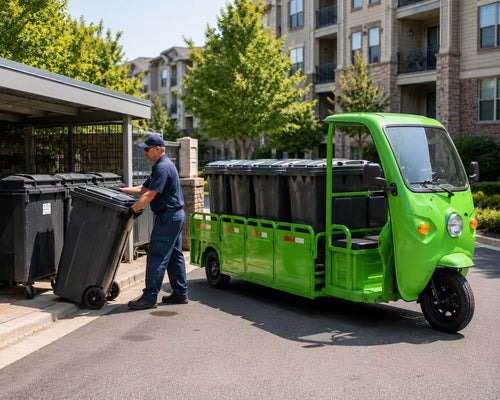
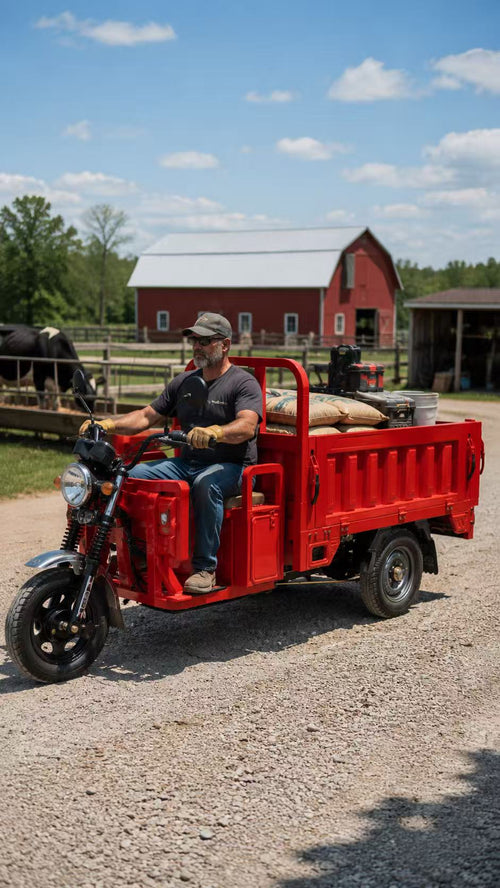
An electric utility vehicle can support this repeated material flow when orchard roads are reasonably firm and the work involves frequent short-distance orchard transport and harvest transport rather than heavy towing or difficult off-road travel. Compact electric cargo trikes are one practical form of electric farm utility vehicle for these conditions because they combine powered transport with an open cargo bed while remaining smaller than many conventional farm UTVs.
The important question is not simply whether an electric vehicle can operate on a farm. Growers should first examine what must be moved, how far it travels, how often the trip is repeated, the width and condition of orchard rows, and whether the vehicle will also be used outside harvest season.
Orchard Harvest Is a Material-Flow Problem
A typical harvest workflow creates two-way traffic.
Empty harvest crates, containers, tools, and supplies move toward the harvest crew. Picked fruit then moves in the opposite direction. Full crates or bins may travel from orchard rows to a collection point and later toward grading, sorting, storage, or the packing area.
This means vehicle selection should be based on the complete route rather than payload alone.
A vehicle that carries a large load but is awkward between trees may slow the crew. A very small farm cart may fit narrow spaces but require too many trips. A larger UTV may provide better rough-terrain capability than the orchard actually requires while adding purchase and operating costs.
For growers making repeated short trips, the useful measure is how efficiently the vehicle supports the entire working day.
Moving Fruit, Crates, and Bins Between Orchard Rows
Fruit collection creates some of the most repetitive transportation work during harvest.
Workers may fill picking bags, crates, lugs, or other harvest containers at different locations along the row. Those loads then need to be consolidated and moved out of the orchard. Depending on the crop and operation, growers may describe this work naturally as moving fruit bins, hauling bins, carrying harvest crates, or bringing full containers out of the rows.
An electric cargo trike can be useful when these loads fit within the vehicle's rated payload and cargo-bed dimensions and the route is suitable for a compact three-wheel vehicle. The powered cargo bed reduces the need to manually push a loaded farm cart and does not require another tractor or vehicle simply to tow a small trailer.
However, large commercial fruit bins can become extremely heavy when full. Buyers should never assume that every fruit bin is appropriate for a compact electric vehicle. Actual loaded weight, dimensions, loading method, center of gravity, and the vehicle's rated capacity must be checked before use.
From Orchard Rows to the Packing Area
The trip does not end when fruit leaves the tree row.
Harvest logistics may continue through a collection point, temporary staging area, grading or sorting location, cold-storage area, or packing station. In many orchards, the same route is repeated throughout the day.
This is where frequent short-distance fruit transport by electric utility vehicle can be valuable. Instead of using a larger farm vehicle for every small movement, an electric utility vehicle can shuttle appropriately sized loads between the harvest area and packing operations.
The return trip can also be productive. Empty crates, containers, tools, water, replacement supplies, or other materials can be carried back toward the harvest crew rather than returning with an empty cargo bed.
This two-way workflow can reduce unnecessary back-and-forth movement and make each trip more useful.
Supporting the Harvest Crew, Not Just Moving Fruit
Harvest efficiency also depends on keeping workers supplied.
Picking bags, hand tools, ladders where appropriate, empty containers, drinking water, safety equipment, and replacement supplies may need to move throughout the orchard as crews progress from one section to another.
A compact orchard utility vehicle can function as a mobile support vehicle for these daily tasks. Instead of workers repeatedly walking back to a central location, supplies can move with the work.
The benefit is therefore not simply vehicle speed. It is the reduction of low-value walking, waiting, and repeated manual carrying.
For operations with several harvest crews, buyers should consider how many routes must be supported at the same time. One vehicle with a high payload may not always be as useful as a smaller vehicle that can reach the right crew quickly and operate efficiently within the available row width.
Electric Cargo Trike vs Farm Cart for Orchard Work
Farm cart is a broad term covering many types of carts and wagons used to move materials around farms and properties. A simple cart can be inexpensive and effective for light loads, especially when trips are short.
The limitation is that many farm carts must be pushed, pulled, or towed.
An electric cargo trike combines the cargo platform and propulsion system in one compact vehicle. For repeated orchard trips, this can make sense when workers are regularly carrying crates, tools, irrigation supplies, fertilizer, nursery materials, or other moderate loads.
A conventional farm cart can still be the better choice when transportation is infrequent, loads are very light, or the operation already has a convenient towing vehicle. Electric power becomes more valuable as trip frequency and daily travel increase.
Electric Cargo Trike vs Electric UTV
Electric UTVs and conventional farm UTVs serve a broader range of terrain and utility tasks. They may offer four-wheel configurations, greater ground clearance, stronger towing capability, passenger capacity, and better performance on difficult farm roads.
A compact electric cargo trike should therefore not be presented as a universal UTV replacement.
Best uses for an electric cargo trike can include:
• Frequent short-distance hauling
• Relatively firm and reasonably level orchard lanes
• Moving harvest crates, tools, supplies, and appropriate fruit containers
• Narrower working areas where a larger vehicle is inconvenient
• Repeated trips between orchard rows and packing or storage areas
• Operations that value quiet electric drive and lower routine energy costs
A UTV, tractor, pickup, or other vehicle may be the better choice for:
• Deep mud or very rough terrain
• Steep slopes
• Heavy towing
• Large trailers
• Severe off-road conditions
• Tasks requiring four-wheel-drive capability
• Loads beyond the electric cargo trike's rated capacity
This distinction matters because the best farm utility vehicle is the one matched to the actual work, not simply the vehicle with the highest specification.
Daily Farm Work Beyond Harvest Season
An orchard vehicle should ideally remain useful after peak harvest ends.
Electric utility vehicles can support many lighter daily farm chores, including moving hand tools, irrigation parts, fertilizer, pruning supplies, nursery materials, maintenance equipment, and other farm supplies.
Similar short-distance farm transport needs also occur in vineyards, greenhouses, nurseries, market gardens, and small farms.
This broader use can improve vehicle utilization throughout the year. Buyers should therefore calculate value based on the complete annual workload rather than harvest alone.
Operating Cost and Daily Trip Frequency
Purchase price is only one part of the decision.
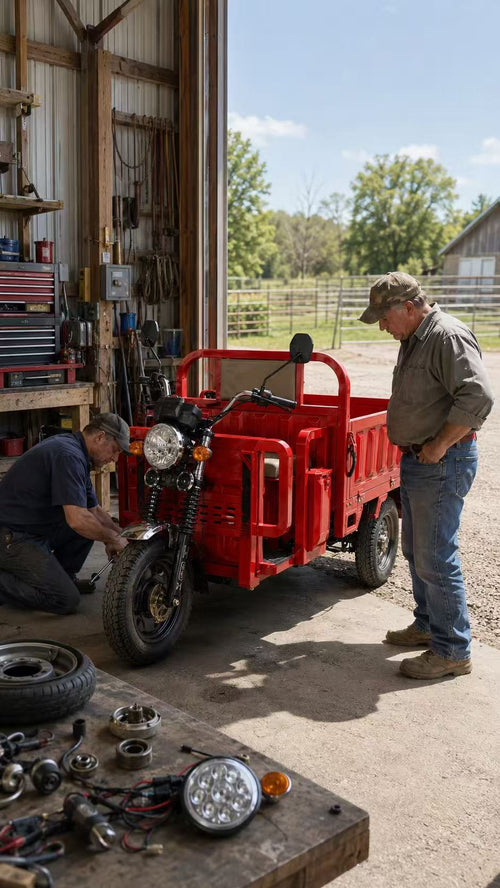
For vehicles making many short trips every day, buyers should also consider charging cost, routine maintenance, battery replacement over the long term, tire and brake wear, and the labor involved in each transportation method.
An electric utility vehicle may offer lower routine energy and maintenance requirements than a gasoline-powered vehicle for suitable light- and medium-duty work. But lower operating cost does not compensate for choosing a vehicle that cannot safely handle the terrain or load.
The correct comparison is therefore task by task.
If a farm needs four-wheel drive, heavy towing, or severe off-road capability every day, a UTV may justify its higher cost. If most daily work consists of carrying moderate loads over short, relatively firm routes, a compact electric cargo trike may provide enough vehicle without overbuying capability that is rarely used.
How to Choose an Orchard Utility Vehicle
Before buying, map the real working route.
Measure the narrowest orchard rows and gates. Check turning space at row ends. Record the distance between harvest areas, collection points, packing areas, barns, and storage locations. Identify slopes, soft ground, mud, gravel, and other surface conditions.
Then examine the loads.
What is carried most often? How much does a typical crate, bin, tool load, or supply load actually weigh? How many units need to fit in the cargo bed? Will loading be done by hand, with a forklift, or by another method?
Finally, calculate frequency.
A task performed once a week creates a very different vehicle requirement from a route repeated twenty or thirty times during a harvest day.
Payload, cargo-bed dimensions, battery range, turning radius, braking, terrain capability, charging access, and daily trip frequency should all be evaluated together.
Best Uses
An electric orchard utility vehicle is best suited to operations where the dominant work is frequent, short-distance movement of moderate loads on suitable farm routes.
It can be especially useful for fruit collection support, harvest transport, harvest crate transport, crew supplies, packing-area delivery, irrigation and maintenance materials, and other daily farm chores.
Pros
• Quiet electric operation
• No gasoline required for daily operation
• Compact dimensions for tighter working areas
• Powered hauling without manually pushing a loaded cart
• Useful for repeated stop-and-go routes
• Can support both harvest and off-season farm work
Cons and Limitations
• Not a substitute for a 4×4 UTV in severe terrain
• Not intended for deep mud or steep off-road routes
• Payload and cargo dimensions limit the size of bins and materials carried
• Three-wheel vehicles require appropriate routes and careful operation
• Battery range must match the actual working day
• Heavy towing and oversized loads require other equipment
Final Buying Decision
The strongest orchard transport system is not necessarily the largest or most expensive vehicle.
Start with the work: what must move, where it moves, how heavy it is, how often the trip occurs, and what the road or orchard row is actually like.
For suitable short-distance work, an electric cargo trike can provide a compact alternative to manually moved farm carts and can perform many tasks that do not require the capability of a full-size farm UTV.
For rough terrain, steep slopes, heavy towing, or demanding off-road work, buyers should choose the more capable vehicle instead.
Matching the vehicle to the real orchard workflow is what improves fruit collection, harvest crew support, transport efficiency, and long-term operating value.
Frequently Asked Questions
Is an electric cargo trike suitable for orchard work?
Yes, when the orchard has suitable routes and the work involves moderate loads, frequent short trips, harvest supplies, crates, tools, or other light- to medium-duty hauling. Terrain, payload, stability, and cargo dimensions must be checked before purchase.
Can an electric utility vehicle move fruit bins?
It depends on the loaded weight and dimensions of the bin and the vehicle's rated capacity. Some commercial fruit bins can be too heavy or large for a compact electric cargo trike. Buyers should verify actual bin specifications rather than assuming compatibility.
Is an electric cargo trike better than an electric UTV for orchard work?
Neither is universally better. A cargo trike can be economical for frequent short-distance hauling on suitable routes. An electric UTV may be better for rough terrain, greater ground clearance, passenger transport, heavier towing, or more demanding off-road work.
Why use an electric vehicle instead of a farm cart?
A basic farm cart can work well for occasional light loads. For repeated daily trips, powered transport can reduce manual pushing or the need to use another vehicle to tow the cart.
What should buyers check before choosing an orchard utility vehicle?
Check payload, cargo-bed dimensions, route width, turning space, terrain, slopes, daily distance, trip frequency, charging access, typical load weight, loading method, and whether the vehicle will also be used for non-harvest farm work.