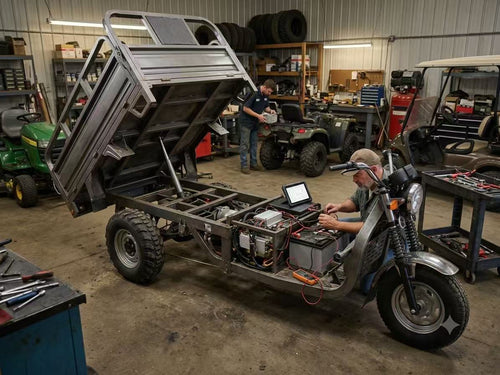
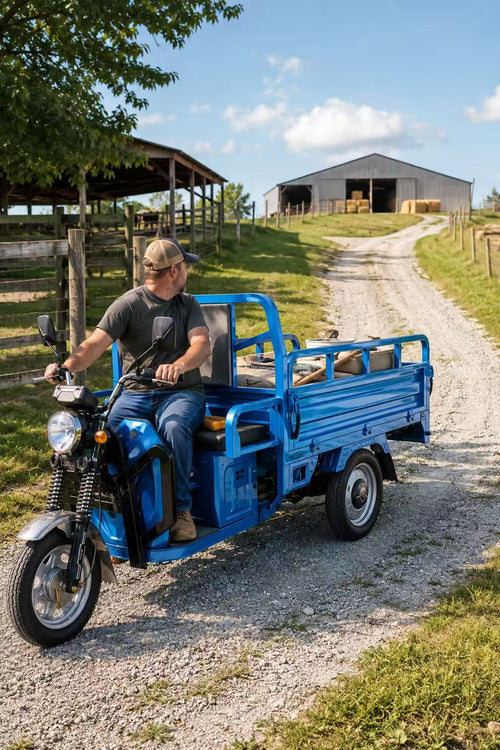
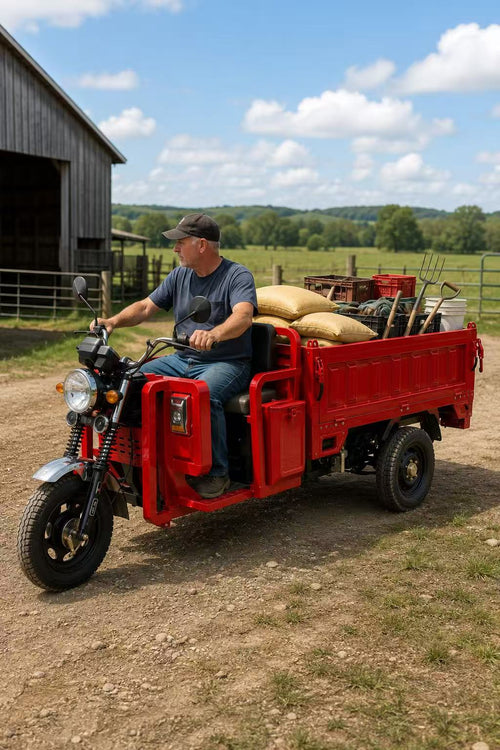
Will It Fit the Route? Choosing an Electric Dump Cart for Gates, Barn Aisles, and Tight Work Areas
Share
Many buyers compare electric dump carts by payload, battery range, motor power, cargo bed size, and price. Those details matter. But before choosing any electric dump utility vehicle, there is one practical question that is often more important:
Will it actually fit the route?
A vehicle can have strong hauling capacity, a hydraulic dump bed, and enough battery power for daily work. But if it cannot pass through a barn door, turn inside a stable aisle, move between greenhouse rows, enter a ranch gate, or reach the dump zone, the real value drops quickly.
The best electric dump cart is not only the one that carries the load. It is the one that can actually reach the work area, turn safely, unload properly, and return for the next load.
For farms, ranches, horse stables, nurseries, greenhouses, landscaping crews, warehouses, and property maintenance teams, route fit should be part of the buying decision.
Why should buyers think about route fit before payload?
Payload is important, but payload only matters if the vehicle can reach the job.
A larger vehicle may carry more material in one trip, but it may also be harder to use in narrow areas. If the vehicle cannot enter the barn, pass through the gate, turn near the compost pile, or move along a side yard, workers may still need to finish the job with wheelbarrows, hand carts, or manual hauling.
That means the vehicle may save less labor than expected.
A compact electric dump hauler can be valuable because it is designed for repeated short-distance material handling in real work areas. The goal is not always to carry the largest possible load. The goal is to move the right load through the actual route without wasting time.
What should you measure before buying an electric dump cart?
Before choosing an electric dump cart, buyers should measure the narrowest and most difficult parts of the daily route. These areas often decide whether the vehicle will be practical.
Important measurements include gate width, barn door width, stable aisle width, greenhouse path width, nursery lane width, orchard row spacing, warehouse aisle width, side yard clearance, turning space near the loading point, turning space near the dump zone, overhead clearance, parking space, and charging area.
It is not enough to measure only the widest road on the property. The vehicle must fit the tightest point on the route.
A farm utility vehicle may travel across open ground easily, but the real test may be a narrow livestock gate, a barn corner, a greenhouse doorway, or a small material storage area.
Will an electric dump cart fit through barn doors and stable aisles?
It depends on the width of the vehicle and the width of the route.
Horse stables, older barns, storage sheds, and livestock buildings may have narrow doors or tight corners. In these spaces, a few inches can make a big difference. A vehicle that looks compact outdoors may feel too large inside a barn aisle if there is not enough room for the operator, cargo bed, wheels, and safe turning.
Buyers should measure the barn door and the narrowest aisle, then consider whether workers still need walking space beside the vehicle. If the electric dump cart will carry manure, bedding waste, feed bags, tools, or compostable material from stalls to a dump zone, it must move comfortably without hitting walls, posts, gates, or stall fronts.
For horse stable cleanup and barn material handling, maneuverability can be as important as load capacity.
Can a compact electric dump hauler work better than a larger vehicle?
Yes. In tight work areas, compact size can be an advantage.
A larger vehicle may look stronger, but it may require more space to turn, park, load, and unload. It may be difficult to use in greenhouse paths, orchard rows, nursery aisles, small barns, landscaping side yards, or apartment maintenance walkways.
A compact electric dump hauler can help small crews reach areas where larger equipment may be inconvenient. It can move through narrow routes, stop close to the work point, carry a practical load, and return quickly for the next trip.
This is especially useful for high-frequency work. If the job requires many short trips, easy access and quick turning may matter more than maximum size.
How much turning space does a dump cart need?
Turning space is one of the most overlooked details. Buyers often measure gate width but forget to check whether the vehicle can turn after passing through the gate.
A route may be wide enough in a straight line but too tight at the end. For example, a vehicle may enter a barn aisle but struggle to turn near a stall cleaning area. It may pass through a ranch gate but have limited space to turn around near a compost pile. It may move down a greenhouse path but not have enough room to reposition for unloading.
Before buying, walk the actual route and look at every place where the vehicle must turn, reverse, park, or unload. The turning area should be safe, firm, and free from tools, animals, workers, fences, posts, trees, stacked supplies, or loose debris.
How much space does hydraulic dumping require?
A hydraulic dump utility vehicle needs more than driving space. It also needs unloading space.
When the cargo bed is raised, the rear of the vehicle needs enough room for loose material to slide out and land naturally. If the vehicle will slowly move forward while dumping soil, gravel, manure, mulch, compost, wood chips, or bedding waste, there must also be enough space in front of the vehicle.
Overhead clearance also matters. A raised dump bed should not contact low barn beams, tree branches, shed roofs, greenhouse frames, overhead wires, shelving, or other structures.
This does not mean the vehicle needs a large worksite. It means the buyer should plan the dump zone before relying on hydraulic unloading. The vehicle should be able to enter, align, raise the bed, unload from the rear, lower the bed, and leave safely.
Which work areas need route checking?
Route checking is useful in many real work environments.
Horse stables need to check stall aisles, manure routes, barn doors, and compost pile access. Ranches need to check gates, lanes, fencing areas, feed storage zones, and livestock working areas. Farms need to check barn entrances, field paths, storage sheds, soil piles, and compost areas. Greenhouses need to check path width, doorway clearance, turning space, and plant table spacing. Nurseries need to check lanes between plant rows, loading zones, and soil storage areas.
Landscaping crews should check side yards, backyard gates, patios, retaining wall areas, mulch beds, and narrow access routes around houses. Warehouse and property maintenance teams should check aisle width, door clearance, service corridors, elevators when applicable, parking areas, and charging locations.
The materials may change, but the route question stays the same: can the vehicle reach the place where work actually happens?
What happens if the vehicle is too large for the route?
If the vehicle is too large for the route, workers may lose the benefit they expected.
They may need to unload farther away and carry materials by hand. They may need to make awkward turns or repeated reversing movements. They may avoid using the vehicle in certain areas. They may return to wheelbarrows for tight spaces. They may spend extra time clearing obstacles before each trip.
In some cases, a vehicle that is too large creates more workflow friction instead of less.
That is why buyers should not choose only by maximum payload or cargo bed size. The right vehicle should match the route, not just the material.
Why does route fit matter for repeated daily work?
Route fit becomes more important when the same job happens every day.
A one-time inconvenience may not seem serious. But if workers must squeeze through a narrow gate, reverse around a tight barn corner, or unload too far from the dump zone ten or twenty times a day, the wasted time becomes part of the labor cost.
This is especially true for manure hauling, bedding waste removal, mulch delivery, soil movement, compost transport, gravel repair, feed supply runs, and property cleanup. These jobs usually involve repeated trips, not just one load.
A route-friendly electric dump cart helps reduce the friction in each trip. Over time, that matters.
Is a smaller electric dump cart always better?
Not always. The right size depends on the work.
A vehicle that is too small may require too many trips. A vehicle that is too large may not fit the route. The best choice is usually the vehicle that balances cargo capacity, maneuverability, route access, and unloading space.
For open farms, larger cargo capacity may be useful. For barns, stables, greenhouses, nurseries, landscaping paths, and property maintenance areas, compact size and easy handling may be more valuable.
The goal is not simply to buy the biggest electric dump cart. The goal is to choose a small electric work vehicle that matches the daily job.
What should buyers ask before choosing a vehicle?
Before choosing an electric dump utility vehicle, buyers should ask route-based questions:
Can it pass through the narrowest gate?
Can it enter the barn or stable aisle?
Can it turn at the loading point?
Can it turn at the dump zone?
Can workers safely walk around it?
Can it reach the compost pile, soil pile, gravel area, or mulch bed?
Is there enough space behind the vehicle for unloading?
Is there enough overhead clearance when the dump bed is raised?
Can it park and charge in a convenient location?
Will it still fit when the cargo bed is loaded?
Will the route stay usable in wet, muddy, or busy conditions?
These questions help buyers think beyond specifications and focus on daily usability.
How can buyers test the route before ordering?
A simple route test can prevent a bad buying decision.
Start at the loading point. Walk the exact path the vehicle would travel. Measure the narrowest point. Look for gates, posts, corners, slopes, soft ground, low beams, uneven surfaces, tight turns, stored equipment, and areas where animals or workers may be present.
Then walk to the unloading point. Check whether the vehicle can align with the dump zone. Look behind the vehicle where the material will exit. Look above the cargo bed where it will rise. Look in front of the vehicle if slow forward movement is needed during dumping.
Finally, check the return route, parking area, and charging location.
This kind of test is simple, but it gives buyers a more realistic picture than a product specification sheet alone.
Why does this matter for farms, ranches, stables, and maintenance teams?
Farms, ranches, stables, and maintenance teams often work in mixed environments. A route may include open ground, gravel roads, compacted dirt, barn doors, narrow aisles, livestock gates, storage sheds, and tight material areas.
The electric dump cart must handle the full route, not only the easiest section.
A hydraulic dump bed is useful. A strong motor is useful. A practical battery is useful. But the vehicle must also be able to move through the daily worksite. If it cannot reach the job, the specifications do not matter as much.
The right vehicle fits the work route
Choosing an electric dump cart is not only about capacity. It is about access.
A good electric dump cart should carry the right materials, fit through the right spaces, turn in the right areas, unload in the right location, and return for the next load without creating extra manual work.
For small farms, ranches, horse stables, greenhouses, nurseries, landscaping crews, warehouses, and property maintenance teams, this route-based thinking can lead to a better buying decision.
The best electric dump utility vehicle is not always the largest one. It is the one that fits the real route, supports daily material handling, and makes repeated work easier.
Before asking only how much it can carry, ask where it needs to go.