Electric Cargo Tricycle for Farm Work: Why Cargo Bed Access Matters More Than Vehicle Size
Share
When buyers compare farm vehicles, they often start with size. A larger vehicle may look stronger, but for many daily farm jobs, vehicle size is not the first thing that matters.
Cargo bed access often matters more.
On small farms, ranch support areas, greenhouses, nurseries, produce handling zones, and property maintenance sites, many jobs involve loading and unloading moderate materials many times during the day. Feed bags, tools, buckets, plant trays, produce crates, fertilizers, soil bags, and small supplies need to move from one work point to another. If the cargo bed is difficult to load, too high, too enclosed, or poorly matched to the task, the vehicle may slow the work down even if it looks powerful.
That is why an electric cargo tricycle can be useful for farm work. It is not about being the biggest vehicle on the property. It is about making repeated loading, short-distance movement, and unloading easier.
Start With the Cargo Bed, Not the Vehicle Label
A vehicle may be called a cargo tricycle, utility trike, farm tricycle, electric mini truck, or small farm vehicle. The label helps describe the category, but it does not answer the most important question:
Can the cargo bed handle the materials your farm moves every day?
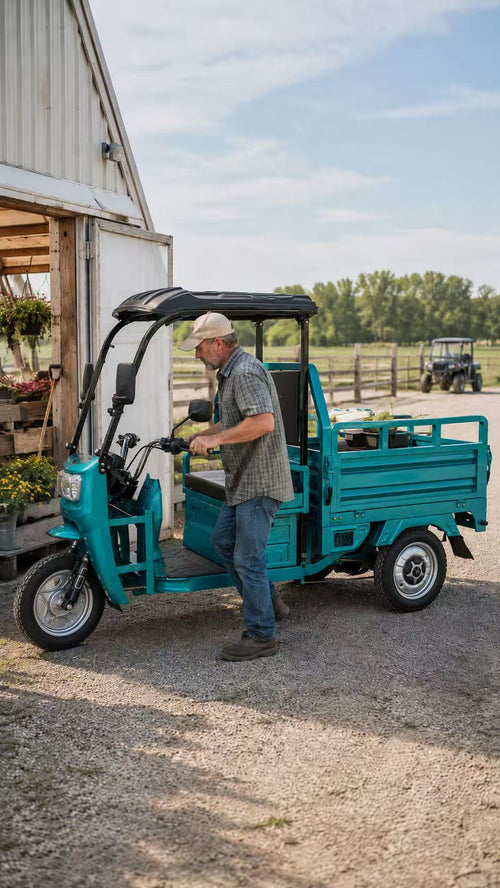
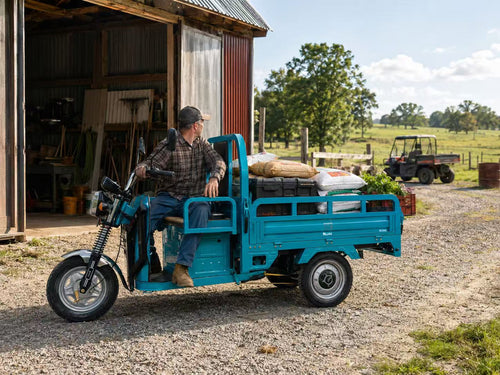
For farm work, a practical cargo bed should be easy to reach, easy to load, and useful for mixed materials. A small electric cargo tricycle with an open bed can help workers load tools, bags, crates, buckets, trays, and supplies without using a larger UTV or pickup for every small job.
The bed layout should match the work, not just the product name.
Why Access Matters During Repeated Farm Work
Many farm transport jobs are not one big load. They are repeated small or medium loads.
A worker may move feed bags in the morning, tools later in the day, produce crates during harvest, and greenhouse supplies in the afternoon. Each job may only take a short trip, but the loading and unloading happens again and again.
This is where cargo bed access becomes important. A bed that is simple to reach from the side or rear can reduce awkward lifting and save time during repeated chores. The worker can load items directly into the bed, check the load quickly, and unload near the work area.
For farms that move materials many times per day, this can matter more than top speed or a large body size.
The Value of an Open Cargo Bed
An open cargo bed gives a farm worker flexibility. Mixed loads are common on farms, and not every item fits neatly into a closed compartment.
An electric cargo tricycle with an open bed can carry different types of daily materials, such as:
feed bags
produce crates
hand tools
small equipment
plant trays
soil bags
fertilizer bags
buckets
fencing supplies
maintenance materials
This flexibility is useful because real farm work changes throughout the day. The same vehicle may be used near a barn, greenhouse, packing area, equipment shed, or livestock zone.
An open cargo bed also makes it easier to see what is loaded, adjust the cargo, and unload items without unnecessary handling.
One Load at a Time Can Still Matter
Farm logistics is often about moving one useful load at a time. That may sound simple, but it is the kind of work that repeats every day.
A compact electric cargo tricycle can help move materials across private farm property without waiting for a larger vehicle. It can connect feed storage areas, greenhouses, produce handling zones, sheds, and work lanes.
For small to mid-sized agricultural properties, this one-load movement can reduce walking, hand carrying, and repeated manual cart use. The goal is not to replace every tractor or full-size utility vehicle. The goal is to make frequent moderate-load movement easier.
When Smaller Size Helps the Cargo Bed Work Better
A large vehicle is not always easier to use. Around barns, greenhouse entrances, narrow service lanes, equipment sheds, and produce handling zones, smaller size can make positioning easier.
A compact electric cargo tricycle can often stop closer to the work point. This means workers may carry the load a shorter distance between the shelf, pallet, feed room, greenhouse bench, packing table, or storage area and the cargo bed.
That shorter loading distance is part of the real value.
For farm work, convenience is not only about how far the vehicle can drive. It is also about where it can stop, how easily workers can reach the bed, and whether the vehicle fits into the work area without blocking everything else.
Cargo Bed Access for Produce Handling
Produce handling is one area where cargo bed access matters. During harvest, crates of vegetables, fruit, or other farm products may need to move from the field, greenhouse, orchard row, or growing area to a washing, sorting, cooling, or packing zone.
A practical cargo bed helps workers load crates in an organized way and move them over short internal routes. For small produce operations, this can be more realistic than using a large truck for every short trip.
The vehicle should allow workers to load and unload without overcomplicating the task. In this kind of work, a simple cargo platform can be more useful than a vehicle designed mainly for passengers.
Cargo Bed Access for Feed and Supplies
Feed bags, bedding supplies, buckets, and tools often move between storage areas and animal zones. These jobs happen repeatedly, especially on small farms, horse properties, poultry areas, and ranch support zones.
If the vehicle can be positioned close to the feed storage area and the cargo bed is easy to reach, the worker can load faster and reduce repeated hand carrying.
This is where a cargo tricycle can work as a small farm support vehicle. It is not chosen because it looks bigger. It is chosen because it fits the daily load pattern.
Do Not Ignore Payload and Terrain
Cargo bed access is important, but it is not the only factor.
Buyers still need to think about payload, surface condition, route distance, and terrain. An electric cargo tricycle may work well on gravel yards, compacted dirt, concrete pads, farm lanes, greenhouse paths, and controlled work areas. It may not be the right choice for deep mud, steep uneven pasture, very rough ground, heavy towing, or large commercial field hauling.
Before buying, the buyer should ask:
How much weight will be carried in a normal trip?
Will the load be bags, crates, tools, trays, or loose materials?
Will the route be gravel, concrete, packed dirt, or pasture?
How often will the cargo be loaded and unloaded?
Can the vehicle stop close to the actual work point?
These questions help determine whether the cargo bed will truly improve the workflow.
When a Cargo Tricycle Is a Better Fit Than a Larger Vehicle
A larger vehicle can be useful for heavy work, long routes, and towing. But for short internal farm transport, a compact cargo tricycle may be easier to use.
It may be a better fit when:
the work happens on private property
loads are moderate but repeated
workers need easy cargo bed access
routes are short
spaces are narrow
the vehicle must stop near work areas
the farm needs a simple tool for everyday movement
In these cases, the best choice is not always the largest machine. It is the vehicle that makes the most common job easier.
Final Thought
An electric cargo tricycle should be judged by how well it supports real farm work. For many small farms, the most important feature is not vehicle size. It is cargo bed access.
If the bed is easy to load, practical for mixed materials, and suited to repeated short-distance movement, a compact electric cargo tricycle can become a useful farm work vehicle. The best question is not only how big the vehicle is. The better question is whether the cargo bed helps workers move tools, feed, produce, and supplies more efficiently around the property.