Small Curbs and Door Thresholds: Can a Powered Dump Hauler Cross Real Worksite Transitions?
Share
Ground damage can happen at edges
Transitions often concentrate pressure.
When a loaded vehicle crosses from concrete to grass, gravel to dirt, or sidewalk to lawn, the tires may press harder at the edge. If the ground is wet or soft, the vehicle may leave ruts or damage the surface.
This matters for landscaping, property maintenance, parks, schools, HOA communities, apartment properties, and private estates.
A buyer should think about where the hauler will leave hard surfaces and enter soft ground. A small transition can become a repeated damage point if the same route is used every day.
A better path may use a curb cut, service lane, gravel strip, plywood protection, ground mat, or firmer approach.
The goal is not only to move the material.
The goal is to move it without damaging the property.
Door width and threshold height should be checked together
A buyer may measure the door width and forget the bottom edge.
That is not enough.
A vehicle may fit through the opening but still have trouble crossing the threshold. A barn door, shed door, greenhouse door, storage room entrance, or maintenance building may have both a width limit and a floor transition.
Both matter.
The buyer should measure:
Overall vehicle width.
Wheel spacing.
Handlebar and body clearance.
Door opening width.
Threshold height.
Floor level difference.
Turning space after entry.
Surface condition on both sides.
A powered dump hauler that barely fits through a door may still be hard to use if there is no room to turn, stop, or back out after crossing the threshold.
Access is more than width.
Repeated trips make small problems bigger
One difficult threshold may not seem important.
But repeated trips change the calculation.
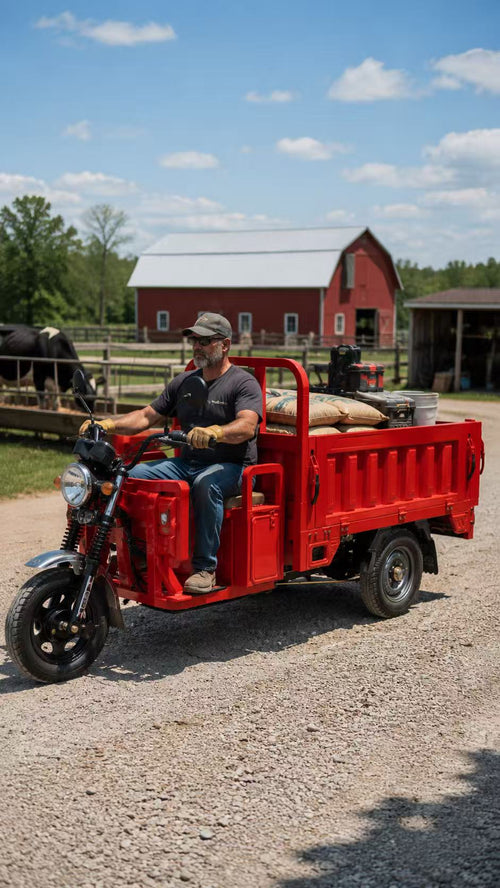
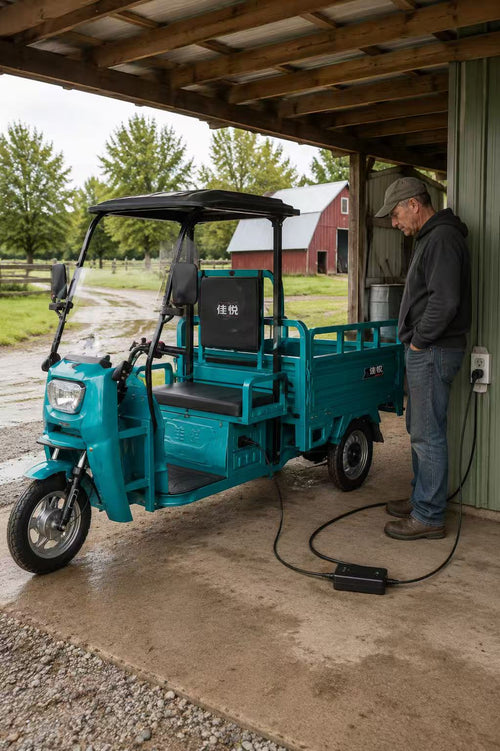
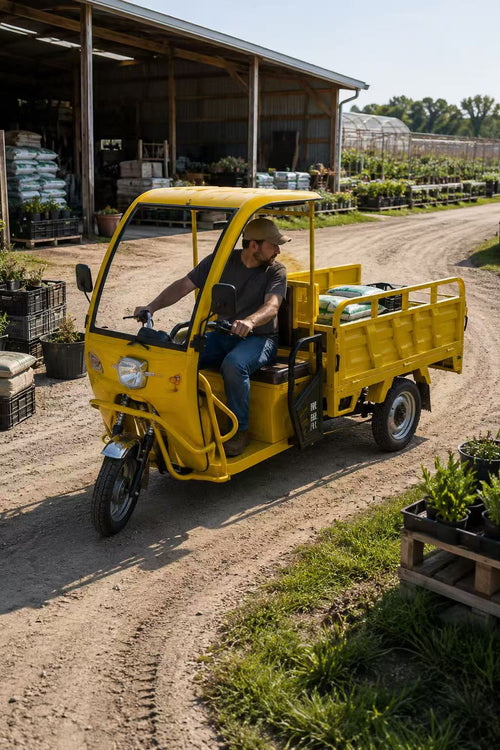
A stable worker may cross the same barn entrance twenty times a day. A nursery worker may move through the same greenhouse door all morning. A landscaping crew may use the same curb cut for several mulch loads. A property maintenance team may move tools across the same sidewalk edge every week.
A small bump becomes a daily workflow issue when repeated.
If each crossing slows the worker, shifts the load, spills material, or causes hesitation, the time adds up.
This is why buyers should not ignore minor route details.
The right powered dump hauler should reduce repeated labor, not create repeated friction at the same point in the route.
Some transitions should be improved before using equipment
Sometimes the best answer is not a different vehicle.
It is a better transition.
If a barn entrance has a sharp concrete lip, a small ramp may help. If gravel has washed away beside a slab, filling and compacting the area may help. If a greenhouse door track creates a hard bump, a smoother approach may help. If a curb must be crossed often, a proper curb ramp or service route may be better.
Buyers should look at the property as a working system.
A powered dump hauler works better when the route is ready for repeated movement.
Improving one threshold can make every future trip easier.
This is especially true for farms, stables, nurseries, greenhouses, and property maintenance areas where the same route is used daily.
Do not use unsafe shortcuts
A powered dump hauler should not be forced over unsafe steps, sharp curbs, broken concrete, deep holes, steep ramps, or unstable boards.
Shortcuts can create problems.
They may damage the vehicle, spill the load, create ground damage, or put the operator in a difficult position. They may also make workers less willing to use the machine.
A safer route may be slightly longer but more repeatable.
For daily work, repeatability matters.
The best route is the one that can be used again and again with normal loads, normal workers, and normal conditions.
A route that only works when everything is perfect is not a strong work route.
Wet weather changes transitions
A threshold that works in dry weather may become more difficult when wet.
Grass becomes soft. Dirt becomes slippery. Gravel shifts. Concrete can become slick. Mud may collect at barn entrances, greenhouse doors, trailer ramps, curb cuts, and shed approaches.
A buyer should think about normal weather conditions.
If the property often works after rain or irrigation, transitions should be judged in those conditions too. A hauler that crosses a dry barn entrance well may need more care when wet bedding, mud, or water collects near the door.
This does not mean the vehicle cannot be used outdoors.
It means wet transitions require slower movement, lighter loads, better route planning, and careful cleanup.
Animal areas need calm transitions
Horse stables, cattle barns, dairy areas, poultry areas, and ranch work zones often include animals nearby.
A rough threshold crossing can create noise, sudden movement, or load shifting. That may disturb animals or make the operator less comfortable.
When working around animals, the hauler should cross doorways and small edges slowly and predictably.
The operator should avoid banging over thresholds, rushing through gates, or forcing the vehicle across uneven ground near livestock.
A powered dump hauler used for manure, bedding, feed, or barn maintenance should fit the calm rhythm of the animal area.
Small transitions matter more when animals are nearby.
Customer-facing properties need cleaner movement
On landscaping jobs, apartment properties, HOA communities, schools, parks, resorts, and private estates, the vehicle may be visible to customers, residents, students, or visitors.
A rough curb crossing, spilled mulch, damaged grass edge, or noisy threshold bump can make the work look careless.
A professional crew should plan smoother transitions.
This may mean using curb cuts, placing temporary ground protection, reducing load size, approaching more slowly, or choosing a better route.
A powered dump hauler can make a crew look more efficient when used well.
It can also look unprofessional if the route is poorly planned.
For customer-facing work, transitions affect appearance as well as productivity.
Buyers should test the real route
The best way to understand transitions is to walk the route before buying.
A buyer should start at the loading point and follow the exact path to the unloading point.
Look for:
Door thresholds.
Concrete pad edges.
Curb cuts.
Small ramps.
Trailer ramp points.
Gravel-to-grass transitions.
Barn entrance lips.
Greenhouse door tracks.
Shed door edges.
Soft spots near hard surfaces.
Narrow turns after thresholds.
Then think about the load.
Will the hauler be carrying mulch, compost, gravel, wet soil, manure bedding waste, feed bags, tools, plant trays, or yard debris?
A route that works empty may not work the same with a real load.
Ask these questions before buying
Before choosing a powered dump hauler, electric dump cart, motorized wheelbarrow, powered wheelbarrow, or battery-powered utility cart, buyers should ask practical transition questions.
Does the route include barn doors, greenhouse entrances, shed thresholds, curbs, ramps, or concrete pad edges?
Will the vehicle cross these points empty or loaded?
Is the transition smooth enough for repeated daily use?
Is the ground firm on both sides?
Will the load shift when crossing?
Can the operator approach slowly and straight?
Is there enough space after crossing to turn or stop?
Will the transition damage grass, gravel, mats, or finished surfaces?
Should the route be improved before using the hauler?
Is a small ramp, curb cut, or compacted approach needed?
These questions help buyers move from product photos to real work planning.
The smallest point in the route can decide daily usability
A powered dump hauler can have strong capacity, useful tires, a practical dump bed, and good control.
But if it cannot move smoothly through the places where work actually happens, it may not be used as often as expected.
Small curbs, door thresholds, ramp edges, concrete pad transitions, and surface changes are not minor details when they appear in every trip.
They are part of the work system.
The best hauler is not only the one that looks strong on open ground.
It is the one that can move a practical load through the real route, cross the normal transitions, and arrive at the unloading point without creating extra problems.
Before buying, do not only look at the open yard.
Look at the edges, entrances, lips, and thresholds.
That is where daily usability is often decided.