Will the Tailgate Open Properly? Why Rear Gate Latches Matter in a Powered Dump Hauler
Share
A powered dump hauler is often judged by the dump bed.
Buyers look at the hydraulic lift, dump angle, cargo bed size, load capacity, motor power, tires, battery range, and whether the vehicle can move mulch, compost, manure bedding waste, soil, gravel, yard debris, feed-area cleanup material, plant waste, or property maintenance loads.
Those details matter.
But there is one smaller part that can affect the whole unloading process:
The rear gate.
A powered dump hauler, electric dump cart, electric work trike, hydraulic dump cart, battery-powered utility cart, electric utility trike, powered wheelbarrow, motorized wheelbarrow, compact utility vehicle, or small farm hauler does not only need a bed that can lift. The tailgate, rear gate, latch, hinge, pin, and rear opening area also need to work properly.
If the dump bed rises but the tailgate does not open correctly, loose material may not release as expected. The load may hang up. Material may pile against the rear gate. The operator may need to stop and correct the problem. In some cases, the unloading area may become messy, inefficient, or harder to control.
That is why tailgate function should be part of the buying decision.
A hydraulic dump bed is only useful when the material can leave the bed in a controlled way.
The rear gate controls material release
The rear gate is not only a door.
It controls how material leaves the cargo bed.
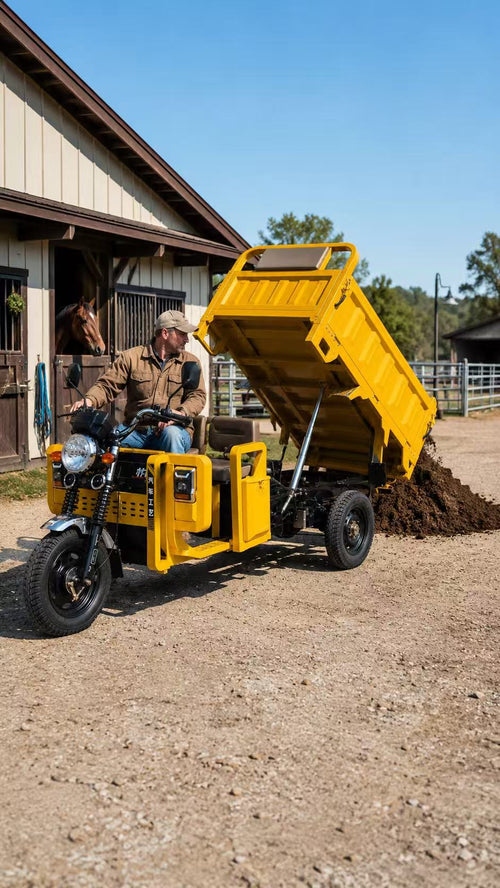
When the bed is raised, loose material such as mulch, compost, manure bedding waste, soil, small gravel, leaves, or yard debris should move toward the rear opening. If the rear gate opens properly, material can slide or fall out in a more predictable way.
If the gate is stuck, latched incorrectly, blocked, bent, jammed, or unable to swing freely, the material may stay trapped inside the bed.
This can reduce the value of the dump function.
A powered dump hauler should make unloading easier than shoveling everything out by hand. But the dump function depends on more than hydraulic lift. It also depends on the rear gate and the space behind it.
Tailgate latches should be easy to understand
A tailgate latch should be simple enough for the operator to use correctly.
In daily work, the operator may be wearing gloves. The work area may be dusty, wet, cold, muddy, or busy. A worker may be unloading near a manure pile, compost area, barn entrance, greenhouse service lane, nursery yard, ranch work zone, or property maintenance site.
If the latch is confusing, hard to reach, or easy to forget, the operator may make mistakes.
A good dump bed gate should be clear:
Locked for travel.
Released before dumping when needed.
Able to open without forcing.
Able to close and latch after unloading.
The buyer should not only look at the size of the cargo bed.
They should also look at how the rear gate is opened, secured, and closed.
A stuck gate can turn dumping into manual work
The main reason to choose a hydraulic dump bed is to reduce manual unloading.
But if the rear gate does not open properly, the operator may still have to shovel, pull, push, or clear material by hand. That defeats part of the purpose.
This can happen when wet material presses against the gate, when mulch packs into the corners, when manure bedding waste catches on the rear edge, when gravel or soil collects near the hinge area, or when the latch is not released before the bed is raised.
A powered dump hauler used for loose bulk materials should allow material to leave from the rear.
When the gate does not work smoothly, the unloading process becomes slower and less predictable.
Buyers should think about tailgate function before they need it.
Rear gate clearance matters before dumping
The tailgate needs space to open.
This sounds simple, but it is easy to overlook in real work areas.
A powered dump hauler may unload near a barn wall, manure pile, fence, compost bin, greenhouse doorway, retaining edge, landscaping bed, equipment shed, trailer, or storage area. If the rear of the vehicle is too close to something, the tailgate may not open fully.
If the gate hits the pile, wall, fence, or debris behind the vehicle, material release may be blocked.
Before raising the dump bed, the operator should check the rear clearance.
There should be enough space for the gate to swing, the material to leave, and the vehicle to remain stable.
A clear rear area supports cleaner unloading.
The gate should be checked before the bed is raised
A tailgate or rear gate check should happen before lifting the dump bed.
Once the bed is raised, the load begins to shift. If the operator then discovers that the latch is still closed or the gate is blocked, the situation becomes more awkward.
The better habit is simple:
Stop the vehicle.
Choose a firm and clear dump area.
Check the rear gate.
Confirm the latch or pin is ready.
Make sure no one is behind the bed.
Raise the bed under control.
This habit is useful in farms, horse stables, nurseries, greenhouses, landscaping sites, ranch lanes, and property maintenance areas.
The rear gate is part of the dump process, not an afterthought.
Latches, pins, and hinges should not be ignored
Small parts can affect big results.
A tailgate latch, hinge, or gate pin may look minor compared with the hydraulic cylinder or cargo bed. But if these parts fail to hold, release, or align correctly, the unloading process can suffer.
A buyer should look at whether the rear gate closes securely. The latch should not feel loose. The hinge should not look badly bent. The pin or lock should be positioned clearly. The gate should not drag, twist, or jam.
This does not require advanced mechanical knowledge.
It is a practical visual and functional check.
A powered dump hauler used for daily hauling should have a rear gate that feels secure during travel and practical during dumping.
The tailgate must latch again after unloading
After dumping, the rear gate should be closed and secured before the vehicle moves again.
This is an important part of the work cycle.
A loose or unlatched tailgate can rattle, swing, catch, or allow leftover material to spill during travel. It can also make the vehicle look poorly managed in a customer-facing property maintenance area or landscaping job.
The operator should not drive away with the gate hanging open unless the work procedure specifically allows it and the route is controlled.
For normal daily hauling, the gate should be returned to its travel position.
The dump cycle is not finished until the bed is lowered and the tailgate is secured.
Wet material can press against the gate
Wet materials behave differently from dry materials.
Wet soil, manure bedding waste, compost, damp mulch, and heavy yard debris may press against the rear gate with more force than dry loose material. If the gate latch is hard to release or the material packs tightly into the corners, unloading may be less smooth.
A powered dump hauler buyer should think about normal material conditions.
Will the vehicle carry dry mulch?
Wet compost?
Stable bedding?
Damp soil?
Small gravel?
Mixed cleanup waste?
Leaves and branches?
The tailgate should match the material.
A gate that works well with light yard debris may feel different when wet, dense material is loaded.
Loose material should exit from the rear
A hydraulic dump cart is designed so suitable loose material can leave from the rear of the bed.
That means the rear gate area should remain clear. The load should not be stacked in a way that blocks the gate. Tools, bags, buckets, or large objects should not be placed against the tailgate if the operator plans to dump.
This is especially important for mixed loads.
A worker may place a shovel, bucket, feed bag, toolbox, or plant tray in the bed along with loose material. If the bed is later raised, those items can block the gate or fall unpredictably.
Before dumping, the operator should confirm that the material is suitable for dumping and that the rear gate area is not blocked.
Not everything in a cargo bed should be dumped.
Bagged items and tools should usually be unloaded by hand
A powered dump hauler may carry many types of material.
But a dump bed does not mean every load should be dumped.
Feed bags, tools, plant trays, buckets, boxed supplies, equipment parts, fragile items, and cleaning supplies should usually be unloaded by hand. These items may damage the gate, jam the rear opening, break, or fall in an uncontrolled way.
The tailgate is most useful for loose bulk material.
Mulch, compost, loose soil, manure bedding waste, leaves, small gravel, and yard debris are more natural dump loads.
Buyers should understand this difference.
A rear gate works best when the load type matches the dump function.
Tailgate function matters in horse stable cleanup
Horse stable work often involves manure bedding waste, wet bedding, clean bedding, feed-area cleanup, buckets, tools, and daily barn waste.
A powered dump hauler can be useful in this environment because it reduces repeated wheelbarrow trips. But the rear gate must work calmly and predictably.
If the tailgate sticks, slams, jams, or releases material unevenly, the unloading process can become stressful around horses, workers, dogs, riders, and barn equipment.
A stable worker should be able to stop in a clear dump zone, check the rear area, release the gate if needed, raise the bed, unload suitable material, lower the bed, and latch the gate again.
For horse stable work, the tailgate is not only a metal panel.
It is part of a calm daily routine.
Tailgate function matters in landscaping work
Landscaping crews often move mulch, soil, compost, branches, leaves, yard debris, gravel, and cleanup material.
These loads often need to be placed near lawns, garden beds, driveways, pathways, trees, retaining walls, and customer-facing areas.
If the rear gate opens smoothly, the operator can unload material in a more controlled way. If the rear gate catches or blocks material, the pile may form in the wrong place, or the crew may need extra manual work to clear the bed.
In landscaping, clean placement matters.
A powered dump hauler with a practical rear gate can help the crew keep the work area organized.
The gate should open where the material is supposed to go, not against a wall, curb, fence, or existing pile.
Tailgate function matters in nursery and greenhouse work
Nursery and greenhouse work often includes plant waste, soil, mulch, pots, trays, bags, irrigation parts, and growing supplies.
Some of these materials can be dumped. Others should not be dumped.
That makes rear gate control important.
Loose plant waste, soil, or mulch may unload through the rear gate in a controlled dump area. But plant trays, boxed supplies, tools, and fragile items should usually be unloaded by hand.
A nursery worker should not raise the dump bed and hope everything exits cleanly.
The rear gate should be checked first.
Is the material loose enough to dump?
Is the rear opening clear?
Is there enough room behind the vehicle?
Will the gate swing without hitting benches, plants, hoses, or structures?
In tight nursery or greenhouse areas, the tailgate may matter as much as the lift.
Tailgate function matters in property maintenance
Property maintenance teams often work in places where people can see them.
Apartment communities, HOA properties, schools, parks, resorts, warehouses, churches, and private estates may all require clean, controlled material handling.
A powered dump hauler may carry mulch, trash bags, branches, soil bags, maintenance parts, cleaning supplies, yard debris, or tools.
When unloading loose material, the rear gate should release predictably.
A gate that gets stuck or spills material unexpectedly can make the job look messy. A gate that is left unlatched after unloading can make the vehicle look poorly managed.
In property maintenance, the hauler is not only a tool.
It is part of how the work looks to residents, customers, visitors, and managers.
A secure and functional tailgate supports a more professional routine.
Tailgate latches should stay clear of packed material
Loose material can pack around the rear gate.
Wet compost, manure bedding waste, soil, mulch, and fine gravel can collect in corners, hinges, latch points, and the lower rear edge of the bed.
If these areas are not kept reasonably clear, the gate may not close properly after dumping. The latch may not seat fully. The gate may rattle or leave a gap.
The operator should check the rear gate area after unloading.
This does not need to be complicated.
A quick look can help confirm that the gate is closed, the latch is engaged, and no large clump is blocking the closing point.
A powered dump hauler used every day should not depend on force to close the rear gate.
The gate should close cleanly.
Do not stand behind the gate during dumping
A rear gate can move.
Material can also move suddenly when the bed is raised.
The operator should not stand directly behind the tailgate while dumping. Other workers, animals, customers, or visitors should also stay clear of the rear discharge area.
This matters on farms, ranches, horse stables, landscaping sites, nurseries, greenhouses, gravel yards, compost areas, and property maintenance routes.
Even a small load can shift faster than expected when the angle changes.
The operator should stand to the side at a safe distance, confirm the rear area is clear, and operate the dump bed under control.
The rear gate is part of the moving dump system.
It should be treated with respect.
Tailgate opening should match the dump zone
A dump zone should match the way the tailgate opens.
Some work areas give plenty of rear clearance. Others are tight. A compost bay, manure area, greenhouse service lane, barn corner, or landscaping bed may limit how far the vehicle can back in.
If the rear gate needs room to swing or release material, the vehicle should be positioned with that in mind.
A powered dump hauler should not be backed too close to a pile if the gate cannot open. It should not be placed so close to a fence or wall that the material has nowhere to go.
The operator should leave space for both the gate and the load.
Good positioning makes unloading easier.
Poor positioning makes the tailgate fight the work.
Rear gate problems can hide until the bed is loaded
A tailgate may seem fine when the bed is empty.
But problems can appear when the bed is loaded.
Wet material may press against it. Gravel may wedge near the lower edge. Mulch may catch in the corners. A slightly bent latch may work empty but resist when loaded. A gate that closes loosely may rattle during travel.
That is why buyers should think about real material, not only product photos.
A powered dump hauler tailgate should be judged by how it works during normal daily loads.
For farms, horse stables, ranches, nurseries, greenhouses, landscaping crews, and property maintenance teams, the normal load is the real test.
The rear gate should match the operator’s routine
Different operators use dump haulers differently.
One person may dump manure bedding waste every morning. Another may unload mulch near landscape beds. Another may move compost across a farm. Another may carry tools during the morning and yard debris in the afternoon.
The tailgate should fit the routine.
If the operator often switches between dump loads and hand-unloaded cargo, the latch should be easy to manage. If several workers use the same vehicle, the gate should be easy to understand. If the route includes tight spaces, the gate should not require awkward access.
A good rear gate supports the work instead of creating another step that workers avoid.
Ask these tailgate questions before buying
Before choosing a powered dump hauler, electric dump cart, electric work trike, hydraulic dump cart, battery-powered utility cart, electric utility trike, powered wheelbarrow, motorized wheelbarrow, compact utility vehicle, or small farm hauler, buyers should ask:
Does the rear gate open clearly?
Does the tailgate latch feel simple and secure?
Can the operator release the gate before dumping?
Does the gate have enough clearance behind the vehicle?
Can material leave from the rear without jamming?
Does wet material press against the gate?
Can the tailgate close and latch after unloading?
Are hinge points, pins, and latch areas easy to observe?
Will the gate work for manure, mulch, compost, soil, gravel, or yard debris?
Will the operator avoid dumping tools, bags, trays, and fragile cargo?
Can workers stay clear of the rear discharge area?
These questions help buyers look beyond the hydraulic lift.
A dump bed needs a working rear gate
A hydraulic dump bed can be one of the most useful features on a powered dump hauler.
But the bed does not work alone.
The rear gate, latch, hinge, pin, rear opening, and dump zone all affect whether material leaves the bed properly.
A powered dump hauler should carry material well.
It should lift under control.
It should unload suitable material from the rear.
It should close and latch properly after dumping.
If the rear gate is ignored, the operator may end up doing more manual work than expected.
Before buying, do not only ask whether the bed can rise.
Ask whether the tailgate can open, release, clear, close, and latch properly during real daily work.
That small detail can decide whether the dump function feels truly practical.