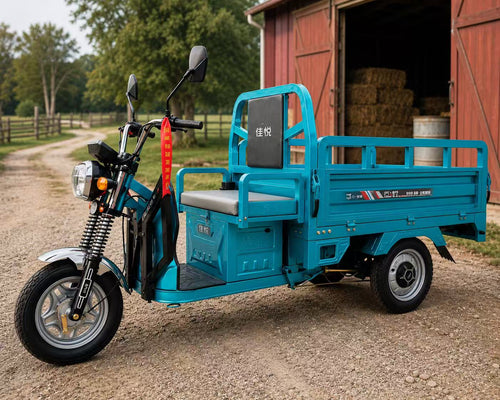
Electric Dump Vehicle for Cabin and Remote Property Maintenance
Share
Maintaining a remote property usually involves many short hauling trips. Owners move firewood, tools, gravel, feed, fencing supplies, waste, and repair materials between cabins, sheds, gates, trails, and work areas.
A full-size truck or tractor may be unnecessary for these daily jobs. A wheelbarrow may be too slow and physically demanding. An electric utility vehicle for remote property maintenance fills the gap by carrying the operator, tools, and materials in one trip.
The right vehicle is not simply the fastest or most powerful. It must match the property’s trail width, terrain, typical load, daily travel distance, storage space, and charging conditions.
Why Remote Property Maintenance Requires a Different Vehicle
Remote land creates transportation problems that are uncommon on paved commercial sites.
A cabin, hunting property, ranch, woodland lot, or large rural estate may include:
• Narrow wooded paths
• Uneven service roads
• Soft or wet ground
• Gates with limited clearance
• Steep or curved trails
• Work areas far from the main building
• Limited access to fuel or electrical power
Most work consists of repeated short trips rather than long-distance driving. An owner may carry fencing tools in the morning, move firewood at noon, transport gravel in the afternoon, and remove branches before the day ends.
For this type of work, low-speed control, cargo space, turning ability, and operating cost usually matter more than top speed.
Common Jobs on Cabins, Hunting Land, and Rural Properties
A compact electric work vehicle can support many routine property-maintenance tasks.
Typical uses include:
• Carrying chainsaws, fuel cans, hand tools, and safety equipment
• Hauling firewood from wooded areas to a cabin or storage shed
• Moving gravel to repair washed-out trails and driveways
• Transporting fence posts, wire, and repair materials
• Carrying feed, water containers, and animal supplies
• Removing storm debris, branches, leaves, and waste
• Moving mulch, soil, compost, plants, and landscaping materials
• Delivering hunting equipment to remote areas of the property
• Carrying pumps, hoses, batteries, and generator supplies
• Transporting maintenance staff between buildings and work zones
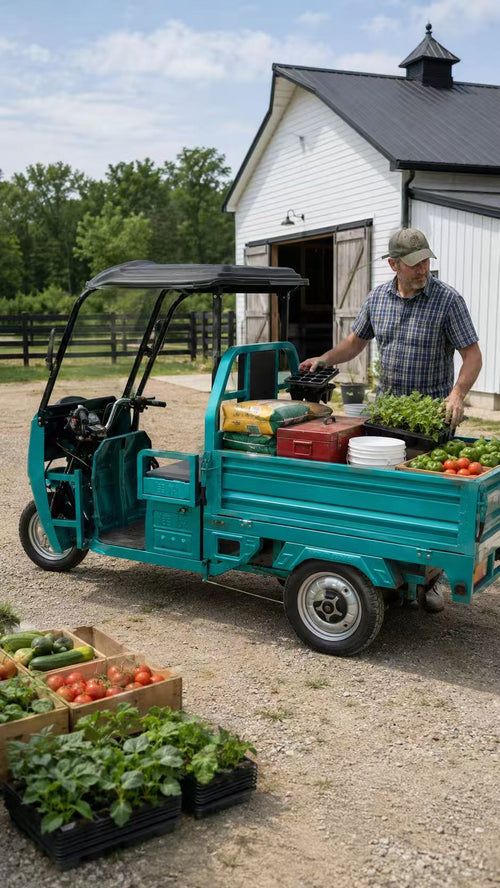
These jobs often require both cargo capacity and operator mobility. A ride-on utility vehicle allows the user to travel with the load instead of walking behind a cart during every trip.
Repeated Hauling Is the Main Workload
The weight of one load is only part of the problem. Repetition creates most of the labor.
Moving ten loads of firewood with a wheelbarrow may require twenty walking trips because the operator must return after every delivery. A ride-on utility vehicle reduces both travel time and physical effort.
The same principle applies to fence repair. The operator may need posts, wire, tools, fasteners, water, and replacement parts. Carrying everything at once reduces unnecessary returns to the shed or cabin.
Before choosing a vehicle, estimate:
• How many trips are made each day
• How far each trip is
• Whether the operator must return with an empty vehicle
• Whether tools and materials need to travel together
• Whether loading and unloading require manual lifting
A vehicle that saves only a few minutes per trip can still save substantial time when the same route is used every day.
Hauling Firewood on Narrow Trails
Firewood transport is one of the most common remote-property jobs. The main challenge is often not the load itself, but access.
Wooded trails may include tight turns, exposed roots, low branches, narrow bridges, and limited space for turning around. A large UTV or pickup may not fit comfortably.
For hauling firewood on narrow trails, check:
• Overall vehicle width
• Minimum trail width
• Turning radius
• Ground clearance
• Tire traction
• Braking control on slopes
• Cargo-bed length and side height
A walk-behind powered dumper can be useful on very short or extremely narrow routes. A ride-on electric utility vehicle is more practical when the operator must travel farther, make repeated trips, or carry tools with the load.
Firewood is bulky, so cargo-bed volume may become the limit before the vehicle reaches its maximum payload. High side panels or a suitable cargo enclosure can help contain split wood, but the load must remain stable and should not block the operator’s view.
Moving Gravel, Rock, and Heavy Materials
Gravel, wet soil, stone, and sand create a different problem. These materials are dense and can exceed the vehicle’s payload before the cargo bed looks full.
The operator should never estimate the load only by appearance. A shallow layer of wet gravel may weigh more than a full-looking load of branches or mulch.
For heavy material transport, consider:
• Rated payload
• Cargo-bed construction
• Braking performance
• Tire load capacity
• Slope limits
• Dumping method
• Tailgate design
An electric dump vehicle can reduce manual unloading when repairing trails, filling holes, spreading mulch, or delivering gravel. A hydraulic dump bed is especially useful for repeated loads because it allows loose material to slide out from the rear.
The vehicle should be loaded evenly. Concentrating heavy rock at the back or on one side can reduce stability and place unnecessary stress on the frame.
For a detailed discussion of compact dump vehicles, see our guide: Small Electric Dump Truck for Farm, Ranch, and Property Work.
Working Over Soft or Wet Ground
Soft ground changes how a vehicle performs. Wet grass, loose soil, mud, sand, and recently landscaped areas can be damaged by repeated traffic.
Ground pressure depends on several factors:
• Vehicle weight
• Cargo weight
• Tire width
• Tire pressure
• Soil moisture
• Number of repeated passes
• Driving and turning behavior
A lighter compact utility vehicle may produce less rutting than a heavy truck or tractor, but no vehicle can guarantee zero surface damage.
To reduce rutting:
• Avoid carrying maximum loads on saturated ground
• Use wider tires suited to soft surfaces
• Follow different routes when possible
• Avoid sharp turns while heavily loaded
• Repair drainage problems before repeated use
• Wait for the ground to dry when the work is not urgent
Wheel spin causes additional damage. Smooth acceleration and controlled speed help maintain traction without digging into the surface.
Narrow Paths, Gates, and Turning Areas
Many owners compare payload and motor power but forget to measure the route.
Before purchasing a small vehicle for wooded property, measure:
• The narrowest gate
• The narrowest trail section
• Bridge width
• Shed or garage entrance
• Space between trees
• Turning space at the end of the route
• Loading space beside cabins and storage buildings
Overall width alone is not enough. A vehicle may fit through a gate but still be unable to turn immediately afterward.
Also check overhead clearance. Branches, roof edges, lights, mirrors, and protective frames can affect access in wooded or covered areas.
A compact vehicle with a useful cargo bed is often more valuable than a larger machine that cannot reach the work area.
Wheelbarrow, Powered Dumper, ATV, UTV, Tractor, or Electric Utility Vehicle?
Each option is suited to a different workload.
Wheelbarrow
Best for light loads, short distances, and low-cost occasional work. It becomes inefficient when routes are long, slopes are present, or many trips are required.
Powered Dumper
Useful for heavy loads in very narrow areas. It offers power-assisted movement and dumping, but the operator normally walks behind it. This can be tiring over longer routes.
ATV
Good for personal transportation and rough trails. Cargo capacity is usually limited, and many loads require racks or a trailer.
UTV
Suitable for carrying people and cargo over rough terrain. However, a full-size UTV may be too wide or expensive for owners who mainly need low-speed hauling.
Tractor
Appropriate for towing, grading, lifting, and heavy farm work. It may be excessive for routine trips between a cabin, shed, gate, and work area.
Compact Electric Utility Vehicle
Suitable for repeated hauling, moderate loads, quiet operation, and short property routes. It carries the operator and cargo together while requiring less space than many full-size work vehicles.
The best choice depends on the job. A remote property may still need a tractor for major work and a smaller electric vehicle for daily transportation.
When a Dump Bed Is Worth Choosing
Not every property requires a dump bed. It provides the most value when the vehicle regularly carries loose materials.
A dump bed is useful for:
• Gravel
• Sand
• Soil
• Compost
• Mulch
• Manure
• Leaves
• Small branches
• General property waste
A flat cargo bed may be better for:
• Toolboxes
• Generator equipment
• Feed bags
• Water containers
• Fence posts
• Crates
• Packaged supplies
Some owners need both types of work. In that case, look for a cargo bed that can carry packaged materials securely while still allowing controlled rear dumping.
Charging on Remote or Off-Grid Property
Charging must be planned before buying an electric utility vehicle for a cabin property.
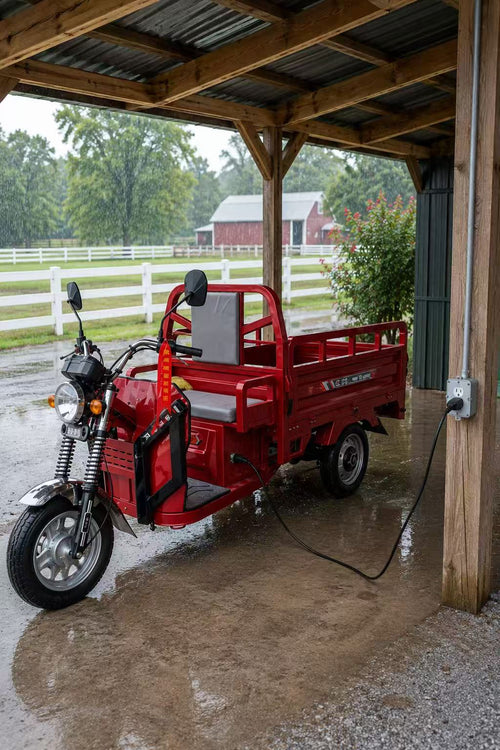
Properties connected to reliable electricity can normally charge the vehicle near a shed, garage, barn, or cabin. The charging location should be dry, ventilated, protected from weather, and close enough to avoid unsafe extension-cord use.
Off-grid properties require more planning.
Possible charging sources include:
• Solar power systems
• Battery storage systems
• Portable generators
• Permanent standby generators
• Grid power at another building
Do not assume every portable generator can safely operate every charger. Check the charger’s input voltage, frequency, wattage, and starting demand. The generator must provide stable power with sufficient continuous output.
An inverter generator may provide cleaner electrical output than a basic conventional generator, but compatibility still depends on the charger and the generator specifications.
When possible, ask the vehicle supplier to confirm the charger’s rated input before choosing off-grid charging equipment.
Daily Range and Route Planning
Maximum advertised range is not the same as practical working range.
Actual range can be reduced by:
• Heavy cargo
• Frequent stops and starts
• Steep slopes
• Soft ground
• Low temperature
• Tire pressure
• Battery age
• Operator weight
• Use of lights and electrical accessories
Estimate the total distance of a normal workday, including return trips. Then leave a reasonable reserve instead of selecting a vehicle whose maximum range only matches the planned route.
For remote property maintenance, predictable daily range is more useful than a high top speed.
Winter Storage and Seasonal Use
Cabins and hunting properties may remain unused for weeks or months. Battery storage therefore matters.
Before seasonal storage:
• Follow the battery manufacturer’s charging instructions
• Avoid leaving the battery fully discharged
• Store the vehicle in a dry, covered area
• Disconnect unnecessary electrical accessories
• Inspect cables and terminals
• Check the battery periodically
• Protect the charger from moisture and freezing conditions
Cold weather can reduce available battery performance. The vehicle may travel a shorter distance during winter than under mild conditions.
Battery requirements vary between lead-acid and lithium systems. Always follow the instructions for the specific battery installed in the vehicle.
Safety on Slopes and Uneven Ground
A compact vehicle can reach difficult areas, but it is not a substitute for careful route assessment.
Before operating on a slope:
• Check the manufacturer’s grade limit
• Reduce the load
• Keep the load centered
• Avoid turning across a steep slope
• Drive slowly
• Allow extra braking distance
• Avoid loose gravel, ice, and deep mud
A high or uneven load raises the center of gravity. Firewood, rocks, tools, and equipment must be secured so they cannot shift while the vehicle is moving.
If the route includes steep drops, unstable edges, or stream crossings, improve the trail before using it regularly.
Choosing Tires for the Property
There is no single tire that is best for every remote property.
Turf-style tires are suitable for lawns and maintained grass where surface protection matters. More aggressive tread can improve traction in mud and loose soil but may damage soft grass during turns.
When choosing tires, consider:
• Grass
• Gravel
• Mud
• Sand
• Snow
• Tree roots
• Paved surfaces
• Mixed terrain
Tire pressure should remain within the manufacturer’s approved range. Reducing pressure without guidance can affect handling, tire wear, load capacity, and safety.
A vehicle used on several surface types may need a balanced all-terrain tire rather than the most aggressive tread available.
Buyer Checklist for a Remote Property Vehicle
Before choosing an electric utility vehicle, answer the following questions.
Access
• What is the narrowest gate?
• What is the narrowest trail?
• Is there enough room to turn?
• Will the vehicle fit inside the storage building?
Workload
• What materials will be carried?
• What is the heaviest normal load?
• Is cargo limited by weight or volume?
• Is a hydraulic dump bed needed?
• How many trips are made each day?
Terrain
• Is the route flat, sloped, muddy, sandy, grassy, or rocky?
• Are there bridges, roots, ditches, or sharp turns?
• Does the property require high ground clearance?
• Will repeated driving damage the surface?
Power
• Is reliable charging available?
• What charger input does the vehicle require?
• Is off-grid generator or solar charging planned?
• Can the vehicle complete the daily route with reserve range?
Storage and Maintenance
• Is there a covered storage location?
• Can local repair support be arranged?
• Are replacement parts available?
• What maintenance is required for the battery, brakes, tires, and drivetrain?
Legal Use
Electric work vehicles are commonly intended for farms, private property, facilities, warehouses, ranches, and internal roads. Road-registration rules vary by location.
Do not assume a vehicle can be legally operated on public roads. Confirm local requirements before purchase if public-road use is part of the plan.
Local Maintenance and Repair Support
Remote-property owners often worry about service access. Electric utility vehicles usually have simpler drivetrains than gasoline UTVs, but they still require inspection and maintenance.
Common service needs include:
• Brake adjustment
• Tire replacement
• Electrical diagnosis
• Battery inspection
• Controller testing
• Charger testing
• Bearing and suspension inspection
• Hydraulic system service on dump models
Many repairs can be handled by local electric vehicle, golf cart, motorcycle, farm equipment, or small machinery technicians.
Before buying, confirm how replacement parts, technical support, and warranty labor will be handled. A clear service plan is more valuable than a vague promise of nationwide repair coverage.
Common Buying Mistakes
Choosing by Top Speed
Remote maintenance rarely requires high speed. Cargo capacity, braking, turning radius, and route access are usually more important.
Ignoring Vehicle Width
A vehicle that cannot pass through gates or wooded paths will not solve the transportation problem.
Looking Only at Maximum Payload
Cargo-bed size also matters. Firewood and branches may fill the bed before reaching the weight limit.
Assuming Maximum Range Is Daily Range
Real working range changes with load, hills, temperature, and terrain.
Buying a Recreational Vehicle for Work
A fast ATV or sport UTV may offer limited cargo space and require a trailer for ordinary maintenance tasks.
Forgetting Charging Conditions
Off-grid owners should confirm charger requirements before relying on a portable generator or solar system.
Ignoring Service Support
Replacement parts and repair coordination should be discussed before the vehicle is delivered.
Who Benefits Most From a Compact Electric Work Vehicle?
An electric utility vehicle is most useful for owners and operators who:
• Make repeated hauling trips
• Work on large private properties
• Need to enter narrow trails or gates
• Carry tools and materials together
• Prefer quiet operation
• Want lower routine operating costs
• Do not need highway travel
• Have access to suitable charging
• Need more capacity than a wheelbarrow or ATV rack
• Do not need a tractor for every daily task
It may not be the right choice for properties that require high-speed travel, deep-water crossings, extreme rock crawling, or continuous heavy towing.
Final Decision
The best electric utility vehicle for remote property maintenance is not the model with the highest speed or the longest specification list.
It is the vehicle that fits the route, carries the normal load, completes the daily distance, works with the available charging system, and can be serviced after purchase.
Measure the property first. Identify the daily materials, route conditions, gate width, turning space, slope, and charging source. Then choose the vehicle around the actual work.
A properly selected compact utility vehicle can reduce walking, shorten repeated hauling trips, and make cabin, hunting property, ranch, and rural land maintenance easier to manage.